Account-Based Marketing Examples for Enterprise Pipeline Acceleration
Three structural moves that compress enterprise sales cycles and actually move pipeline.

Enterprise B2B sales cycles stretched to 8.6 months on average in 2024, and most of that time gets wasted chasing accounts that were never going to buy. This piece is about what actually works to compress that timeline: specific ABM programs, with real numbers, that got enterprise pipeline moving faster by narrowing focus instead of widening it. The thread connecting every example here is structural, not creative. It comes down to who you target, when you reach them, and whether every channel is saying the same thing at the same time.
Here's the problem underneath the timeline. Enterprise deals don't have a single decision-maker anymore; they have buying committees, often six or more people with different priorities, and outreach that hits one person and ignores the rest just sits there. Layer on top of that the fact that only about 5% of B2B buyers are actively in-market at any given moment, and you get a math problem: most outreach lands on the 95% who aren't ready, gets ignored, and reps chalk it up to a bad list. ABM, done right, solves a narrower problem than people think. It doesn't create demand out of nothing. Instead, it concentrates limited resources on the accounts most likely to move, and times the push for when they're actually ready to move.
The structural logic shared by every effective enterprise ABM program
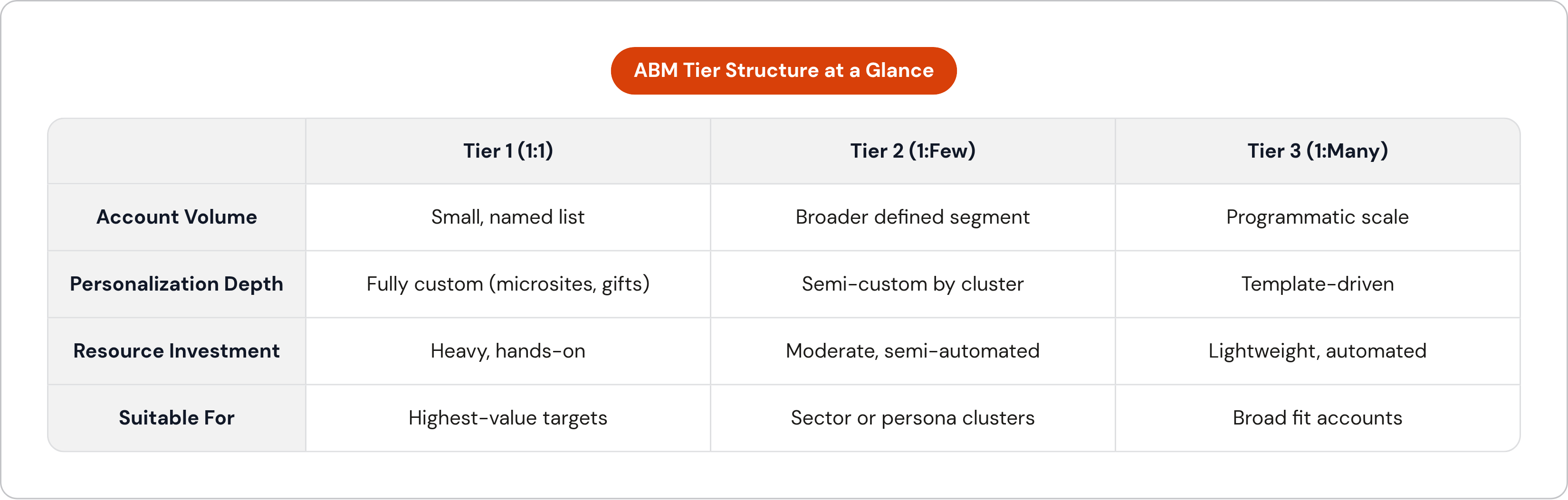
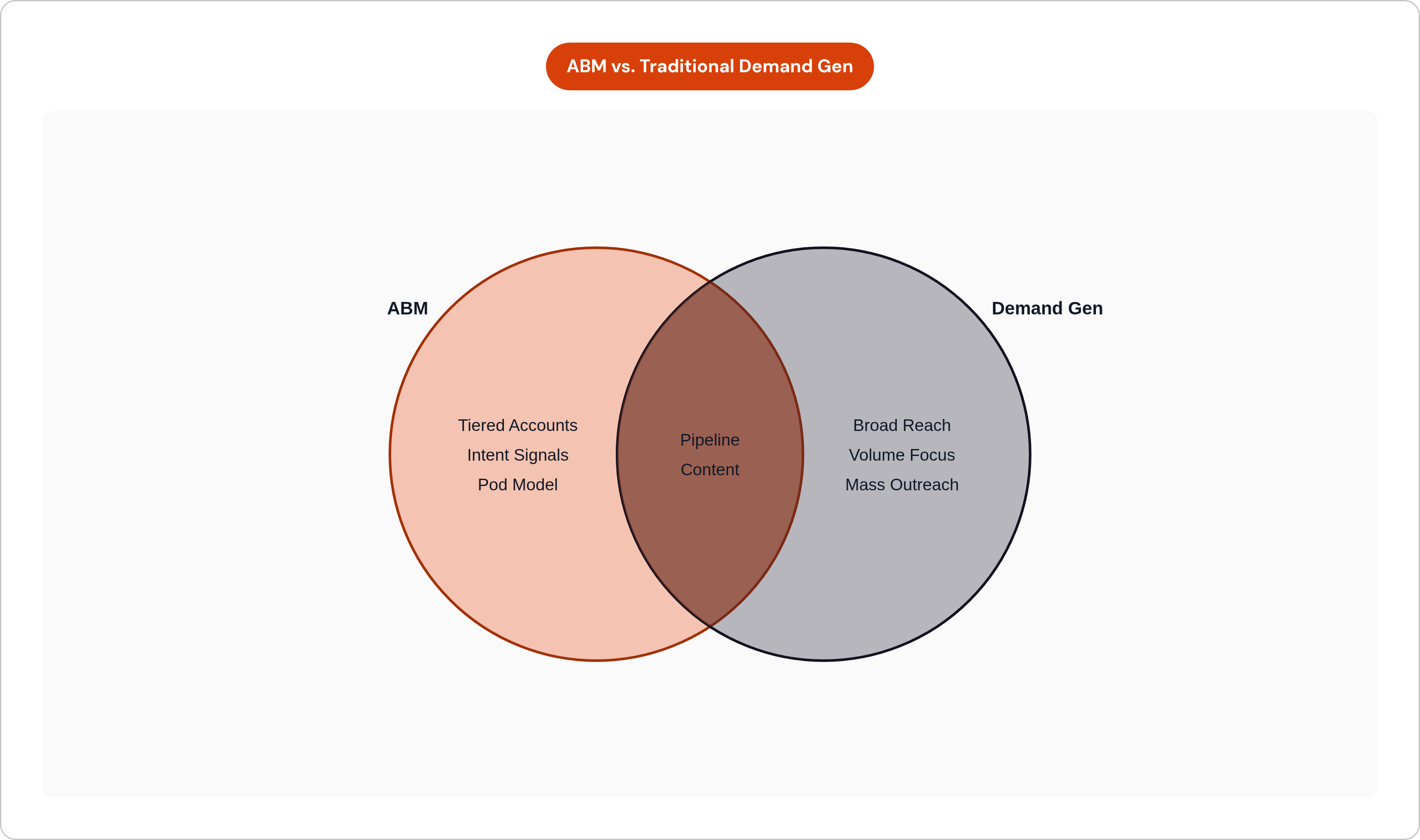
Every strong program I've looked at, regardless of industry or deal size, comes back to three things working together. Skip one and the other two can't fully compensate.
First is tiered account selection. Not a spreadsheet with three thousand logos on it, but a deliberate hierarchy: a small Tier 1 list getting heavy, hands-on investment, a broader 1:few tier getting semi-custom treatment, and a 1:many tier running more programmatic plays. Second is intent signal layering. Firmographic fit tells you a company matches your ideal customer profile (ICP); it says nothing about whether they're buying now. You need behavioral data, technographic signals, and in-market indicators stacked on top of fit to know timing, not just suitability. Third is multi-channel coordination, and this is the one people get backwards most often: it means hitting the buying committee, often spanning economic buyers, champions, and technical evaluators, from several directions at once, not running email this week and ads next month and calling that a sequence.
Why does sales-marketing alignment sit underneath all three of these rather than beside them? Because tiering, signals, and channels all require both teams agreeing on definitions before any of it works. ZoomInfo's State of ABM 2025 Report found that organizations with shared KPI contracts between marketing and sales see 27% faster MQA-to-SQO (marketing qualified account to sales qualified opportunity) conversion and 34% higher win rates. That's not a soft cultural win. Rather, it's what happens when both sides stop arguing about what "qualified" means halfway through a deal. Adobe's State of Personalization 2025 Report backs up the tiering piece specifically: organizations using tiered personalization frameworks report 42% higher conversion rates and 37% faster pipeline progression. The examples that follow all draw on at least one of these three pillars. The ones that fail, and there are plenty, usually skipped account selection discipline or ran channels that never talked to each other.
SAP's $27 million pipeline play built on sales-marketing alignment
SAP didn't launch its ABM program as a marketing initiative that got handed to sales after the fact. Alignment was the starting condition, not an afterthought bolted on when engagement numbers looked soft. The result: a $27 million increase in new marketing pipeline opportunities.
What did that alignment actually look like day to day? Sales and marketing jointly selected which accounts deserved tiered investment, rather than marketing building a list in isolation and lobbing it over the wall. They agreed, in writing, on what counted as a qualified account engagement versus a warm lead, closing the definitional gap that quietly kills most ABM reporting. And sales reps helped shape messaging before campaigns launched, instead of just receiving whatever marketing produced and being asked to make it work.
That $27 million figure didn't come from one clever campaign or a well-timed ad. It came from removing the handoff failure that kills most enterprise ABM programs before the first campaign even runs. Worth sitting with that for a second, because it's counterintuitive: the highest-leverage move wasn't a tactic at all, it was an operating agreement. SAP has brand recognition and budget most companies don't have access to, so a fair question follows naturally: does this hold up without an enterprise-scale name behind it?
How a mid-market SaaS company hit 300% pipeline acceleration by targeting 75 accounts
A mid-market SaaS company selling into financial services answered that question by going small on purpose. They ran a 1:few ABM program against 75 accounts spread across credit unions, community banks, and emerging fintech companies. Pipeline acceleration hit 300% within six months. Twenty-four qualified opportunities showed up in the first quarter alone, a 400% jump over what their previous inbound demand generation motion had been producing.
Why 75 accounts and not 750? A tighter list means deeper research per account, which means messaging that actually reflects what that account cares about instead of a generic template with the logo swapped in. Because credit unions, community banks, and fintechs face genuinely different regulatory and competitive pressures, splitting the 75 into sub-segments let messaging speak to each cluster's real concerns rather than flattening them into one persona. Resource concentration did the rest: content, paid ads, and outbound could all point at the same 75 accounts in the same stretch of time, instead of spreading thin across a list ten times the size.
Here's the compounding part that's easy to miss. When marketing, ads, and sales outreach all land on the same account in the same window, the prospect doesn't experience three separate campaigns. They experience one company that seems to understand their situation from multiple angles at once, and that reads as coherence instead of noise. The unit of ABM was never the individual lead. It's the account-level experience, and a small, well-defined list is what makes that experience possible to actually build.
Intent signal timing as the difference between a response and a missed window
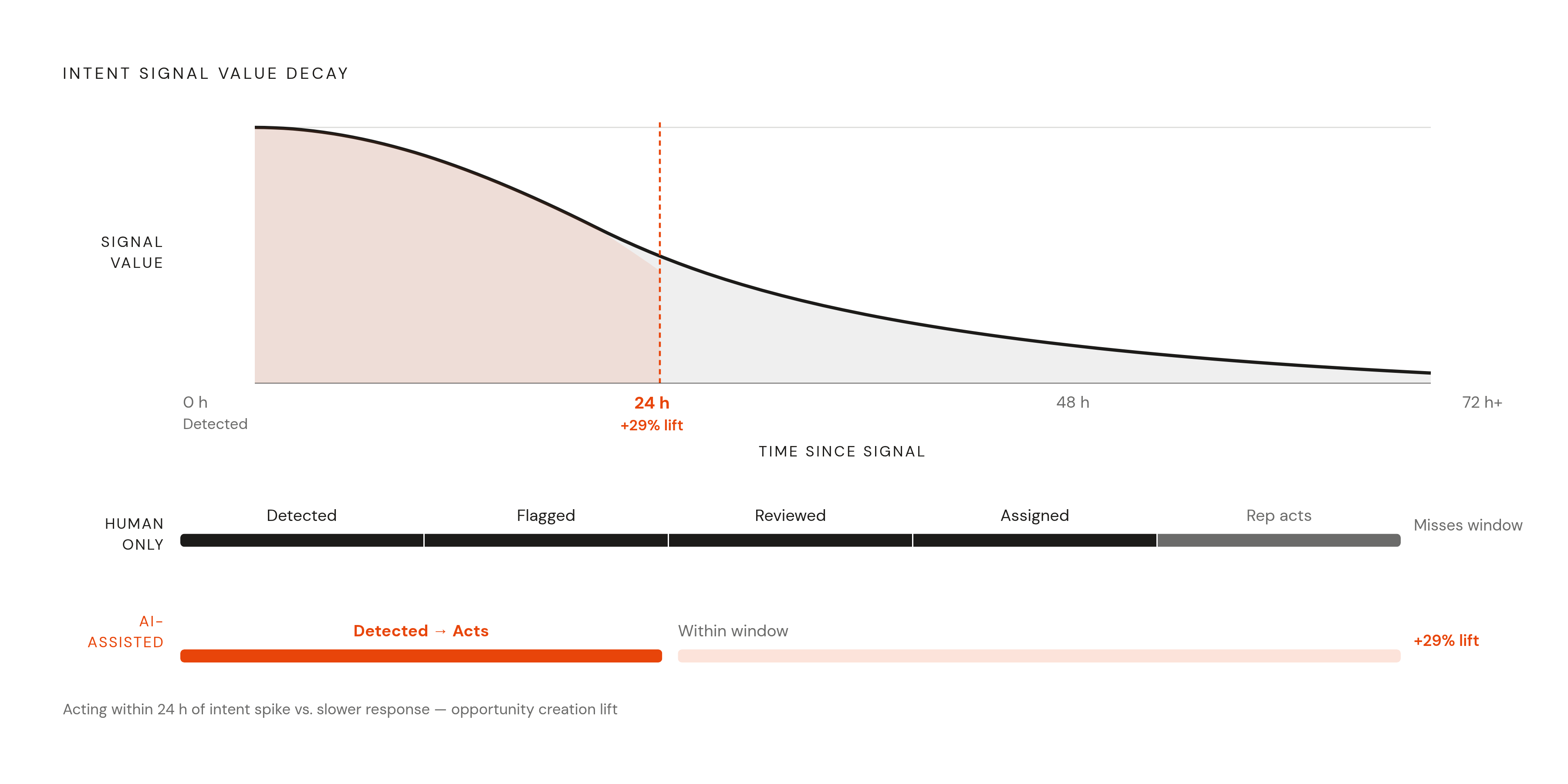
Even a perfectly chosen account is a wasted effort if outreach lands outside its buying window. So what should teams actually be watching for?
First-party signals: pricing page visits, demo requests, someone coming back to the same piece of content three times in a week. Third-party intent data: topic surge data showing a company's employees are suddenly researching a category, review site activity, patterns that suggest competitor evaluation. Technographic signals: a tool getting installed or ripped out, which often means a buying motion just started whether or not anyone announced it. Organizational signals also matter: leadership changes, hiring spikes, funding rounds, all of which mark a company in a state of change, and companies in flux buy differently than companies in steady state.
ZoomInfo's 2025 ABM Intelligence Study put a number on how fast this decays: teams acting on intent spikes within 24 hours see a 29% lift in opportunity creation compared to teams that respond slower. Twenty-four hours isn't a lot of runway. Consider also what that timeline rules out. Human-only workflows, where a signal has to get flagged, reviewed, assigned, and acted on by a person checking a dashboard once a day, often can't move fast enough to catch that window before it closes. That's the gap that's pulling AI-assisted workflows into ABM programs that used to run entirely on human judgment, and it's the bridge into how the execution layer itself is changing.
Cognism's microsite and gifting plays — what high-personalization ABM looks like at the account level
Cognism runs two plays worth studying closely because they show what personalization looks like when it's pushed to its practical limit.
The first is account-specific microsites. Cognism builds a page for a named target company with a headline that says exactly that: "We created this site to demonstrate how Cognism can help [Company Name] generate more pipeline." Below the headline sits a customized demo video addressing that account's specific pain points, not a generic product walkthrough. Below the video, those pain points get restated in text, followed by social proof relevant to that account's situation. Average time on page: 5.6 minutes. For a sales asset, that's an unusually long stretch of attention, and it tells you something real is happening rather than a page getting glanced at and closed. Why does it work? The prospect feels recognized rather than targeted, and the page answers objections before the prospect has to raise them out loud.
The second play is stranger and arguably more instructive. Cognism's customer success team sent cupcakes to leads who'd gone quiet, each one tied to account-specific messaging rather than a generic gift-box blast. The campaign target was a 20% response rate. Actual response rate: 80%. What made that gap so wide wasn't the cupcakes themselves; it was that the list was tight and the message attached to each one was specific to that buyer's situation, not a template with a name field.
Both plays raise an obvious tension. This kind of personalization takes real time and real people, and it only makes financial sense for Tier 1 accounts where deal size justifies the labor. You can't build 500 microsites the way you build five. Cognism's own broader ABM program, run at appropriate scale for lower tiers, still generated over $700,000 in pipeline in the first half of 2025, which suggests the economics work fine as long as the heaviest personalization gets reserved for the accounts that warrant it.
GTM pods as the organizational structure that stops multi-channel ABM from fragmenting
Most ABM programs have a decent playbook on paper and still fall apart in execution. Why? Because no one owns the account experience end to end. Marketing runs the ads, sales runs the sequences, customer success handles renewals, and none of those three groups is talking to the other two in real time.
The GTM pod model, described by Loren Shumate and others writing in MarTech, addresses this directly. A small cross-functional team, typically an account executive, an SDR or BDR, a marketing specialist, and someone from customer success, owns a defined set of accounts together, start to finish. Each person contributes across the full arc: targeting, meeting, deal, adoption, expansion, advocacy. There's no siloed handoff where one team passes a record to the next and loses the context that went with it. The pod passes context, which is a different thing entirely from passing a lead status field in a CRM.
This matters specifically for pipeline velocity because the biggest delay in most enterprise cycles isn't any single stage; it's the gap between stages, where an account sits waiting for someone to pick it up. Pods compress or eliminate that gap because the same small group is watching the account the whole way through. That said, pods aren't a cure-all. They still require disciplined account prioritization, because a pod spread across too many accounts just recreates the fragmentation problem at a smaller scale. That loops right back to the tight Tier 1 list from earlier in this piece.
Where AI agents are changing the execution layer of enterprise ABM
Here's the practical constraint that's shaped ABM for years: a human-only team can manage deep, genuine personalization for maybe 10 to 20 accounts before quality starts slipping. AI-assisted teams are extending that quality to hundreds of accounts, which shifts the real constraint from craft, meaning can we produce this content, to judgment, meaning which accounts actually deserve this level of investment.
What are AI agents actually doing inside live ABM programs right now? Detecting intent spikes and triggering outreach immediately, closing that 24-hour window automatically instead of waiting for a person to check a dashboard. Pulling firmographic, technographic, and news data to pre-brief reps before a call happens, so the rep isn't starting from zero. Generating outreach sequences tailored to account-level context rather than generic persona templates. Also handling CRM hygiene and signal routing, so the right pod sees the right account activity without a revenue operations (RevOps) function manually sorting through a queue.
A few tools are worth naming here because they represent genuinely different approaches. 6sense has won Gartner Magic Quadrant recognition five years running and offers predictive intent through RevvyAI; median contracts run well into the five-figure range annually, which tells you it's built for large teams with dedicated RevOps support behind it. Clay works differently, offering access to 150-plus data providers with waterfall enrichment and a research agent called Claygent for multi-step lookups; it's powerful in the hands of a team with an engineer to build and maintain the workflows, priced from the low hundreds to several hundred dollars a month. Apollo covers more ground as an all-in-one, with hundreds of millions of contacts and built-in sequencing, a solid entry point for teams consolidating list building and outreach in one place, priced free up to around a hundred dollars or more per user per month.
Here's the honest part, though. Roughly the vast majority of organizations report no meaningful bottom-line gains from AI so far, and that gap is almost never about the technology itself. It's structural. An AI agent running a poorly defined play just produces bad results faster than a human would have. Gartner has flagged this pattern too, warning about "agent washing," where plenty of tools slap the word "agent" on what's really just automation or a chatbot triggering a single action. Real agentic capability means owning a multi-step outcome end to end, not firing off one email when a form gets filled out.
What separates the ABM programs that compound from the ones that plateau
Look back across every example in this piece and a pattern shows up that has nothing to do with budget size. SAP's alignment work didn't just produce $27 million once; it built infrastructure that every later campaign ran on. The 75-account fintech program generated enough data, quickly, to know which sub-segments were actually responding, which meant the next round could be sharper than the first. Cognism's 80% response rate on cupcakes wasn't a lucky one-off; it came out of a playbook refined across several earlier attempts that didn't hit as well.
The mechanism underneath all three is the same: good ABM programs generate account intelligence as a byproduct, meaning which accounts engaged, which signals showed up right before a deal moved, which messages actually landed versus which ones got ignored. That intelligence makes the next campaign better, and the one after that better still. ZoomInfo's 2025 Data Confidence Index found teams running structured QA processes generate 33% more pipeline revenue per dollar spent, and it's worth pausing on what that number is really saying. Data discipline isn't overhead sitting on top of the real work; it's the thing that turns one good quarter into a program that keeps improving.
A plateau looks almost exactly like a program that never asks itself hard questions. Same account list quarter after quarter, same messaging, same channels, and success measured by impressions or opens rather than whether accounts actually moved a stage. So what's the standard worth holding a team to? After every campaign cycle, someone should be able to answer plainly: which accounts moved, which signals predicted that movement before it happened, and what specifically changes about the next list because of what was just learned. None of the examples in this piece are templates meant to be copied line for line. They're evidence that a repeatable structure exists, and the teams that internalize that structure and keep iterating on it are going to outrun the teams still chasing whatever tactic worked for someone else last quarter.