First-Party vs Third-Party Intent Data for Outbound Prioritization
Different intent signals answer different questions, so use each one for what it actually measures.

First-party and third-party intent data get treated like interchangeable inputs in most sales stacks. They measure different behaviors, carry different reliability, and belong at different points in an outbound motion. Mix them up and a perfectly good pipeline review turns into a guessing game about why nothing's converting.
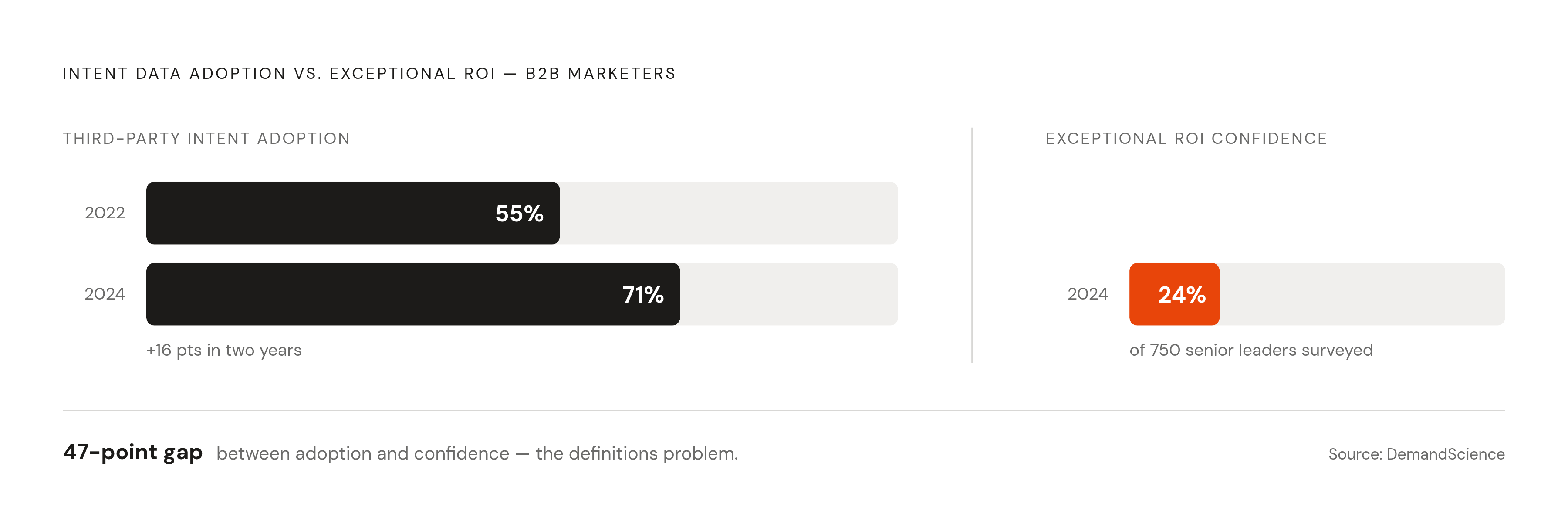
Adoption of third-party intent data climbed from 55% of B2B marketers in 2022 to 71% in 2024, fast growth for any account-based marketing (ABM) martech category. Confidence in the return didn't climb with it: DemandScience surveyed 750 senior B2B marketing leaders and found only 24% report exceptional ROI from intent data. That gap between "we bought it" and "it worked" points to a definitions problem most teams never sat down to sort out. Separately, 87% of organizations admit their marketing produces unreliable or inflated intent signals, and only 26% of flagged accounts convert into qualified opportunities. So when a signal fires, what's it actually telling you, and what's supposed to happen next?
What first-party and third-party intent data each actually measure
There are really three layers here, though most conversations flatten it into two. First-party data comes from your own properties: site visits, pricing-page dwell time, content downloads, product-trial activity. Second-party data comes from review sites like G2 and TrustRadius, where a company's research activity becomes visible to you because the platform shares it. Third-party data comes from publisher co-ops (Bombora is the dominant name here), aggregating research behavior across thousands of B2B sites and selling you the pattern.
First-party intent is high fidelity because you own the pipeline end to end. You know exactly what happened and when. A prospect hitting your pricing page twice in a week is a fact you logged yourself, not an inference someone made on your behalf. The tradeoff is scope: first-party data only covers accounts that already found you. It's blind, structurally, to the much larger total addressable market still shopping the category who haven't hit your site at all.
Third-party intent flips that tradeoff. It reaches your full TAM, including accounts you've never touched, because the co-op watches topic consumption across a shared publisher network instead of your own domain. What you lose is precision. Nobody at the co-op knows for certain that a spike in "sales software" content consumption means an actual buying committee has formed. Maybe it does, or maybe one junior analyst read three blog posts on a slow Tuesday and that's the whole story.
First-party answers who's engaged with us. Third-party answers who's shopping the category. Ask one to answer the other's question and that's usually where the prioritization model quietly breaks.
The reliability gap between the two signal types
Third-party intent is good for spotting buying activity across a wide account set. First-party gives you confidence about what one specific account is doing. Different tools, different failure modes, and the signal-to-noise ratio matters more than whatever average sits on a vendor's slide deck.
The precision problem on the third-party side is documented well enough that nobody in this space should still act surprised by it. The Starr Conspiracy's 2024 ABM Operations Audit, covering 47 deployments, put median precision for topic-based third-party intent at 0.51. Read that plainly: roughly half the accounts flagged as "surging" on a topic aren't in an active buying motion. Mature programs push that to 0.63, which helps, but still leaves more than a third of flagged accounts as noise.
Why so much noise? Co-op data gets aggregated at the domain level, not the individual buyer level, so one researcher at a large company reading a competitor's blog can register as account-wide intent, a domain-level aggregation problem no enrichment layer fully solves. Topic taxonomy matching stacks more imprecision on top of that. And a lot of providers stop at the account level entirely, meaning even an accurate surge signal leaves you without a name. You end up paying extra, somewhere else, just to find the human who did the reading.
First-party carries its own noise too, and that part gets glossed over more than it should. An account visiting your pricing page once could be a competitor doing recon, an analyst writing a comparison piece, or a current customer checking whether their contract's still competitive. None of those are prospects. The real distinction is about role: third-party widens the aperture on who you're looking at, while first-party sharpens what you say once you've found them.
What each signal type is actually built to do in an outbound motion
Third-party intent works best as a discovery tool. It finds companies researching your category before they've heard your name, which makes it the right instrument for building and ranking a prospecting list against your full TAM, not just the sliver that stumbled onto your site on its own. It's also the sharpest tool available for competitive displacement. If an account is researching a competitor's category page, getting in front of them before the shortlist locks matters a lot: 6sense's 2025 research found 94% of buying groups rank their vendor shortlist before ever talking to a salesperson. Third-party signal is frequently the only lever that gets you there in time.
First-party intent serves prioritization and personalization inside an account set you already know. A prospect visiting your pricing page twice is telling you something specific, and the right move is outreach that names exactly what they did, sent while the moment's warm rather than folded into a generic nurture email three days later. Teams with a strong inbound engine get outsized value from first-party simply because they have more of it to work with. Teams doing cold outbound into a broad TAM lean harder on third-party, since it's the only signal covering ground they haven't touched.
Second-party data sits in its own lane: late-stage, comparison-shopping signal. A company browsing "best sales prospecting tools" on G2 is closer to shopping than researching. That makes it one of the higher-confidence signals in the stack, even though it's still adjacent to third-party rather than a direct brand interaction. Think of it as the bridge between broad third-party discovery and the tighter first-party engagement that follows.
Gartner's 2025 survey found 73% of B2B buyers actively avoid outreach they consider irrelevant. Use the wrong signal to justify the wrong message at the wrong moment and the damage lands across your whole TAM, not just on that one deal.
How a combined signal framework actually works in practice
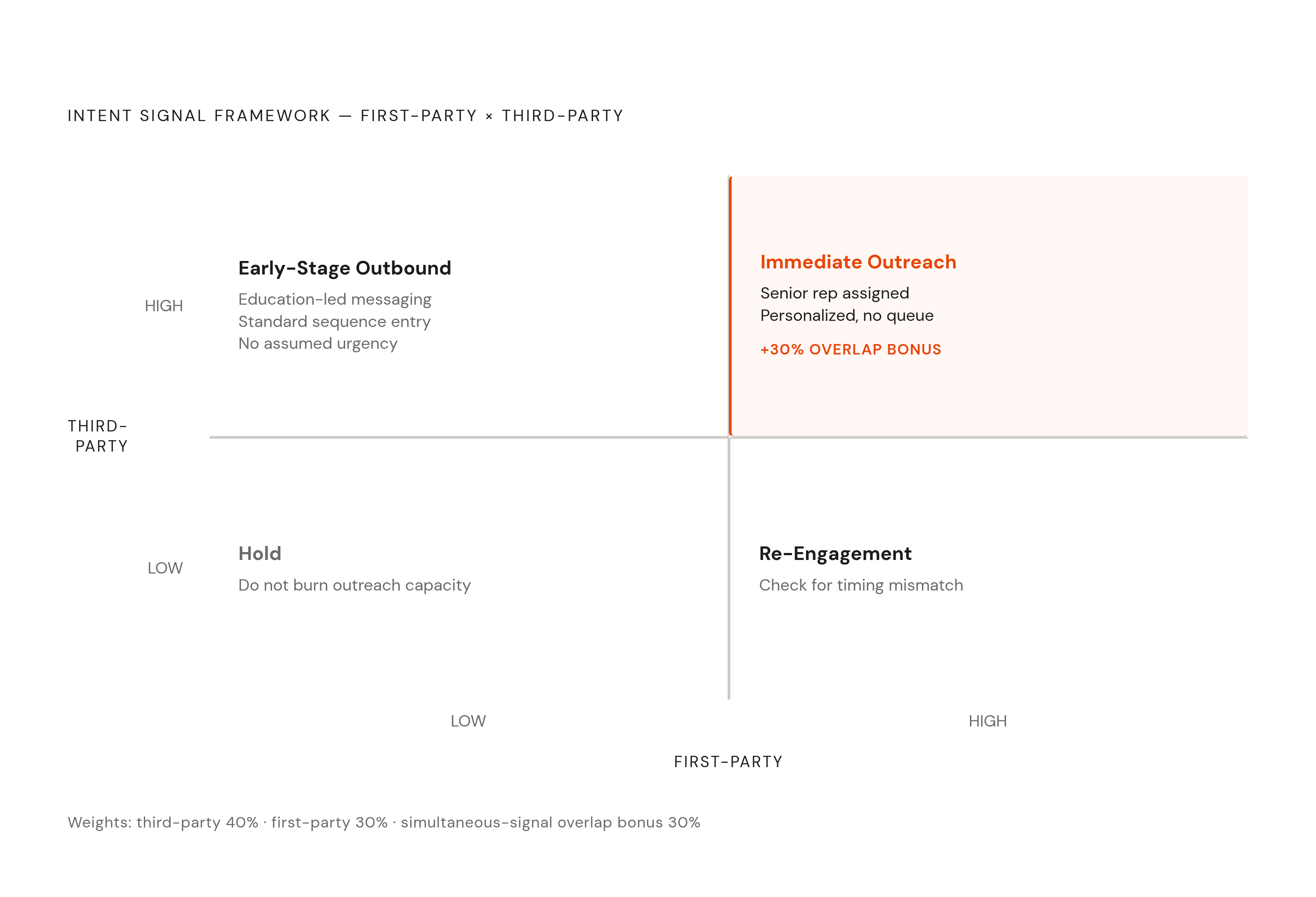
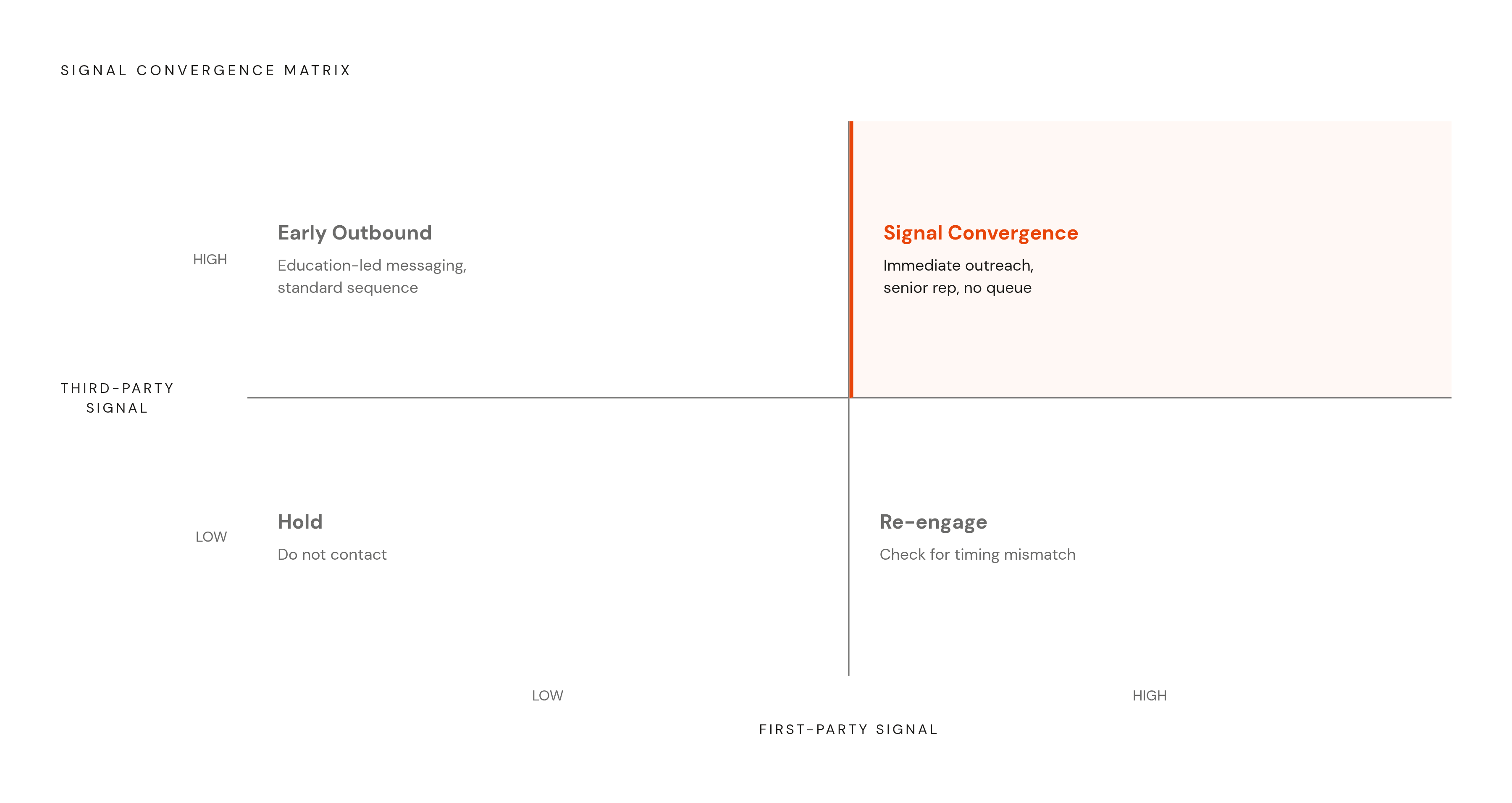
Run first-party and third-party together and accounts sort into four groups. The group an account lands in should decide what happens next, with a clear-eyed view of where the two signals disagree rather than a blended score that quietly papers over it.
High third-party paired with low first-party describes an account actively researching the category that hasn't touched your brand yet. That's early-stage outbound territory: education-led messaging, standard sequence entry, no assumed urgency. Flip it (low third-party with high first-party) and you get accounts engaging with your content without showing broader category research. That's a re-engagement case, worth checking for a timing mismatch too, since the account may have gone quiet on the category for a reason you haven't found yet.
High on both is the group that matters most. An account researching the category broadly while engaging directly with your brand is about as clear a buying signal as this data produces. That should trigger immediate, personalized outreach with a senior rep assigned: no queue, no waiting for Tuesday's pipeline review. Low on both means what it sounds like: hold, and don't burn outreach capacity chasing a cold account just because it sits inside your ideal customer profile (ICP) on paper.
One weighting approach that's held up in practice: 40% of the score to third-party research activity, 30% to first-party engagement, and a 30% bonus applied only when both fire at once. That overlap bonus isn't decoration. Convergence, both signals firing at the same time, is the single most reliable buying intent signal this whole stack produces. The hard part isn't sourcing the data anymore; most teams already have too much of it sitting around unused. Keeping the integration logic clean is what's hard, since that's the only thing standing between you and double-counting an account that shows up in both feeds for entirely unrelated reasons. Second-party data slots in as a late-stage qualifier layered onto accounts already in the high third-party group. Trigger events like funding rounds, leadership changes, or tech stack shifts work best as multipliers on behavioral intent rather than standalone inputs.
The pipeline math behind getting signal prioritization right
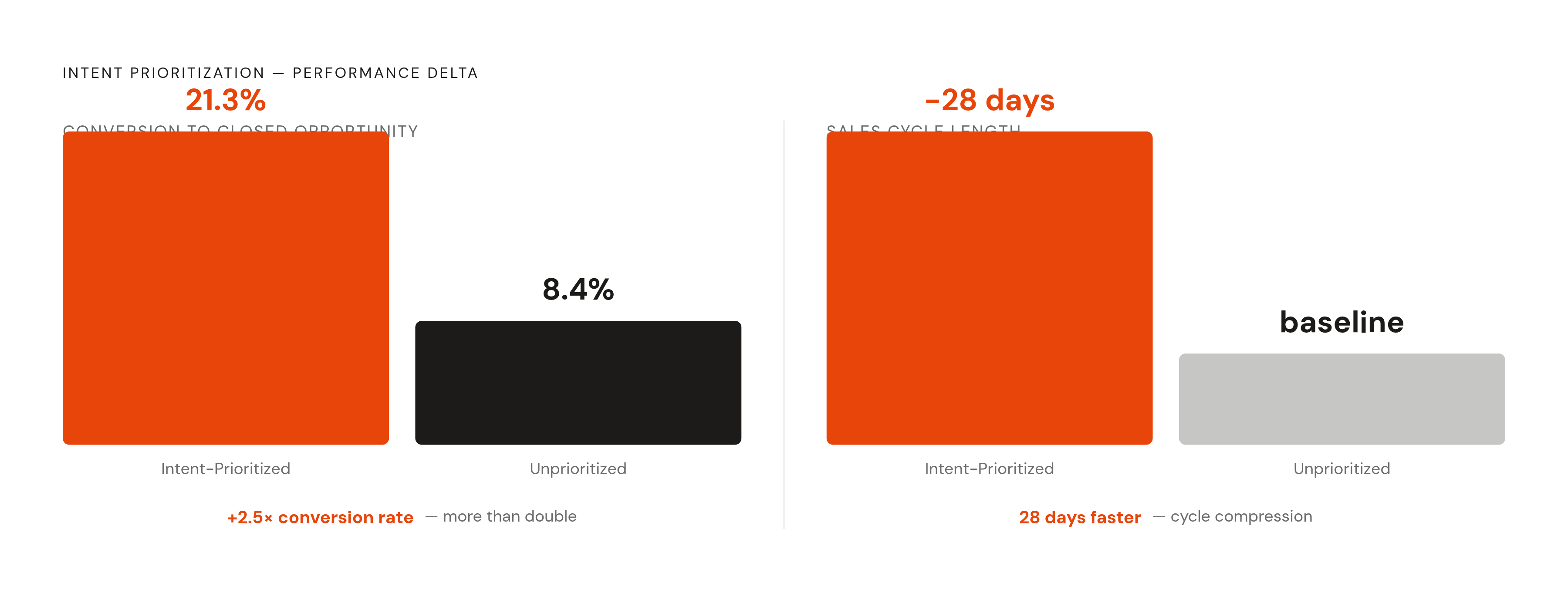
The case for doing this well isn't theoretical. A 2024 B2B Buying Study found intent-prioritized accounts converted to closed opportunity at 21.3%, against 8.4% for accounts not prioritized at all: more than double. The same study found median sales cycle compression for intent-flagged accounts reached 28 days against baseline, so the benefit shows up in speed as much as conversion. Separately, 76% of B2B marketers report increased ROI specifically from focusing effort on high-intent leads rather than spreading it evenly across a list.
None of that arrives free. Worth being straight about the ramp instead of assuming intent data pays off on day one. That same Starr Conspiracy audit found the median time from signing a new intent data contract to that data producing its first qualified pipeline was 94 days, with the slowest quartile taking longer than 180. For a well-capitalized enterprise team, three months barely registers on the calendar. An early-stage or capital-constrained team faces a real planning problem here, and pretending otherwise sets up a bad quarter down the line. That argues for sequencing the spend on purpose: first-party can go live immediately since the data already lives inside your own systems, while third-party programs need calibration time before they produce pipeline anyone should trust.
The signal-to-action gap matters just as much as the signal itself. Reply rates on outbound triggered directly by a signal firing run 8% to 15%, against 3% to 8% on cold static lists with no signal behind them. That gap is almost entirely targeting and timing. Copy sharpness plays a much smaller role than most sales orgs assume after years spent optimizing subject lines.
Where AI agents change what's possible with real-time signal routing
Most intent programs stumble less over data quality than over the lag between a signal firing and a relevant message reaching the prospect, and that gap is often measured in days when it should be measured in minutes. A surge alert sitting in a Slack channel for a week before anyone acts on it is a familiar story to anyone who's run one of these programs. By the time someone finally does act, the account has often already picked a vendor and moved on.
This is the problem AI revenue agents are built to close: routing intent signals directly into personalized outbound the moment they fire, no manual scoring queue, no weekly meeting deciding who gets contacted. In practice, a third-party surge on a target account triggers sequence entry with category-aware messaging right away. If a first-party signal follows (a pricing-page visit, say) that account escalates within the sequence to something more urgent and specific. When both land at once, the system flags the account for direct human outreach as the top priority in the queue.
Agents tend to work better when each one owns a distinct, narrow play rather than one system trying to apply the same logic everywhere at once. One agent for third-party surge entry and a separate one for first-party escalation beats a single generalized model doing both jobs half as well. There's a consolidation case worth making here too. Running signal intake, sequence logic, CRM sync, and outreach execution from one connected platform removes the lag that timing-sensitive outreach can't survive when it's stitched together across four or five disconnected tools, each with its own sync delay.
An AI agent running a founder's voice and playbook, triggered by a real signal the moment it fires, is a real compounding advantage for an early-stage team, where every rep's time is scarce and every reply counts for more than it will once the team's twenty people deep.
Building a prioritization framework that improves with each cycle
Intent prioritization isn't something you configure once and walk away from. The signal mix, the weighting, the sequence triggers: all of it needs checking against what's actually converting into pipeline, not against what looks good on a dashboard during Monday standup.
Where you start depends on what you already have. A team with an established inbound motion should activate first-party signals right away and layer third-party on top to expand the universe beyond who's already showing up on their own. A team running cold outbound into a broad TAM with no inbound engine should treat third-party as the primary filter while building first-party instrumentation in parallel, for when accounts eventually start engaging directly. A team at early stage with limited tooling should prioritize the highest-confidence signals available before paying for a full co-op subscription: pricing-page visits, direct site engagement, second-party review category activity.
Measure precision, not just conversion. Track which category, first-party, third-party, or the combined trigger, is actually producing qualified opportunities rather than just producing replies, because those aren't the same outcome. Treat them as interchangeable and you end up chasing vanity metrics for two quarters straight without noticing. Cut the signals that inflate the top of the funnel without improving what comes out the bottom. A 26% qualified opportunity rate on average intent signals means most teams are chasing a lot of false positives and calling it pipeline anyway.
Treat third-party as a hypothesis about buying intent, first-party as confirmation, and save the combination of both for your highest-effort, most personalized outreach. Worth remembering too that mass-blast outbound against unqualified lists carries real cost under the tightened bulk-sender rules Google and Microsoft rolled out. Every sequence entry built on a bad signal compounds against sender reputation, not just against that day's reply rate. The frameworks that work get built through iteration, nothing more exotic than that: keep what produces qualified pipeline, cut what inflates the queue, and tighten the signal definition a little more each cycle.