Job Change Triggers in Outbound Prospecting
Former champions at new companies convert six times better than cold outreach.

Job change triggers convert better than almost any other signal in B2B outbound. This piece looks at why that's true, how fast the opportunity decays once a job change happens, and what a team actually has to build to catch it before it's gone. Most outbound triggers are noise wearing a signal's costume: a keyword on an earnings call, a LinkedIn like, a Series B with nothing to do with your category. Job changes sit apart because they're structural. New role, new budget authority, a fresh vendor list, and a buyer whose habits haven't hardened yet.
Start with the shortlist dynamic, because it explains why urgency isn't just something salespeople say to justify a 6pm Slack ping. Per 6sense's 2025 Buyer Experience Report, the winning vendor was already on the buyer's shortlist before any conversation with a salesperson happened, in 95% of deals. The deal is functionally decided before outreach even starts, in nearly every case that matters. Being early isn't an edge stacked on top of a good pitch; it's close to the whole mechanism by which vendors win at all, which is why first-mover advantage in B2B is less a cliché than a structural reality.
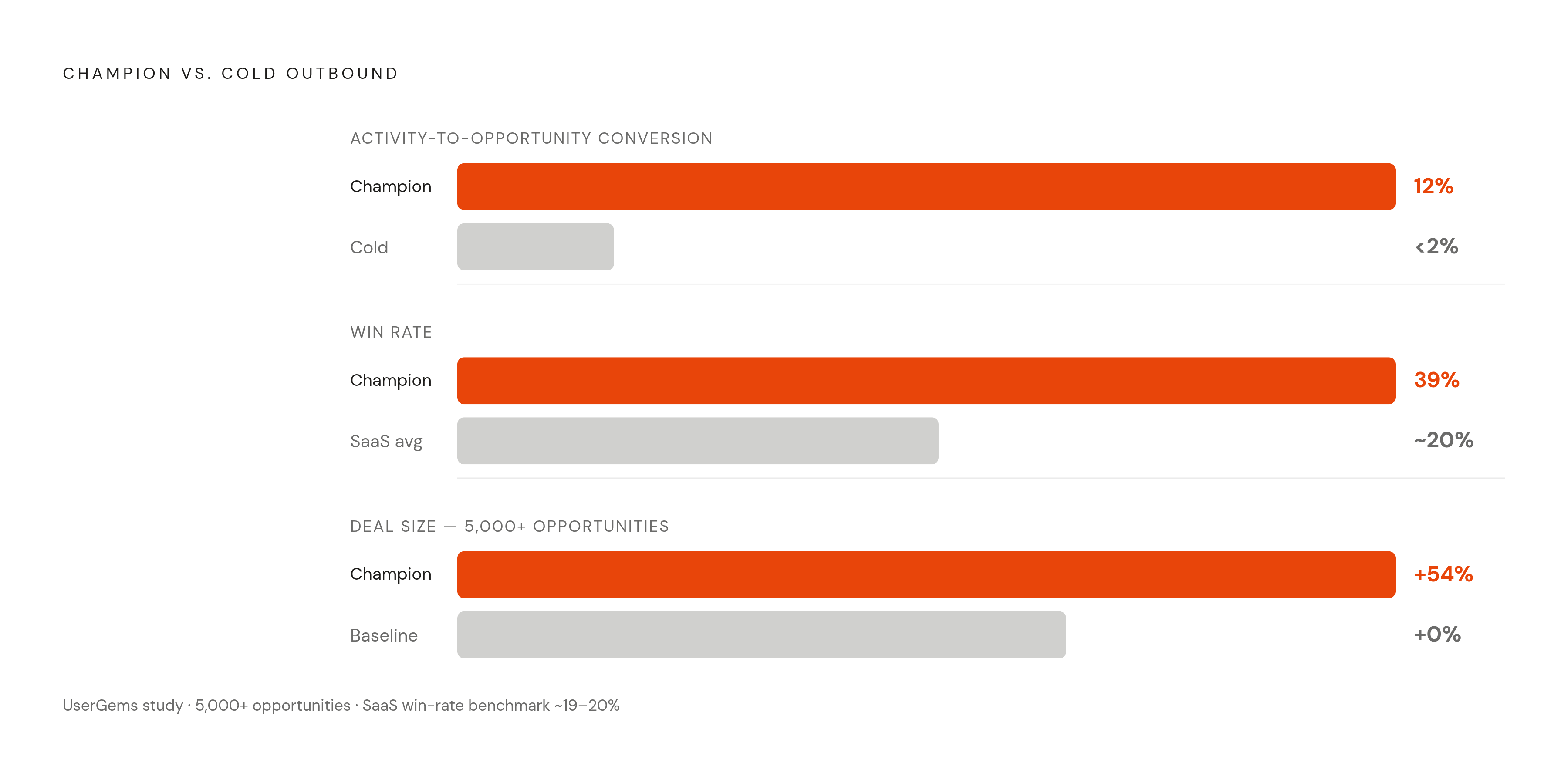
Now add former champions into the mix, people who used and liked your product at a prior company before moving on. Prospeo ran the numbers across a large sample of tracked contacts and found a 12% activity-to-opportunity conversion rate for these contacts, against less than 2% for cold outbound, with a 39% win rate running roughly double the SaaS average. Twelve percent versus two percent isn't a gap you close with better copywriting. Champion-based outreach and cold outbound just aren't playing the same game, even though they run through the same CRM, and trigger-based selling is what separates the two at the execution level.
And the scale sitting quietly inside a typical CRM is bigger than most revenue teams assume. Something like 20 to 30% of tracked contacts change jobs in a given year, and 40 to 50% of those land somewhere that fits the ideal customer profile, or ICP. Run that math on a database of 1,000 contacts and you land somewhere between 80 and 150 warm leads a year. Mostly untouched. Nobody built the system to notice when they moved.
The four contact types worth tracking, and what each one signals
Not every job change deserves the same urgency, and figuring out which contact types actually matter is the first real decision here, well before anyone drafts a line of outreach.
Former customers and buyers sit at the top for obvious reasons. They've paid for the product, they know what it does, and they're carrying both budget authority and a working reference point into the new job. Less explaining, less trust to rebuild from scratch.
Contacts inside an open opportunity are messier. A mid-cycle departure can stall or kill a deal that was otherwise moving, though it doesn't have to. Reach the departing contact fast and you can often preserve the relationship, sometimes carry it somewhere new entirely.
High-NPS product users, the ones who genuinely liked the tool but never signed a check, tend to get undertracked compared to economic buyers. That's a mistake worth correcting. These are frequently the people most likely to advocate internally at a new employer, precisely because their enthusiasm was never tangled up in budget politics to begin with.
Then there's the closed-lost contact who blocked a previous deal. Their departure isn't neutral. It's an opening. Whoever replaces them inherits the account with no prior objection baked in, so the conversation gets to start clean. Tracking who leaves a blocked account matters about as much as tracking who arrives somewhere new; the two are just pointing in opposite directions.
One distinction is worth sitting with. Most teams default to chasing decision-makers, since that's who signs the contract, but that also means every message competes against every other vendor hitting the same title at the same company in the same week, targeting the same buying committee. Champions face far less inbox competition when they move, and they're usually hungry to make a mark early in the new job. Less noise, more motivation, and that combination is exactly why champion tracking beats decision-maker tracking on a pure numbers basis, counterintuitive as it feels to anyone trained to chase the signer.
Signal stacking pushes this further. A former champion landing at a company already showing intent data signals, active content consumption, pricing page visits in your category, is close to the best outbound trigger available. Job change flags openness. Intent signal flags active evaluation. Stack the two and outreach lands exactly when someone with buying influence has both the motive and the appetite to listen.
UserGems studied more than 5,000 opportunities, and the numbers are hard to argue with: deals involving previous champions showed 54% larger deal sizes and 114% higher win rates. The category of contact isn't a minor variable in this equation. It's most of the equation.
Why the conversion window closes faster than most teams expect
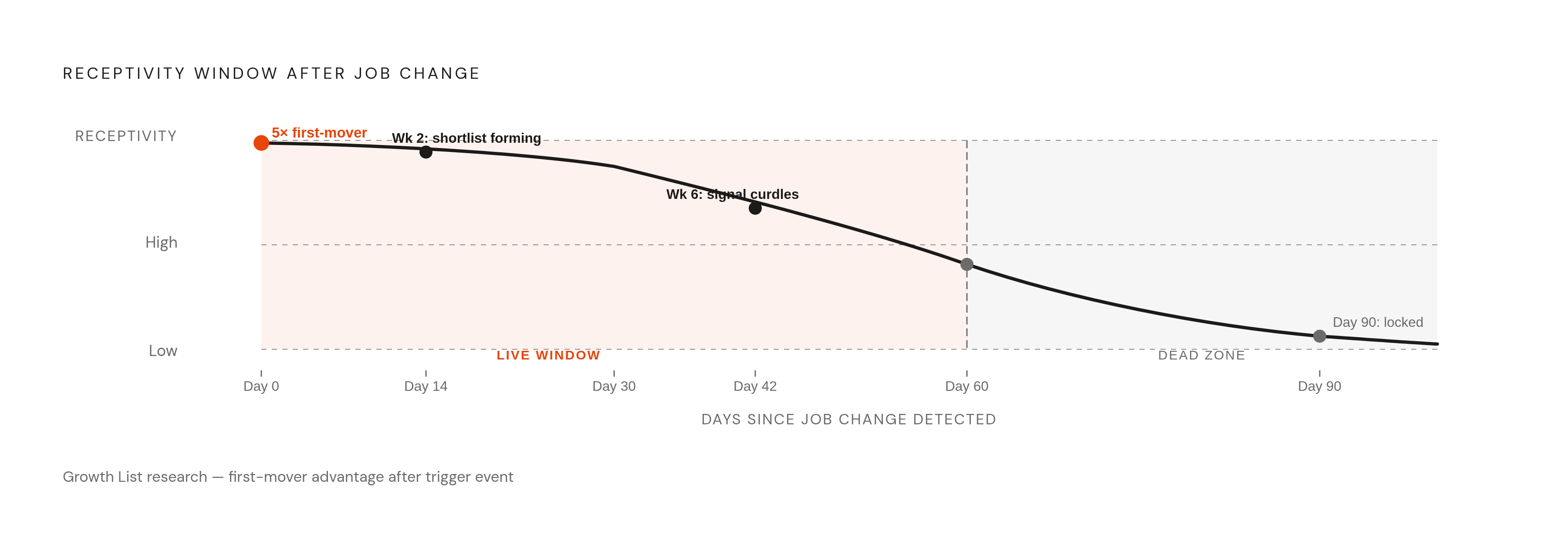
New executive hires are most receptive to outside conversations in roughly their first 60 to 90 days. After that, vendor relationships start forming on their own, priorities lock into place, and a window that was wide open starts narrowing fast, whether anyone noticed it happening or not.
What's actually going on in those 90 days? Agenda-setting, team building, decisions about where discretionary budget goes. The buyer isn't passively fielding pitches; they're actively deciding who they'll work with going forward, and those early decisions get harder to unmake the longer they sit unchallenged.
Research on trigger-based outreach from Growth List found the first seller to reach out after a trigger event is five times more likely to win the deal. Five times is the difference between shaping the shortlist and being one of six emails skimmed and archived before lunch.
So what actually kills that first-mover advantage? Detection latency, mostly. A job change that surfaces weeks after it happened, through a manual CRM review or a quarterly list scrub, has already missed the window. The signal doesn't just age, it curdles into noise; the same information that would've opened a door in week two reads as stale, faintly odd, by week six.
That raises an uncomfortable operational question nobody enjoys answering out loud: what happens when a team misses the window anyway? Good GTM teams track when a signal fired, not just whether it fired, and they'll deprioritize an account if the response came in too late rather than send something stale just to close the loop. A late, generic message can do more damage than silence, because it signals the opposite of what the outreach was supposed to convey: that this vendor is paying attention.
There's an adjacent problem here, easy to confuse with the timing issue but distinct from it. Trigger fatigue shows up when a signal is publicly loud, a funding round trending on LinkedIn, a C-suite hire covered in the trade press. Everyone sees it, everyone reaches out, and the prospect's inbox floods with near-identical messages inside 48 hours. Quieter signals, an internal role shift, a team growth pattern, a change in the tech stack, carry more real value for the simple reason that fewer people are watching for them.
How to detect job changes at the scale and speed the window demands
Three approaches exist here, each with tradeoffs worth naming instead of glossing over.
Manual monitoring, LinkedIn alerts, Google alerts on named contacts, works fine for a short list of high-value former champions someone genuinely wants to track by hand. It falls apart once that list grows past a couple dozen names, because a human checking alerts doesn't scale the way a database does.
CRM enrichment tools that periodically re-verify contact data catch changes eventually, but they lag by days or weeks depending on the enrichment cadence. That lag is exactly the gap that turns a hot signal cold, per the timing dynamics above.
Purpose-built job change tracking platforms, the ones monitoring contact movement continuously and firing alerts the moment a change is detected, are the only approach that consistently lines up with that 60-to-90-day window. It comes down to a system built to notice things in near real time, against a process that notices things eventually, once someone remembers to check.
A few platforms are worth naming. UserGems was built specifically for champion tracking: it watches CRM contacts for role changes and triggers outreach workflows off those changes automatically. Its Gem-E product, launched January 2025, layers in AI that builds lists, scores accounts, and drafts sequences without a human starting from a blank page each time. Apollo.io takes a different angle, folding a large B2B contact database together with job change alerts and sequencing in one place, useful for teams that don't want detection and outreach living in separate systems. LinkedIn Sales Navigator remains the most direct source of role-change data, pulling straight from self-reported job data at the source, though it still needs manual follow-through or an integration layer to turn an alert into action. And for high-growth or founder-led teams, purpose-built AI revenue agents can be set up to monitor for job change signals and trigger personalized outreach on their own, without bolting a separate alert tool to a separate enrichment layer to a separate sequencer.
That last point gets at something structural. Detection alone doesn't do much if it can't hand off directly into enrichment, pulling new company, new title, new contact details, and then straight into outreach. Any manual step wedged into that chain reintroduces the exact latency the tool was supposed to remove.
None of it works without clean data underneath, though. UserGems puts the figure at roughly 20% of CRM contacts changing jobs in a given year. Teams that don't maintain contact records on a rolling basis, a practice sometimes called CRM hygiene, aren't just missing a signal here and there; they're stacking up a backlog of stale outreach targets that gets heavier every quarter it sits unaddressed.
What to say and when to say it across the main job-change scenarios
Message construction starts with the scenario, not a template pulled off a shelf. The right opening line depends almost entirely on relationship history and which of the four contact types is on the other end.
Take a former buyer or champion landing at a new, ICP-fit company. Lead with the prior relationship rather than a fresh pitch, since they already know what the product does. Acknowledge the move, ask about the new mandate, and let the conversation about how you might help follow on its own instead of forcing it into line one. Timing matters too: reaching out in the first two or three weeks keeps you on the Day-One shortlist without feeling like you're chasing the LinkedIn notification the second it posted.
A high-NPS user who isn't the economic buyer calls for a different ask entirely. Instead of "do you have budget," it's "who should I be talking to." The champion may never sign anything, but they can open a door that would otherwise take months to find on your own. Offer something useful first, a usage tip, a case study relevant to their new industry, a peer reference, and that introduction tends to come easier than if you'd just asked for it cold.
Closed-lost accounts split into two paths depending on which direction the movement runs. If the contact who blocked the original deal has left, approach the successor fresh, no reference to the prior history; they didn't make that call, so there's no reason to hold it against them. If instead a former user from that closed-lost account has moved somewhere new, treat them as a champion re-engagement rather than a cold prospect. The relationship, small as it is, already exists.
Mid-cycle job changes demand speed on two fronts at once. Reach the departing contact right away at their new company, since they've already lived inside your sales cycle and understand the problem you solve. At the same time, start mapping who's stepping into their old role internally; the original deal may still close if the right champion lands in that vacated seat.
One mistake shows up across every scenario: leading with the trigger itself, "I saw you just joined…", as though the observation were the message. It isn't. Signal awareness should shape what gets said and how, but the trigger by itself gives nobody a reason to respond.
On cadence, the goal is enough touches across the early window to let the contact settle into the new role before the ask escalates, while keeping enough structure in place that the sequence doesn't quietly fade into nothing.
Building the infrastructure so this motion runs continuously, not campaign by campaign
A lot of otherwise well-designed programs fall apart right here: treating job change outreach as a periodic campaign instead of an always-on, triggered go-to-market motion. A quarterly push misses most of the window most of the time, by definition, since job changes don't happen on a quarterly schedule. They happen every day, scattered across a CRM, and a system that checks in four times a year is going to miss most of them before they're even actionable.
An always-on version of this needs a few pieces to actually hold together. Contact lists need continuous monitoring instead of a quarterly enrichment refresh. Alerts need routing logic that gets the right signal to the right person, or the right agent, immediately rather than sitting in a queue somewhere. Scenario playbooks, the four types from earlier, need to be pre-built so nobody's starting from a blank page every time a trigger fires. And CRM logging needs to capture trigger date, outreach date, and eventual outcome, so the team can measure conversion by scenario instead of guessing at what worked.
The fragmented-stack problem is often the quiet reason a program underperforms despite everyone's good intentions. Detection in one tool, enrichment in another, sequencing in a third, CRM sync somewhere else entirely, and you've reintroduced the exact latency gaps that kill the timing window in the first place. Teams already juggling a dozen simultaneous go-to-market motions are stretched thin as it is; stacking on more disconnected point solutions doesn't solve the speed problem, it compounds it.
This is where autonomous agents change the shape of the problem, not just the tooling underneath it. An agent that monitors for job changes, enriches the contact record, picks the right scenario playbook, drafts the opening message, sends it, and logs the activity is compressing a workflow that used to take a human several manual steps down into minutes. Gartner's 2025 research found AI-driven pipeline automation improves sales velocity by 25 to 30%, which tracks with the argument running through this whole piece: speed is the scarce resource here, not insight.
One governance note worth taking seriously before any of this goes live: test message quality on a small cohort first. The real risk with automation isn't that it fails to personalize, it's that the personalization reads as obviously template-generated, which lands worse than a plain, thoughtful generic message would have, especially given that the recipient already has a real relationship to measure it against.
Then there's the iteration loop, and this is where the whole thing either compounds or stalls out flat. Keep the sequences that convert by scenario, cut the ones that stall, sharpen the playbook every cycle. Teams that treat CRM signal data as something to learn from, rather than just a record of what already happened, are the ones who get better at this over time instead of running it on repeat.