Predictive Lead Scoring Models for Outbound Prioritization
Predictive models rank leads by conversion likelihood so reps focus time on the right deals.

Predictive lead scoring is a machine learning approach to ranking leads by conversion likelihood, and it earns its keep in outbound work, where nobody hands you a signal for free. This piece walks through what these models actually do, what data they need before you can trust the number they spit out, and how a founder or a small GTM team turns a score into a working outbound motion instead of a dashboard nobody opens.
Outbound reps have a fixed number of hours in a day, and most lead lists get treated like every name on them deserves equal attention. That math never works out. A rep staring down 200 leads with no ranking system defaults to habit: call whoever came in most recently, chase the recognizable logo, favor the VP title over the director title with zero behavioral evidence behind the pick. That's what happens when a queue outpaces judgment and there's nothing better to lean on.
Survey data on the profession backs this up: a significant share of sales reps report being too busy to follow up on every lead they're given. Triage happens whether anyone admits it or not, and the real question is whether it runs on principle or on whoever happens to answer the phone that day, whether that's a founder, an SDR, or a full-cycle rep. Under unscored outbound, conversion rates tend to stay low, and that gap between leads touched and deals closed looks less like a talent problem than an allocation problem. Time spent on the wrong fifteen leads is time not spent on the right five.
Inbound doesn't face this the same way, because inbound leads self-select; someone filling out a demo form has already told you something real about intent. Outbound gets no such gift. The team has to manufacture the signal that inbound just hands over, and founders running early-stage GTM feel this most, since there's usually no dedicated SDR layer to absorb the inefficiency. Every misallocated call draws directly against a runway that isn't getting any longer, especially when the rep has no ideal customer profile to anchor the decision.
What predictive lead scoring actually does, stripped of the jargon
At its core, predictive lead scoring is a model trained on your own history of wins and losses, built to estimate propensity to buy for a given lead. That estimate comes out as a number, usually on a 0 to 100 scale, and it updates as new data rolls in.
The break from old rule-based scoring matters here. Traditional scoring is a human deciding, somewhat arbitrarily, that a VP title is worth 15 points and a filled-out form is worth 10. Defensible enough as a starting guess, but it's static, and it decays: the assumptions baked in on day one rarely hold eighteen months later once the market or the product or the buyer has shifted underneath them. Predictive scoring lets the model comb through thousands of actual closed and lost deals and surface which combinations of attributes and behaviors were actually present when things converted. Nobody has to guess that pricing-page visits matter more than company size; the model finds that out from what already happened, and feature importance rankings make those findings inspectable.
Four categories of input tend to feed these models. Behavioral data covers website visits, email opens and clicks, content downloads, time spent on a pricing page. Demographic and firmographic data covers job title, company size, industry, geography. CRM history covers past deal patterns, prior interactions, how fast similar accounts moved through the pipeline. Third-party or intent data covers funding announcements, executive job changes, new technology installs, technographic data on tools added or dropped, and content consumption tracked outside your own site.
The dynamic update piece sets this apart from sorting a spreadsheet by static criteria. A lead who visits the pricing page today moves up the list today, without anyone touching the record. A lead who goes quiet for three weeks slides back down without anyone manually re-scoring the account. That responsiveness, frankly, matters more than the machine learning label itself deserves credit for.
Adoption has moved well past the early-adopter phase. Adoption of predictive lead scoring among B2B organizations has grown substantially over the past decade, and a large share of high-growth B2B companies now run some version of this system. Does wider adoption mean the approach works, or just that it's become the safe default nobody wants to be caught without? I'd guess some of both, honestly. Either way, this stopped being a capability reserved for companies with a data science team a while ago. Table stakes, not edge, is closer to where the market actually sits.
The data a model needs to produce a score worth trusting
A model is only as good as what it's trained on, and this is usually the first wall a founder hits. You can't train anything meaningful on eleven closed deals; there isn't enough contrast in the data for an algorithm to find a pattern worth acting on.
As a concrete reference point, Some vendor platforms require a minimum number of qualified and disqualified leads within a defined window just to begin training, a floor set to guarantee some baseline statistical reliability before attempting a score. That's a floor set by a vendor that has to guarantee some baseline statistical reliability before it'll even attempt a score, and it's a useful number to keep in your back pocket the next time someone pitches you predictive scoring for a pipeline with two closed deals in it.
Clean data matters as much as data volume, maybe more. Conversion needs a consistent definition, recorded the same way every time in the CRM, not left up to whatever a given rep decides counts as "qualified" on a given Tuesday. Lost deals need the same rigor as won ones; a model learns as much from what didn't close as from what did, and a CRM full of unmarked, abandoned opportunities teaches the model nothing at all. Duplicate records and half-filled fields quietly degrade model accuracy too, which makes data hygiene a prerequisite rather than something you get to later. None of this works, though, if the model can't reach the data in the first place. It needs a live connection to marketing automation, the CRM, website analytics, and any intent feed in use, or it's scoring on a partial picture and calling it complete.
So what does an early-stage team do before it has thousands of closed deals behind it? This is the part most vendor pitches skip over entirely. A sensible sequence starts with fit. ICP scoring built on firmographic and demographic criteria doesn't need historical outcome data the way behavioral scoring does, and it gives a team something usable on day one. Behavioral signal layers in as it accumulates from there. Third-party intent data can partially substitute for thin first-party history too, buying a young company some of the signal quality a five-year-old company gets for free from its own accumulated behavioral logs. Still, a model trained on 50 deals won't carry the same reliability as one trained on 5,000, and a team should treat an early score as a prioritization input, not a verdict handed down from on high. Judgment stays in the loop until volume builds.
One thing changes what "recalibration" even means going forward: these models keep ingesting new outcomes and updating their own weighting on their own. Revenue operations doesn't need to sit down every quarter and manually re-run a win/loss analysis just to keep scoring current. That work happens continuously, in the background, as new deals close or die.
Intent signals that sharpen outbound prioritization beyond fit alone
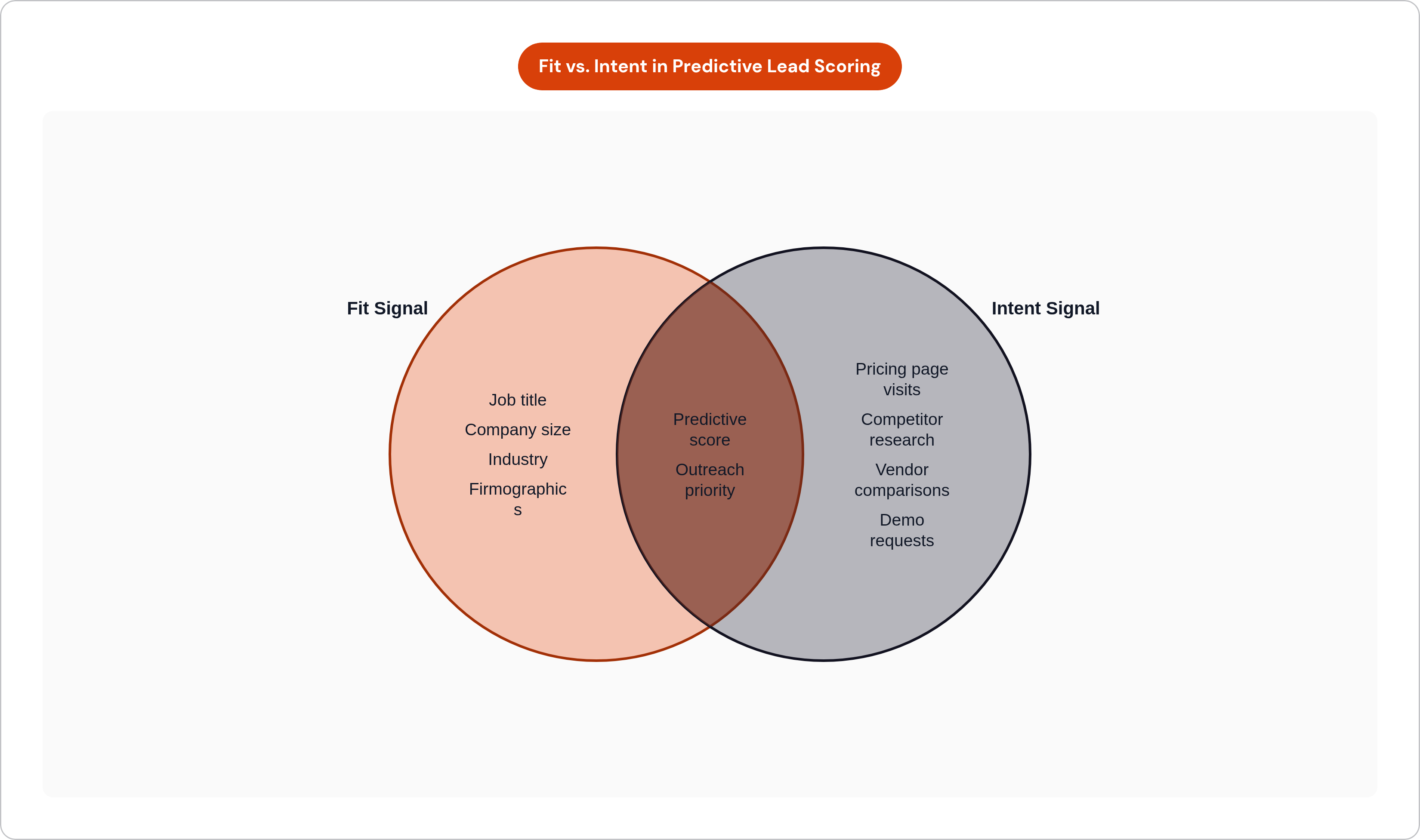
Fit tells you who's a good prospect. Intent tells you who's a good prospect right now, and outbound needs both, because a perfectly-fit account that isn't currently showing buying intent is, in practical terms, a worse target than a decent-fit account that's actively comparing vendors this month.
Intent signal comes in a few distinct flavors, and they don't carry equal weight. First-party behavioral signal, things like pricing page visits, demo requests, repeat downloads of the same case study, sits at the top of the confidence ladder because it's happening on your own property and you know exactly who did it. Third-party intent, tracked through networks like G2 or Bombora, tells you when an account is researching your category or reading a competitor's content. Weaker signal, since you're inferring intent rather than watching it happen directly, but still meaningful. Firmographic triggers (funding rounds, new executive hires, product launches, headcount growth) shift the likelihood of a purchase decision at the account level regardless of what any one individual is doing. Technographic signals, a tool getting installed or dropped, can flag that a problem just emerged that your product happens to solve.
Why does timing matter this much? A scoring model that only accounts for fit is blind to the difference between an account that's ready and one that's merely qualified. Two accounts can carry an identical fit score and be worlds apart in how receptive they'd actually be to a cold call this week.
The 2025 State of B2B GTM report, which surveyed 195 GTM leaders, found 45% plan to increase investment in intent-based outbound specifically. That's a meaningful chunk of an industry telling you where the practice is heading. A stated intention to invest isn't the same as a completed shift, granted, but signal-first outbound looks to be edging toward the default rather than staying a niche tactic for the handful of teams sophisticated enough to bother with it.
There's a sharper distinction buried in here too, between sensing and acting. A model that surfaces intent but still needs a human to review it and manually decide to do something is capturing maybe half the value on the table. The real leverage shows up when a score crossing a threshold triggers something on its own: a sequence starts, a rep gets pinged, a priority queue reorders itself without anyone touching it. That's also what separates a scoring tool from an actual outbound system.
It changes what the outreach itself sounds like, too. Cold outbound built on fit alone tends to lean generic, because there's nothing specific to say, while intent-triggered outreach gives a rep something concrete to reference: a job change, a funding announcement, a page visited three days ago. The personalization gets earned instead of performed.
How scores translate into an actual outbound workflow
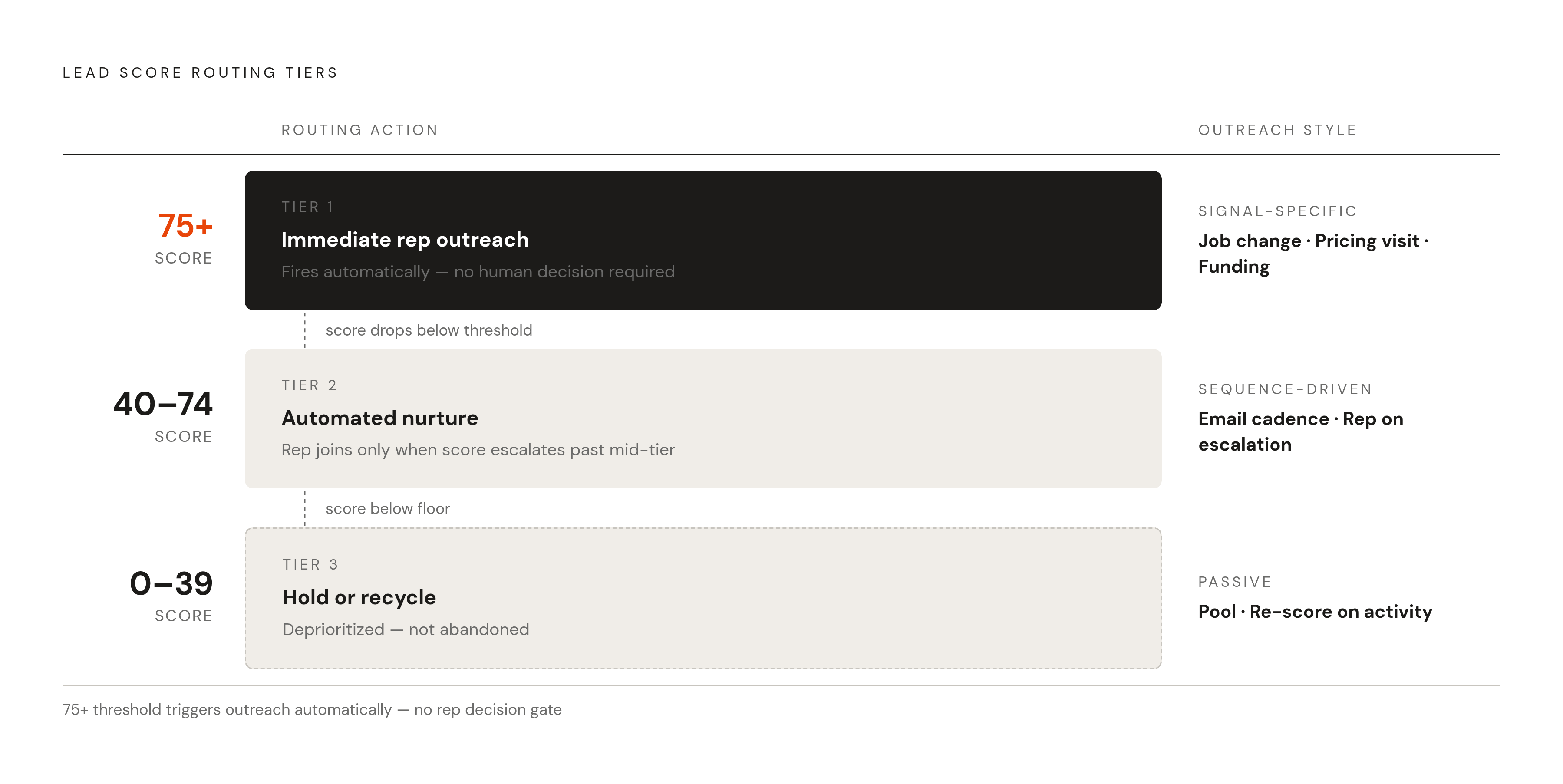
A score sitting in a dashboard that changes nobody's behavior is a reporting exercise, not a revenue motion. The real question is how lead routing works: what happens automatically when a number crosses a line, and what still needs a human's judgment stacked on top.
Tiering is the most common structural answer. Leads scoring above a high threshold, say 75 or up, go straight to a rep for immediate, personalized outreach that references the specific signal driving the score. Leads in a middle band, maybe 40 to 74, get folded into an automated nurture sequence built to collect more behavioral signal over time, with rep involvement kicking in only once a lead's score escalates past that mid-tier. Leads below the floor get held or recycled rather than dropped outright, deprioritized rather than abandoned, so rep time concentrates where the odds of a close are actually highest.
Threshold-triggered automation is what makes this run without someone re-checking the list by hand every morning. A score crosses a line, and a sequence starts or an alert fires, according to rules set up in advance rather than a fresh judgment call each time. That one mechanism removes a decision that would otherwise eat a founder's or a rep's whole morning: instead of auditing the full list, the score tells you where the next two hours belong.
The outreach at each tier should look different, and this is where a lot of teams under-invest even after they've built the scoring itself. High-tier outreach references the specific event that drove the score up: the job change, the pricing-page visit, the funding round. The score told the rep to call; the signal tells the rep what to actually say. Mid-tier outreach should stay lighter and more educational, built to generate the next behavioral signal rather than push for a meeting the lead isn't ready to take yet.
None of this works if the CRM and the scoring engine are separate systems that don't talk in real time. Scores need to live where the rep is already looking, updating alongside the activity history, not sitting in a side analytics tool that needs a second login and a mental translation step every time someone checks it.
B2B companies using predictive scoring models have seen lead-to-appointment conversion rates double and appointment-to-opportunity conversions increase fivefold. That lift concentrates in the top tier specifically, not spread evenly across the whole list, which is exactly what you'd expect if the mechanism at work is better allocation of a fixed amount of rep attention rather than some general bump in lead quality across the board.
Where the major scoring tools sit in 2025 and who each one fits
Picking a tool here isn't just a features question. It's a stage question, a budget question, and a workflow question, and getting it wrong is its own kind of expensive. A platform running $3,600 a month is not the right call for a 35-person SaaS company working through 400 leads a month, no matter how the scoring logic reads in the sales deck.
HubSpot rebuilt its lead scoring tool in August 2025, replacing the legacy version with something that supports multiple models at once and includes explainability, meaning it shows which specific signals drove a given score instead of handing back an opaque number and asking you to trust it. Manual scoring sits inside Marketing Hub or Sales Hub Professional, priced around $890 a month for three seats. The predictive version needs Enterprise, at $3,600 a month with a ten-seat minimum and a $3,500 onboarding fee on top. Fits teams already living inside the HubSpot ecosystem who want scoring native to the CRM they open every day anyway.
ZoomInfo Copilot launched in 2024 and expanded through 2025, layering AI-driven scoring and prioritization on top of ZoomInfo's existing B2B data asset, surfacing account insight and intent signal in the same place a rep already looks up contact info. Professional pricing starts near $14,995 a year, with Copilot's features gated behind the Advanced tier at $24,000-plus a year or Elite at $39,995. ZoomInfo reported in 2025 that teams using Copilot were closing deals at rates 41% higher than baseline; that figure comes from the vendor itself, so treat it as a claim worth weighing rather than something an outside auditor signed off on. Even discounted somewhat, though, the pricing alone puts this firmly in mid-market-and-up territory. A three-person founding team isn't the target buyer here, and probably shouldn't try to be.
6sense combines intent data, AI scoring, and account-based orchestration, and its 2025 additions brought generative AI into rep enablement and buyer-stage sequencing. Built for enterprise teams running long-cycle, multi-touch account-based marketing plays. More weight and complexity than most early-stage teams have any real use for right now.
Breadcrumbs runs a no-code scoring engine that blends demographic, behavioral, and firmographic inputs, with API support solid enough to let a team wire it into an existing stack without an engineering sprint eating up the roadmap. Fits lean teams that want to build and iterate on a custom model without a data science hire on the payroll.
Some platforms are built with founders and high-growth outbound teams specifically in mind, folding list building, intent monitoring, scoring-based prioritization, and sequence execution into one connected platform rather than making a team stitch together separate tools for data, scoring, and outreach. That consolidation matters most at the early stage, because it closes the manual handoff gap: when a score crosses a threshold, outreach fires from the same system, no export-import step, no second tool a founder has to remember to check between meetings. This approach suits founder-led teams that need scoring and execution to function as one motion, not two tools bridged by hand and hope.
Weigh these against each other long enough and the same tradeoff keeps surfacing: the most powerful tool on paper is rarely the right one. The right one integrates with whatever CRM and outreach stack is already in place, and it's whichever one the team will actually use to route decisions day to day, rather than glance at once a week and quietly forget exists.
What makes a scoring model degrade and how to keep it calibrated
Scores go stale when the business changes and the model doesn't keep pace with it. A new product line, a shift in ICP, a move into a new segment: any of these can leave the training data describing conditions that no longer match how deals actually close today.
A few tells are worth watching for. High-scored leads start converting at rates no better than the mid tier, a direct signal the model has lost its discriminatory power. The sales team quietly stops trusting the scores and drifts back to gut-feel routing; that's a behavioral signal in itself that something upstream has drifted, often well before anyone's run a formal audit to confirm it. Or the pipeline mix shifts meaningfully, a new market opens up, a new use case starts generating deals, with no corresponding update to the model that's supposed to be ranking those same leads.
Calibration is ongoing maintenance, full stop, not a one-time setup task. That means regularly checking win-loss outcomes against the scores the model assigned: were the deals it ranked highest actually the ones converting at a higher clip? It also means watching for signal dropout, which tends to happen quietly and without fanfare. A tracking script on the site breaks, or a third-party intent feed lapses, and the model keeps churning out scores with no obvious alert that one of its inputs went dark weeks ago. And it means expanding the training set as the win-loss log grows, since a model built on thin early data should get measurably sharper as volume accumulates, not stay frozen at whatever accuracy it started with.
There's a governance layer here too, and it matters at any company size, not just at enterprise scale. Autonomous scoring and routing systems need defined guardrails: scoped roles, limited permissions, a human checkpoint for anything high-value enough that a wrong automated call would actually cost something real. The framing that's taken hold in enterprise IT circles, that the guardrails matter as much as the technology itself, holds just as true for a ten-person team running its first scored outbound motion as it does for a Fortune 500 rollout.
What separates teams that keep their edge from teams that plateau after one good quarter comes down to whether scoring gets treated as a living system or a project that shipped once. Checking quarterly what the model got right and wrong, sharpening inputs, retraining as the win-loss log deepens: that's compounding work, and it pays out over time. Deploy it once and walk away, and a team gets one good cycle of lift before the model's assumptions quietly stop matching whatever reality has become.
What AI revenue agents add when scoring is already working
Scoring answers who to call. It doesn't answer who actually calls them, and that gap, between a prioritized list and outreach that's actually gone out the door, is where a lot of the manual labor in outbound still lives even after a decent scoring model is humming along.
An agent layer sits on top of the scoring itself to close that gap. A prospecting agent can watch intent signals continuously and surface new accounts the moment they cross a scoring threshold, no person checking the list by hand each morning. An outreach or sequencing agent can fire a personalized sequence the instant a threshold gets crossed, closing the lag that otherwise sits between a signal showing up and a rep finally getting around to it. A pipeline management layer can keep activity logged and current as deals move, so the CRM reflects what's actually happening rather than whatever a rep remembered to type in at the end of a long day, half-distracted, five minutes before logging off.
The agent layer builds on top of the scoring model rather than replacing it, and the score still decides who matters most right now. What the agent layer changes is the distance between that decision and the action that should follow it. For a founder or a lean GTM team working against a runway that isn't infinite, closing that distance is often worth as much as the scoring accuracy itself.