Pricing Page Visit Triggers for Outbound Sequences
Turning anonymous pricing visitors into leads requires the right tech stack and timing.

A pricing page visit is the closest thing B2B has to a raised hand, and yet most companies still treat it the way they treat a blog view: log it, maybe score it, move on. This piece is about what changes when you treat that visit as the specific, time-sensitive signal it actually is, and build a sequence purpose-built around the moment rather than bolting it onto a generic cadence. That means different timing rules, different message framing, and different step logic than anything you'd use for cold outreach. The rest of this piece walks through each of those pieces in order, starting with the fact that most of the people making that visit never tell you who they are.
Not all intent signals carry the same weight, and it's worth sorting them before we get further. A blog read or an email open sits at the low end: cheap to generate, cheap to fake, and mostly reflective of curiosity rather than commitment. A webinar attendance or a content download sits in the middle; someone spent ten or fifteen minutes on you, which counts for something. A pricing page visit sits at the top of the stack, because by the time someone reads pricing, they've already decided the category is worth their company's money. The "why now" question has been answered before they ever land on your domain. Your sequence only has to answer "why you."
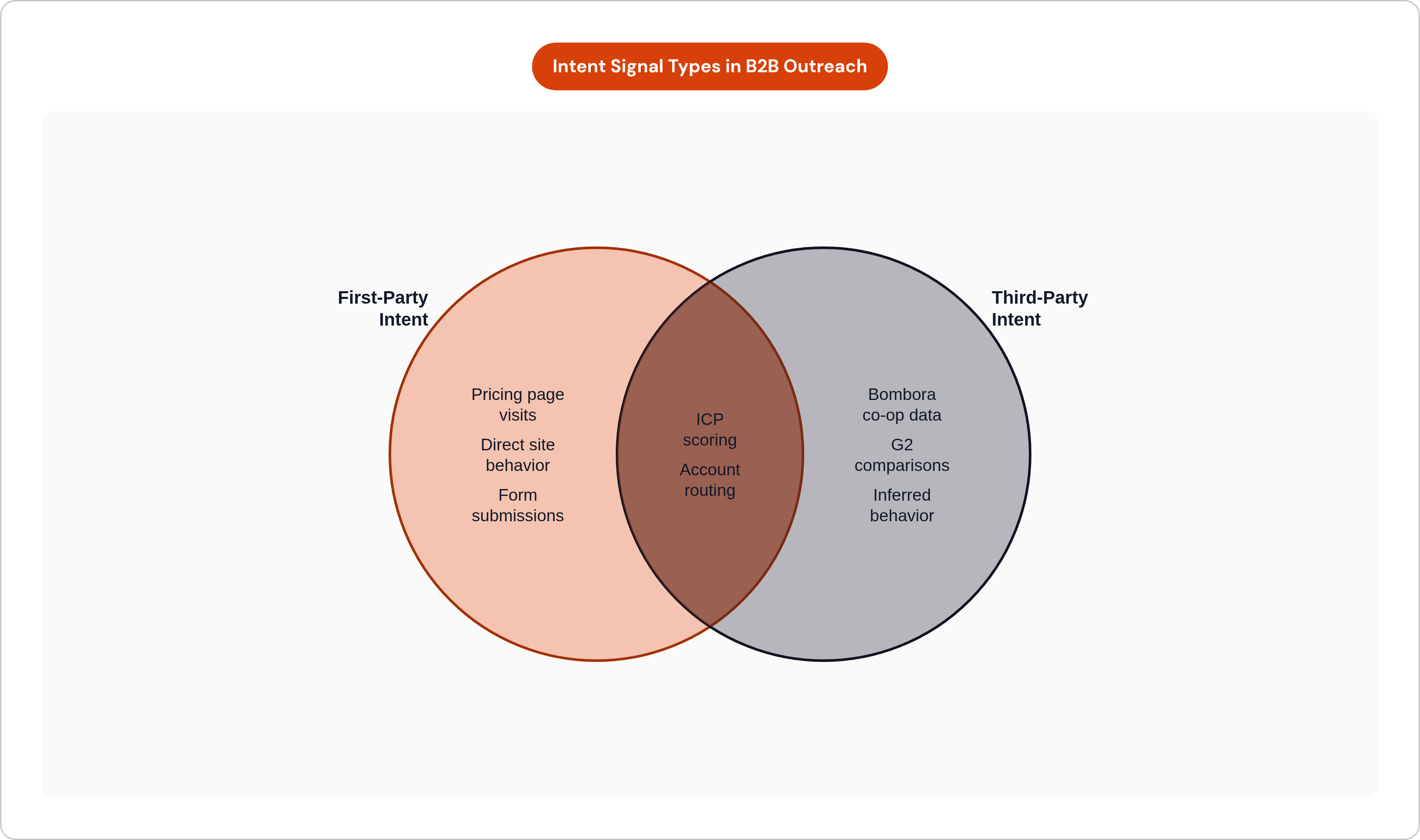
That's a meaningfully different job than what a cold sequence does. And it matters where the signal comes from, too. First-party intent, the kind generated on your own properties, is the highest-confidence layer available because you control the collection and no competitor has access to the same data. Second-party intent, like partner data or G2 comparison activity, and third-party intent, the co-op style data that vendors like Bombora aggregate across networks, both add breadth to your view of the market. But they carry more noise, because you're inferring intent from behavior you didn't directly observe. A pricing page visit on your own site skips all of that inference. It's about as close to a form fill as a B2B buyer gets without actually filling out a form.
This lines up with what we already know about how B2B buying happens. Most of the real decision-making, the researching, the shortlisting, the internal debate over which two or three vendors deserve a conversation, happens before anyone ever talks to a salesperson, in what analysts now call the dark funnel. By the time a prospect submits a demo request, they've frequently already formed a preference. A pricing page visit is a window into that earlier, more fluid stage, before the shortlist calcifies. HubSpot's internal rule, which treats two pricing page visits within a single week as a distinct trigger rather than scoring each visit identically, is a useful illustration of the underlying logic: behavior plus timing is the right unit of analysis, not behavior alone. One visit might be curiosity. Two visits in seven days looks like evaluation.
The identification problem: most pricing page visitors never identify themselves
Here's the catch that undercuts a lot of this in practice: the vast majority of B2B visitors to your pricing page will never fill out a form, and without dedicated tooling, they stay completely anonymous. You know traffic hit the page. You don't know who. That gap, between "someone from a company we can't name looked at pricing" and "here is the actual person, their email, and their LinkedIn," is the first problem any pricing-page trigger motion has to solve.
There are two resolution levels worth understanding, because they unlock different things. Account-level resolution uses IP lookup to identify the company, its domain, industry, and basic firmographics. It's useful for account-based scoring and for marketing attribution, both core to ABM programs, and it tends to have a higher match rate since you're only trying to identify a company, not a person. But it doesn't give you a contact, which means it can't drive outbound on its own. Person-level resolution, sometimes called de-anonymization, goes further, surfacing an actual name, email address, and LinkedIn profile using identity graphs and third-party cookie data. The match rate is lower, and coverage skews heavily toward US-based B2B traffic, but it's the only version that's directly actionable for an SDR trying to send an email.
On tooling, the trade-offs are fairly stark. RB2B does person-level identification, focused on US traffic, and pushes matches to Slack in near real time, which makes it one of the sharpest instruments available for SDR-led outreach on a lean budget; its free tier has narrowed to company-level resolution only, so the person-level layer now requires a paid plan. Warmly operates in a similar space but layers in ICP scoring and multi-channel trigger logic on top of identification, and it stacks several data providers together to push match rates higher than any single source could manage alone, at a meaningfully higher annual cost. A common pattern that's emerged is what you might call the power stack: an identification tool surfaces the visitor, Clay enriches and verifies the contact, and a CRM or sequencing platform fires the actual outreach.
Match rate isn't the only variable worth optimizing for, and this is where a lot of teams get the calculus backwards. A 30% match rate on person-level data that gives you a name and email is more useful than an 80% match rate on account-level data that only gives you a company name, if your entire motion depends on reaching a specific human being. Single-source providers also leave coverage gaps almost by definition, since no one data source resolves every visitor. Waterfall enrichment, cascading a contact through multiple providers until one of them returns valid data, closes a meaningful chunk of that gap. Before any of the sequence logic below matters, a team needs four things actually talking to each other in near real time: a visitor identification tool, an enrichment layer, a CRM connection, and a sequencing platform. If any one of those pieces lags or requires manual handoff, the timing advantage that makes this whole approach work starts to erode.
Why timing is the single variable that separates pricing-page sequences from cold outreach
Cold email reply rates have been compressing for years, a byproduct of inbox saturation and tighter spam filters that have made recipients faster to ignore anything that reads as templated. Signal-based outreach, particularly when it references a specific, real trigger, produces reply rates that run several multiples above that cold baseline. It's tempting to credit better copywriting for that gap, but the bigger factor is timing: you're reaching someone at the exact moment they're actively comparing options, rather than at some arbitrary point on a sending calendar.
But intent signals decay, a phenomenon sometimes called signal decay, and they decay fast. A pricing page visit today doesn't carry the same weight days from now, because in the intervening time, that same prospect may have already moved further down the evaluation process with another vendor. Lead response time is the metric that matters most here, and Tier 1 signals call for same-day contact. Tier 2 signals get a 48-hour window before urgency starts to matter less. This is the piece that most differentiates signal-triggered outreach from cold sequences, which can sit in a queue for a week without any real cost, since nothing about a cold list changes meaningfully day to day. A pricing page trigger doesn't have that luxury.
What does "reaching them before they've made up their minds" actually buy you? It means you're showing up while the shortlist is still being built rather than after it's locked, and that gives you a real shot at shaping how the prospect evaluates the category, not just responding to criteria they've already settled on somewhere else. Revisit the HubSpot two-visit rule here, because it's really making the same point from a different angle: a single pricing page view could be idle curiosity, someone forwarded a link, someone's doing competitive research for an unrelated reason. Two visits within a tight window looks like someone building a case internally.
So the design implication for the sequence itself is a real tension. The first touch has to fire fast, sometimes within hours, but the message can't read like it was generated the moment the trigger fired. If it feels automated or, worse, surveillance-adjacent, the speed that should work in your favor starts working against you instead.
How to tier and route incoming pricing page signals before the sequence fires
A pricing page visit is the trigger, but the raw visit alone isn't the verdict. Treating every visit identically, regardless of who made it, is how teams end up burning rep time on accounts that were never going to convert, and it's worth building at least three layers of scoring on top of the raw signal before anything fires.
Layer one is ICP fit: industry, company size, tech stack, hiring activity, geography. Layer two is account history. Is this a first-time visitor or a returning account? Do they already exist in the CRM? Has someone already reached out to them in the past quarter? Layer three is the visit behavior itself. A single page view is a different animal than someone who clicked through multiple pricing tiers, and both of those are different again from someone who read pricing and then went straight into documentation or a case study in the same session.
Signal stacking multiplies the confidence you should place in any of this. A pricing page visit from a company that's simultaneously posting a job for a revenue operations hire tells you something the visit alone doesn't. A visit from an account that's already sitting in an active CRM opportunity, especially one with multiple buying committee members visible in the CRM, calls for a different kind of response than a net-new signal, and that distinction is worth building into your routing logic explicitly.
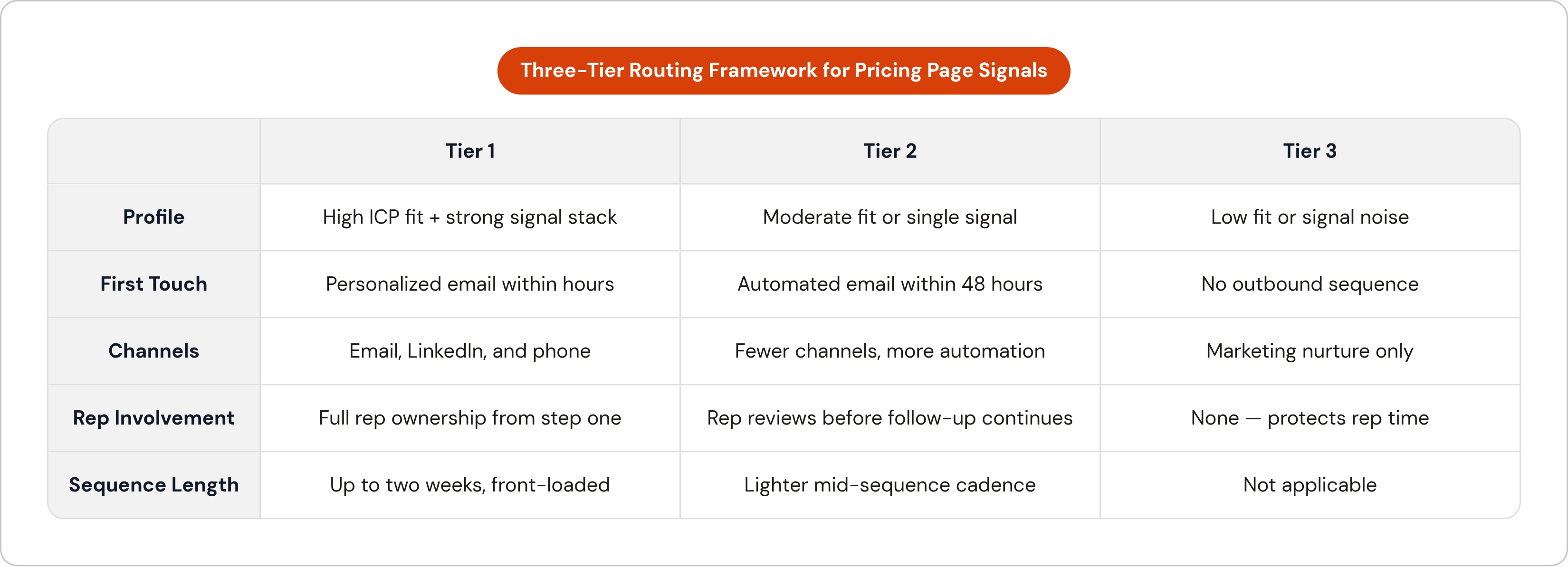
From there, a three-tier framework does most of the routing work. Tier 1, high ICP fit stacked with a strong signal combination, gets immediate rep notification, a personalized first touch within hours, and the full multi-channel sequence described below. Tier 2, moderate fit or a single isolated signal, gets an automated first touch within 48 hours, with a rep reviewing and accepting the lead before any follow-up steps continue. Tier 3, low fit or signal noise, doesn't get an outbound sequence at all; it goes to marketing nurture, which protects both rep time and sender reputation from accounts that were never going to close.
Routing to the right person matters just as much as the timing itself. If the account sits in an existing territory, the AE or the founder owns that outreach, not a cold SDR working a general queue. If it's net-new, it goes to whichever SDR or AI agent is assigned to that segment. And here's the failure mode worth naming directly: over-automating to the point where a Tier 1 account gets the same template as a Tier 2 account defeats the entire purpose of tiering in the first place. The whole value of a high-confidence signal is that it earns you permission to be specific. Waste that permission on a generic template and you've thrown away the advantage the signal gave you.
Designing the first touch: framing that uses the signal without weaponizing it
Here's the tension at the center of the first message: you know they visited the pricing page, but they have no idea you know that, and how you handle that asymmetry determines whether the email reads as helpful or unsettling. "I saw you visited our pricing page" is surveillance framing. It tells the prospect you're watching their behavior, which is true, but leading with that truth makes you sound like a vendor with a tracking pixel problem rather than someone who might actually be useful to them.
Two approaches hold up here. The first is the timing-neutral opener: you lead with a relevant pain point or a company-specific observation that would be true and relevant whether or not the visit ever happened. The pricing page visit informed the timing of your outreach and maybe the specific angle you chose, but the message itself stands on its own merit, independent of the trigger. The second is direct acknowledgment, used sparingly and only where the relationship or existing context makes transparency feel natural rather than invasive. "Noticed some activity from your team recently" can land fine, while something as pointed as "you visited our pricing page at 2:14pm on Tuesday" is likely to land poorly under almost any circumstance.
Whichever framing you choose, the first touch has one job: establish relevance immediately. Why this person, why now, why you and not the three other vendors also sitting in their shortlist. That means naming something specific about their company, their role, or their situation that a cold email couldn't have known, and closing with a next step that's small and time-bounded rather than the reflexive "let's hop on a call."
Subject lines follow the same logic. Personalized subject lines outperform generic ones by a wide margin, because specificity at the subject line signals that the body of the email was actually written for this person, not copy-pasted across four hundred sends. Reference the outcome the prospect appears to be evaluating, not the product feature you're most excited to talk about.
Length matters too, and it cuts the opposite direction from what you'd expect. These emails should run shorter than a cold outreach message, because the prospect is already in research mode; they don't need convincing that the problem exists. Three to five sentences with one clear ask is almost always a more respectful use of someone's attention than a five-paragraph company overview.
The step logic for a pricing-page trigger sequence: what changes across touches
Cold sequences build context slowly because there's no existing relationship to draw on; each touch has to earn a little more trust than the last. A pricing-page trigger sequence works differently: the context already exists the moment the trigger fires, so the sequence should use it immediately rather than working up to it over several emails.
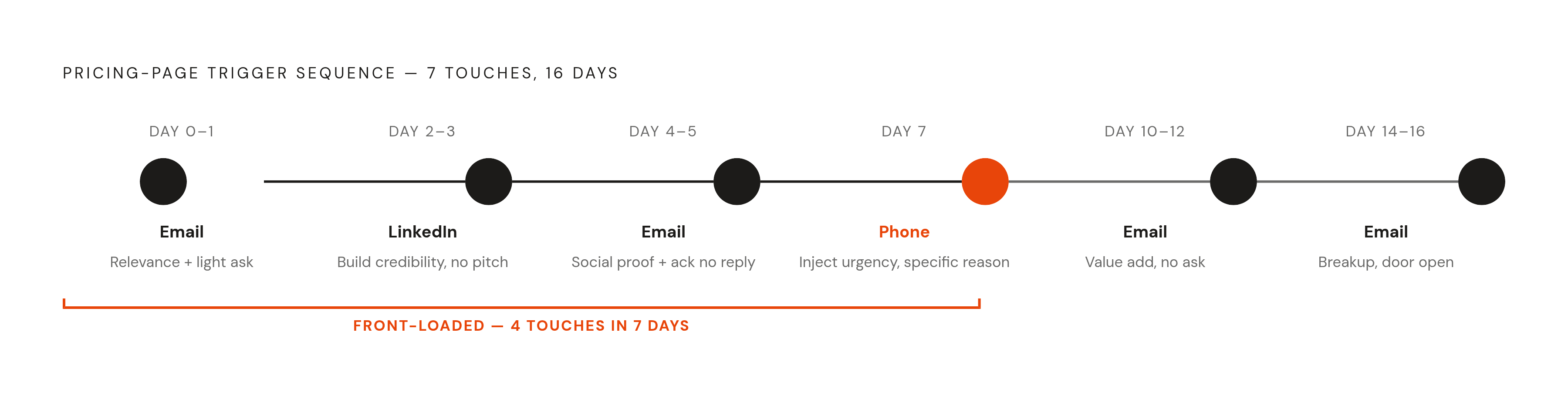
That changes the shape of the whole thing. Front-loading gets more aggressive, with more touches packed into the first week than a cold sequence would ever justify sending. Total length runs shorter too. If a high-intent account hasn't responded within a couple weeks, the window that made this a high-intent account in the first place has likely already closed.
A workable architecture looks something like this. Day zero or the next morning: a personalized email referencing specific fit or a specific pain point, no product pitch, just relevance and a light ask. Day two or three: a LinkedIn connection request with a short, non-pitchy note, which puts a face to the name and opens a second channel. Day four or five: a follow-up email that introduces a specific piece of social proof, a customer in their industry or a comparable use case, without turning into a hard pitch; acknowledge you haven't heard back without apologizing for the follow-up. Day seven: a phone call or voicemail, brief, referencing the earlier email, with a specific reason to talk now rather than a generic "just checking in." Day ten through twelve: a value-add touch, sharing a comparison guide or a short case study with no ask attached, which does more to position you as worth talking to than another pitch would. Day fourteen through sixteen: the breakup email, low pressure, acknowledging the timing might just be off, leaving the door open. These often generate replies precisely because they remove the pressure that's been building across the previous touches.
Multi-channel isn't optional for Tier 1 accounts. Combining email, LinkedIn, and phone produces response rates that no single channel gets close to on its own, because each one is doing a different job: email carries the content and the documentation, LinkedIn builds the relationship and the credibility, and the phone call injects urgency and an actual human voice into a sequence that otherwise lives entirely in text.
Tier 2 accounts get a lighter version. Fewer channels, more automation running through the middle of the sequence, with rep review kicking in only when someone responds or when day seven passes without one. And there are clean exit conditions that should pull an account out of the sequence immediately, no matter the tier: a response hands the account straight to a rep and halts automated steps; a booked demo ends the sequence entirely with a CRM update; an unsubscribe or removal request is a hard stop, logged, and flagged for a look at whether the ICP model needs adjusting.
Personalizing at scale without degrading quality: where AI agents earn their place in this motion
Here's the practical bottleneck underneath everything above: no founder and no single SDR can hand-write a genuinely personalized first touch for every pricing page visitor that clears the Tier 1 threshold, not once volume picks up. Teams without some form of automation tend to land in one of two bad places. Either they batch everything into a generic template, which defeats the entire point of a signal-triggered sequence, or they cherry-pick the accounts they have time for and quietly miss the rest. AI agents solve the personalization-at-scale problem without sacrificing specificity, but only if the underlying signal and enrichment data are actually clean; garbage enrichment produces garbage personalization no matter how good the model is.
There's a real, defined set of tasks an agent should own outright here. Monitoring the visitor identification feed and scoring it against ICP criteria. Pulling enrichment data, recent company news, job postings, tech stack signals, LinkedIn activity. Drafting the first-touch message using that context, referencing a specific, timely detail about the account rather than swapping a name into a mail-merge template. Scheduling and sending the subsequent steps according to the timing logic laid out above. And logging every bit of that activity back to the CRM in real time, so nothing sits in a spreadsheet somewhere disconnected from the rest of the motion.
Some things should stay firmly human, though. Defining the ICP tiers and the trigger thresholds is a strategic call the agent executes against, not one it makes. Reviewing first-touch drafts before they go out to Tier 1 accounts, or at minimum spot-checking a sample regularly, catches the kind of subtle misfire that a model won't flag on its own. And any live conversation, once a prospect actually responds, belongs to a person. The agent can get the meeting on the calendar; a human has to show up to it.
This is the design principle worth sitting with: one connected platform handling list building, enrichment, sequencing, and CRM sync closes the timing gaps that kill this motion, while splitting those functions across four disconnected tools reintroduces exactly the lag that made cold outreach ineffective in the first place. And the risk on the other end is just as real. An AI agent running without a specific, well-defined play recreates the cold email problem at higher speed and higher volume, generating outreach that reads as generic because nobody bothered to define what "specific" should mean for this motion. Intent data and agent-driven outreach are both still early in B2B adoption. That's exactly why building this now, carefully, with the tiering and timing logic actually thought through, is worth the effort. The teams that get the mechanics right before this becomes standard practice are the ones who'll still be getting outsized reply rates once everyone else catches up.