Hiring Signal Outbound: Using Job Posts as Buying Triggers
Job postings reveal budget decisions weeks before traditional intent data catches up.

Job postings tell you what a company already decided to do with its money, weeks before that decision shows up anywhere else. A requisition on LinkedIn is a budget line that already cleared internal approval, and the teams that read it right get to the buyer before anyone else does.
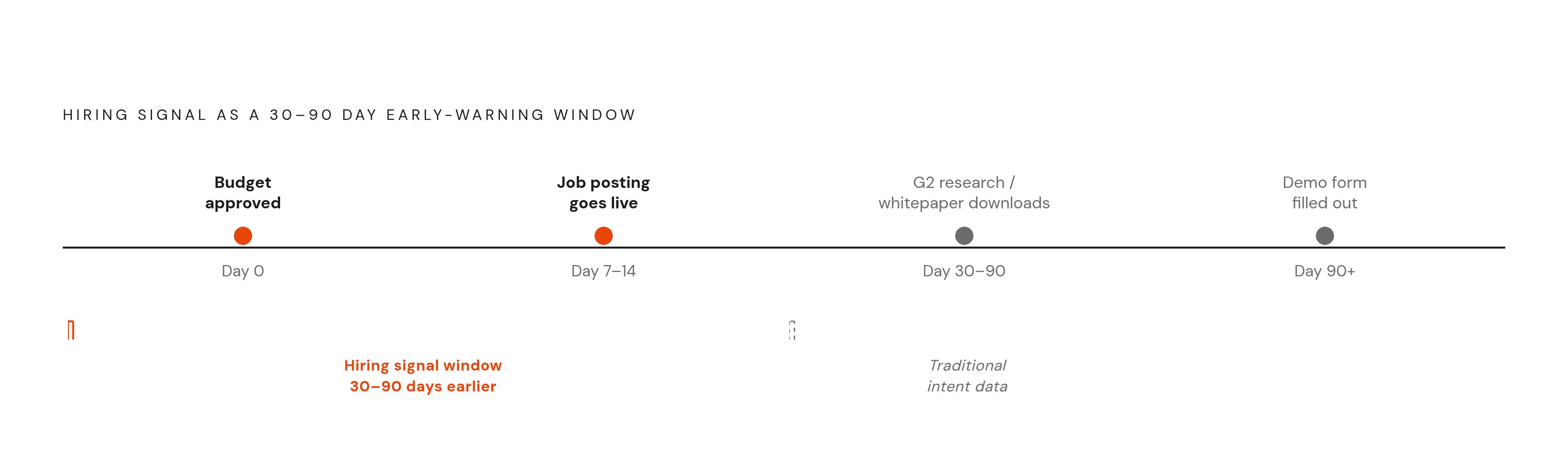
Most of what the industry calls "intent data" captures behavior already underway. Someone visits G2, downloads a whitepaper, spends four minutes on a pricing page. Fine signals, sure, but they describe research in motion, not a decision that's already been made. A job posting works differently, because nobody opens a requisition for a new SDR or a VP of RevOps without a budget conversation happening first, and that conversation usually wraps well before the posting goes live. Companies don't commit headcount dollars on a whim; the approval chain behind a new role, especially a net-new one, moves slower and more deliberately than a marketing team's content calendar ever does.
A posting often surfaces the buying window thirty to ninety days before that same account shows up in review-site data or fills out a demo form. And unlike most intent signals, which tell you an account might be in-market, a hiring signal tells you who to contact. It names a function, sometimes a level, occasionally the exact problem the new hire exists to solve. Research consistently finds that whichever vendor is already in a buyer's head on day one of an evaluation wins the deal the large majority of the time, a first-mover advantage that compounds once a shortlist forms. Arriving before evaluation starts isn't a nice-to-have edge. It's close to the entire game, and everything below is really just working out what that means in practice.
What specific roles actually signal, and how to read the difference between noise and conviction
A company always has some hiring going on somewhere. The skill is telling maintenance apart from a strategic shift, and most false starts in this playbook happen right at that fork.
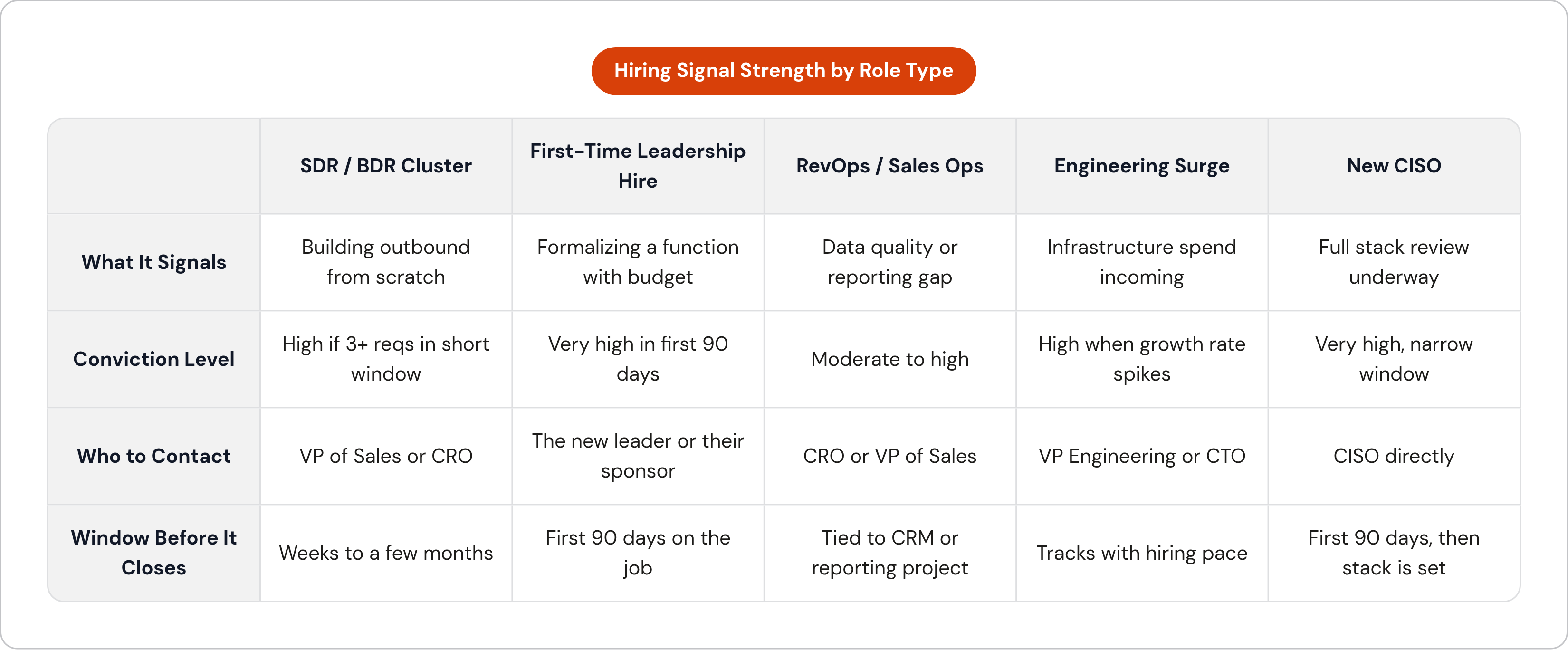
Take SDR and BDR postings. One opening for a single rep is normal churn, someone left, or the team's padding out. A cluster of SDR postings in a tight window is a different animal, and it usually means a company is standing up outbound as a function for the first time. Watch for the phrase "first SDR" specifically. That single line means the sequencing tool, the dialer, the prospecting data source, none of it exists yet, and the buying decision is close rather than theoretical. Pace matters as much as the title; three SDR reqs in two weeks says something that one req sitting open for three months does not.
First-time leadership hires carry similar weight, maybe more. A role that's never existed at a company before is a formalization event, someone deciding a function needs a real owner instead of getting handled part-time by whoever's closest to it. UserGems found that new Director and VP-level buyers convert at notably higher rates in their first few months on the job than a year in, and that new buyers spend most of their tooling budget in that early window. Combine a new VP of Sales with open SDR reqs on the same team and you've got a leader who inherited both a mandate and an infrastructure gap on day one. The clock started the moment they signed.
RevOps and Sales Ops hires point somewhere specific too. A posting that mentions cleaning up CRM data or building reporting from scratch is, functionally, a data-quality buyer announcing itself in public. Engineering surges run on the same logic but for infrastructure; rapid headcount growth there tends to precede spend on compute, CI/CD, monitoring, security tooling, and the rate of growth matters more than the raw headcount. A company going from twelve engineers to twenty in a quarter is telegraphing something different than one that's added two a year, steadily, for three years running.
Security hires deserve their own mention. New CISOs review the existing security stack in their first ninety days, close to always, and that window is the outbound play. Miss it and the stack review's probably done, budget already committed somewhere you're not.
Then there's the case where no single posting maps cleanly to your buyer, but the department's overall hiring velocity spikes anyway. A sharp jump in sales-function hiring, even spread across roles that don't individually scream "buyer," still signals a scale-up. The trend line beats any one data point on its own. Worth remembering before writing off an account because no single req looked promising.
Where to find job posting signals without an expensive data contract
None of this sits behind a paywall, which is the reassuring part. LinkedIn, Indeed, Glassdoor, individual careers pages, Google's jobs index: all public, all free. Reading job ads as buying signals isn't proprietary knowledge. It's attention, applied to something sitting in plain sight that most people scroll past.
Clay has become something of a default starting point, mostly because it indexes a large volume of LinkedIn job posts and lets you query that data without burning enrichment credits on every account you check. A typical workflow: match postings against a set of pain keywords, dedupe by company domain so you're not working the same account five times, enrich the decision-makers, then run an AI qualification pass asking something like whether the description implies they're building in-house outbound for the first time. It's cheap and it works, mostly. Accuracy has slipped some lately, though. Posting delays and abandoned searches introduce lag into the data, so a manual verification pass before sending anything isn't paranoia, it's just good hygiene.
On the paid side, platforms built specifically to track job movement, like LoneScale, trigger outbound campaigns off new postings automatically. ZoomInfo folds job posting data into its Copilot product alongside intent signals, earnings transcripts, relationship intelligence. Those earn their spend once volume, or the need to layer multiple signal types, actually justifies the cost. Not before.
Signal decay is the real risk here. Postings go live weeks after the internal decision got made sometimes, and they often stay posted well past a hiring freeze, or after the role's already filled. That produces false positives. Treat a job posting as one layer in a stack, never a standalone trigger in a trigger-based outreach program you fire blindly. For founders and early go-to-market teams, the free sources are exactly the right place to start; paid tools earn their keep once the motion's proven and the volume outgrows what a human can track by hand.
Mapping signals to your ICP so outreach goes to the right person, not just the right account
The mapping principle is simple: the closer a posting sits to the actual buying decision for your product, the stronger the signal. Everything past that is a matter of degree.
Sell outbound or sales engagement software? SDR, BDR, and RevOps postings are your strongest tell. Sell HR tech? CHRO and People Ops roles carry the weight. Security vendors watch CISO and security engineering postings. Infrastructure and DevOps vendors watch engineering growth rate more than any single title. The category you sell into decides which roles you scan for as part of your ICP definition, not the other way around.
Read the job description itself closely, not as a skim. JDs name tools, sometimes as requirements and sometimes as "nice to haves," and that list is a technographic data point sitting right there in plain text. "Experience with Salesforce and Outreach" tells you the current stack. A responsibilities line reading "build outbound sequences and cadences from scratch" is a prospecting-tool buyer describing their own problem before you've said a word to them.
Once you've found the signal, the harder question is who actually gets the email. This is where a lot of otherwise solid hiring-signal programs fall apart: teams find the right account, then default back to whoever's sitting on the generic contact list, and the whole signal evaporates on contact. Match it to the likely economic buyer within the buying committee instead. A VP of Sales posting several SDR roles means you talk to the VP of Sales, not the recruiter who typed up the listing. A first-ever Head of RevOps hire means the sponsor, probably the CRO or the VP of Sales who pushed for that headcount, is the one who actually feels the pain the hire is meant to fix. The signal only pays off if it reaches the person whose problem it describes.
Turning a job posting into the first sentence of an email that earns a reply
Here's the most common failure in this playbook: teams use the hiring signal to build the list, then send the exact email they would've sent anyway. The signal filtered who got contacted. It never touched what got said, and that's a wasted signal.
The message has to change, not just the segment. Good signal-based messaging references the pattern behind the hiring activity, not the posting as a document. It shows the recipient you understand what this decision means for their next ninety days, and it makes the timing of the email obvious without spelling it out. The buyer should feel, almost instinctively, why this note landed now and not three months from now.
A few things reliably kill this kind of email before it gets read past the first line. Opening with "I saw your job posting for..." reads like a job applicant, not a peer who gets the business. Referencing a single junior-level opening is a tell too; one associate-level req isn't a real signal, and an experienced buyer clocks the reach immediately. Describing the signal without connecting it to a specific pressure just restates public information back at them. That's not insight. It's a mirror, nothing more.
The stronger version names the pattern directly: "Looks like you've brought on a VP of Sales and opened a handful of roles under that team." Then it names the pressure that pattern implies: "That usually means the new leader's on the hook for coverage and ramp time before the next board update, probably before they've even finished building the team." Only after that framing does the product get mentioned, and by then it's earned its spot, because the context already did the work. Digital Bloom found that timeline-based hooks, messages anchored to something happening in real time, roughly double the reply rate of generic problem-focused openers. Martal Group's 2025 cold email study landed somewhere similar, with personalized messages beating generic outreach by a wide margin on replies. The goal isn't cleverness. It's specificity the recipient can feel, the sense that this message could only have been written for them, this week, and not lifted from a template with their name dropped in.
Sequence structure that keeps a hiring-signal play alive past the first touch
A hiring signal earns a more aggressive sales cadence than a cold list gets, because the window it opens is real, and it's closing on a clock you don't control. Treat it like a standard cold sequence, one email and a slow trickle of follow-ups, and you waste the urgency the signal was supposed to buy you.
Higher touch count is the first adjustment. Raising volume without changing substance just annoys people faster, though, so each touchpoint needs a genuinely new angle on the underlying signal rather than a "bumping this to the top of your inbox" rewrite. Multi-channel helps too, when the signal's strong enough to justify it: email plus a LinkedIn connection request referencing the same hiring pattern, plus a call attempt if there's real heat behind the account.
A reasonable structure looks something like this. Day one, a signal-anchored email using the framing above. Day three or four, a LinkedIn connection request with a short, no-pitch note acknowledging the direction the company's heading. Day seven or eight, a follow-up that advances the argument, maybe pulling a specific line from the job description or a comparable customer case. Day fourteen, a different angle entirely: a short question, a relevant piece of content, a brief call attempt. Day twenty-one and beyond, either a breakup email or a shift into longer-term nurture, depending on how much the account actually matters to you.
Layering other signals on top changes the math considerably. If the same account also just raised a funding round, swapped out part of its tech stack, or brought on a new executive alongside the hiring signal, that account jumps the queue and the timeline compresses. Multiple overlapping signals usually mean the window's wider than any single signal would suggest, and closing faster at the same time; both things are true, oddly enough. Recency matters throughout: signal decay is real, and a posting from six weeks ago for a role that might already be filled is a weak trigger by the time you get around to it, so prioritize what's fresh over what's merely relevant. Research consistently finds that a large majority of B2B buyers actively avoid suppliers who send irrelevant outreach. Mistimed or off-target follow-up doesn't just get ignored. It tends to close the door for good.
Layering hiring signals with other buying triggers to build a prioritization system
A hiring signal alone is useful. Layered against other signals firing on the same account, it turns into something closer to a conviction score.
A few combinations are worth watching. A hiring surge paired with a recent funding round usually means fresh budget landed and headcount's expanding in the same direction; technology evaluations tend to follow within weeks. A new VP of Sales arriving alongside open SDR postings means mandate plus infrastructure gap, about as acute as this gets. A hiring surge paired with a technographic change, some new tool showing up in the stack, means a company's actively building a function and already spending on the pieces adjacent to it. And a hiring pattern lining up with something said publicly, an earnings call comment or a strategic pivot in a press release, means the company already announced its direction and is now staffing to make it real.
Prioritization follows from that naturally. When several signal types fire on the same account inside a short window, move it to the top and shrink the time between touches. Beyond hiring, the signal types worth tracking alongside it include funding and M&A activity, tech stack changes, leadership turnover in your target persona, review-platform engagement, and, for public companies, earnings calls and SEC filings.
What this produces is a ranked account prioritization list rather than a flat one. High-conviction accounts get the personalized, aggressive sequence described above; lower-signal accounts get lighter, more automated touches that don't burn a rep's time chasing a maybe. AI-powered revenue platforms that combine list building, signal monitoring, and sequencing into one system let smaller go-to-market teams run this kind of layered prioritization without stitching together five separate tools by hand. Speed to signal is the actual differentiator here, not a slide in someone's deck.
How AI agents operationalize hiring-signal outbound at a pace humans can't maintain manually
The manual version of all this has a hard ceiling, and it's worth being blunt about where that sits. Watching job boards daily, mapping every posting back to an ICP, enriching the right contact, writing a genuinely personalized first line, timing follow-ups correctly across dozens of accounts at once: that's more than one rep, or honestly most small teams, can sustain week over week without something slipping through the cracks.
AI agents change the shape of the work rather than just speeding up the old version of it. Continuous monitoring is the first piece. An agent watches for new postings matching a defined set of criteria across sources around the clock, so nothing depends on a rep remembering to check LinkedIn before coffee. When a qualifying signal fires, enrichment happens automatically too, pulling the right contact and the relevant context together before a human even opens the record.
The personalization step matters most, because personalization at the volume hiring signals demand is exactly the bottleneck that breaks most manual programs somewhere around month two. An agent can draft a first-touch email using the specific pattern in a posting, the implied pressure on the new hire, and the relevant product angle, before a rep's spent a minute on it by hand. That doesn't replace judgment; someone should still read what goes out before it lands in an inbox. But it collapses the gap between when a signal appears and when a genuinely relevant message reaches the right person. That gap, going back to where this piece started, is the entire advantage this approach is built on.