Account-Based Marketing in B2B Outbound Campaigns
Account selection and timing matter more than outreach volume or personalization.

Account-based marketing takes B2B outbound out of the volume business entirely. Instead of asking how many contacts you can reach this quarter, it asks which accounts are worth winning and what it would actually take to win them. That distinction sounds small on paper, but it changes almost everything downstream: how lists get built, how outreach gets sequenced, and how sales and marketing decide to spend their time.
The old model is familiar to anyone who's run outbound for more than a year. Big lists, templated sequences, SDRs burning hours doing research one contact at a time before firing off the same email with a name swapped in. It was a motion built for scale, optimized to maximize how many people got touched rather than whether the right people got touched. And for a while it worked well enough that nobody questioned the logic underneath it.
Then a few things broke at once. Buyer tolerance for generic outreach collapsed; inboxes filled with AI-generated noise that made even decent copy invisible; deliverability penalties turned high-volume sending into a liability rather than an asset. The failure wasn't a lack of effort. The targeting logic was broken: when the account selection is wrong from the start, no amount of personalization downstream fixes it. That's the problem this piece is built around, and it's the thread running through every section that follows: account selection, buying group mapping, outreach sequencing, and the feedback loops that make each cycle sharper than the last.
What account-based marketing actually means in a B2B outbound context
ABM flips the funnel. Traditional outbound starts wide and filters down; ABM starts with a defined, named set of target accounts and builds the campaign inward toward them. The structural difference is resource concentration instead of resource distribution: you're not trying to reach everyone in a category, you're trying to win a shortlist you've already decided matters.
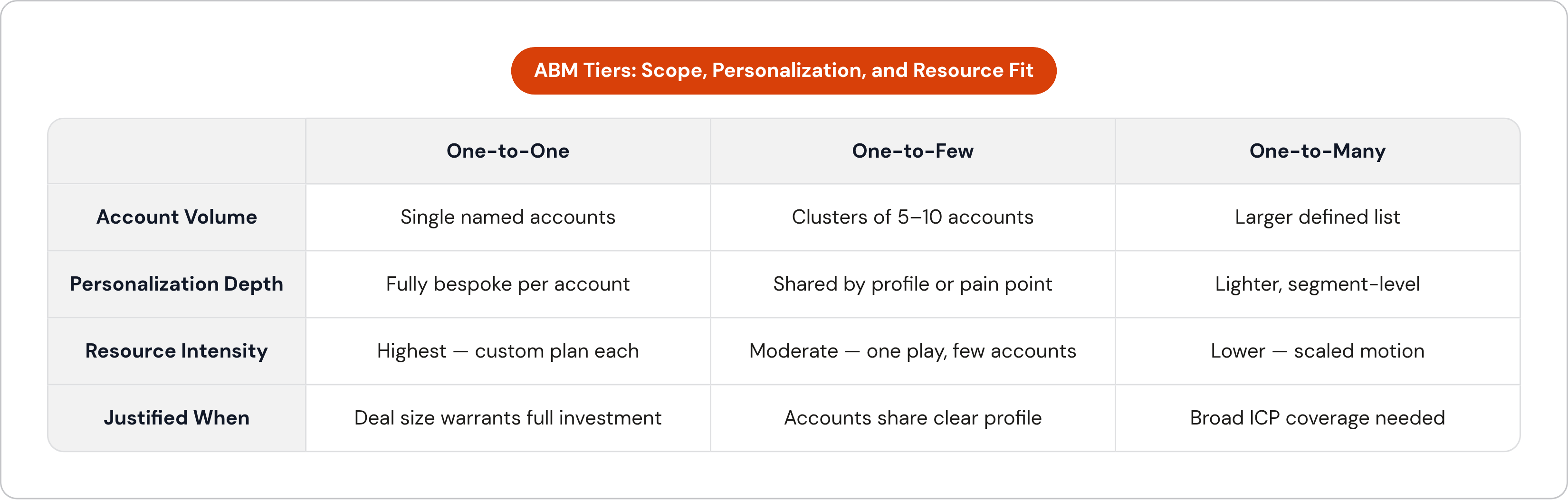
Most practitioners break ABM into three tiers, and the distinction matters because it changes what "personalization" is allowed to cost. One-to-one ABM is fully bespoke, reserved for a small number of named strategic accounts where the deal size justifies a custom plan for each one. One-to-few clusters accounts that share a profile, an industry, or a specific pain point, so a single play can serve five or ten accounts at once. One-to-many is scaled ABM, lighter personalization spread across a larger list; it looks closer to traditional outbound, but it's still anchored to specific accounts rather than a generic segment.
Mapped onto outbound specifically, the "campaign" stops being a calendar artifact and becomes an account engagement plan. Outreach gets timed around account signals, a funding announcement, a leadership hire, a spike in pricing page visits, rather than a Tuesday send schedule. That's a real shift in how a marketing calendar gets built.
Worth being precise about the boundaries here. Inbound with better targeting bolted on doesn't qualify as ABM. Spray-and-pray at the account level instead of the contact level doesn't either, which is a trap teams fall into when they think ABM just means smaller lists. And a tool purchase doesn't make an ABM program; the model is a coordination structure between sales and marketing that determines how attention gets allocated across the whole funnel, not just at the top.
The adoption numbers tell the real story here. Roughly three-quarters of B2B companies say they've adopted ABM, but a much smaller slice, under a fifth, report having a fully developed strategy behind it. That gap is the whole ballgame. Most teams are running ABM in name, checking a box that says "account-based" on a slide, while still executing something closer to old-model outbound underneath. The performance difference between the companies seeing real returns and the ones seeing none doesn't live in the adoption number. It lives in that maturity gap.
How to build a target account list that selection can actually defend
Here's where most ABM programs quietly fail before they ever send an email. The account list gets built on gut feel: sales reps nominate their favorite logos, marketing pulls a loose approximation of the ICP, and nobody can articulate why account 47 made the cut while account 48 didn't.
A defensible list needs three layers working together. Firmographic fit covers company size, industry, revenue band, headcount, geography, the basics that define whether a company even resembles your ideal customer profile. Technographic fit looks at what's already in the account's stack; the tools a company runs signal workflow maturity and, often, spend capacity. Behavioral fit is the layer that tells you timing: is this account showing signals of active need right now, or does it just look good on paper?
Data quality is the structural obstacle nobody likes talking about. A meaningful share of B2B marketers, over four in ten by some counts, name unreliable data as their primary challenge in choosing targets. A beautifully designed ICP framework is worthless if the enrichment behind it is stale or wrong. This is the part of ABM that's unglamorous and gets skipped, and it's exactly the part that determines whether everything built on top of it holds up.
The signal layer is what separates a good list from a timely one. Static firmographics tell you an account could be a fit. Real-time intent data signals, pricing page visits, a job change at the VP level, a hiring spree in a relevant department, competitor research activity, tell you an account might be a fit right now. That distinction between "fits our profile" and "is in-market this quarter" is the difference between a list that converts and a list that just looks organized.
Once the list exists, it needs tiering. Not every account earns the same spend; stratify by revenue potential, fit score, and signal strength, then assign resources accordingly. The accounts that clear all three bars get the one-to-one treatment. The rest get folded into clusters or scaled motions.
There's also something data tools don't fully capture, especially at early-stage companies: founder pattern recognition. Founders who've been in enough sales calls develop an instinct for which accounts will close that no enrichment platform will surface on its own. The best lists blend the signal layer with that institutional knowledge rather than treating either as sufficient alone. A useful checkpoint, and it's a blunt one: if you can't say in one sentence why a specific account made the list, take it off.
Why buying groups, not individual contacts, are the right unit of engagement
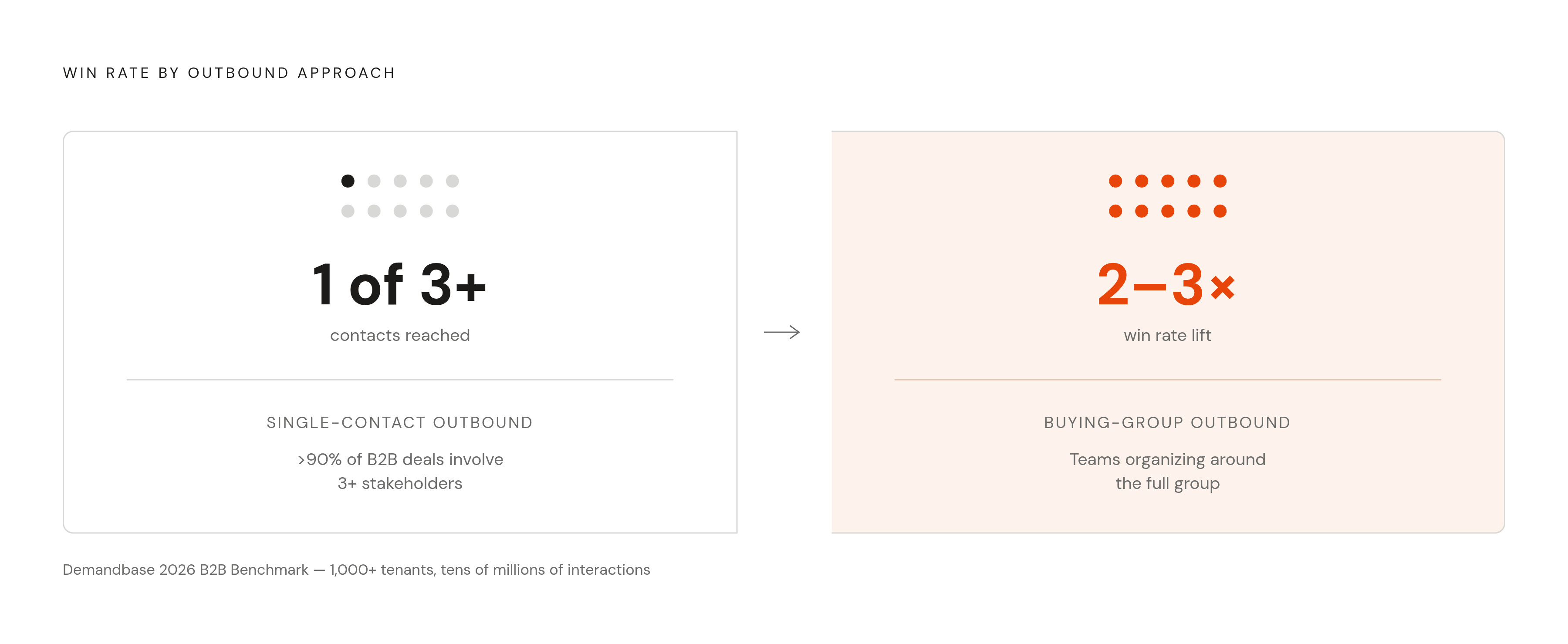
B2B purchases aren't made by individuals. They're made by committees, and the data backs this up more emphatically than most marketers assume: Forrester has found that the overwhelming majority of sellers, north of 90%, sell to groups of three or more stakeholders, and a notable share sell to groups of ten or more. That's not a niche enterprise phenomenon; it's the norm.
Which means single-contact outbound is structurally fragile even when it's executed well. You can write the perfect email to a champion, get them excited, and still lose the deal because the economic buyer never heard from you, legal wasn't looped in, or a competing internal voice filled the silence you left behind. A perfect pitch to one person in a ten-person buying group is still, mathematically, a pitch to one-tenth of the room, which is exactly the problem multi-threading is designed to solve.
Demandbase's 2026 benchmark study, built from over a thousand tenants and tens of millions of marketing and sales interactions, found that teams organizing their execution around buying groups rather than individual leads see win rates run two to three times higher. That's not a marginal lift. That's the kind of number that should make anyone still running contact-by-contact outbound stop and reconsider the unit of analysis they're working with.
Mapping the buying group has to happen before outreach starts, not as an afterthought once a deal stalls. Identify the economic buyer, the champion, the technical evaluators, and anyone who might quietly block the deal. Understand what each one actually cares about, because it's rarely the same thing: the economic buyer wants ROI, the technical evaluator wants to know implementation won't be a nightmare, and someone in the room is probably worried about vendor stability more than anything else. Sequence engagement so the champion has air cover, internal validation and material to work with, before you approach the economic buyer directly.
This is also where sales and marketing either work from the same map or don't. If each function keeps its own contact list, siloed and unshared, the outreach fragments across the buying group; one stakeholder gets a pitch about ROI while another gets a pitch about features, and nobody in the room hears a coherent story. Every touchpoint in an account-based motion should be calibrated to a specific stakeholder's role and stage, not blasted out as one uniform sequence to everyone whose email address you found.
Building the outreach sequence: channels, timing, and personalization at the account level
Three channels carry the weight in ABM outbound: email, LinkedIn, and phone. None of them wins alone; combined and sequenced with intent, they consistently produce more meetings than any one channel run in isolation.
Each channel has a job. Email establishes context and leaves a paper trail, useful for the initial framing and for follow-ups that need to carry real substance. LinkedIn works as the relationship layer, running in parallel: engaging with someone's content, sending a connection request, following up with a DM that references something specific. Phone gets reserved for high-signal moments, not used as a first move. If an account has opened multiple emails or visited the pricing page, that's a signal worth a direct call; calling cold into an account that's shown zero engagement is closer to the old spray-and-pray model than anyone wants to admit.
Timing matters as much as channel choice. Most responses land within the first several touches, and the evidence points to somewhere around six to eight touchpoints spread over two to three weeks as the window where returns are strongest. Push past that window and the returns drop off sharply; a fifteenth touch to an unresponsive account is rarely the one that lands.
Personalization is the actual differentiator ABM is supposed to deliver, and it's also the part most teams get lazy about. Dropping a first name and a company name into a templated sequence amounts to mail merge with better branding, not personalization. Real personalization means referencing something specific to that account: a recent funding round, a new VP hire, a product launch, a pain point that's common across that ICP segment but stated in language specific to their situation. If the account selection work in the earlier section was done properly, this is where it pays off, because you already know why that account is on the list, which gives you something concrete to write about.
AI agents earn their place here, and it's worth being specific about what they're actually doing well. They can run multi-step research tasks, pulling recent news, identifying decision-makers, surfacing technographic data, at a speed no human researcher will ever match doing it by hand. But the output still needs a human layer. Founders and reps should be reviewing and sharpening what the agent produces, not shipping it straight through; the strongest outreach blends AI-sourced context with a person's editorial judgment about what's actually worth saying.
This approach uses distinct AI revenue agents, each assigned to a specific task, research, enrichment, sequencing, CRM sync, rather than one general-purpose agent trying to do all of it at once. Each agent runs a well-defined play inside the larger account motion, which keeps the work legible; you can tell exactly which agent did what and why.
One infrastructure note that gets skipped too often: none of this works if deliverability is broken. High-volume sending at the account level still requires clean domain infrastructure and warm sending practices to protect sender reputation. A beautifully personalized email that lands in spam because the sending domain got flagged is a wasted research investment. Personalization gains get erased before they ever reach the inbox if the infrastructure underneath isn't solid.
What ABM actually produces when it works: the ROI case
The headline number gets cited constantly: companies running ABM have reported revenue increases north of 200% in marketing-generated revenue over a three-year window. That's a real number, and it's worth taking seriously, but it needs immediate context. It's a ceiling reached by mature programs running for years, not a guarantee handed to anyone who launches an ABM motion this quarter. Treating it as a day-one benchmark sets teams up to feel like failures at month three.
Other markers are worth naming alongside it. A majority of B2B marketers, close to six in ten, report seeing larger deal sizes once they shift to ABM, which tracks with the logic of the model: precision targeting naturally surfaces accounts with more spend capacity than a wide net does. RollWorks has found that pipeline velocity for ABM-targeted accounts runs more than twice as fast as for accounts reached through generic tactics.
That deal size effect matters more for high-growth companies than the topline revenue number does. One well-won enterprise contract can de-risk an entire quarter in a way that fifty small deals, chased at the same cost in time and attention, simply cannot. That's not a minor point; it changes how a growth-stage company should think about where its limited sales capacity goes.
There's a pipeline quality story here too. At mature ABM programs, the large majority of sales opportunities, close to eight in ten, trace directly back to ABM activity. That's the tell that ABM eventually stops being a supplemental motion running alongside everything else and becomes the primary pipeline engine for the business.
But here's the honest caveat, and it's an important one: only a minority of ABM users, around 40%, report that the model actually shortens their sales cycle. Read that carefully. It doesn't mean ABM fails to shorten cycles for most teams; it means most teams can't yet prove whether it does, because they haven't built the measurement infrastructure to attribute pipeline movement back to specific account plays. The performance numbers cited above come from programs that solved measurement first. Teams that skip that step will struggle to prove the model is working even in cases where it demonstrably is.
What does this mean if you're early-stage and don't have three years of ABM data to point to? You don't need a mature program to see lift. Even a disciplined one-to-few motion, tight ICP, real buying-group mapping, will produce measurably better conversion than volume outbound almost immediately. The ceiling numbers are aspirational; the floor is achievable fast.
Where AI agents fit in an ABM motion — and where they don't
Adoption of AI in sales organizations is nearly universal at this point, north of 85% by most counts. But there's a sharp drop-off when you ask how many of those organizations run agentic workflows, the autonomous, workflow-driving kind that actually replaces manual steps rather than just assisting with a draft. That number sits closer to a quarter. Most "AI in sales" today functions as a copilot for a human doing the same steps they always did, rarely as a system executing the steps itself.
Where agentic AI genuinely earns its keep in an ABM motion: account research at speed, pulling firmographic data, news events, leadership changes, and technographic signals across a target list faster than a research team could manage manually. Enrichment and CRM hygiene, keeping account records current as a deal progresses rather than stale a week after the first call. Sequence management, triggering the next touch based on an actual behavior signal instead of a fixed calendar interval. And the administrative layer, scheduling, follow-up reminders, the stuff that eats the majority of a rep's working week without ever touching a prospect.
Where it does poorly without a human in the loop is just as important to name. Judgment calls about when not to reach out, because an AI system doesn't read internal politics or relationship context the way a person who's been in the room can. High-stakes first contact with a strategic account, where one misstep costs disproportionately more than it would with a smaller target. And fully autonomous outreach at high volume without solid domain infrastructure is a fast way to torch sender reputation; spam complaint rates above roughly 0.3% start triggering enforcement action from email providers, and that damage doesn't undo itself quickly.
A controlled experiment run by AI Agenix put this to the test directly: AI agents and human reps working the same contact list. The AI ran at a fraction of the cost per touchpoint. But the humans generated substantially more revenue and produced meaningfully higher meeting show rates. The lesson from that gap is about scope, not capability: fully autonomous isn't the same thing as optimal. Cost efficiency and revenue outcome aren't the same axis, and optimizing for one at the expense of the other runs against ABM's whole premise.
The right model, and it's the one this piece keeps circling back to, splits the work by what each side does best: agentic AI owns research, enrichment, sequencing, and admin; humans own the strategic account decisions, the message review, and the touches where relationship context actually matters. Building distinct AI revenue agents for specific, well-defined plays rather than one system trying to run the whole motion maps naturally onto ABM's account-level specificity. The agents amplify a human's judgment about which accounts matter and why, and that judgment stays with the human.
Aligning sales and marketing around the same account plan
Traditional B2B revenue orgs run on a baton pass: marketing generates an MQL, hands it to sales, sales takes it from there, while ABM replaces that handoff with a shared marketing qualified account instead. ABM breaks that model at the root, because the account was selected before any lead existed. There's no baton to pass when both functions were supposed to be working the same account from day one.
Real alignment looks like a few concrete things. A shared account list, owned jointly rather than by one function with the other function reacting to it. A shared definition of what "engagement" actually means at the account level, not just whether one contact opened an email, but whether the account as a whole is showing movement. Agreed entry criteria: what signal or behavior has to happen before an account moves from marketing nurture into active sales engagement. And a recurring account-level check-in, distinct from the usual monthly pipeline call, where both functions look at the same accounts and ask the same questions.
This connects directly back to the buying group problem from earlier. Alignment is what makes multi-stakeholder coverage possible in practice. If marketing is engaging the technical evaluators through content and events while sales only has a relationship with the champion, the buying group map fractures right down the middle, and nobody notices until the deal stalls for reasons that seem mysterious but aren't.
For founder-led teams, this problem doesn't exist yet, and that's worth being honest about. When the founder is both the marketer and the seller, alignment is trivially solved; it's the same person holding both halves of the plan in their head. But it becomes a real friction point the moment the first SDR or marketing hire shows up, because now the logic that lived in one person's head has to get written down and handed to someone else. Document the account plan logic before you delegate it. Skipping that step is how founder-led motions quietly degrade the moment they try to scale.
Shared metrics are the actual mechanism that makes alignment durable rather than aspirational. Pipeline generated from target accounts, engagement scores at the account level, win rate broken out by account tier: these give both functions a common language for what's working, which matters more than any org chart or weekly meeting.
The feedback loop that makes each ABM cycle smarter than the last
Here's the part of ABM that compounds, and it's easy to miss because it doesn't show up in a single quarter's results. ABM's real advantage isn't that it outperforms volume outbound in one cycle, though it usually does. Each cycle also produces data that makes the next one sharper, in a way that undifferentiated outbound structurally can't replicate.
What needs measuring at the account level: engagement rate by tier, win rate by account tier, are the one-to-one accounts actually responding and closing at a rate that justifies the resource poured into them, or are they consuming a founder's time with nothing to show for it? Pipeline velocity, how fast target accounts move through stages compared to the accounts that weren't part of the plan. Win rate by ICP segment, which account profiles are actually closing versus which ones just looked promising on paper. And deal size distribution, whether ABM is actually producing the larger contracts the model is supposed to surface, or whether that's a promise that hasn't materialized yet for this particular program.
This is where the ROI measurement problem from earlier comes back around. Teams that don't build measurement into the program from the start lose the exact data they'd need to improve it. Measurement in ABM functions as an iteration mechanism, not a reporting exercise for a board deck after the fact; skip it, and you're running the same playbook cycle after cycle with no way to tell which parts are earning their place.
Signal feedback matters just as much as the touchpoint itself. Opens, clicks, page visits, meeting accepts, meeting no-shows, all of it carries information about account fit and message resonance that a single "did they respond" metric misses entirely. An account that opens every email but never replies is telling you something different than an account that ignores everything until the fourth touch.
The iteration logic, in the end, is fairly simple to state even if it's hard to execute consistently: keep what earns response, cut what doesn't, and sharpen the message for the account profiles that actually convert rather than the ones you assumed would. Run that discipline for three cycles and the playbook should look noticeably different by the third one. If it looks the same, the feedback loop isn't actually closing, and that's worth more scrutiny than any single quarter's revenue number.