Sequence Length and Touchpoint Cadence for Precision Lists
Shorter sequences work better on qualified lists, not generic templates.

Most sales teams treat sequence length as a platform default. A rep opens a sequencing tool, finds a twelve-step template, and ships it regardless of list type. I've watched this happen in organizations that had every resource to do it differently. The list type is precisely what should be driving the design, and it almost never does.
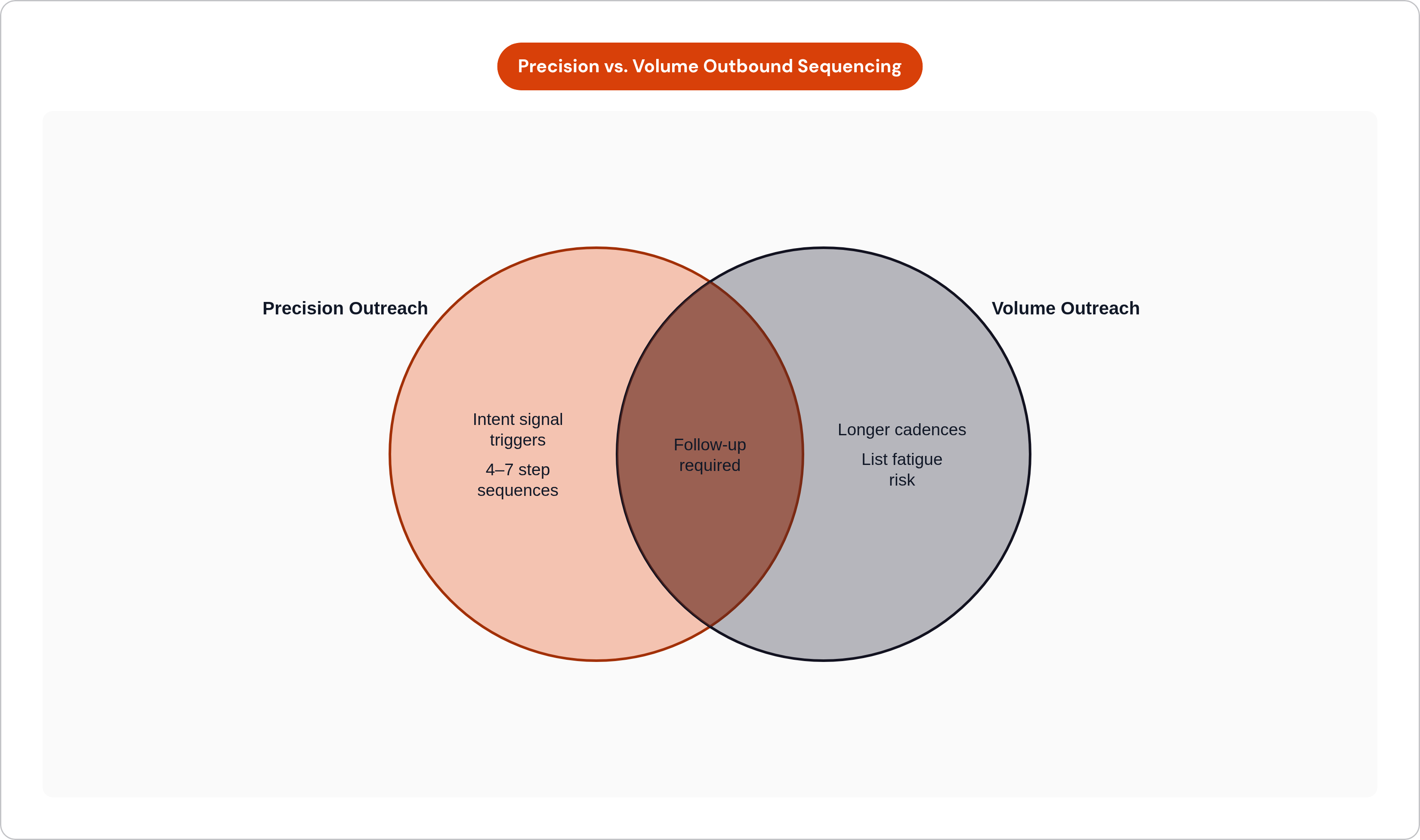
A precision list, built on tight ICP (ideal customer profile) criteria, verified intent signals, and known firmographic triggers, arrives pre-qualified. The prospect has already done much of the sorting work before step one. That front-loaded qualification compresses what the sequence itself must accomplish. Spray-and-pray logic works differently by design: send more, reach further, outlast indifference. Precision logic inverts that. Fewer steps, tighter spacing, each touch earning its place through specificity rather than sheer repetition.
The cost of ignoring that distinction is real. Over-sequencing a warm, well-qualified prospect signals poor list hygiene, damages sender reputation, and can poison a relationship before it starts. Signal-based outreach to ICP-matched accounts reaches reply rates of 10 to 15%, versus a notably lower average across generic cold outreach. That gap is evidence the list is already doing substantial work. Piling volume logic on top of a precision list doesn't compound those results; it erodes them.
Instantly's 2026 benchmark, drawn from billions of cold emails sent across calendar year 2025, puts the most effective sequences at four to seven steps, each message under 80 words, spaced three to seven days apart. That is the floor for single-channel outreach. Multi-channel sequences look different: high-performing teams running email, phone, LinkedIn, and voicemail design cadences spanning 17 to 21 days with 8 to 12 touches. The difference is channel scope, not a contradiction of the earlier figure. Conflating step count with email count is a common error when teams try to adapt these benchmarks to their own motion.
Follow-up remains non-negotiable regardless of list quality. Fifty-eight percent of replies come from step one; the remaining 42% come from follow-up, and that figure holds even on precisely qualified lists. Separately, 80% of sales require five or more touchpoints to close, yet most reps abandon sequences after two or three attempts. These numbers establish a floor, not a ceiling. Even a warm, trigger-activated prospect needs follow-up. But what if the real questions worth arguing about are not whether to follow up, but how many times and through which channels?
The "3-7-7" timing structure, touches landing on day three, day seven, and day fourteen with steps distributed in between, captures the majority of replies from prospects who will respond by day ten. It reflects something empirically true about buyer attention: enough frequency to build familiarity, enough spacing for a busy buyer to surface between contacts.
Deal complexity is the other major variable alongside list precision. A SaaS team selling to small businesses can often book meetings within five touchpoints. Enterprise IT infrastructure or multi-stakeholder procurement may require substantially more, because the decision carries greater organizational weight and more internal buying committee gatekeepers. Precision list design sits closer to the low end of this range by definition. When a well-qualified, trigger-activated prospect does require extended sequencing, the cause is usually deal complexity, not list weakness, and the cadence should be calibrated accordingly.
How Touchpoint Volume Has Inflated Across the Market, and What That Means for Precision Targeting
Booking outbound meetings used to require somewhere between 200 and 400 aggregate touchpoints per sourced opportunity. It now takes roughly 1,000 to 1,400. That figure demands careful interpretation: these are aggregate totals across all contacts in all active cadences contributing to a single opportunity, not per-prospect sequence step counts. Reading it the wrong way leads to bloated individual sequences that punish exactly the prospects you most want to keep warm. I've seen teams make this mistake and spend a quarter wondering why their precision lists were underperforming.
Several forces are driving this inflation simultaneously. Seventy-five percent of buyers take longer to make purchasing decisions today than in prior years, meaning every cadence is structurally longer as a consequence. According to 6sense's 2025 B2B Buyer Experience Report, the average B2B buyer doesn't engage with sales reps until roughly two-thirds through their customer journey, a period often called the dark funnel. McKinsey's B2B Pulse Survey finds that buyers now engage across an average of ten channels during that journey. That is not a favorable environment for anyone manufacturing attention from a cold list.
For volume outbound, this creates a compounding problem. More noise in the channel means more touches required just to register, and spray-and-pray sequences get trapped in a cycle of diminishing returns. Adding steps produces marginal gains at the cost of accelerating list fatigue.
But what if the math looks different for precision outbound? Entering the conversation when intent is already present sidesteps much of that inflation. The sequence doesn't need to manufacture readiness; it needs to match readiness that already exists. Volume inflation is largely a problem for campaigns trying to create attention out of cold indifference. A precision sequence meets momentum already in motion, which changes what the sequence is actually being asked to do, and what it should be measured against. These are distinct problems being solved by outwardly similar-looking tools, and treating them as equivalent is where a lot of outbound strategy goes wrong.
What Counts as a Trigger Worth Designing a Sequence Around
Intent signals are the precondition for precision sequencing. Without a verified trigger, there is no basis for compressing the sequence. Shorter without precision is not strategic; it is just lazy.
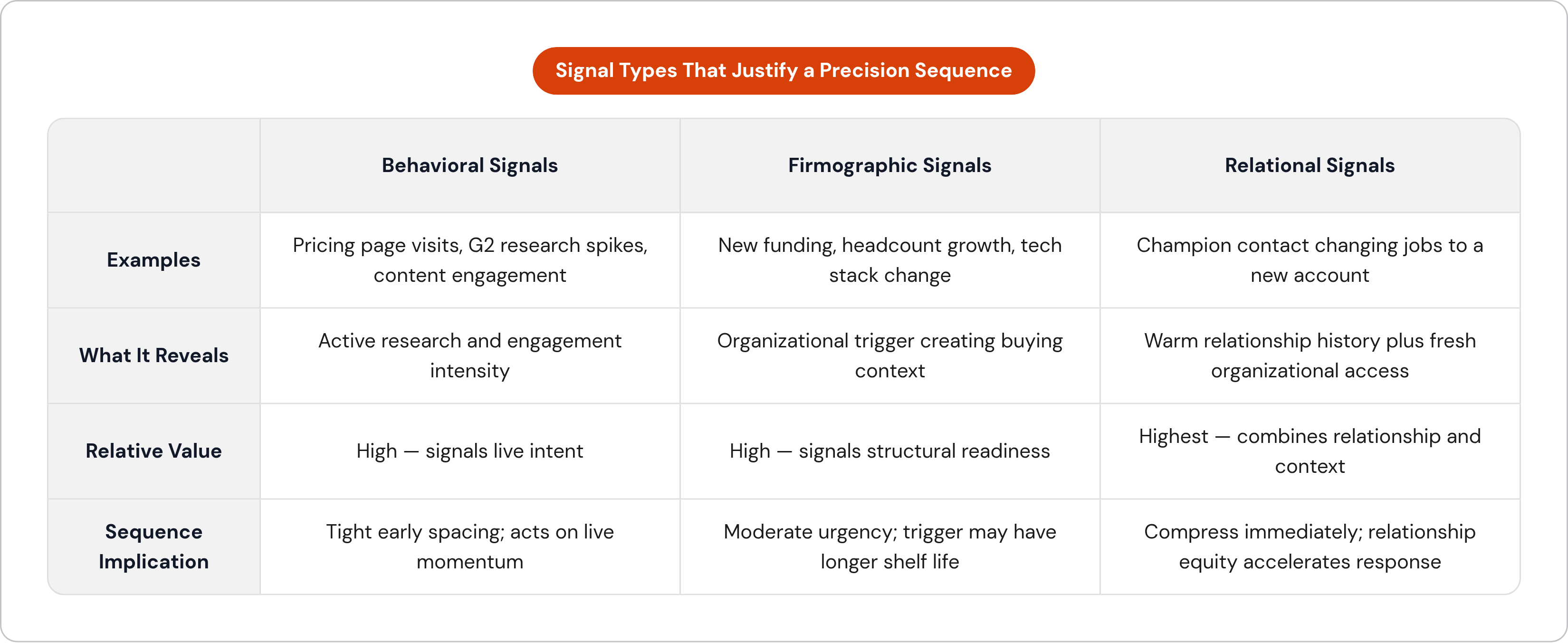
Actionable signals fall into three broad categories. Behavioral intent data signals include pricing page visits, G2 research spikes, and content engagement from a known decision-maker. Firmographic signals include a new funding round, headcount growth in a target department, or a technology stack change. Relational signals are often the most valuable of the three: a champion contact changing jobs and landing at a new account combines warm relationship history with fresh organizational context. Most revenue teams treat job-change signals as the highest-value single trigger in their signal libraries, and in my experience that ranking is correct.
What signals reveal, in ways generic prospecting cannot, is a specific combination: what companies are researching, how intensely they're engaged, and which stakeholders are involved. That specificity enables compression. Signal-based outreach done well reaches reply rates of 15 to 25% on email, versus 1 to 3% for generic cold email. The signal performs pre-qualification work that would otherwise fall to additional sequence steps.
Seventy-six percent of B2B marketers confirm increased ROI from focusing on high-intent leads, per current market research. Intent-first prioritization is no longer a niche practice; it is the direction the market has already moved.
The operational test before building any sequence: what observable trigger justifies outreach right now? If there is no clear answer, the list is not ready for a precision sequence. Run more signal-gathering time or build a nurture track. Under pipeline pressure, this rule gets ignored more often than it should, and the quarter-end scramble to hit numbers is usually when precision discipline collapses first.
Calibrating Step Count and Spacing When the List Is Already Warm
The core design shift with a precision list is compression at both ends: shorter total length, tighter early spacing, and a harder stop when engagement signals aren't returned.
For email-first sequences, the four-to-seven-step range from the benchmark data is the right ceiling, not the floor. A well-qualified, trigger-activated prospect rarely needs seven steps to decide whether to respond. Multi-channel sequences can extend the count without extending the duration, because each additional channel serves a distinct function rather than repeating the same medium. The test for each step is direct: does this touch add new information, a new channel, or a new angle? If it's pure persistence, cut it.
Spacing should reflect the temperature of the trigger. Tighter early spacing, days one, three, and five rather than one, seven, and fourteen, is appropriate when a trigger is recent and time-sensitive. A pricing page visit cools fast; urgency should be visible in the cadence. The three-to-seven-day range from the benchmark remains the right guardrail for both reply rate and deliverability, closer to three for hot signals like a live pricing or demo page visit, closer to seven for slower-burn triggers like a funding announcement. After day ten, prospects who haven't engaged are unlikely to respond through the same channel. The correct move is a channel shift or a pause, not another email.
Per-touch format matters as much as cadence. Initial emails should run under 120 words; follow-ups should be shorter still, because targeted personalization compensates for brevity in ways that length cannot. Subject lines under seven words, tied to a company-specific observable fact, outperform clever or generic alternatives because they demonstrate research before the prospect opens. The first line should be anchored to the trigger. One clear ask per touch: a meeting, a reply, a yes-or-no question. Multiple asks in a precision context split attention and reduce the probability of any response.
It is also worth considering the exception. A high-ACV deal with multiple stakeholders or a long procurement cycle may warrant a longer sequence even on a precision list. Deal complexity overrides list quality as the primary length driver at the top of the market. The sequence still benefits from precision logic in its tone and specificity, but step count may need to expand to accommodate the organizational surface area of the decision.
Building the Multi-Channel Layer Without Losing the Precision Logic
RAIN Group's research finds that B2B sales require an average of eight touchpoints to generate conversions. Those touchpoints should span multiple channels, not accumulate as email follow-ups. Teams routinely collapse that distinction under pressure to keep sequences simple.
Channel sequencing for precision lists follows a logical hierarchy. Email opens the sequence because it is low-friction and records the trigger reference in writing, creating a paper trail the prospect can reference at their own pace. A LinkedIn touch, whether engaging on a prospect's recent post or sending a connection request with a short contextual note, warms the name before a direct message or call. Troy Munson, Senior AE at Proofpoint, has described engaging with content the prospect has commented on as a way to surface your name in their feed before making a direct ask; the strategy uses the platform's own visibility mechanics as a warm-up layer. A phone call or voicemail after two unanswered emails changes the medium, not just the frequency, and signals genuine interest to a prospect paying attention.
Emerging channels merit attention on precision lists because differentiation is part of the value proposition. Cognism SDRs have reported strong receptivity to WhatsApp follow-ups after an initial call, with minimal negative feedback. Slack Connect stands out as a touchpoint precisely because it is unexpected; the novelty signals effort. A meaningful share of GTM teams are now incorporating digital sales rooms into cadences, per Highspot's 2025 State of Sales Enablement Report; for precision lists where deal size justifies the production effort, a curated digital sales room as a mid-sequence touch signals preparation in a way an email cannot.
Here is the practical test applied to channels: after three email attempts without engagement, continuing on email is volume-outreach behavior. Switching to a new channel is precision behavior. The channel shift communicates to the prospect that you are responding to what is and isn't working, rather than running a script.
Adding channels to hit a touchpoint count target, rather than to reach the buyer where they actually are, degrades precision logic faster than almost anything else. Every channel added should have a reason tied to this specific prospect's observable behavior. This discipline is harder to maintain than it sounds, especially when sequence templates are shared across a team and the original rationale for each channel choice gets lost.
How AI Agents Execute Precision Sequences Without Letting Volume Logic Creep Back In
Precision sequencing is structurally harder to execute at scale than volume sequencing. It requires real-time signal monitoring, per-prospect calibration, and continuous iteration. Manual workflows fail here predictably; the gap between intent and execution widens fastest under volume pressure.
Traditional sales engagement platforms follow rigid if/then rules programmed in advance. It can run a sequence but cannot adjust step count or spacing based on signals arriving mid-sequence. True AI revenue agents do something different: they execute sequences autonomously, adjust based on prospect behavior, route responses, and sync to CRM without requiring human intervention between touches. According to Gartner's 2025 research, deal cycles compress by 25 to 30% when autonomous agents eliminate delays, because leads are qualified immediately, meetings are scheduled without friction, and follow-ups trigger automatically. Sales teams using AI report 47% productivity increases and roughly 12 hours per week of manual work cut, per the same Gartner research; that recaptured time goes to the high-judgment work agents cannot do, including reading a live conversation, adjusting tone, and deciding whether a prospect is uninterested or simply slow to respond.
The governance question is where teams that move fast tend to get burned. Agentic execution of precision sequences requires the same discipline as the sequence design itself. The system needs a data layer that ingests real-time intent signals to trigger sequences correctly; a context layer grounded in conversation intelligence so follow-up messages reference what has already been said; and human oversight before broad deployment. Poor configuration produces off-brand or non-compliant outreach at scale, and at speed. Run small test cohorts first. This is the part of AI-assisted outbound that gets skipped when there's pressure to show results quickly, and the problems it creates are hard to unwind.
The design principle that matters most is specificity at the play level. A precision sequence for a job-change trigger is a different agent motion than a sequence for a pricing-page visit. Treating them as the same produces volume behavior dressed in AI clothing. Agents work best when they execute distinct, well-defined sales plays; the intelligence lives in how those plays are architected, not just in the execution of them.
Consolidating email, phone, LinkedIn outreach, and CRM syncing in a single system addresses one of the friction points that degrades precision logic at scale, because coordinating across disconnected tools introduces delays and data gaps that erode the signal freshness a precision sequence depends on. Salesforce's 2026 State of Sales report puts a number on the broader pattern: 83% of sales teams using AI reported revenue growth in the past year, versus 66% of teams that don't. That raises an important question: if a 17-point gap compounds as teams using AI iterate their sequences faster than those relying on static templates, how long before the gap becomes structurally unrecoverable for teams that haven't made the shift?
The Iteration Loop That Keeps Precision Sequences Sharp Over Time
Average cold email reply rates in 2025 sit in the low single digits. Teams that standardize sequence rules push toward top-quartile and top-decile benchmarks. What separates them is iteration discipline, not a better initial template.
Precision sequences produce something volume sequences rarely do: clean signal. When a short, specific sequence underperforms, the reason is usually legible. The trigger was wrong, the ICP slice was off, or the channel order wasn't matched to this buyer's observable behavior. The sequence had few enough variables to isolate the cause. When a long, generic sequence underperforms, the cause is noise: was it the subject line, step five, the timing, the list quality? Too many variables to diagnose with any confidence. I'd rather run a six-step sequence that teaches me something than a fifteen-step sequence that teaches me nothing except that someone didn't respond.
The iteration protocol for precision sequences follows a clear hierarchy. Track reply rate by step to identify which step generates the most replies and which steps generate nothing. Kill steps that produce neither replies nor meaningful channel shifts; the sequence should compress toward what actually works. A/B test one variable per cycle, subject line first, then first-line personalization, then channel order. Testing all three simultaneously produces unreadable results. When a new trigger type surfaces, whether a new job board signal, a new intent category, or a new firmographic event, build a new sequence rather than retrofitting the existing one. Distinct plays for distinct signals is the architecture that keeps precision logic intact as the signal library grows.
There is a compounding dynamic here worth examining carefully, partly because it is the argument most likely to get dismissed in favor of short-term volume. Each iteration of a precision sequence produces data on a narrower, more specific population than a volume sequence would. That specificity makes the learning faster and more transferable to adjacent trigger types. Teams that build this loop early accumulate institutional knowledge of what resonates with their ICP that competitors running undifferentiated volume cadences cannot easily replicate, because those competitors lack the clean signal required to learn at the same rate.
The sequence is the execution layer. It should be calibrated to match the precision of the intelligence feeding it, and rebuilt when that intelligence changes.