Customer Research Methods for B2B Outbound Targeting
Real customer conversations reveal the urgency and triggers that firmographics cannot capture.

The standard ideal customer profile covers industry, company size, and title. That framing is necessary. But what if teams that stop there are doing targeting theater?
A complete ICP captures what firmographic attributes cannot: the specific pain that carries urgency, not just a general problem category; the trigger that made the pain acute at this particular moment; the language the buyer used to describe the problem before they knew your product existed, which is almost never the vendor's language; and the decision process, including who else is involved and what objections surface at each stage — the core questions of a jobs-to-be-done analysis. These are not soft additions. They are the operative variables that determine whether a message lands or gets deleted.
There is something the founder who personally closed the first meaningful customer cohort knows that no briefing document can transfer. They heard the objections directly. They felt the hesitation in real time. They learned, through repetition and occasionally through embarrassing miscalculation, which problems were genuinely acute versus which ones buyers mentioned because they felt obliged to say something. That experiential knowledge is the foundation of a real ICP, and every other version is an approximation of it. Sometimes a good approximation. But still an approximation, and the gap matters when you are deciding who gets outreach this week.
The wedge principle follows from this. Narrowing to the smallest defensible ICP segment first, building the motion around it completely, and refusing to expand until that segment is saturated is the correct sequence, regardless of how large the total addressable market appears. Early wins spread across too many segments look like traction; they are actually diffusion, and diffusion is hard to distinguish from progress until the pipeline starts converting at a rate that exposes the confusion. The confirmation that a real ICP has been found is behavioral: prospects begin repeating your language back to you in replies and on calls. They use your framing of the problem. That feedback loop is harder to manufacture than it sounds, and it is worth paying attention to when it appears.
The practical output of a well-developed ICP is not only a list of qualifiers. It is an equally specific list of disqualifiers. Knowing which accounts to skip immediately is operationally as valuable as knowing which to pursue, because it is the mechanism by which research time is protected from the gravitational pull of hopeful targeting.
Customer Interviews as the Research Method That All Other Methods Depend On
Firmographic data tells you who bought. Interviews tell you why, and crucially, why now. That distinction is why interviews sit at the foundation. Everything downstream, including messaging, trigger identification, and targeting criteria, is only as precise as the interview data feeding it.
The interviews worth conducting fall into three categories. Best customers, defined by retention, expansion rates, and referral behavior, are the primary source. The goal is to reverse-engineer what made them convert and stay. Lost deals, particularly ones where the prospect evaluated seriously before choosing a competitor or declining entirely, are the second, and the structured version of this practice is often called win/loss analysis. The no-decision case is often more instructive than the competitor-won case, because it isolates what the market is not yet ready to pay for. Churned customers are the third. What changed, what the product failed to deliver on, what the moment of recognizing the wrong fit felt like: these answers sharpen exclusion criteria more than any other source.
What to listen for differs from what to ask. The specific moment the problem became urgent, the triggering event that preceded the search for a solution, is the most important signal in the interview. So are the words the buyer used to describe the problem before they knew your product existed. Those words are not customer feedback; they are outreach copy, and collecting them systematically is what voice of the customer research is actually for. What almost stopped them from buying matters equally, because it surfaces the objections that will reappear at every stage of the sequence and the closing motion.
Format matters more than most teams admit. Twenty to thirty-minute recorded calls with open-ended questions, transcribed for later analysis, produce qualitatively richer output than surveys. Surveys compress and pre-frame the answer; calls let the respondent go off-script, which is where the useful data tends to appear. The most important insight often surfaces as an offhand comment near the end, the kind of thing no survey instrument would have captured, and you only catch it if you are actually listening rather than waiting for your next question.
Ten well-chosen interviews at an early stage will surface patterns that a hundred-row spreadsheet of firmographic data cannot approximate. The compounding value is that interview findings feed every downstream motion simultaneously: messaging, objection handling, targeting criteria, and sequence personalization all improve from the same source.
How to Read Your Existing Customer Base as a Targeting Dataset
Most GTM teams underuse the customer base as a research asset. It is already a curated dataset of accounts that said yes, and the signal it contains is more reliable than anything a third-party vendor can provide, because it reflects actual buying behavior rather than modeled probability.
Firmographic clustering is the first analytical pass. Pull closed-won deals and look for concentrations: which industries, sub-verticals, or company sizes appear repeatedly? Which titles converted at high rates versus which ones churned or stalled in implementation? Which deal sizes closed fastest and showed the shortest time-to-value? These concentrations are the empirical backbone of the ICP, grounded in what actually happened rather than in hypothesis.
Behavioral patterns in the customer journey add a second layer. What did best-fit customers do before they converted? Which pages did they visit, which content did they consume, which trials did they start? What product actions in the first thirty days correlate with long-term retention versus early churn? These patterns form the behavioral basis of a product-qualified lead definition. These patterns are predictive. They identify the pre-conversion behaviors that signal real fit before a deal is even initiated.
The lookalike logic follows directly. Once the aggregate profile of best customers is understood in firmographic and behavioral terms, that profile can be used to build a prospecting list from external data sources that mirrors those attributes. This is the bridge between internal analysis and outbound list-building, and it is often where teams discover that their intuitions about who the ICP is were partially wrong.
One practical constraint shapes all of this: CRM hygiene. IBM's State of Salesforce 2025-2026 report found that fifty-three percent of companies cite poor data quality as the top adoption barrier for agentic AI. The same constraint applies to manual analysis. If the CRM data is incomplete, inconsistently entered, or stale, the patterns it surfaces will be artifacts of the data problems rather than real market signals.
The practical output of this analysis is a tiered ICP model. Tier 1 accounts represent the closest match to best customers across the most attributes. Tier 2 accounts show strong fit but fewer confirming signals. Tier 3 accounts are experimental, worth testing in small batches to probe adjacent segments. Outbound effort allocated according to this tier structure is outbound effort allocated according to evidence.
Firmographic and Technographic Data: What It Can and Cannot Tell You
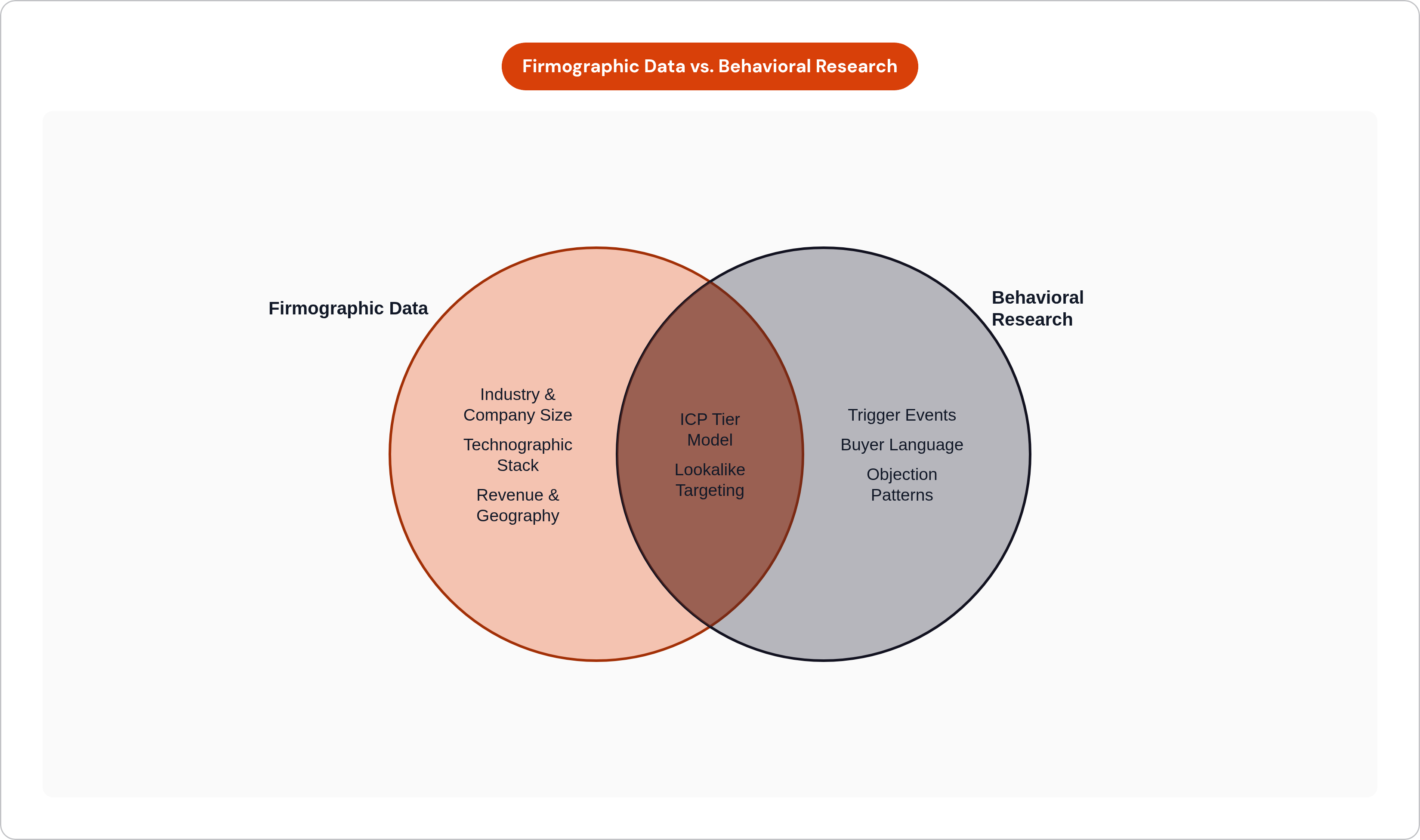
Firmographic data covers industry, company size, revenue range, geography, headcount, and growth stage. Technographic data adds the tools a company runs: their CRM, marketing automation stack, infrastructure choices. Together, these data types serve three specific functions in the research stack: filtering out poor-fit accounts before research time is wasted on them, identifying companies that structurally match the best-customer profile, and spotting technology displacement opportunities where a prospect uses a tool you integrate with or replace.
The hard limit is this: firmographic and technographic fit tells you a company could be a customer. It tells you nothing about whether they have the problem right now, whether there is budget urgency, or whether anyone there is actively looking. Treating a firmographically filtered list as ready to work is a category error, and it produces the experience most outbound practitioners know well: technically qualified prospects who respond to nothing.
The correct framing is that firmographic and technographic data set the outer boundary of who qualifies. They define the universe. Intent signals and behavioral triggers determine who within that universe gets outreach this week. One without the other is either too broad or too narrow to be operational.
Key data sources in this category include ZoomInfo, Apollo, Clay, and Clearbit. Each carries different coverage strengths, data freshness profiles, and accuracy characteristics. Accuracy varies meaningfully across sources and should be validated against known accounts before large-scale use.
Intent Signals and Behavioral Triggers: The Research That Tells You When to Reach Out
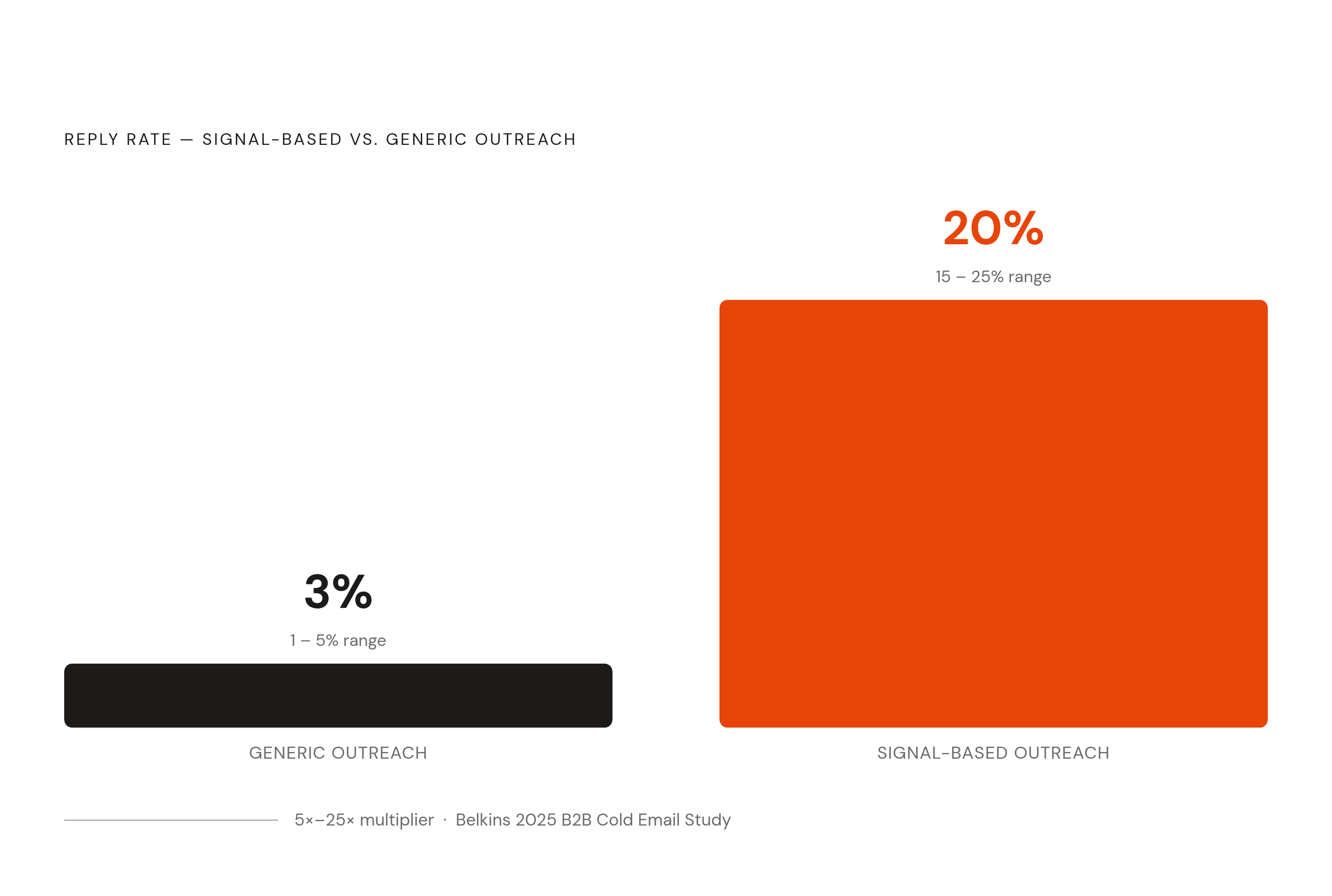
Belkins' 2025 B2B cold email study found that signal-based outreach personalized to a specific triggering event produces reply rates in the fifteen to twenty-five percent range. Generic outreach sent to the same companies produces one to five percent. The difference is not writing quality. It is the presence or absence of a real, contextually grounded reason to reach out at that particular moment.
The categories of intent signal worth tracking span a meaningful range of confidence levels. First-party behavioral signals, including pricing page visits, trial sign-ups, feature exploration, and content downloads, are the highest confidence because they represent direct interaction with your own product or content. Job change signals, specifically a champion at a past customer joining a new company that fits the ICP, rank among the highest-conversion triggers in outbound; the relationship, the trust, and the product familiarity transfer. Hiring signals surface when a company posts for a role that indicates a problem you solve: a Head of Revenue Operations suggests scale pain; a VP of Data Engineering suggests infrastructure investment. Funding events, particularly Series A and B announcements, compress decision timelines and create new budget urgency. Competitor displacement signals, accounts posting negative reviews of a competitor or reducing spend on a tool you replace, indicate active dissatisfaction with the incumbent. Third-party buyer intent data from platforms like G2 and Bombora, tracking accounts researching relevant categories, carries lower confidence than first-party signals but remains directional.
The timing logic is close to non-negotiable. A signal without a rapid response window is wasted. The value of a trigger decays quickly; outreach within hours of a signal materially outperforms outreach days later. This is not a best practice recommendation. It is a function of how buying attention moves. The signal creates a window, and windows close.
The signal also changes the nature of the outreach itself. It becomes the opening, not the product. "I saw you just expanded your sales team" is a human observation. It references something real. It invites a conversation rather than demanding one. This is the difference between outreach that earns a reply and outreach that earns an unsubscribe.
The operational requirement this creates is an infrastructure question. Manual monitoring of hiring pages, funding announcements, and review sites does not scale. The workflow challenge is routing signals into outreach without adding latency at the handoff.
Competitive and Social Listening as a Secondary Research Layer
Competitive and social listening operates as a secondary layer. Valuable, but not the foundation. What it surfaces that primary research cannot: accounts actively dissatisfied with an incumbent, categories gaining or losing mindshare, and new objections entering the market that have not yet reached the sales floor.
The places worth looking are specific. G2, Capterra, and Trustpilot reviews, particularly recent one- and two-star reviews on competitor pages, often name the exact problem your product solves, written in buyer language rather than vendor language. LinkedIn activity, comments on thought leadership posts, questions surfaced in professional communities, and engagement with competitor content reveal which topics are generating friction and for whom. Reddit threads and Slack communities in your category provide unfiltered buyer language and objections at a scale that formal interviews cannot match. Job postings, approached from a different angle than the intent signal use case, reveal what skills and tools a company is prioritizing, which tells you what problems they are actively trying to solve.
The research output from this layer is qualitatively distinct from firmographic or interview research. It surfaces ICP segments that internal analysis would not have generated, message angles that would not have emerged from internal conversations, and accounts already in an active buying motion indicated by their public behavior.
The practical constraint is time. This is qualitative, labor-intensive research when done manually. Its highest value is periodic rather than continuous: used to update ICP assumptions quarterly, to pressure-test whether the messaging framework still reflects how the market talks, and to identify emerging displacement opportunities before they become obvious. The language harvested from this layer should feed directly into interview question design and outreach copy, creating a closed loop between market listening and targeting execution.
How to Layer These Methods into a Research Workflow That Produces a Working Target List
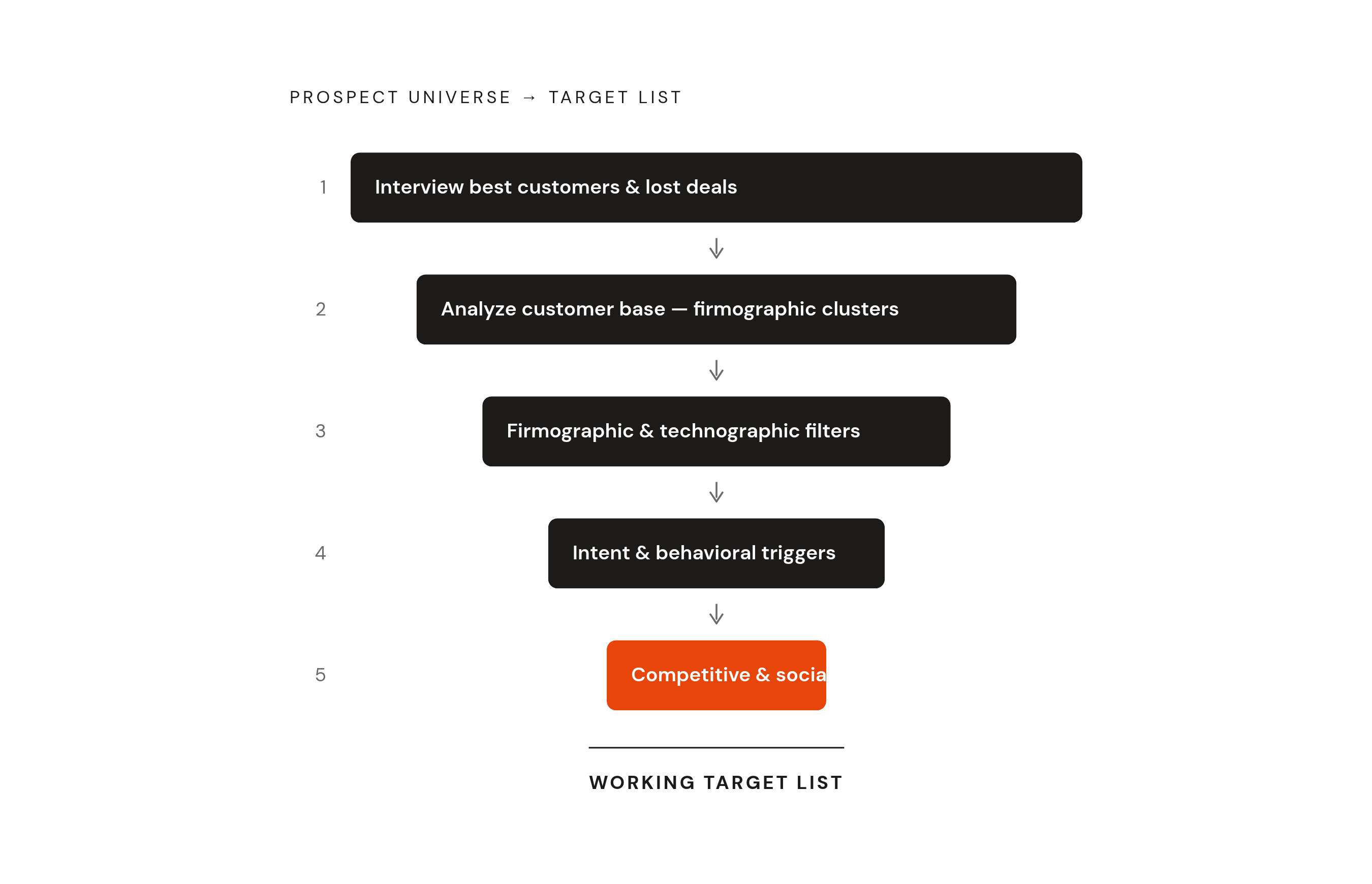
These methods are not parallel tracks. They run in sequence, each one narrowing and enriching the output of the one before. Running them out of order, or treating any single method as sufficient, produces a list that is incomplete in ways the team will be unable to diagnose from reply rate data alone.
The sequence: interview best customers and lost deals first, to extract triggers, language, and the conditions that made the problem urgent. Analyze the existing customer base next, to identify firmographic and behavioral clusters that characterize best-fit accounts. Apply firmographic and technographic filters to external data to build the outer universe of accounts that structurally qualify. Layer intent signals and behavioral triggers to reduce that universe to accounts currently showing active buying conditions. Apply competitive and social listening findings last, to validate ICP assumptions and surface additional high-intent accounts that signal monitoring may have missed.
The output is not a single list. It is a tiered, prioritized queue. Tier 1 accounts, those with high firmographic fit and an active signal, get personalized outreach immediately. Tier 2 accounts, strong structural fit but no current signal, go into a monitoring queue to be activated when a trigger appears. Tier 3 accounts, marginal fit or early exploratory hypothesis, get tested in small batches with careful measurement.
What this research enables that volume outbound cannot is specific, observational outreach tied to real context. The openers that produce above-average reply rates are not clever; they are accurate. They reference something the prospect actually did or experienced. That accuracy comes from research, not from a better subject line.
The refresh cadence matters practically. ICP assumptions decay as markets shift, as the product evolves, and as the competitive landscape changes. Signals expire. The customer base shifts composition over time. This workflow should be revisited quarterly at minimum, not treated as a one-time setup.
The tooling constraint is real. Running this workflow across five disconnected tools creates latency and data loss at every handoff. The signal-to-outreach window is the operative performance variable in signal-based outbound, and it degrades with each step that requires manual transfer between systems. A connected platform that consolidates list building, signal monitoring, and sequence execution keeps the research and the action in the same loop.
What Good Research Discipline Looks Like as the Outbound Motion Scales
Outbound generates data continuously. Every reply, every non-reply, every conversion, and every deal that stalls is a signal about the quality of the targeting. The teams that compound their outbound performance over time treat that data as input back into the ICP and targeting criteria, not as a performance report filed and forgotten.
The metrics that indicate research quality is working are specific. Reply rate by signal type tells you which triggers actually predict engagement. Conversion rate by ICP tier tells you whether the tier definitions are calibrated correctly or need to be redrawn, which is the most direct feedback loop the research workflow produces. Deal velocity by customer segment tells you where time-to-close is shortest, which is often the clearest indicator of where the problem is most acute and the solution most obviously valuable.
It is also worth considering the real leverage question embedded in all of this around AI. Sales teams using AI to process and act on targeting research report materially higher revenue growth rates than those without, and the differential is significant enough to have drawn consistent attention in recent GTM technology research. But that advantage compounds only when the underlying research inputs are clean and specific. AI operating on vague targeting criteria produces confident-sounding outreach at scale to the wrong people, which is worse than no outreach at all because it burns the sender's domain reputation along with the prospect's patience.
The founder-led sales context creates a particular structural risk worth naming plainly. The founder running their own outbound has a natural research advantage: they are in every conversation, absorbing every signal, updating their ICP assumptions in real time through direct experience. That advantage exists only in their head. It disappears the moment the first GTM hire joins and needs to replicate the motion. The founder's tacit knowledge has to be documented, the ICP formalized, the trigger criteria written down, the messaging framework extracted from instinct into a shareable system before the motion can survive the transition. The failure mode here is consistent: the founder cannot explain why a particular account was a good fit, only that they recognized it when they saw it. That is not a system. It is a bottleneck wearing the costume of expertise.
What scales in a maturing outbound operation is the tiered ICP model, the signal monitoring infrastructure, and the messaging framework built from real customer language. What does not scale is ad hoc research conducted before each campaign, gut-feel targeting, and lists built once and refreshed rarely. The research discipline described here is the mechanism by which that ceiling gets raised, and the compounding only starts when the discipline is treated as ongoing rather than foundational.