Ideal Customer Persona vs Ideal Customer Profile in Outbound
Five layers beyond firmographics turn static checklists into precision targeting.

The default ICP is firmographic: industry, headcount, revenue band. Teams write it down, drop it in a Notion doc, and consider the exercise complete. That gets you onto the right continent, and not much further.
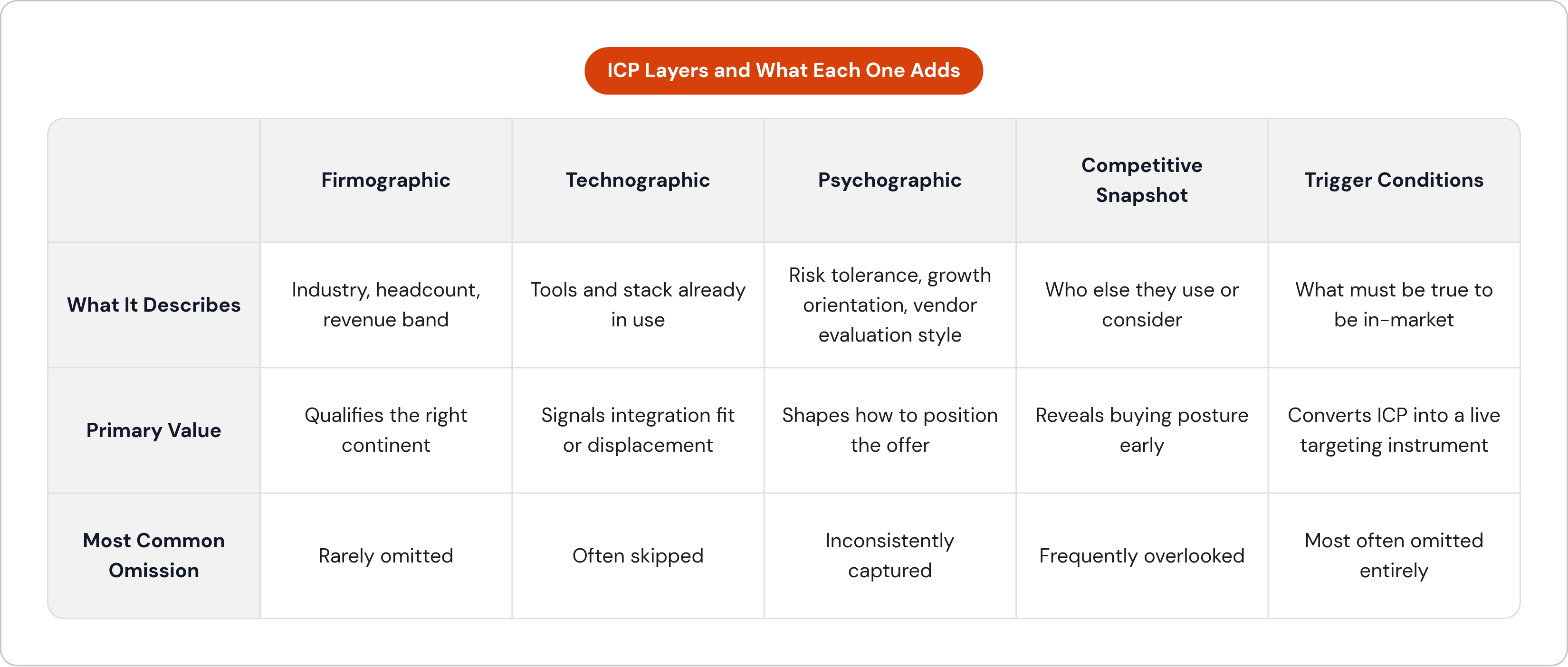
A complete ICP contains at least four additional layers. Technographics tell you what tools a company already runs, which signals integration fit, displacement opportunity, and sometimes the technology adoption maturity of the problem you're solving. Psychographics describe how the organization thinks: its risk tolerance, its growth orientation, how it typically evaluates vendors. A competitive snapshot captures who else they're using or considering, surfacing buying posture before you send a single email. And trigger conditions define what has to be true for a company to be genuinely in-market: a new funding round, a leadership hire into a relevant role, a stack change, a product launch.
Trigger conditions are also the layer most teams omit entirely, and that omission is consequential. Of the five layers, trigger conditions are the most operationally useful, because they transform ICP from a static qualification checklist into a live targeting instrument.
Consider the distinction between ICP and persona in concrete terms. "B2B SaaS company, 50 to 200 employees, Series A funded, running an outbound sales motion" is an ICP. "Head of Sales Development, measured on meetings booked, increasingly frustrated by low reply rates on their current sequences" is a persona. The ICP determines who goes on the list; the persona governs what gets sent once they're on it. These two things are doing completely different jobs, and conflating them is where outbound discipline starts to unravel.
One more thing worth clarifying: an ICP is not a description of all your current customers. It describes the customers where you win cleanly, retain longest, and expand most profitably. Build your ICP from your full customer base rather than your best-performing cohort, and you encode average performance into your targeting rather than your ceiling. Salesforce's State of Sales research found that 86% of business buyers say they're more likely to purchase when sellers demonstrate an understanding of their goals. Understanding goals at the company level, the organizational pressures and strategic context, is precisely what a properly constructed ICP makes possible.
What an Ideal Customer Persona Contains (and the Layer of Insight It Adds)
The persona operates one level down from the ICP. Where the ICP describes the organization, the persona describes the individual: the decision-maker or evaluator who reads your message and decides in roughly two seconds whether to respond or archive it.
What a persona actually contains goes well beyond job title. It includes the person's day-to-day responsibilities and what they're measured on, their near-term goals, where friction lives in their workflow right now, and the objections they'll raise when outreach doesn't resonate. It also captures where they consume information — which LinkedIn communities, newsletters, or Slack groups they actually pay attention to — and how they prefer to be approached in a way that reads as credible rather than intrusive. That last piece gets underrated consistently. Credibility cues are persona-specific, and getting them wrong on the first touch is often unrecoverable.
A role is not a persona. "VP of Sales" is a role. A persona accounts for how that VP thinks, what they fear, what success looks like for them this quarter, and what kind of message earns a reply versus gets quietly filtered out.
In complex B2B sales, a single ICP-matching company contains multiple personas simultaneously, forming a buying committee: the economic buyer who controls budget, the technical evaluator who assesses fit and implementation risk, the end user who lives with the product daily. Each requires a different message. Sending the economic buyer's framing to the technical evaluator is one of the most common and expensive persona errors in outbound; the value proposition, the assumed context, and the stakes are all wrong for the person reading it.
But what if you've built a genuinely strong persona and skipped ICP work entirely? You write a perfect message to exactly the right kind of person at a company that simply cannot buy from you: wrong funding stage, wrong size, wrong problem set. The personalization is excellent and the targeting is structurally broken. This happens more often than most outbound teams are willing to admit.
Why the Order Matters: ICP Filters First, Persona Aims Second
The most common structural failure in outbound is going straight to persona work before ICP is defined. It looks productive. You've identified the right titles and built sequences with real specificity. Without ICP as the upstream filter, though, those personas get applied to companies that will never convert, regardless of how good the messaging is.
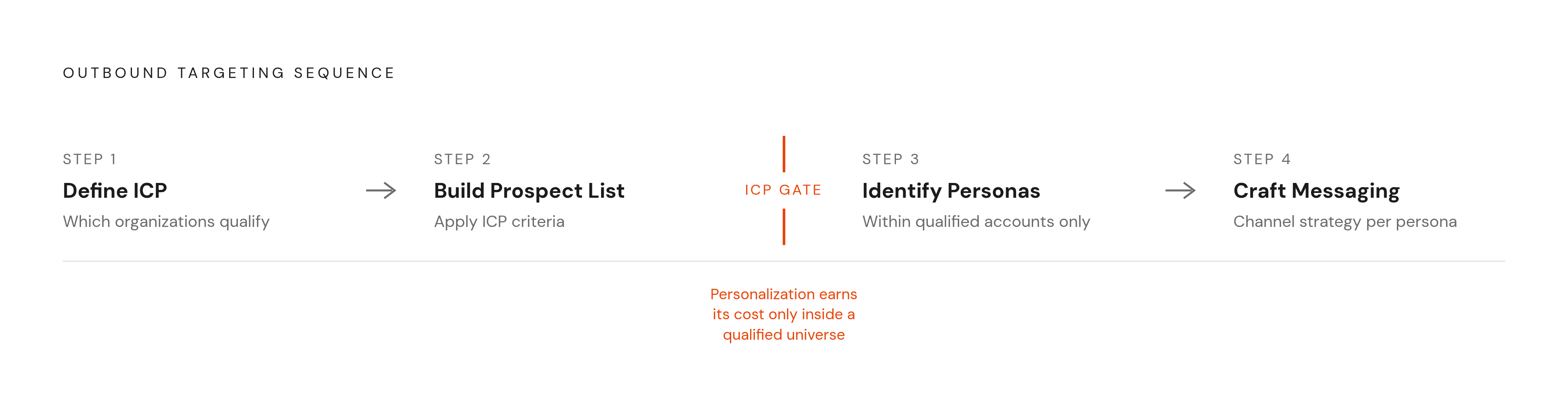
The correct sequence runs like this. Define the ICP first, specifying which organizations within your total addressable market qualify for the pipeline at all. Then build the prospect list using those criteria, filtering before any outreach logic is written. Within those validated accounts, identify which personas matter at this deal size and stage. Then craft the messaging and channel strategy against those personas, knowing each account has already cleared the qualification gate.
Personalization is expensive. It takes time, judgment, and attention, and applying it to unvalidated accounts wastes the highest-leverage activity in the outbound motion. When ICP filters first, every creative decision made at the persona level happens inside an already-qualified universe.
The account tiering logic follows directly from this. Accounts that match every ICP criterion and show active buying signals deserve the highest-quality, persona-driven personalization. Accounts with partial ICP fit get lighter outreach. Accounts outside ICP don't get the resource at all. For a small GTM team, or a single founder doing their own outreach, this is how you work hundreds of prospects without quality collapsing at the top tier.
Both layers need to run simultaneously once the sequence is established. ICP governs who is on the list; persona governs every creative decision made after they're on it.
The Most Common Ways Teams Get Both Wrong, and What It Costs Them
ICP errors cluster in recognizable places. The most frequent: pulling a list by industry and headcount and stopping there, without technographic signals, trigger conditions, or competitive context. Beyond that, teams build the ICP from aspirational accounts rather than from the cohort where the business has actually won, retained, and expanded. Markets shift, products evolve, and competitive landscapes change; treating the ICP as a one-time document rather than something revisited quarterly means the motion gradually drifts from the accounts it should be targeting. And when ICP lives in the marketing deck but never gets socialized across sales and product, different teams target different profiles and generate structural waste that no amount of persona work downstream can fix.
Persona errors are different in character. Equating persona with job title remains the most pervasive: "VP of Sales" is a filter, not a persona. Building personas from internal assumptions rather than win/loss interviews with actual customers and lost deals means the persona reflects what the sales team believes about the buyer, not what the buyer has said. And ignoring that a single account contains multiple personas, especially as deal size grows and buying committees expand, produces messages calibrated for one stakeholder that land in someone else's inbox. Forrester's research on B2B purchasing found that an average of 22 people influence each enterprise buying decision; persona miscalculation at the account level compounds across every contact the team will eventually need to engage.
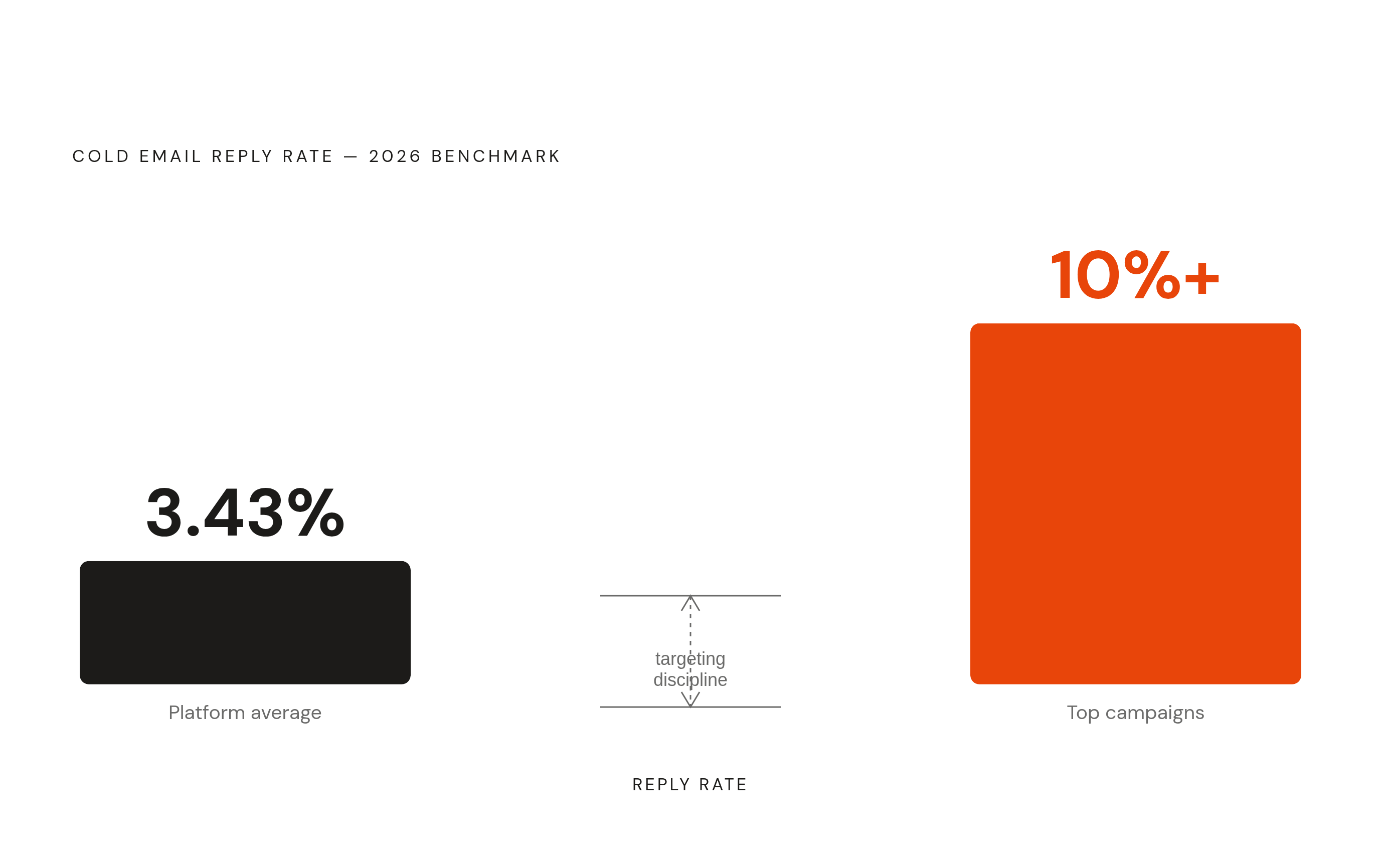
The combined cost is measurable. The most resource-intensive version of this failure is strong persona work applied to an unvalidated ICP: excellent, highly personalized outreach delivered at scale to exactly the wrong companies. The 2026 Cold Email Benchmark Report showed a platform-wide average reply rate of 3.43%, with top campaigns exceeding 10%. That gap lives largely in targeting discipline, in the quality of ICP definition and persona calibration underneath the campaigns.
How Signal Data Sharpens Both Layers Over Time
Intent signals and behavioral data don't replace ICP and persona work. They enrich it in ways that static demographic data cannot.
A company visiting a pricing page, posting a job for a role that signals an active initiative, or swapping out a key tool in its stack communicates that its ICP fit is active right now, not theoretical. A contact's recent LinkedIn activity, a new hire into a directly relevant role, or a funding announcement tells you that the persona's context has shifted in ways that affect urgency, budget authority, and near-term priorities. The message that would have been premature three months ago lands differently when the trigger condition has just fired.
ICP refinement through signal works incrementally. As conversion data accumulates (which accounts convert, which expand, which churn) patterns emerge in the technographic and trigger-event data that predict go-to-market fit and weren't visible from demographics alone. The ICP tightens around the characteristics that actually predict revenue, rather than the ones that felt logical at the outset.
Persona refinement is more granular. Reply patterns, objections raised in early calls, topics that generate positive engagement, messages that fall flat across a whole campaign cycle: all of it is data. Each outbound cycle produces a cleaner picture of what the persona actually cares about, as opposed to what the team assumed at the start. Teams that capture and act on this build increasingly accurate targeting; teams that don't are essentially rerunning the same campaign with slightly different copy.
That raises an important question about prioritization specifically. Accounts with ICP fit plus active buying signals get full-personalization treatment and immediate follow-up. ICP-fit accounts with no current signal get a lighter sequence designed to surface intent. Accounts outside ICP don't receive the resource at all, regardless of how many people inside them match a target persona. Signal data is what makes this tiering dynamic rather than fixed.
How the ICP-to-Persona Sequence Runs Inside a Connected Outbound Platform
Most teams run this framework across disconnected tools rather than a unified sales engagement platform. ICP criteria live in a spreadsheet or a CRM filter; list building happens in a separate data tool; sequencing runs in an email platform; CRM logging is yet another system. The ICP-to-persona logic that looks clean in a document falls apart at the handoffs between each of these, because the criteria encoded in one system don't automatically govern decisions in the next.
A consolidated platform solves this by collapsing the handoffs. ICP criteria get encoded at the list-building stage, before any outreach logic is written. Persona-level targeting is reflected in the sequence before the first touch goes out, not appended afterward as a personalization variable. Signal triggers wire directly into campaign logic, so a qualifying event fires the right sequence to the right persona automatically, rather than waiting for a human to notice and act. CRM sync captures which persona-level messaging generated replies and booked meetings, feeding the next iteration of both ICP and persona calibration.
The AI agent layer makes the quality of these inputs even more consequential. When AI revenue agents execute outreach, the precision of ICP and persona inputs determines the relevance of the output. Vague targeting produces low-relevance outreach regardless of how capable the underlying model is. The two most common causes of AI agent failure in outbound are category mismatch (contacting companies that fall outside the ICP) and an underspecified persona that leaves the agent without enough context to write a message that fits the recipient's actual situation.
Founders and early-stage GTM teams can define ICP criteria, build lists, deploy persona-specific AI agents across distinct sales plays, and iterate against real performance data inside a single platform, without stitching together separate tools for each step. For a founder doing their own outreach, the sequencing discipline this enforces matters considerably: every cycle spent on out-of-ICP accounts or misaligned persona messaging is a cycle that cannot go toward the accounts most likely to close.
Well-defined ICP, sharp persona work, and intent signals are the three conditions under which specific, creative outreach compounds into a real pipeline generation engine. The reply rate data reflects what happens when neither layer is properly defined.