List Building Criteria That Define a Precision Outbound Campaign
Tight firmographic, technographic, and persona filters separate viable accounts from time-wasters.

Firmographics are where every ICP starts and where most of them quietly fail. The impulse to use broad categories feels like targeting. It is not. "Technology" as an industry classification eliminates nothing. "B2B SaaS, Series B through D, 100 to 2,000 employees" is a filter, because it removes entire categories of accounts before any further work is done and begins to carve a workable TAM out of a much larger universe.
Three firmographic axes require tight definition, though the order in which teams typically apply them is worth examining. Industry vertical is the one most teams get wrong first, and the failure almost always occurs at the sector level rather than the sub-vertical. Sector gets you into the general neighborhood; sub-vertical gets you to the specific pain. Company size, the second axis, is where headcount range alone misleads. Revenue band tells a different story about budget and buying process than headcount does, and together the two metrics produce a more complete picture of organizational readiness than either does in isolation. Geography tends to get treated as a compliance checkbox or a language filter, which undersells it considerably. Time zone affects outreach timing in ways that compound across a sequence, and that operational detail belongs in the criteria layer from the beginning.
For companies operating in high-growth or venture-backed markets, funding stage belongs inside the firmographic layer rather than appended as an afterthought. A post-Series B company is typically rebuilding its revenue infrastructure: new capital creating new headcount and tooling decisions that have not yet been made. A post-Series D company is optimizing a stack that already exists, which implies a different buyer, a different buying process, and a different urgency profile entirely. Treating all funded companies as a single population is a firmographic failure, and it tends to get misdiagnosed as a messaging problem because the symptoms show up in sequence performance rather than in the list itself.
What firmographics cannot tell you: whether the account is ready to buy, what their current technology environment looks like, or whether they are actively feeling the pain your product solves. That is what the next two layers address.
How technographic filters expose budget, stack compatibility, and the right entry point
Technology stack serves as a proxy for three things simultaneously: buyer sophistication, existing spend patterns, and whether your product has a natural integration story to lead with. These signals materially affect how you enter the account and who you talk to first.
CRM choice alone restructures the conversation. HubSpot shops and Salesforce shops are buying from different contexts, and the persona who owns the purchasing decision differs accordingly. Reaching both groups with identical outreach does not reflect personalization; it reflects a list filtered with insufficient care.
The standard tools for technographic filtering at scale are Clay, Clearbit, and BuiltWith. Each carries different coverage depth and data freshness tradeoffs, and those differences matter more in fast-moving categories where stack changes are frequent. The choice of primary source is worth understanding before committing to it, particularly if your category sits adjacent to tools that turn over quickly.
What technographic filtering surfaces that firmographics cannot: whether the prospect is already paying for category-adjacent tools, which signals willingness to invest; whether they are using a competitor, which signals active engagement with the problem your product solves; and whether they are using nothing in the category at all. That last signal is ambiguous. It might indicate a greenfield opportunity. It might indicate organizational unreadiness. Distinguishing between those two interpretations is exactly where persona-level criteria become necessary.
Technographic gaps can disqualify as efficiently as positive signals. A company running legacy infrastructure with no evidence of modern tooling investment signals a long, difficult sale, and that is a disqualifier worth surfacing at the list stage rather than three calls into a sequence, when the rep has already invested significant time on an account that was never going to move quickly.
Why persona-level definition inside the account is where most teams stop too early
Most teams define their ICP, or ideal customer profile, at the company level and treat it as complete. Contact selection becomes a search query, a title typed into a database, rather than a criteria layer in its own right. The result is a list of people who share a job title but not a buying context, which is a meaningfully different problem than it first appears.
Knowing the account is a Series B SaaS company with 50 to 200 employees tells you the company qualifies. It does not tell you that the decision-maker is typically a VP of Sales or Head of Revenue Operations, a RevOps-adjacent role, with a team of at least five reps, and that reaching a VP of Marketing at the same account will produce a fundamentally different outcome. That specificity belongs in the criteria, not in the message.
Psychographic fit extends the persona layer into territory that firmographics cannot reach. What pain is this person actively managing right now? What are their internal pressures: board expectations, a headcount freeze, an aggressive growth target they have been asked to hit with the same resources? What prior solutions have they tried and abandoned? These are not soft considerations. They determine whether a message lands as relevant or as noise, regardless of how carefully the firmographic and technographic criteria were applied.
A practical test for whether persona criteria are tight enough: does the message speak to one specific type of person, or does it speak to everyone who holds a particular title? If the answer is the latter, the criteria are insufficient. Most teams struggle to answer that question plainly, because they have never actually tried.
Persona definition should also feed multi-threading logic before outreach begins, because a B2B buying committee rarely has a single decision point. Identifying both a champion contact and an economic buyer within the same account during list construction, rather than after an initial response, changes the architecture of the campaign entirely. Waiting until a reply arrives to do this work surrenders time for no particular reason.
What negative indicators do that positive criteria can't: cutting accounts that would waste the campaign
A complete ICP includes explicit disqualifiers. These are not the absence of positive criteria; they are their own layer, and they eliminate accounts that would otherwise pass every positive screen.
Several disqualifiers are systematically undercodified. Recent churn from a comparable vendor is one. On the surface it looks like opportunity: the account has the problem, they are no longer locked into a solution. But it frequently signals organizational unreadiness, a buying process that collapsed before implementation, or expectations that no product currently on the market can meet. A hiring freeze or mass layoff in the preceding 90 days is another disqualifier, one that signals budget contraction regardless of what the company's website suggests about their growth trajectory. No evidence of a dedicated buyer for the category is a third. If nobody at the account owns the problem your product solves, the pain has not been operationalized yet. You are trying to create a decision rather than accelerate one, and those are different sales with different resource requirements and different close rates.
The most underused dataset for building the negative criteria layer is closed-lost records. They reveal which account characteristics correlate with deals that stall or collapse, not just the ones that close. Using closed-won data to weight positive criteria and closed-lost data to weight negative criteria gives the ICP model empirical grounding rather than intuition, which is what a structured win-loss analysis is supposed to produce. Most teams have this data sitting unused, which is a real waste, because the pattern usually becomes obvious quickly once someone actually looks at it.
The output of applying firmographic, technographic, persona, psychographic, and negative criteria in sequence is a list where every account has earned its inclusion. The next step is ranking them against each other.
Translating the five layers into a scored, tiered account model
A documented ICP is useful. A scored ICP is operational. The difference is whether the team can rank accounts in real time or treats all qualified accounts as equivalent, which they are not.
One practical weighting approach: industry and vertical at 25 points, company size at 20, tech stack fit at 20, geography at 15, with the remaining weight allocated to behavioral and signal inputs. These allocations should be calibrated against closed-won data over time. The architecture matters more than the precise weights at the outset, and the weights themselves should be treated as a working hypothesis rather than a fixed formula.
Signals layer on top of fit scores to adjust priority. A recent funding announcement warrants a meaningful positive adjustment to a base score. SDR or AE hiring activity signals revenue motion expansion and justifies an upward adjustment of its own. A champion in-network at the account, someone with a relationship to your product or your organization, represents the highest signal per unit of effort available in outbound.
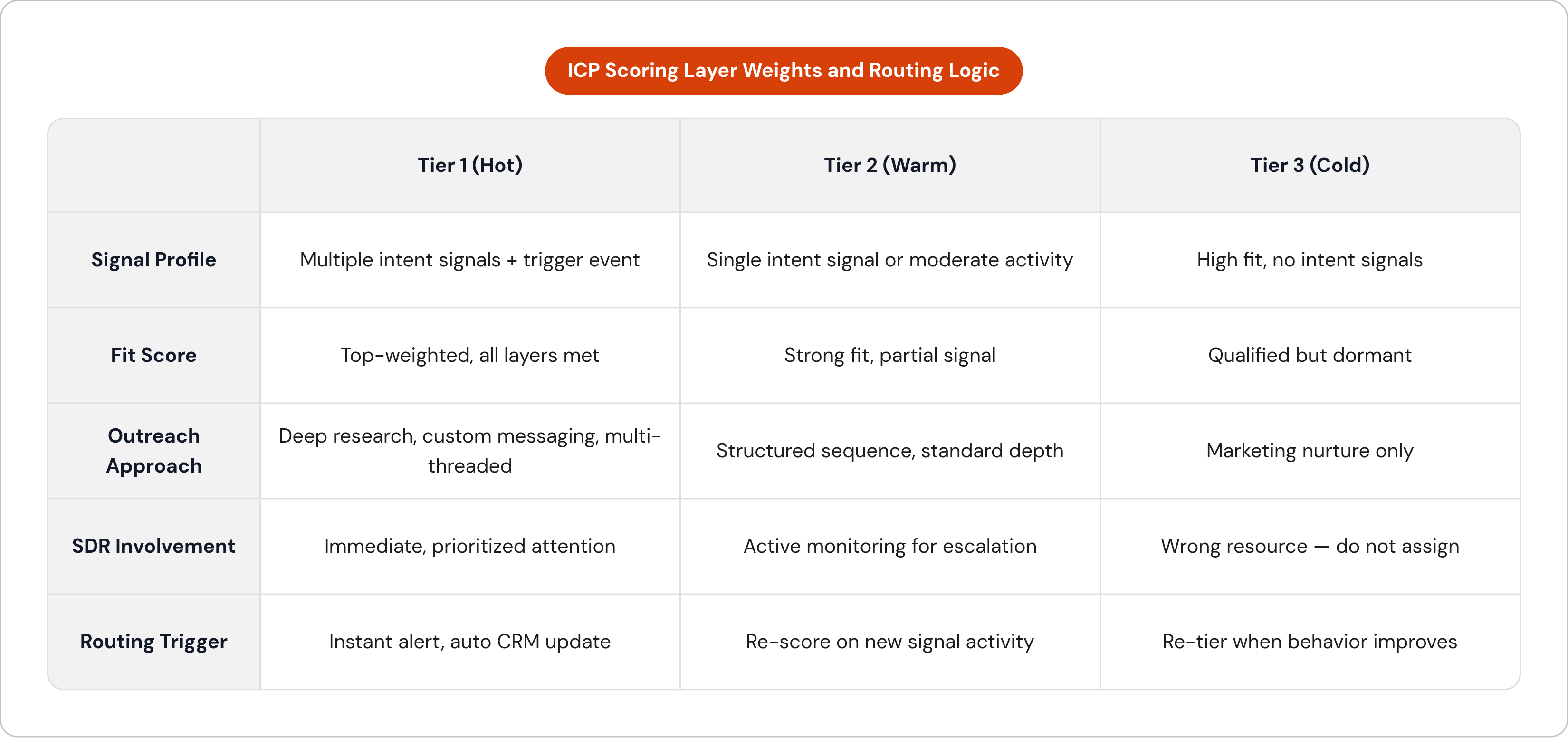
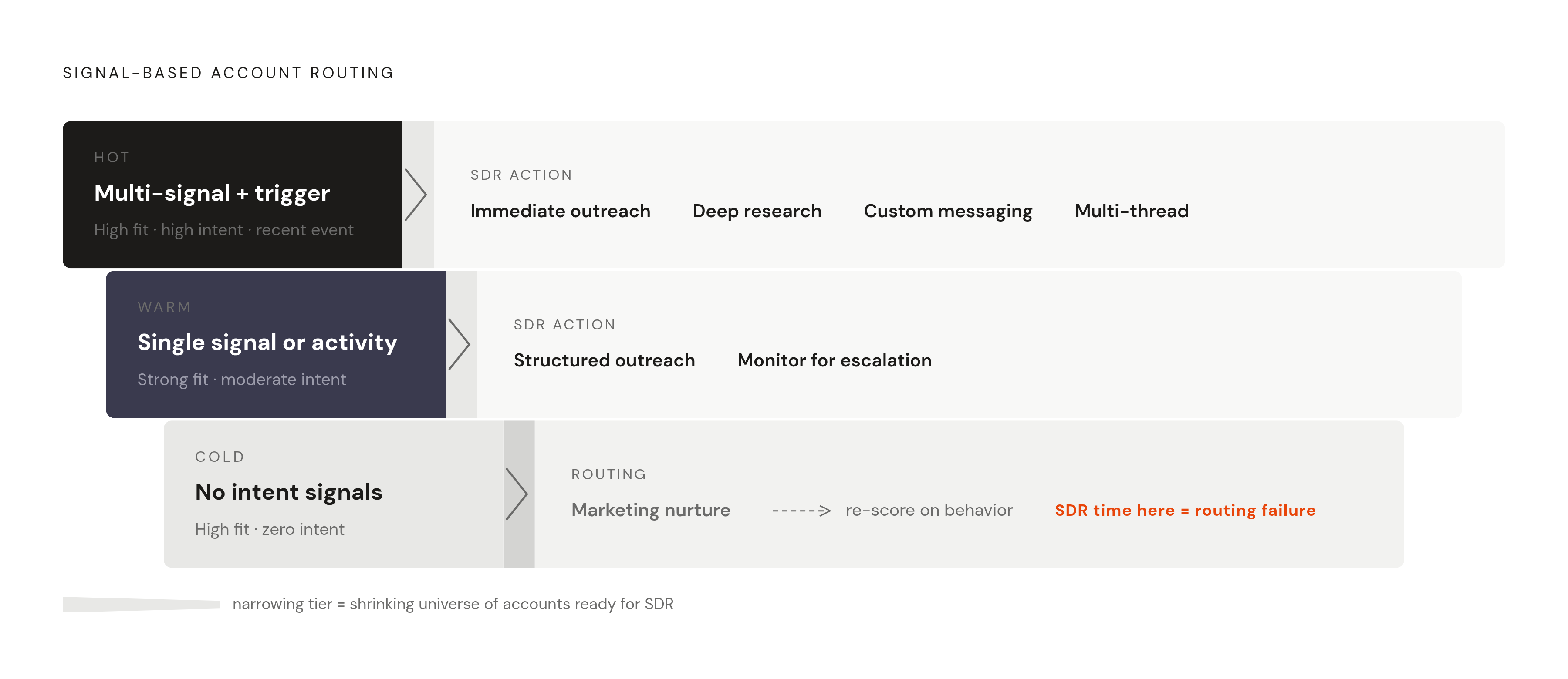
The tier structure that follows from scoring should tie directly to cadence depth and resource allocation, which is the core operating principle of account-based marketing. Tier 1 accounts receive deep research, custom messaging, multi-channel engagement, and multi-threaded outreach, because the conversion probability justifies the effort. Tier 2 accounts receive relevant, structured outreach at standard sequence depth, with active monitoring for signals that would escalate them. Tier 3 accounts, which carry high fit but no intent signals, belong in marketing nurture until behavioral activity improves their score. SDR, or sales development representative, time spent on Tier 3 accounts is not underperformance by the rep; it is a routing failure, and the distinction matters for how you diagnose it.
Research from Landbase's B2B framework work found that 68% of B2B companies have not clearly defined their ICP, and the gap widens further when the ICP is scored and operationalized rather than maintained as a document. The scored model also creates accountability at the rep level: if Tier 1 effort is being applied to a Tier 3 account, a well-designed system surfaces that mismatch before it drains capacity.
The intent signal layer: what behavioral data adds that fit criteria can't
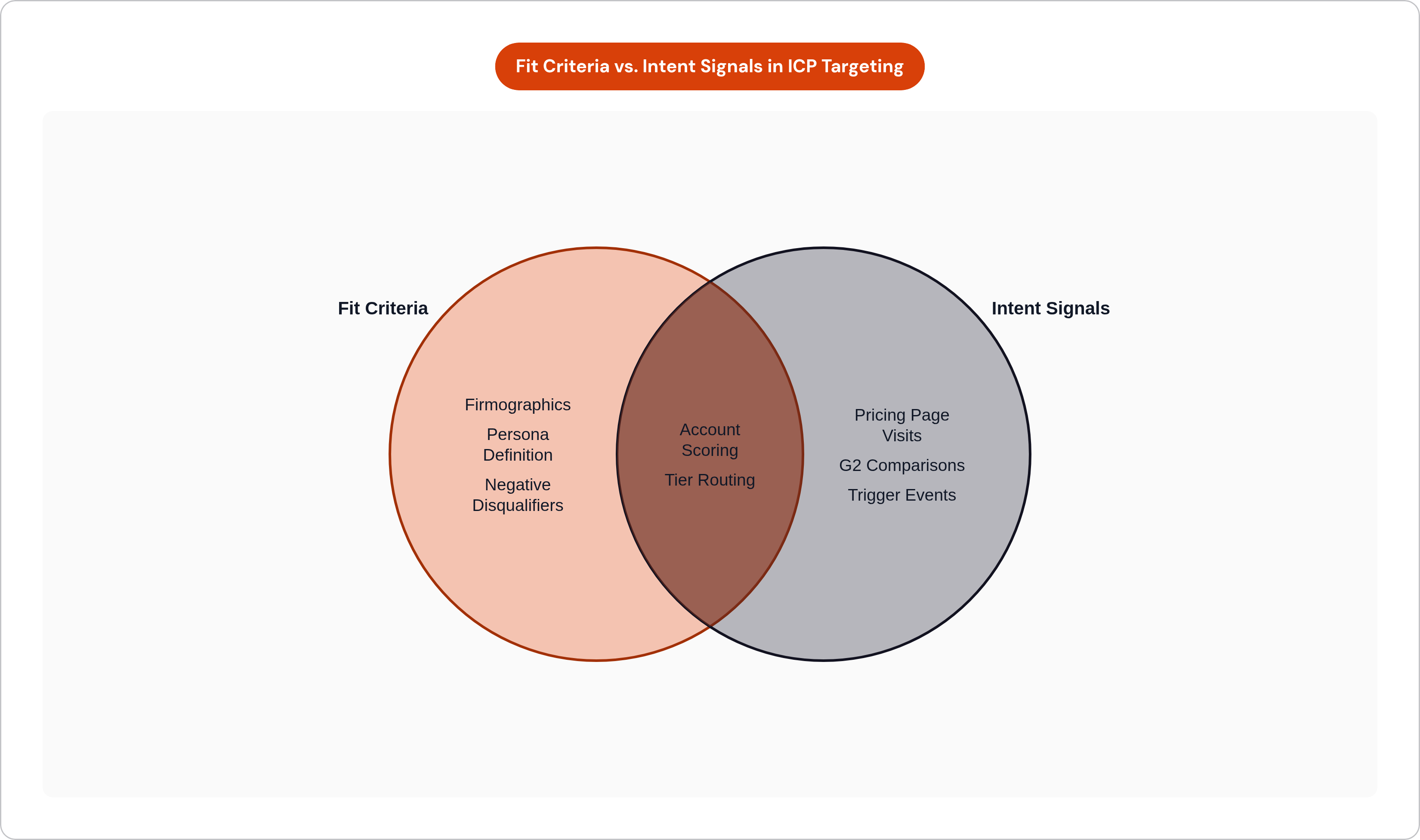
Fit criteria identify who could buy. Intent signals identify who is actively thinking about buying right now. These are different populations, and conflating them is one of the primary mechanisms by which precision lists drift back toward generic ones.
Three signal types are worth distinguishing, not because they are equivalent but because each serves a different purpose. Behavioral signals, including pricing page visits, feature comparison activity, and content downloads, are first-party intent data and the most reliable. Firmographic and technographic signals capture changes in company profile that suggest shifting needs: new funding, a new hire in a key role, a change in the technology stack. Third-party intent data, from providers like Bombora and G2, aggregates browsing behavior across the web to surface purchase research activity at accounts not yet in your ecosystem.
Signal strength maps to buying stage in ways that should influence routing decisions. G2 comparison activity and pricing page visits are late-stage signals; they warrant immediate outreach. Whitepaper downloads are earlier-stage and warrant nurture. Treating all intent signals as equivalent is a version of the same error as treating all funded companies as equivalent.
DemandScience data found that 91% of marketers report using intent data, but only 24% describe themselves as achieving exceptional ROI from it. That gap is largely an execution problem. Intent data that is stale, or that lands in a spreadsheet rather than triggering action, produces results no better than having no intent data at all. Bynder's use of 6sense intent data to identify in-market accounts resulted in a 2.5x increase in outbound pipeline and full ROI within four months, a concrete illustration that the infrastructure around the data matters as much as the data itself.
The trigger events that create the highest-conversion windows in any list
Not all intent signals carry equal conversion weight. Trigger events tied to organizational change create buying windows that standard intent data cannot replicate, because they represent moments when decision-making authority is active and external evaluation is expected, sometimes even welcomed.
Funding announcements open a window because new capital signals pending infrastructure decisions. Leadership in a freshly funded company is actively evaluating what the growth architecture will look like, and vendors who reach out during this window encounter less inertia than they would six months later, once those decisions have been made and budgets allocated. The window is shorter than most teams assume.
Leadership changes are among the highest-conversion trigger types available. A new VP of Sales 90 days into a role is actively evaluating vendors, is more likely to engage than an incumbent with no external pressure to change anything, and is building credibility internally in ways that make vendor relationships part of the process. I kept weighting new leadership changes more heavily than almost any other trigger, not because of a framework, but because I kept watching the pattern repeat: the incumbent ignored the outreach; the successor took the call. That observation is not a rule, but it has been consistent enough to treat as a strong prior.
Champion tracking operates differently from the preceding two triggers. When someone who has used your product at a previous company moves to a new role, they carry both the purchase history and the institutional knowledge of what the product solved. Tools like Clay and UserGems detect these moves from LinkedIn profile updates, and the conversion probability at that account is substantially higher than cold outreach to an account with no prior relationship.
Tech stack changes round out the highest-value trigger types. Adding or removing a tool adjacent to your category signals a vendor review already in progress; the account is already in evaluation mode, and the question is whether you are present for it.
Research on trigger-based outreach consistently points toward higher conversion rates and shorter sales cycles compared to cold outreach from static lists. Speed is not optional here. The first seller to reach out after a trigger event is substantially more likely to win the deal, and the window for leadership changes and funding announcements in particular is measured in hours rather than days. A precision list built to sit for 90 days before being worked is a static artifact that decays from the moment it is built, regardless of how precisely it was constructed.
How to route signal-scored accounts into the right outreach tier without losing speed
The criteria work done upstream means nothing if routing introduces latency. A signal that fires and sits unacted upon for 48 hours is a missed window, not a strategic asset. Teams with strong list criteria lose deals because their routing process required a human to read a report every Monday morning. That is a painful thing to diagnose after the fact, and it happens more often than anyone running the team usually realizes until a lost deal surfaces the timeline.
A three-tier routing model based on signal strength translates the scoring architecture into action. Hot accounts, those with multiple intent signals, a high fit score, and a recent trigger event, require immediate SDR attention. These accounts are in an active buying motion, and the outreach should reflect that with deep research, custom messaging, and multi-threaded engagement. Warm accounts carry a single intent signal or moderate activity against a strong fit profile; they receive structured, relevant outreach and are monitored for escalation signals. Cold accounts carry high fit but no intent signals, and SDR time is the wrong resource for them. Marketing nurture, calibrated to surface the behavioral activity that would warrant re-scoring, is the right motion.
Routing accounts by signal strength rather than alphabetical order or static territory assignment produces a measurable improvement in SDR meeting rates. The directional finding is consistent across teams that have made the switch: rep time concentrated on the highest-signal accounts outperforms rep time distributed evenly across all qualified accounts.
The routing layer should be designed to trigger Slack alerts, surface meeting links, and update the CRM the moment a signal fires. Accounts that move from cold to warm on new signal activity should be re-scored and re-tiered automatically, rather than staying in a bucket that no longer reflects their status. Manual re-triage is where the latency originates, and latency is where the window closes.
The tooling that makes precision list criteria executable at scale
A precision list-building workflow spans several tool categories: data sourcing, enrichment, intent data, and outreach execution. Each handoff between them is a place where data freshness and accuracy can degrade, and degradation at any point in the chain reduces the value of everything that preceded it.
For firmographic and funding data, Apollo, LinkedIn Sales Navigator, and Crunchbase cover company-level filtering and funding stage identification. For technographic data, Clay, Clearbit, and BuiltWith provide real-time stack filtering, each with different coverage and freshness tradeoffs. For intent and third-party behavioral data, the Forrester Wave on intent data providers named Intentsify, 6sense, Bombora, Informa TechTarget, and Demandbase as Leaders, evaluated across 21 criteria; pricing in that segment ranges from roughly $7,000 to well over $150,000 per year depending on scope and tier. Champion tracking and job change signals are covered primarily by Clay and UserGems.
The cost trap in this stack is real and underappreciated. The cheapest intent data tool frequently becomes the most expensive once you account for the downstream infrastructure required to act on what it produces. Evaluating tools on total workflow cost rather than license cost changes the comparison in ways that are invisible on a vendor pricing page, and most teams only discover this after the contract is signed.
The more substantive challenge is the handoff architecture. Static exports from enrichment tools that feed into a separate outreach platform introduce lag at precisely the point where speed matters most. Platforms that close the loop between enrichment signals and outreach execution, reducing the number of manual steps between a signal firing and a rep taking action, produce better outcomes not because the underlying data is different but because the latency between signal and response is compressed. Some platforms are built around that principle, integrating technographic signals directly into outreach logic and triggering automated follow-ups when a prospect's stack changes or a new tool appears in their environment.
Criteria quality and execution speed are related variables, not independent ones. A precision list built on five criteria layers and a rigorous scoring model can still underperform if the infrastructure routes signals slowly or requires manual intervention to act on them. The list is the strategy. Tooling enables the strategy to operate at the pace the market requires.