Personalization at Scale vs True Precision Outbound
Teams reach for volume outreach dressed as personalization when precision timing should come first.

There is a phrase that has quietly colonized the sales technology industry: "personalization at scale." It appears in every tool's marketing copy, every SDR manager's quarterly objectives, every conference keynote about the future of outbound. And like most phrases that achieve ubiquity, it has lost the precision that would make it useful. What most teams mean when they say it is something considerably more modest: first-name tokens, company-name inserts, a sentence repurposed from a LinkedIn bio, assembled by an enrichment pipeline and dispatched to a list of thousands. What they think they mean is something else entirely, something closer to what the industry would be better served calling precision outbound. Conflating these two strategies is not merely a semantic problem. Teams that treat them as interchangeable end up running volume outreach dressed up as personalization, absorbing the cost of both approaches while capturing the conversion rate of neither.
The distinction matters enough to state cleanly before proceeding. Personalization at scale automates customization tokens and variable fields across a large prospect universe to make generic outreach feel marginally more relevant. Precision outbound is a signal-first targeting discipline where real-time behavioral triggers determine who gets contacted, when, and with what message. The former answers "can I reach this person?"; the latter asks "should I reach this person right now?" The article that follows does not argue that personalization at scale is useless. It argues that most teams reach for it first, when precision targeting should come first.
How "personalization" Became a Volume Game, and Why That Created a Noise Problem
Outbound tooling evolved to solve a coverage problem. The question every sales leader asked was some version of: how do we reach more accounts faster? The answer the industry built was automation layered on top of enrichment. Waterfall enrichment pipelines fill in contact fields from multiple data providers; variable substitution then personalizes at send time. That architecture made sense when inboxes were less saturated. A personalized subject line was differentiating when most cold outreach was plainly generic.
The environment has shifted. Decision-makers now receive an overwhelming volume of cold emails weekly, and spam filters have grown sophisticated enough that inbox placement has become a meaningful technical challenge. More consequentially, buyers have developed acute pattern recognition for template-based outreach. A LinkedIn job-title mention no longer reads as evidence of research; it reads as evidence that someone ran a Clay table. The industry's response to declining response rates has been to add more personalization tokens, which produces diminishing returns, which prompts the addition of still more tokens. It is a treadmill.
The deeper structural problem is that enrichment-first pipelines were never designed to answer the timing question. They tell you who exists in an account and what their title is. They do not tell you whether that person is actively evaluating a solution to the problem your product solves, which is what buying intent signals are designed to surface. That question, the one about timing and in-market intent, is what separates signal-first outbound from data-waterfall outbound. It is also the question most teams skip entirely, because their tooling was built to skip it.
What Buyers Actually Want When They Receive Outreach, and Why Cognitive Load Matters
The expectation gap in outbound is well documented even if rarely acted upon. A large majority of buyers report expecting personalized interactions; a similarly large share express frustration when those expectations go unmet. The intuitive response is to personalize more. But there is a ceiling on personalization that the industry rarely acknowledges.
Gartner's research has surfaced a counterintuitive finding: buyers on highly personalized journeys are significantly more likely to feel overwhelmed and to experience decision fatigue, a cognitive load effect that correlates with deal stall and purchase abandonment. More personalization can translate to more cognitive load rather than more conversions. The problem is not personalization itself; it is personalization applied at the wrong moment, to a buyer who is not yet in-market. A heavily customized email sequence landing in an inbox where no active evaluation is underway does not feel like thoughtful outreach. It feels like pressure at an inopportune time.
A related shift compounds this: a substantial share of B2B buyers now express a preference for a rep-free buying experience, according to Gartner's research on buyer behavior. Outreach that opens immediately with "book a thirty-minute call" misreads where most buyers sit in their decision process. Outreach that routes to a self-serve asset, a relevant case study, a benchmark report, a specific insight, earns attention before asking for time. The implication is that personalization is not the output. Relevance is the output, and relevance is a function of timing and signal, not of how many fields were populated before sending.
A buyer who just posted a job for a VP of Sales, raised a Series B, or migrated CRM tools is a fundamentally different contact than the same person three months earlier. Identical firmographics, entirely different moment. That moment is what precision outbound is designed to find.
The Five Signal Tiers, and Why Most Teams Only Use the Lowest One
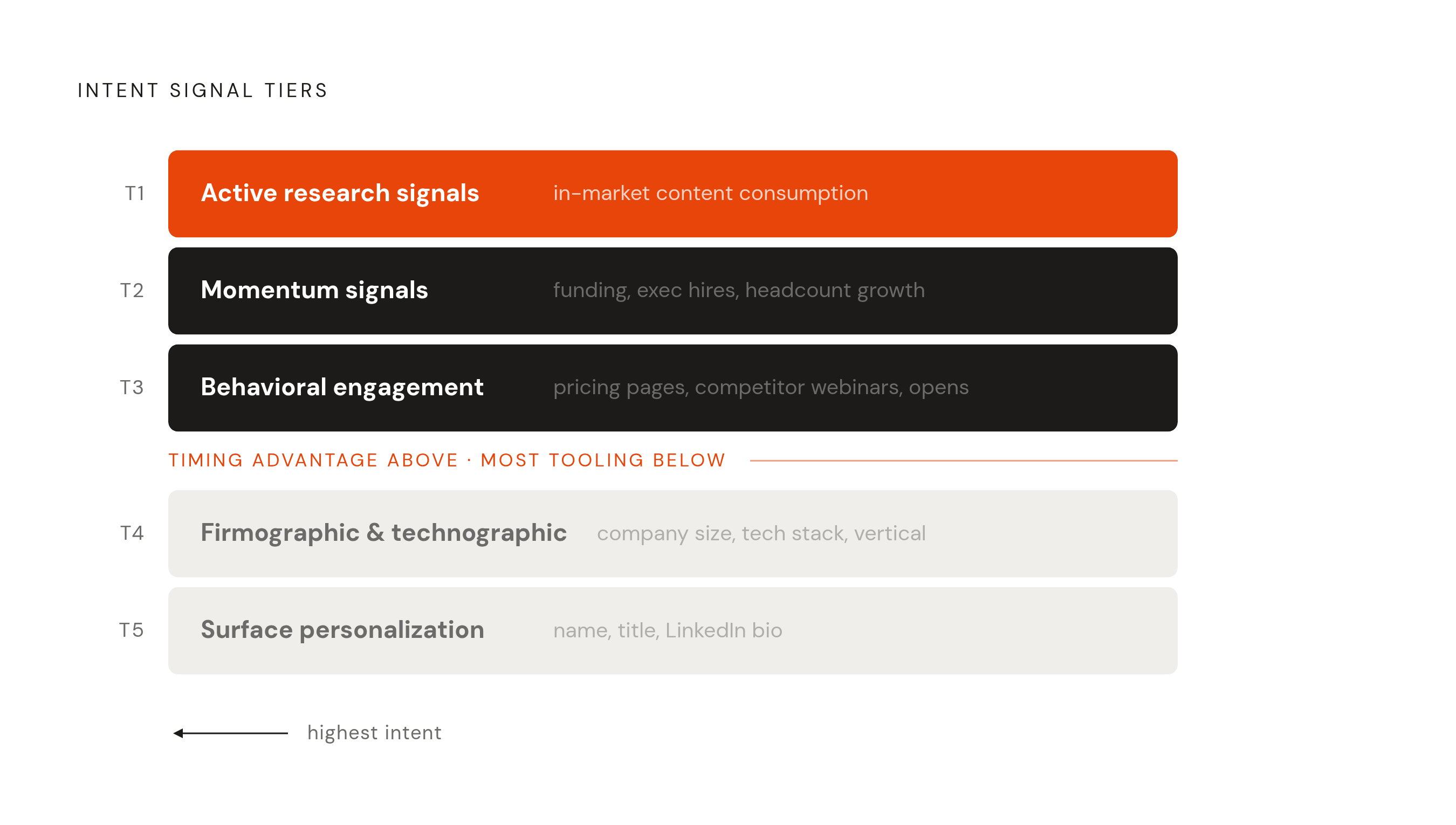
Not all signals carry equal weight. There is a hierarchy based on how directly a signal indicates in-market intent, and understanding that hierarchy makes clear why most outbound underperforms.
At the top sits active research signals: an account is consuming content directly related to the problem your product solves. Below that are momentum signals, funding rounds, executive hires, rapid headcount growth, product launches. Third are behavioral engagement signals, a prospect visiting a pricing page, attending a competitor webinar, opening a previous sequence. Fourth are firmographic and technographic data, company size, tech stack, industry vertical. At the bottom sit surface-level personalization fields: name, title, company name, a detail from a LinkedIn bio.
The observation that follows from this hierarchy is not subtle. Most outbound tooling is built around tier four and tier five. Enrichment pipelines are designed to populate those layers. Sequencing platforms are designed to insert those fields. The industry optimized for the two signal tiers that require no real-time infrastructure and no judgment, because those were the easiest to automate.
Tier one through tier three require something different: real-time signal ingestion, rather than static list enrichment. And they require a different sequencing logic. The mistake most teams make is enriching first, then hunting for signals to justify outreach they have already committed to sending. That is backwards. Signal-first sequencing runs the other direction: detect an in-market trigger, identify the right contact at that account, enrich only that contact, then activate a sequence built specifically around the triggering event.
The performance gap between these approaches is not marginal. Consider the signal combinations that generate the highest leverage. A company posts a job for a sales operations role while also announcing a Series A: strong indication of imminent investment in sales infrastructure. A prospect's competitor just shipped a significant new product: a window for a competitive displacement conversation opens. A contact changes jobs into a new company that fits your ideal customer profile: research consistently shows the first ninety days of a new role represent a high-intent window for outreach, because new leaders are actively evaluating tools and vendors, making job change triggers one of the highest-converting signal types in precision outbound. In each case, the signal creates a specific, timely context that a well-crafted message can reference. The same message sent three months later, with all the same personalization tokens, lands in a different psychological environment entirely.
What Precision Outbound Looks Like in Practice: The Small-Pool, High-Contact Model
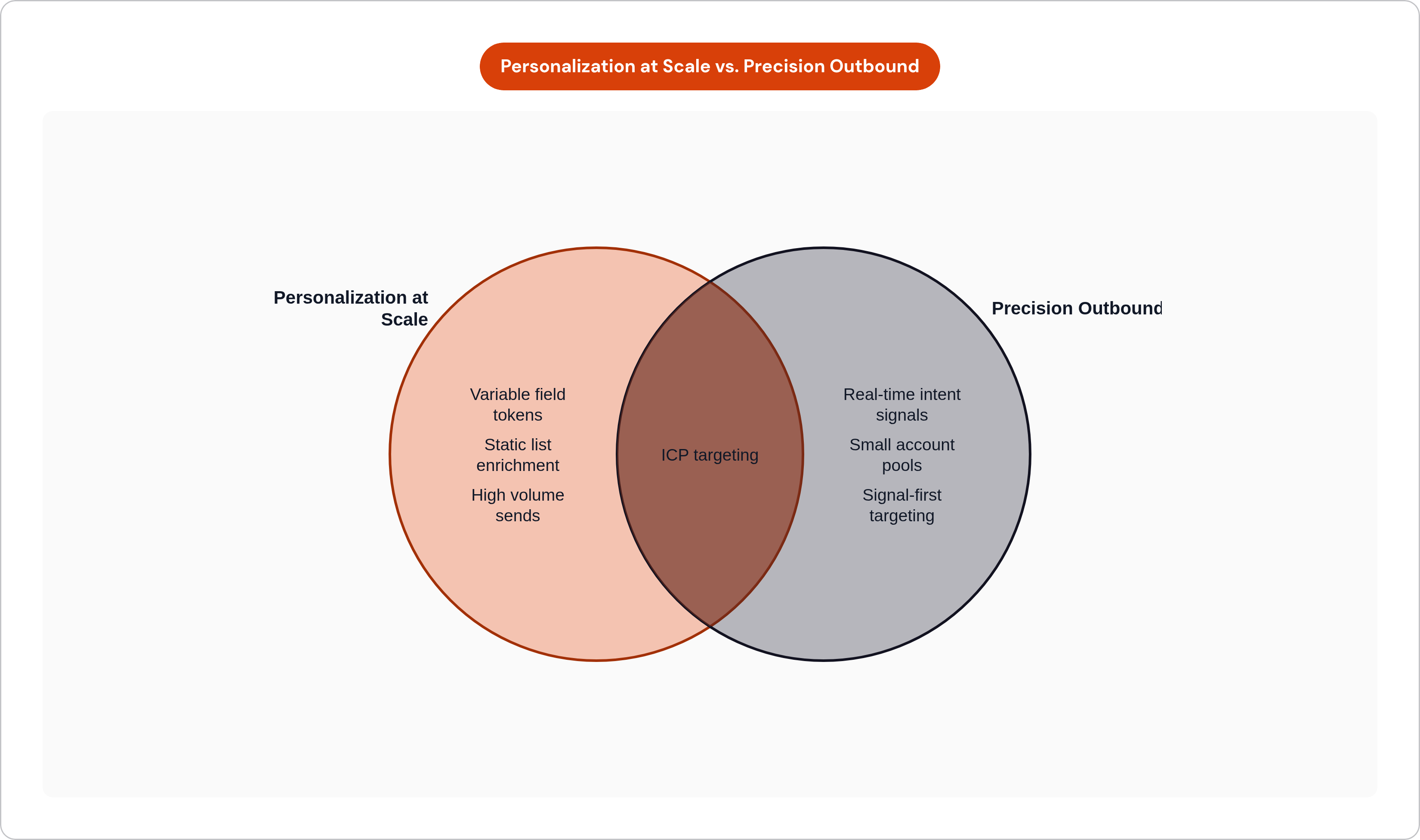
The most clarifying case study on precision outbound methodology comes from documented practitioner work at Deel, where a single rep ran hyper-personalized sequences on pools of roughly thirty accounts per business case, with one clear angle, one specific trigger, and a multi-channel approach. The structural logic is worth examining directly. A pool of thirty accounts makes deep per-account research tractable; one clear angle keeps the message tight and coherent across the sequence; multi-channel touch across email, LinkedIn, and phone multiplies surface area without diluting the central argument.
"One angle, one trigger" sounds simple and is harder to execute than it appears. One angle means the specific business problem this prospect has that your product solves, described in terms of the prospect's situation rather than your product's features. One trigger means the real-world event that makes right now the right time to surface that problem. Every follow-up in the sequence, every LinkedIn touchpoint, every call reinforces that single angle rather than introducing new value propositions. This is the opposite of how most sequences are written, where each touchpoint introduces a different benefit in hopes that something lands.
Multi-channel lift is real and measurable. Sequences that coordinate email, LinkedIn, and phone generate meaningfully higher engagement than single-channel approaches, and the multi-touch cadence itself should plan for a substantial number of touchpoints per prospect, typically in the range of eight to twelve, rather than the two to three touchpoints common in volume outreach.
The contrast with personalization at scale is structural, not merely philosophical. Volume personalization runs five thousand contacts through two to three touchpoints with variable fields and a broad ideal customer profile (ICP). Precision outbound runs thirty accounts through eight to twelve touchpoints with signal-triggered activation and a single business case per pool.
For early-stage teams in particular, the math strongly favors precision. When total addressable pipeline is a few hundred companies, a small number of deeply researched sequences will consistently outperform a large number of generic emails. One tactic worth naming here: inviting a small group of industry experts into an advisory conversation, rather than a sales pitch, generates early meetings and creates a pathway from advisor to buyer that entirely sidesteps the cold-email dynamic. It is a precision move precisely because it treats the relationship as the asset.
Where AI Agents Fit, and the Difference Between Automating Volume and Automating Precision
The market is moving quickly toward agentic AI in outbound sales. A meaningful share of enterprises have already deployed autonomous AI agents, and adoption is projected to grow substantially over the next several years, per Deloitte's research on enterprise AI adoption. But the category has a feature-washing problem. Gartner has named "agent washing" as a specific risk: tools relabeling existing automation as agentic AI without delivering autonomous decision-making.
The distinction that actually matters for outbound practitioners is not whether a platform calls itself agentic. It is whether the agents are executing volume at scale or executing precision at scale. Volume AI generates more emails, personalizes more tokens, sends to more contacts: it automates the same flawed strategy faster. Precision AI monitors signals continuously, identifies which accounts cross an intent threshold, activates the appropriate sequence at the right moment, and routes to a human when judgment is required. These are categorically different applications of the same underlying technology.
Capable agentic functionality in an outbound workflow looks like this: signal ingestion and account scoring without manual list-building; sequence activation triggered by a specific event rather than a batch send schedule; CRM sync and follow-up execution without rep intervention on routine steps; escalation to a human for high-value actions where relationship judgment is irreplaceable. The agent handles the workflow; the rep handles the moment.
Research on enterprise deployments of sales automation has demonstrated that pipeline stages progress meaningfully faster when agents handle enrichment and follow-up, not because more outreach was sent, but because friction was removed from every step that does not require human judgment. The value creation is in velocity and precision, not in raw volume.
The governance dimension is not optional for teams building this seriously. Agents with access to customer data and the ability to take autonomous actions require defined permissions and human approval gates for consequential decisions. Gartner has been direct on this point: the guardrails matter as much as the technology. A team that deploys precision AI without governance constraints will eventually have an agent send something to someone at exactly the wrong moment, with no human in the loop to prevent it.
Why Founder-Led Teams Are the Natural Home for Precision Outbound, and How AI Changes Their Leverage
Early-stage teams do not have the list size, the budget, or the inbox reputation to win a volume game against established players. They rarely should try. What they do have is a structural advantage that volume outreach cannot replicate: the founder or earliest GTM hire typically knows the ICP more deeply than any outsourced SDR team, because they built the product in response to a problem they observed firsthand. That knowledge is the raw material precision outbound runs on.
Research into early-stage GTM strategies consistently surfaces the same finding: LinkedIn, warm outbound, and founder brand are the most effective channels for early-stage companies, not broad cold email campaigns. These are inherently precision channels. LinkedIn rewards specificity and expertise. Warm outbound depends on real relationships and context. Founder brand compounds over time through specific, sometimes contrarian takes that build trust with potential buyers before the first direct outreach. When the cold email eventually arrives, it lands differently because the recipient has already formed an opinion about the sender.
The first-180-days framework from documented early-stage GTM practice is worth making explicit. Prove one repeatable wedge before launching every channel. Run founder-led outbound on a small pool: a hundred targeted emails, ten meetings, three customers. Refine the ICP based on who actually bought, then double down on that profile. Activity that does not map to the established wedge is distraction, not progress. This is discipline that large sales teams struggle to maintain and early-stage teams can enforce structurally.
AI changes the leverage equation for these teams in a specific way. A two-person team using AI agents for signal detection, sequence execution, and CRM automation can produce the output volume of a much larger GTM function. The constraint shifts from capacity to targeting quality. But the risk is symmetrical: AI amplifies whatever strategy it is pointed at. A two-person team using AI to send more generic outreach at higher volume will reach saturation faster, exhaust their limited addressable pool, and burn inbox reputation that is difficult to recover. The same team using AI to execute fewer, sharper sequences will extend their runway, improve conversion, and build relationships that compound into referrals.
The Stack Problem: Why Fragmented Tooling Makes Precision Outbound Structurally Harder to Run
Precision outbound requires signal detection, account research, list building, sequence activation, multi-channel coordination, and CRM synchronization to all operate from the same data layer. When those functions live in separate tools, the workflow breaks, and it breaks in ways that are difficult to diagnose because the failure is distributed across the stack.
The fragmentation problem in practice looks like this: a signal is detected in one tool, manually exported to a list-building platform, enriched by a third-party data provider, imported into a sequencing tool, and then logged manually to the CRM. By the time that workflow completes, the signal window may have passed. The account that was in-market last week has already received outreach from a competitor whose signal-to-sequence velocity was faster. In precision outbound, timing is not a nice-to-have; it is the mechanism. Every tool boundary introduces latency and data loss that degrades the precision of the entire strategy.
Volume personalization is tolerant of fragmentation because timing is irrelevant to its logic. Sending to a static list on a batch schedule can absorb a two-day lag between enrichment and send without consequence. Precision outbound cannot absorb that lag, because the signal that justified the outreach may no longer be active.
Deliverability is a related integration failure that fragmented stacks handle poorly. Secondary domain management, mailbox warming, email authentication, and volume ramping need to be coordinated across the sending infrastructure. When those functions live in different tools maintained by different vendors, deliverability devolves into an IT problem rather than a revenue function. Teams running precision sequences on small pools have no tolerance for deliverability failures; every bounced email or spam-folder placement represents a meaningful percentage of their total outreach capacity.
The consolidation case is not about convenience. It is about whether the strategy is structurally executable at all. Platforms built primarily around tier four and tier five signals perpetuate the personalization-at-scale trap by design, because their data models were built to answer "who can I reach" rather than "who is in-market right now." Cardinal is built around a different premise: as an AI agent platform for outbound sales, it deploys AI agents to handle prospecting, enrichment, and sequence activation from a unified platform, consolidating the signal-to-sequence workflow that fragmented stacks force teams to stitch together manually across disconnected tools.
The broader point holds regardless of which platform a team chooses: a precision outbound strategy executed across a fragmented stack will underperform a volume strategy executed on an integrated one, simply because the friction of the workflow will erode the timing advantage that precision depends on. Solving the strategy without solving the infrastructure is an incomplete answer.
The industry will continue selling "personalization at scale" because it is a tractable product to build and an easy promise to make. Tokens are automatable; timing requires judgment. But the teams that compound over time, the ones that build pipeline efficiently and sustainably, are the ones that learned to ask the harder question first: not "can I reach this person," but "is right now the right moment to." That question is not answered by enrichment. It is answered by signal. And the gap between teams that understand the difference and teams that are still missing it is widening fast enough that it is worth taking seriously now.