Precision Outbound for Founder-Led Sales at Pre-Seed
Founders should do early outbound themselves, targeting only prospects with immediate urgency.

Inboxes in 2025 are more defended than at any prior point in the history of email. AI-generated outreach has flooded every channel to the point where buyers have developed sophisticated filters, both technical and psychological, against anything that reads as automated. A named founder with a real face, a credible professional history, and a real stake in the outcome cuts through that noise in a way a generic sales development representative cannot, which is the central premise of founder-led sales.
Some of this is structural. A founder's outreach doesn't read as a sales function; it reads as a peer conversation, and buyers respond to those differently. The implicit message in a founder's email is: the person who built this thing thinks it's relevant to your situation. The buyer isn't evaluating a product pitch so much as deciding whether a peer considers their problem worth solving.
Some of it is reputational. Before a buyer at a mid-size SaaS company takes a call with an unknown startup, they run a backchannel check: LinkedIn profile, anything published, a quick sense of the person before a single word is spoken. Domain credibility does a significant portion of the selling before the meeting begins. A VP of Sales receiving an email from a founder with a visible background in revenue operations engages differently than if the same message came from an anonymous SDR account.
The less-discussed dividend may be the most valuable one. Every outbound call a founder takes is simultaneously a product research session, an objection-collection exercise, and a positioning feedback loop. The patterns that surface in those early conversations, the objections that keep appearing, the arguments that actually land, become the sales playbook that future account executives inherit. No secondary research produces what ten solid sales conversations produce in a week. I have watched founders try to shortcut this by hiring an SDR at pre-seed, and what they tend to get is a playbook built on borrowed assumptions rather than earned signal.
The constraint is real: founder time is the scarcest resource at pre-seed. That constraint is not a reason to delegate outbound early. It is a forcing function for targeting precision, because you cannot afford to spend founder hours on the wrong people.
Defining the ICP Tightly Enough to Actually Use It
Most startup outbound programs fail at ICP definition, and no tool compensates for a bad one. This is the most common and most consequential mistake I have seen, partly because demographic ICPs feel specific enough to be useful when they are not.
An ICP built around firmographic data like industry, company size, and buyer title is a starting point, not a targeting strategy. A description like "VP of Sales at B2B SaaS companies with 50 to 200 employees" could describe tens of thousands of people, most of whom have no urgent reason to engage with an unknown early-stage product right now. Urgency is the variable most ICP frameworks omit entirely, and it is the one that matters most at pre-seed.
A usable ICP is an intersection: company stage, technology stack, observable growth signals, buyer title, and a specific urgency condition that predicts active evaluation. Consider the difference between "VP of Sales at a Series A SaaS company" and "VP of Sales at a Series A SaaS company, 20 to 80 employees, hired within the last 90 days, currently running HubSpot." The second description is a targeting decision. The first is a persona document.
Why do so many founders default to the persona document? Not because they don't understand the distinction. In my experience, they default to it because specificity feels like risk; it seems to shrink the addressable market. This is understandable and mostly wrong. At pre-seed, a smaller list of the right people outperforms a larger list of the wrong ones regardless of total addressable market size, and not by a small margin. The first ten conversations will reshape your ICP more than any research session — surfacing the firmographic details you assumed mattered and didn't, and the ones you hadn't thought to include that turn out to predict conversion.
A useful test for ICP tightness: could you build a list of 50 people matching this description in under two hours using publicly available information? If the answer is no, the definition is not operational. It may be accurate; it is not actionable. Start narrow and expand. ICP definition is iterative, not declarative, and the iteration is only possible if you begin with something specific enough to generate feedback.
Using Trigger Events to Build a List That Feels Almost Predictive
A new VP of Sales, 90 days into a role, is actively evaluating vendors and, per 2025 campaign data, roughly three times more likely to reply to outbound than a counterpart operating under no external pressure to change. The mechanism is straightforward: executive hiring creates a natural evaluation window. The incoming VP is expected to assess the current stack, identify gaps, and make moves. Outreach that arrives during that window is not interrupting; it is arriving at the right moment.
This is the core principle behind trigger-based list building. The prospect is already in motion. Your message does not need to create urgency; it needs to arrive when urgency already exists.
High-value triggers for pre-seed outbound include several distinct event types. Executive hiring at the VP of Sales or Head of Revenue level signals an active tool evaluation cycle. Recent funding announcements signal that a company is in buying mode, though "congratulations on your raise" has become among the most ignored openers in cold email; a more effective approach layers in the hiring or technology signal rather than leading with the funding fact. Job postings for SDR or AE roles signal that an outbound motion is being built from scratch, which is precisely the moment to reach the founder or revenue lead with a relevant solution. Technology stack changes, visible through technographic data providers that track software installs and departures, signal a switch in progress and a buyer who has already accepted the need to change vendors. News triggers including product launches, expansion announcements, and merger activity create new operational pressures that justify referencing the specific event rather than a generic pain point.
Y Combinator, Techstars, and 500 Global batches represent an overlooked source for certain product categories. These companies receive a flood of congratulatory emails after each announcement cycle, but almost none of those emails are segmented by actual hiring or technology signals. A signal-layered approach targeting the relevant subset of a batch stands out because the batch-level "congrats" email has become its own category of noise.
The practical discipline I have found most durable is to hand-pick ten leads daily based on trigger events rather than building a large static list and working through it mechanically. This forces you to stay connected to the signal, to evaluate whether each account actually meets your urgency condition, and to resist the temptation to inflate list size in ways that dilute quality. The infrastructure cost for bootstrapping this is minimal: LinkedIn job change alerts, a funding announcement monitor, and a single job board tracker are sufficient to build a daily trigger event list without a large tooling budget. The discipline cost is real but manageable.
Cold Email Economics and Why Volume Is the Wrong Instinct
Cold email is the only B2B outbound channel where a ten-person startup can reach a VP at a five-hundred-person company for under two dollars per contact. LinkedIn's paid CPM rates run between $15 and $30 per thousand impressions. Google Ads targeting B2B keywords averages $40 to $80 per click. Cold email's cost structure is not its only advantage, but its accessibility at pre-seed makes it worth understanding precisely.
The economics that matter, though, are not raw cost. They are the relationship between targeting precision and outcome quality.
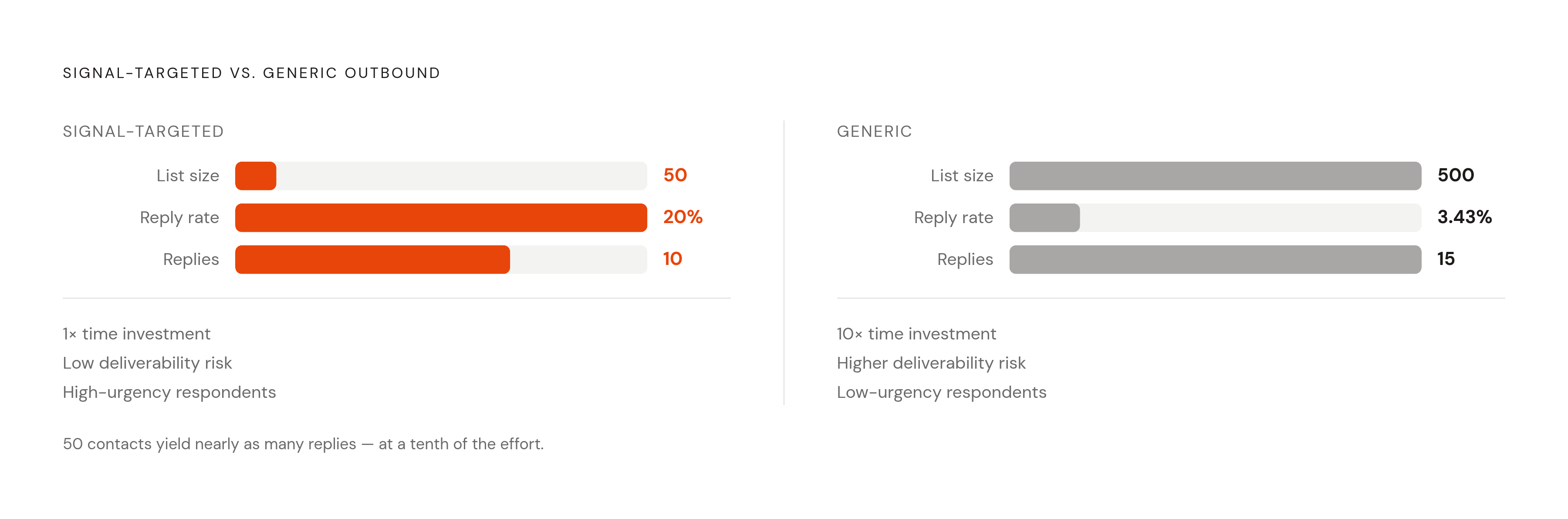
Generic cold outreach averages a 3.43% reply rate, per the Instantly 2026 Benchmark. Signal-based personalization, pairing a specific trigger event with a relevant value proposition, reaches 15 to 25%. Stacking two or three signals can push that range to 25 to 40%. A 50-person signal-targeted list at a 20% reply rate produces ten replies. A 500-person generic list at 3% produces fifteen replies, but at ten times the time investment, with meaningfully higher deliverability risk, and with a population of respondents who have demonstrated no urgency. The ten replies from the tight list represent conversations that validate ICP and surface repeatable objections. The fifteen from the generic list are, by construction, mostly noise.
It is worth pressing on what those fifteen replies actually cost in founder time: time that could have been spent deepening the signal on accounts most likely to convert. The instinct to scale volume before validating targeting is common among first-time founders. It is also frequently wrong, and the reason it persists is that it feels productive. Sending 500 emails is a measurable action. Spending two weeks tightening ICP criteria and building a 50-person list is harder to defend internally.
Eighty percent of high-performing B2B teams rely on outbound as a key revenue source, per the Outreach Prospecting 2025 Report. The gap between average and elite performers has never been wider, and it is almost entirely a function of targeting discipline. Over a sustained 30 to 45 days of founder-led outbound executed with this level of precision, a focused effort can realistically produce eight to twelve qualified meetings and an initial pipeline of $150,000 to $250,000. That figure depends heavily on ACV, ICP accuracy, and sequence quality; it is not a guarantee. It is, however, what careful execution of this approach has produced across the companies I have seen run it well.
Building the Email Infrastructure Before Touching a Single Prospect
Email deliverability tightened significantly between 2024 and 2025. Google and Microsoft moved toward engagement-based filtering, meaning sender domain reputation is now a managed asset with real consequences for mismanagement.
The most damaging mistake a founder can make in cold outbound is sending from their primary company domain. One spike in spam complaints and real business email, including investor correspondence and customer conversations, starts landing in junk. The damage is technically reversible and practically very difficult to undo. I have watched founders learn this lesson mid-campaign, and the cost is not just the lost send volume; it is the two to three weeks of warmup required to rehabilitate a new domain before outbound can resume.
The setup that consistently works involves buying separate sending domains that are variations of your primary domain. Every domain needs SPF, DKIM, and DMARC authentication records configured correctly before a single email is sent. Mailboxes need a dedicated email warm-up period of three to four weeks, starting at 20 to 30 emails per mailbox per day and scaling to 50 to 80 at full volume. Most pre-seed founders run two to three mailboxes total, enabling 100 to 240 emails per day: more than sufficient for precision targeting and manageable without a team.
Hard bounce rate must stay under 2% as volume scales. Email verification before sending is the primary lever for maintaining bounce rate at acceptable levels, not an optional precaution. Several reliable verification tools exist at low cost per contact.
Two to three weeks of infrastructure work before sending a single prospecting email produces better outcomes than launching immediately. A burned domain requires starting over entirely, including a fresh warmup cycle. The compounding cost of that delay, measured in lost pipeline during what is typically a narrow founder-focused selling window, exceeds the cost of the initial setup by a wide margin.
Writing the Sequence: What to Say, When, and Across Which Channels
Most founders reach out once and interpret silence as rejection. The evidence does not support that interpretation. Multi-touch sequences, sometimes called sales cadences, produce substantially higher response rates than single contacts, and the most effective orienting principle is to contact ten accounts ten times rather than one hundred accounts once.
The opening email should reference the specific trigger event, not a generic pain point. The prospect should feel encountered at a relevant moment. The construction is simple: one trigger observation, one specific implication for their current situation, one low-friction ask. A request for a 15-minute call converts better than a request for a full demo; the friction is lower and the implied commitment is proportionate to the relationship.
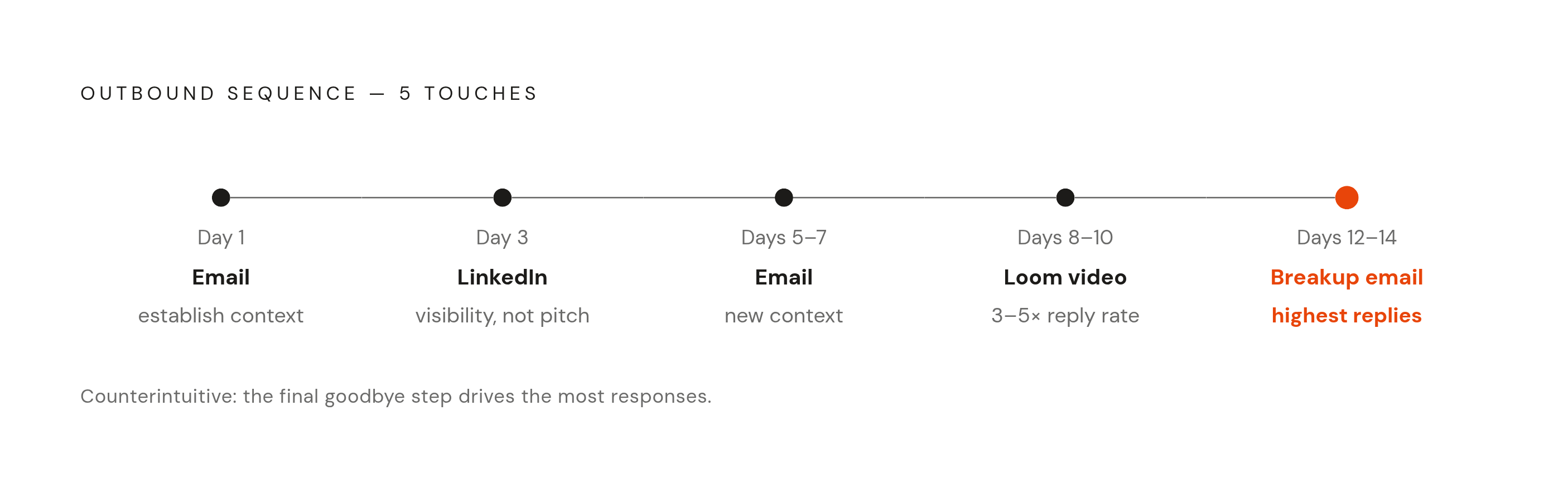
Multi-channel sequencing follows a logic built around progressive investment in the relationship. On day one, the trigger-referenced email establishes context. On day three, a LinkedIn connection request or a comment on the prospect's recent post adds a social layer without a pitch; visibility, not conversion, is the goal at this stage. On days five to seven, a follow-up email adds one new piece of relevant context rather than restating the opener. Between days eight and ten, a short Loom video showing the prospect's website or a relevant screen demonstrates real effort in a way text cannot: personalized video prospecting, deployed correctly in follow-up sequences, produces three to five times higher response rates than text-only outreach. On days twelve to fourteen, a final email with explicit breakup framing, making it easy for the prospect to say no, is frequently the highest-reply step in the entire sequence.
Video works best as a follow-up touch rather than a day-one opener. The earlier contacts establish enough context for the video to feel personal and specific; as a cold opener, before any other signal has been established, it can read as intrusive. Stacking channels increases response odds without adding send volume that damages deliverability. Many prospects see a message in one channel and act only after a second contact in another.
The first variable to test is subject line and opening line, because these determine whether the email is opened and whether it earns a reply. Hold everything else constant until one variable produces a clear and directionally consistent signal before moving to the next.
Using the Founder's Public Presence as an Outbound Multiplier
Every prospect who receives a cold email from a founder will look them up. What they find either substantiates the message or undermines it.
The goal is not a large following. The goal is a credible signal: a public record showing that this founder understands the prospect's problem, has thought about it rigorously, and has something useful to say. A founder whose LinkedIn profile and content history demonstrate domain expertise has effectively done a portion of the selling before the call is scheduled.
For founders who cannot afford significant time on content creation, the practical approach is to post three times per week about the problems they solve, not the product they sell. Content that surfaces failures, hard-won lessons, and counterintuitive conclusions performs better than product announcements for building trust with skeptical buyers. Buyers evaluating an unknown startup are looking for evidence of real expertise and intellectual honesty; product promotion is not that evidence.
Tyler Denk, CEO of beehiiv, grew to more than $20 million in ARR in under four years in part by using radical transparency as a distribution strategy, publishing detailed weekly shipping logs on Twitter and LinkedIn and treating product updates as sales materials. The mechanism is worth examining: consistent, specific, honest content creates an audience of people who are already sold on the founder's thinking before they ever receive a cold email. Not every founder builds an audience at that scale, and Denk's distribution was exceptional. But the underlying dynamic holds even at small scale. A handful of posts demonstrating real expertise changes how a prospect interprets a cold email from the same person, and the change is not subtle.
The pipeline reinforcement effect is direct and underappreciated. When you publish content that addresses the objections surfacing in your outbound calls, and a prospect later encounters that content, the sales cycle shortens. They have already seen your thinking on the problem they were going to raise. A Calendly link in the LinkedIn profile turns passive content engagement into inbound meeting requests with no additional active effort required.
Increasingly, B2B purchasing decisions are discussed in private Slack communities, WhatsApp groups, and professional networks like Pavilion. Founder visibility in these spaces compounds the impact of direct outreach without requiring additional direct contacts. A founder who is already known in a community before reaching out to a community member is operating from a fundamentally different starting position.
What to Track and How to Sharpen the Playbook After Each Cycle
The metrics that matter at pre-seed are not impressions, follower counts, or email volume. They are reply rate by trigger type, meeting rate by ICP segment, and objection frequency by message variant. Each of these answers a specific question about where the system is working and where it is not.
Reply rate by trigger type reveals which signals actually predict buying urgency. After 20 or more touches using a given trigger, a clear pattern emerges about whether that trigger corresponds to real in-market behavior. Triggers that consistently underperform should be cut. Those generating reply rates of 15% or higher should be prioritized.
Objection frequency is the most underused diagnostic in early-stage sales. If the same objection appears across a majority of first calls, it is a positioning problem, not a sales execution problem. The sequence's job is to surface the signal; addressing the root cause is the founder's job. Treating frequent objections as individual persuasion challenges rather than systemic positioning gaps is a common and expensive mistake, and it tends to produce sequences that get incrementally wordier without actually improving.
Intent data and trigger signals are widely used and frequently misapplied. Per DemandScience's State of Performance Marketing report, 91% of B2B marketers use intent data, but only 24% report exceptional ROI. The gap is almost always in execution and follow-through rather than signal quality. A trigger identifies an in-market account; the value is entirely in the speed and specificity of the response. Most teams stall at the detection stage and allow the timing advantage to erode.
After each 30-day sprint, keep the message variant with the highest reply rate, retire the ICP segments that produced zero conversions, and introduce one new trigger type to test. Each sprint should be structured as an experiment with a hypothesis, not a production process to repeat unchanged. The compounding effect of this iteration, applied consistently over several months, is a sales playbook derived from evidence rather than assumption.
The investor-facing output of this iteration is significant and often underestimated. A documented playbook showing month-over-month pipeline growth, improving reply rates, and a tightening ICP is exactly the traction signal that distinguishes a fundable company from one still searching. The median time between seed close and Series A reached 616 days in mid-2025; median Series A revenue hit $2.5 million in 2025, roughly 75% higher than 2021, and frequently exceeds $5 million before a check moves. Investors are writing fewer checks and demanding earlier proof. A playbook demonstrating repeatable, data-derived outbound motion is increasingly the price of admission to the next round, and it is built one ten-person list at a time. Cardinal, a revenue platform that deploys AI agents to automate the prospecting, enrichment, and outreach work this playbook describes for high-growth teams, is one option founders use to run these motions without assembling a separate stack of point tools.