Competitive Intelligence AI Tools for Outbound Targeting
Most sales reps face competitors unprepared, costing millions in winnable deals yearly.

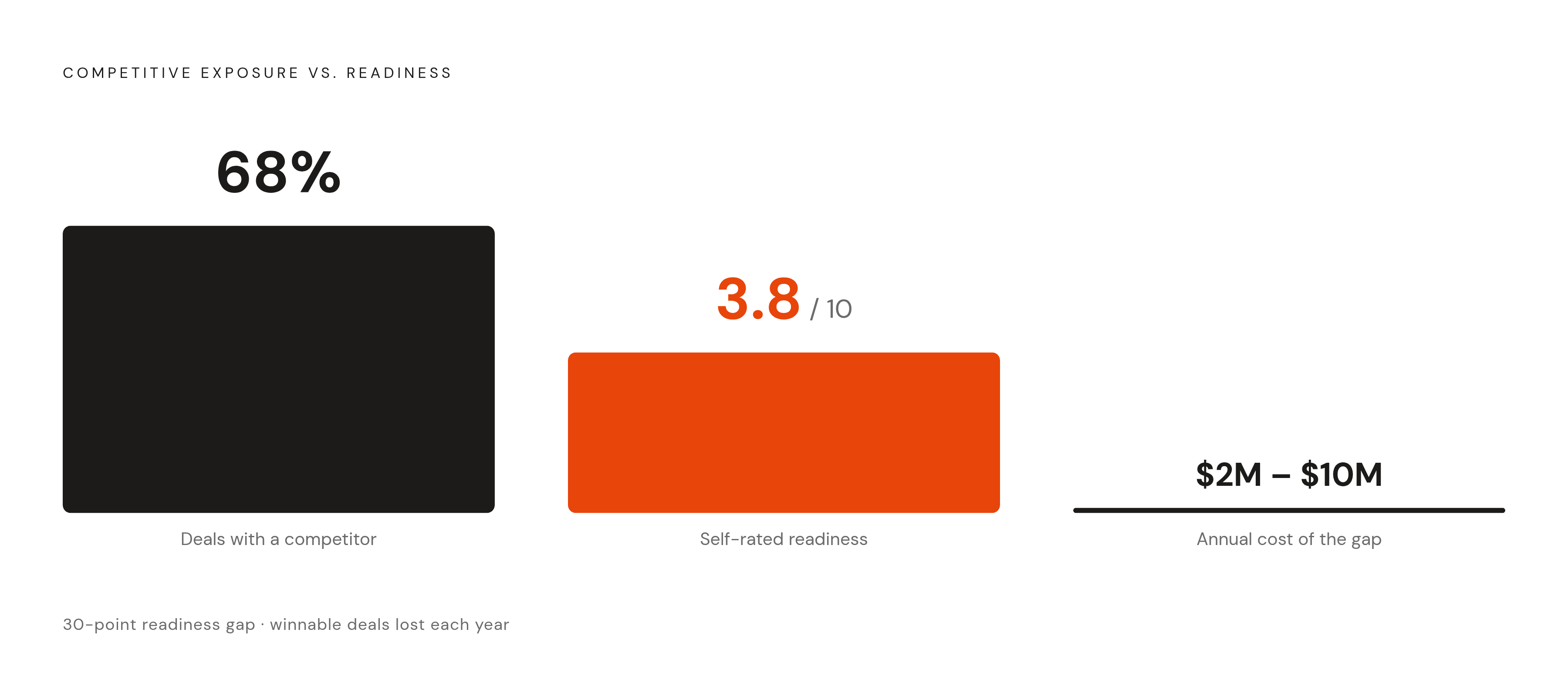
Crayon's 2025 State of Competitive Intelligence report puts a number on something most sales leaders already sense: 68% of B2B deals involve at least one direct competitor. That's the common case, not the edge case. It's most of the pipeline. And yet the same report has sales teams rating their own competitive readiness at 3.8 out of 10, on average. Two-thirds of deals have a competitor in the room, and most reps walk in barely a third prepared for it.
The dollar cost of that gap runs $2 million to $10 million a year in winnable deals, depending on org size, per the same research. That figure is the entire business case for this category, stated before any vendor comparison starts.
What's missing isn't data. Most sales orgs already drown in competitive intel: win-loss decks, stale battlecards, Slack threads from six months back that nobody scrolls up to find. What's missing is timing and placement. Information that shows up late, generic, or buried in a tool the rep never opens might as well not exist. A rep who hears a competitor's name in discovery and gets the relevant battlecard 48 hours later has already lost that argument. The deal moves on without them.
So what closes the gap? Not more competitive data, but data that arrives fast enough, specific enough, and in the right place to change what a rep says in the next five minutes of a call. That's the standard the rest of this piece holds every tool against: does it just track competitors, or does it tell someone who to call, why now, and what to say when they pick up the phone.
How the CI tool market is structured and where outbound-relevant tools live within it
The market has grown fast enough to justify the attention. Mordor Intelligence values the CI software market at $590 million in 2025, on track for $1.46 billion by 2030. Gartner renamed the category from "Tools" to "Platforms" in 2025, a small naming change that says something real: point solutions are giving way to systems that touch CRM, call recordings, and win-loss data all at once.
Inside that market sit roughly five distinct subcategories, and confusing them is the single biggest reason teams churn out within a year. There are dedicated CI and competitive enablement platforms built for sales and product marketing (Crayon, Klue, Kompyte). There's enterprise market intelligence built for corporate strategy and financial research (AlphaSense). There are sales intelligence platforms that bolt competitive signals onto a contact database (ZoomInfo, 6sense). SEO and digital tools built for traffic and ad benchmarking round out one corner, and win-loss and conversation intelligence platforms built for mining calls after the deal already closed or died round out another.
A team that needs outbound triggers and buys a digital-benchmarking tool is going to be disappointed, no matter how good that product is on its own terms. Same story in reverse for a team that needs financial-market signals and buys a lightweight battlecard app. For outbound targeting specifically, only two categories matter: the dedicated CI platforms, for competitive context, and the sales intelligence platforms, for the contact data that turns a signal into a name and a phone number. Everything else is a distraction dressed up as a solution, and teams that buy across five categories at once are usually buying insurance against a decision they haven't actually made.
AI adoption inside CI teams jumped 76% year over year, and 60% of teams now say they use AI daily just for competitive analysis. Gartner's forecast puts real weight behind that curve: by 2026, 40% of technology and service providers will run a commercial CI tool, up from something close to 10% just a few years back. Which raises an uncomfortable question for anyone still deciding whether this is worth the budget line. If 40% of competitors are about to be running these tools, is CI still an edge, or is it becoming table stakes fast enough that not having one becomes the actual liability?
Crayon: end-to-end CI workflow for teams that need measurable impact on win rates
Crayon has earned top-tier recognition from major analyst firms covering the competitive and market intelligence category, including placement in the Forrester Wave for Q3 2026.
The workflow runs end to end. Crayon monitors competitor websites, review sites, social channels, SEC filings, and job postings, then uses AI to classify and rank what it finds before pushing battlecards into Salesforce. Its Measure product goes a step further, tracking how CI usage actually correlates with deal outcomes rather than just counting how many alerts got opened. Win Story Insights pulls competitive patterns automatically out of call recordings, CRM notes, and win-loss inputs, saving someone from manually stitching that story together every quarter. A native integration with Glean puts competitive intel directly inside AI search, so a rep isn't hunting for the right doc mid-call.
G2 has Crayon at 4.6 out of 5. Vendr data puts the median contract around $30,000 a year, with enterprise deals starting near $15,000. That price point, and the depth of the platform, points to a specific buyer: mid-market to enterprise sales orgs with someone whose actual job is competitive intelligence or product marketing, not a founder running CI as a side task between everything else.
That's also the limitation. Crayon's breadth is a genuine asset when someone drives it, and a source of noise when nobody does. The configuration curve is real, and the platform is built more for tracking a wide competitive field in depth than for firing off an account-specific trigger the second a rep needs one. The signal Crayon surfaces earns its keep when it feeds directly into an outreach motion downstream. Left inside the battlecard with no pipe running out of it, even Crayon's depth just becomes another dashboard nobody opens.
Klue: when battlecard delivery and win-loss analysis need to live in the same system
Klue sits alongside Crayon as a Leader in that same 2026 Gartner Magic Quadrant, and its pitch is narrower, and sharper: it's the only major platform combining CI collection, battlecard delivery, and automated win-loss analysis inside one system.
The feature built specifically for outbound-style urgency is Compete Agent, which pushes real-time competitive intel to sellers two ways. Deal Tips lands in email, and Ask Klue works as an in-Salesforce query assistant, so a rep can ask a question without leaving the CRM tab already open. That's about as close as a pure CI product gets to actually triggering action rather than just logging it. Auto Insights generates competitive summaries automatically from CRM data, call recordings pulled from Gong or Chorus, and win-loss interviews. Win-Loss Clips turns buyer interviews into short video highlights automatically, a small feature with an outsized effect on whether anyone internally actually watches the win-loss findings.
Klue also pushes battlecards into HubSpot, Slack, and Gong, not just Salesforce. And the headline number is hard to ignore: Compete Agent reportedly lifted customer win rates by 28% against top competitors. G2 has Klue at 4.8, the highest rating in the category across more than 400 reviews. Vendr pricing starts around $15,000 to $16,000 a year, with enterprise deployments running higher from there.
The best fit is an org where seller adoption makes or breaks the whole CI program, and where the CRM genuinely functions as the system of record rather than a place data goes to be forgotten. But the catch is real: Klue delivers its strongest value when the full stack, competitive intel plus win-loss, runs together. A team that only wants lightweight competitor tracking is paying for more platform than it needs, and should look at Kompyte instead.
Kompyte: lowest-friction entry into competitive monitoring for budget-constrained teams
Kompyte is the budget option in this category, and it doesn't pretend otherwise. Entry pricing starts around $300 a year, a rounding error next to Crayon or Klue.
What it does well: automated tracking of competitor websites, pricing pages, and review sites, with battlecard generation built in, minus the heavy configuration lift that comes with the enterprise platforms. That fits teams that need some structure around competitor tracking but don't have a dedicated CI analyst or PMM hire, which describes a lot of early-stage and founder-led go-to-market teams running lean.
What it doesn't do as well: win-loss analysis and agentic delivery, where both Klue and Crayon go considerably deeper. Kompyte is better at telling a team something changed than at routing that change into a rep's workflow the moment a deal is live. The honest trade-off is this: Kompyte gets a team watching competitors for a fraction of the cost of the bigger platforms, but somebody still has to manually connect that signal to an account list and decide who gets contacted. The tool surfaces the fact. It doesn't close the loop on its own, and for a team without that manual discipline already in place, the fact just sits there, unread, same as the alerts in Crayon's Slack channel that nobody triages.
AlphaSense: financial and strategic CI that surfaces account-level triggers for enterprise sellers
AlphaSense operates at a different altitude entirely. Used by 85% of S&P 100 companies, it crossed $500 million in annual recurring revenue in 2025, not long after a $930 million acquisition of Tegus that expanded its footprint into expert interviews and private company research.
It's a Leader in both the Forrester Wave for Q3 2026 and the inaugural 2026 Gartner Magic Quadrant, which puts it in the same top tier as Crayon and Klue on paper, even though the use case looks nothing alike in practice. AlphaSense searches across more than 10,000 data sources: earnings call transcripts, SEC filings, broker research from firms including Morgan Stanley across 1,500-plus sources, expert interviews, ESG reports, live event transcripts. Pricing runs around $24,000 a year per user, firmly enterprise territory: corporate strategy teams, equity research desks, sales orgs calling on public or large-cap accounts.
For an outbound team, the value isn't daily monitoring, it's the account-level trigger. A competitor mentions a new product line on an earnings call. A target account's SEC filing reveals an expansion plan nobody announced publicly. Those are specific, timely, legitimate reasons to reach out, the kind of detail that makes a cold email read like it wasn't cold at all. But AlphaSense isn't built for a rep to open between calls, and this is where it should be graded honestly rather than generously: someone has to translate a filing into a one-line reason to call before it becomes an outreach trigger, and that translation step is the whole bottleneck. Right tool for enterprise and strategic sellers working large accounts where financial and regulatory detail actually changes the conversation. Wrong tool for a team that needs something a rep can act on without a research step in between, and buying it for that purpose is the single most common mismatch in this category.
Sales intelligence platforms with CI built in: ZoomInfo and 6sense as full-stack options
This is where the category looks genuinely different. ZoomInfo and 6sense aren't CI platforms with contact data bolted on. They're contact and intent platforms with competitive signal built in, and that ordering matters, because it shortens the distance between signal detected and outreach sent considerably. The database is already sitting there, which means the manual hand-off that kills most CI workflows never has to happen in the first place.
ZoomInfo starts around $15,000 a year, and ZoomInfo reports Copilot users closing deals at rates 41% higher than baseline, per the company's own 2025 data. It pairs its contact database with buying-intent signals and workflows built to identify accounts that may be evaluating alternatives. 6sense runs higher, a median around $55,000 a year, working as a full account-based platform that layers AI-predicted buying stage on top of contact targeting, so a team prioritizes accounts already showing in-market behavior instead of guessing.
The case for this tier is straightforward. If the bottleneck is connecting a competitive trigger to the right contact at the right account, a platform holding both the signal and the database in one place removes the hand-off. The case against is just as straightforward: these are the priciest, most configuration-heavy tools in the stack, and a two-person GTM team doesn't need the surface area 6sense ships with. Most teams buying 6sense at this stage are overpaying for account-based infrastructure they don't yet have the headcount to operate.
One further step is worth naming here. For a team that wants one connected system running from signal detection through actual outreach execution, an AI revenue platform that unifies list building, prospecting, and sequencing alongside intent data can compress this entire stack into a single motion, routing a competitive trigger straight into a personalized send without a separate CI subscription sitting on top.
How competitive signals actually become outbound triggers, the workflow most teams skip
This is where most CI programs actually die, and it has nothing to do with the tool. An alert fires. It lands in a Slack channel. Nobody owns turning that alert into a prioritized list and a message, so it sits, gets scrolled past, and the next alert lands on top of it.
Not every signal carries equal weight, and it's worth sorting them by how directly each one converts into a reason to pick up the phone. A competitor's pricing change is a reason to go after accounts locked into an annual contract about to renew. A product gap surfaced in G2 reviews is a reason to target accounts whose core use case sits right on top of that gap. A wave of job postings from a competitor hints at strategic direction and flags which accounts that competitor is about to start fighting for. A target account mentioning a competitor in an earnings call or press release is about as clean a reason to reach out as CI ever produces, and loss patterns pulled from win-loss data point straight at the deal profiles where a given message lands fastest.
One case study, unattributed and worth reading with some skepticism, describes a rep who got battlecard intel 27 minutes after a competitor came up in discovery. Win rates on those deals reportedly moved from 32% to 67%. Whatever the exact number turns out to be in any given org, the underlying point holds up: the entire value of competitive intelligence lives inside that timing gap between when the competitor gets mentioned and when the rep has something useful to say back.
For a signal to be outbound-actionable, it needs three things at once. A specific account attached to it, a clear reason why now rather than next quarter, and a landing spot inside a tool the rep already has open, not a separate dashboard requiring a separate login. Crayon's 2025 State of CI report found teams using conversational intelligence to track competitor mentions in live calls saw an 82% jump in sales effectiveness. The signal feeds straight into the next action instead of waiting in a queue, which explains why.
The fix is a discipline problem before it's a tooling problem. Name someone as the signal owner. Define in advance which triggers automatically qualify an account for outreach, and build the actual outreach sequence before the alerts start flowing, not three months after the Slack channel is already full of pings nobody reads.
AI revenue agents as the next layer: from signal detection to autonomous outreach execution
The next shift is already underway. Deloitte's 2025 research expects 25% of enterprises using generative AI to have deployed AI agents that same year, climbing to 50% by 2027. Gartner projects 33% of enterprise software applications will carry some form of agentic AI by 2028, up from under 1% in 2024. Read those two numbers together and the direction is unmistakable: competitive signals are going to get acted on by agents more often, not routed to a human for manual triage first.
What changes when an agent sits in that loop instead of a rep checking a dashboard? The signal fires, the agent identifies the right contact, drafts a message referencing the specific trigger, sequences the follow-up, syncs the whole thing back to CRM, all without a person deciding what happens next. Workato's 2025 rollout is a useful data point here: 28 agents, internally called the "G28 initiative," running autonomous processes that include opportunity enrichment, quote generation, approval routing, meeting follow-ups. Workato reports that deals touched by agent-enriched data move through pipeline stages up to 20% faster.
But how does this affect the timing gap discussed earlier? If a rep needed a battlecard within 27 minutes to swing a deal, an agent acting in seconds compresses that gap almost to nothing. That's the promise, and it's a real one. It also raises the obvious risk, and this is the part vendors tend to skip past: an agent acting on a competitive signal without review can send off-brand or non-compliant outreach at real scale before anyone notices. The correct posture is to start narrow, on a defined and limited set of signal types, before letting agents run broad, not to hand the whole motion over on day one because a vendor demo looked clean.
The platform question that actually matters here is which agent can prove it works in production, not just in a demo. It's whether the competitive signal and the outreach execution live in one system, list building, sequencing, CRM sync, agent-driven personalization together, instead of a signal passing through three separate tools before a rep, or an agent, ever sees it.
Building a CI-to-outbound stack that doesn't collapse under its own complexity
None of the tools covered here are wrong choices in isolation. Crayon and Klue lead the category for good reason, AlphaSense earns its price tag for the accounts where financial detail is the deal, Kompyte fills a real gap for teams with no budget for the enterprise tier, and ZoomInfo and 6sense shorten the path from signal to name by keeping both under one roof. The mistake most teams actually make is buying breadth when the real need is speed, paying for AlphaSense's ten thousand data sources when what the team needs is a battlecard that lands in Salesforce within the hour. That's the wrong purchase for most outbound-focused teams, full stop, no matter how impressive the platform looks in a demo.
The honest test of any of these platforms is how it performs on real workflows over time, not its G2 score or its data-source count. Does the signal survive contact with the rep? Does it show up where the rep already works, with an account name attached and a reason stamped on it, inside a window still short enough to matter? A tool that scores brilliantly on data breadth but dies in a Slack channel nobody checks has failed the only test that counts.
That's the thread running through every section here, and it deserves restating since it's the whole argument: the 40% abandonment rate is a verdict on how often teams buy monitoring when they need targeting, and never build the workflow, the ownership, or the follow-through that closes that gap, regardless of what tool sits in the stack.