Inbound vs Outbound for B2B SaaS Growth
Outbound must come first for early-stage SaaS, but only when it's precise.

Inbound attracts prospects through content, SEO, review presence, and distribution. When someone arrives, they arrive with context already formed: they have read something, searched for something, compared something. The sales conversation begins later in their decision process, which is both an advantage and a constraint. But what if that late-stage arrival is not the advantage it appears to be?
Outbound flips the sequence. You identify the prospect, determine the timing, choose the message, and initiate contact. The control is real. So is the cost.
Where inbound breaks down is well-understood but routinely underestimated. Content takes six to twelve months before it ranks, compounds, and generates reliable pipeline. It demands dedicated capacity across content strategy, technical SEO, distribution, and conversion optimization. A three-person founding team cannot run a real inbound program while also selling. The deeper structural weakness is that inbound cedes targeting control entirely: you cannot decide which accounts find you or when, and in a noisy market, the accounts that find you are not always the accounts you would have chosen.
Where outbound breaks down is less often discussed honestly. Pipeline stops when activity stops; there is no compounding return. CAC is front-loaded and meaningful. More consequentially, undifferentiated outbound is actively destructive. Gartner's 2025 data found that 73% of B2B buyers actively avoid suppliers who send irrelevant outreach. A burned list is an irreversible cost; no content strategy rehabilitates a contact who has already filtered you into spam.
The cost comparison between channels is time-indexed rather than absolute. Outbound is cheaper in month one. Inbound is cheaper by month twelve if the content is built properly. What makes this comparison genuinely difficult is that most founders are making it at different stages, different ACVs, and with different runway conditions. They are often not comparing the same thing at all.
One shift that complicates both channels simultaneously: B2B buyers now receive more than 120 sales emails per week, according to Forrester's 2025 survey data. At the same time, G2's 2025 Buyer Behavior Report found that AI chatbots have become the single largest influence on vendor shortlisting at 17.1%, ahead of vendor websites at 12.8%. The information intermediaries that used to constitute a company's distribution moat are being reorganized, and neither channel has a clean answer to that yet.
Before $1M ARR: why outbound has to come first
An estimated 95% of B2B SaaS revenue before $1M ARR comes from outbound. That is not a preference; it is a structural reality. The inbound engine does not exist yet, and even if it did, it would not generate pipeline on a timeline that affects this quarter.
At this stage, outbound is doing two jobs. The first is obvious: generating near-term revenue. The second is less discussed. Early outbound conversations are the primary source of ICP intelligence that will eventually feed inbound targeting, content strategy, and message development. The conversations are data, not just pipeline.
Runway determines sequencing. Less than one quarter of cash: outbound, no debate. Twelve or more months of runway: inbound foundations can be laid in parallel, but they are foundations, not the primary motion.
What founder-led outbound actually looks like is specific enough to state plainly. Build a list of roughly 100 target accounts using LinkedIn Sales Navigator, Crunchbase, or manual research. Find the relevant buyer. Reach out via email or LinkedIn and personalize on a visible pain signal: a recent funding announcement, a relevant job posting, a LinkedIn post where someone articulated a specific problem. Lead with an observation, not a pitch. Founders should personally run the first twenty to fifty sales conversations before delegating anything to scale. A VP-level hire is an operator, not an explorer; they scale what works, they do not figure out what works.
The mistake that kills early-stage GTM (go-to-market) is hiring sales or marketing leadership before ICP, messaging, and initial channel performance have been validated. It is one of the most common and expensive errors in the category, driven by the instinct to treat headcount as a proxy for progress.
B2B sales cycles have lengthened roughly 38% since 2021, averaging approximately 6.5 months according to Kondo's 2025 analysis. A sharp, narrow ICP (ideal customer profile) is the cheapest available tool for shortening that window. Pre-seed is customer discovery and message testing. Seed is building a repeatable demand engine. Series A is scaling proven channels. Running the wrong stage's playbook is the single most common reason early GTM fails, and it tends to be invisible until the burn has already happened.
How outbound works when it's done precisely rather than at volume
The shift that separates effective outbound from noise is signal-based selling. Spray-and-pray has always been expensive relative to its conversion rate; it is now actively counterproductive given how readily buyers disengage from irrelevant contact, and the rise of intent data has made the alternative more accessible than it was.
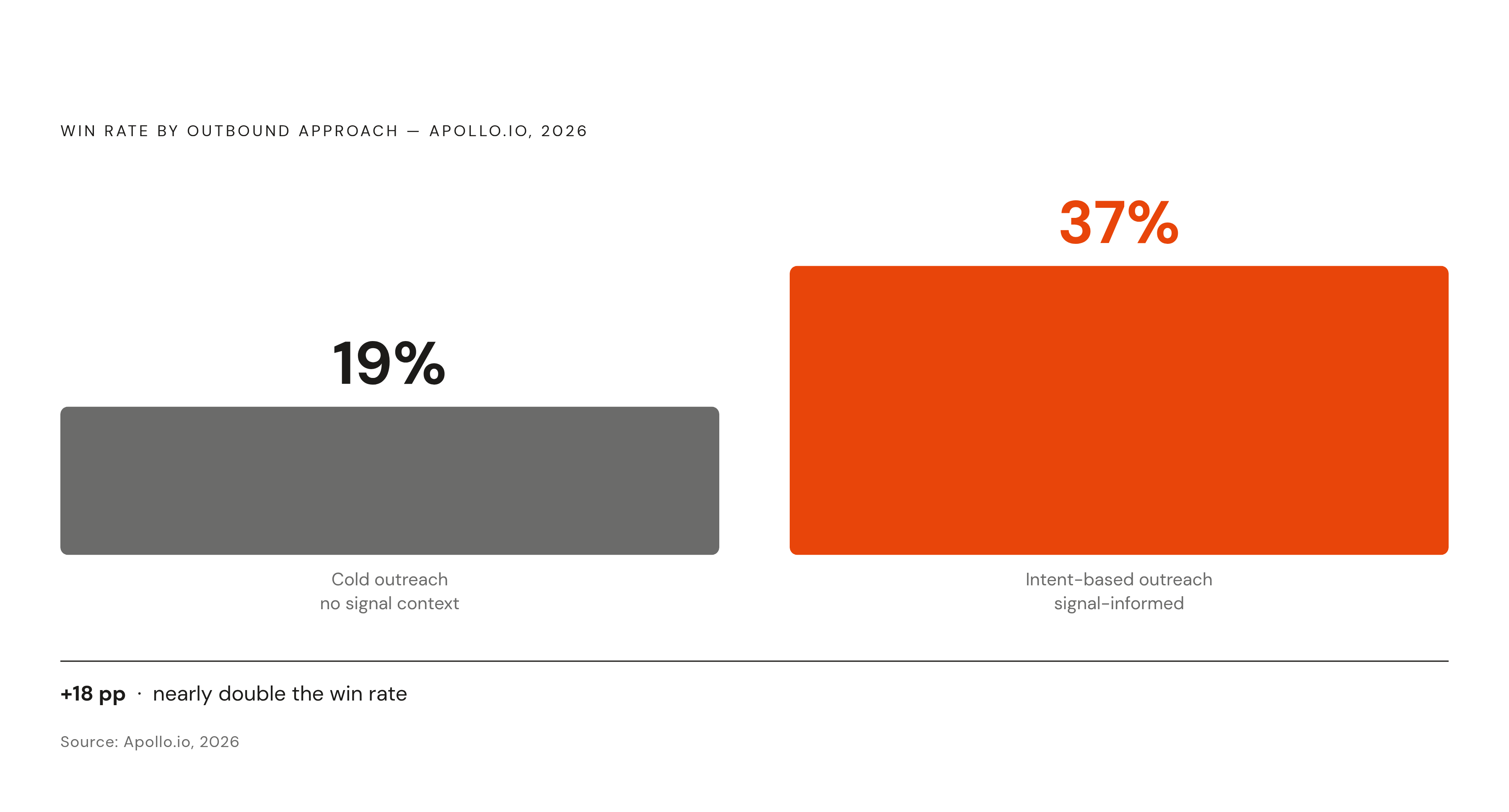
Apollo.io's 2026 data found that companies acting on intent data achieved 37% win rates, compared to 19% for cold outreach without signal context. That gap is large enough to be a strategic rather than a tactical consideration. Why exactly does this happen? Because intent data tells you not just who might buy, but when they are actively looking — and timing is the variable most outbound sequences treat as fixed.
What counts as a meaningful signal is more specific than most teams treat it. Funding rounds, leadership hires, job postings for roles in your category, and technographic changes (shifts in the tools a company is adopting or retiring) are the obvious tier. Temporal clustering of website behavior is more nuanced and often more actionable: five pricing page visits in one week signals active evaluation; the same five visits spread across three months signals curiosity. The distinction determines urgency and sequencing. Buying committee formation is a third signal layer: multiple people from the same company appearing on review or comparison pages within a short window suggests a formal evaluation has started, not an individual exploring, which is the distinction that B2B sales cycles increasingly turn on.
Multi-channel sequencing is no longer optional at this level of competition. Research cited by The Digital Bloom puts the number of touchpoints required to book a meeting with a cold prospect at eight to twelve. Average cold email reply rates sit at three to five percent, with top-quartile campaigns reaching above fifteen percent through tight targeting. LinkedIn generates the largest share of high-quality B2B social media leads according to Martal Group's 2026 analysis, and personalized connection requests paired with a signal-specific note achieve meaningfully higher acceptance rates than generic outreach.
Events deserve attention as outbound infrastructure rather than one-off tactics. Pre-event outreach to book meetings, side events designed for a specific ICP slice, post-event follow-up within twenty-four hours: these sequences build the kind of in-person trust that digital channels cannot replicate, and they are underutilized by most early-stage teams.
One operational boundary on AI-assisted outreach is worth holding. Research suggests that 88% of recipients ignore emails they suspect are AI-generated, and a substantial majority report they would switch vendors if a company relies too heavily on AI communication. The productive use of AI in outbound is research, drafting, and signal aggregation, with human review before anything is sent. The hybrid approach yields meaningful time savings while protecting response rates and brand trust.
Even well-executed outbound has a structural ceiling. Forrester's 2025 data estimates that 22 people now influence the average B2B purchase decision. An outbound sequence, however well-crafted, is reaching a subset of that group. Above a certain ACV threshold, outbound alone cannot close at scale; it needs inbound presence to do the work that happens before any outreach lands.
When to start building inbound — and what the build actually requires
The timing logic for inbound is counterintuitive: the build should start at month one if runway allows, not because it generates pipeline at month one, but because the compounding clock starts then. Every month delayed is a month of compound interest foregone.
A reasonable 12-to-24-month trajectory looks like this: by month twelve, inbound should be generating more pipeline than outbound at a lower cost per lead. By month twenty-four, it should be the primary pipeline source. By $5M ARR, the best-performing B2B SaaS businesses have shifted to roughly 60% inbound and 40% outbound. These benchmarks reflect the point at which content has indexed, ranked, and compounded enough to justify the shift in resource allocation.
What inbound actually requires tends to be undersold. Content strategy, technical SEO, distribution, and conversion optimization each need dedicated ownership. A founding team running active outbound while laying inbound foundations is not running a full inbound program; they are building infrastructure that a future team will operate. The distinction matters for expectation-setting and for avoiding the trap of underfunding both motions at once.
Conversion infrastructure deserves specific attention. HubSpot's 2025 State of Marketing benchmarks put healthy B2B homepage conversion at two to five percent for visitor-to-lead. A homepage converting below two percent typically signals that the value proposition is unclear or the CTA is buried. Driving inbound traffic without conversion infrastructure in place is wasted spend, regardless of content quality.
It is also worth considering what happens to inbound when the discovery layer itself shifts. G2's 2025 Buyer Behavior Report data shows AI chatbots as the leading influence on vendor shortlisting, ahead of organic search results. Inbound strategies built primarily around SEO face real disruption as the information discovery layer shifts. Distribution, review presence, and community contribution now matter as much as search rankings for inbound discovery, which raises the skill and coordination requirements for the motion considerably. I do not think anyone has fully worked out what the inbound playbook looks like on the other side of that transition.
How CAC payback and ACV determine which motion you can actually afford
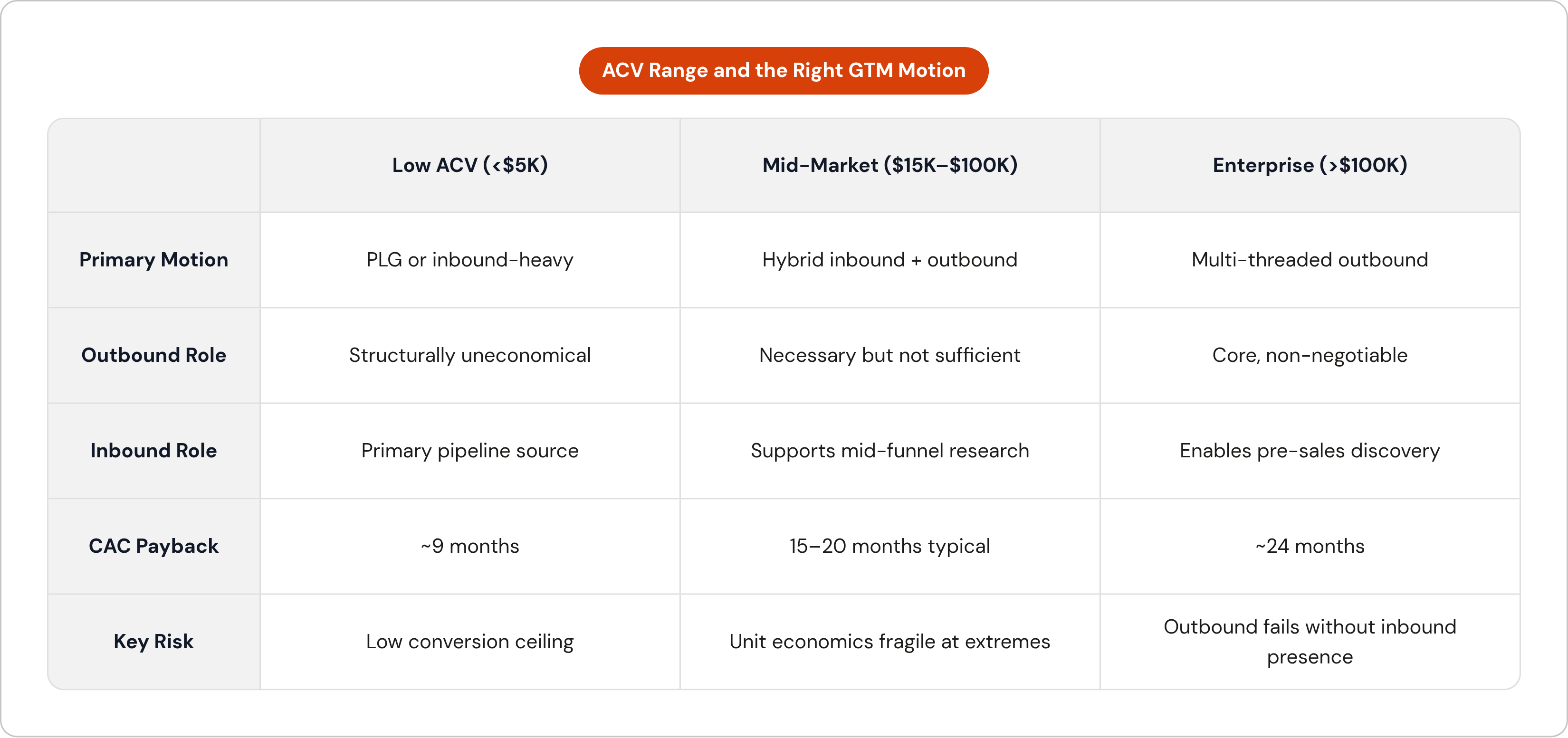
Benchmarkit's 2025 data puts median CAC payback across B2B SaaS at approximately 15 months, but the figure scales sharply with deal size: roughly nine months below $5K ACV and approximately 24 months above $100K ACV. The implication that rarely gets stated directly: if your ACV cannot fund a sales team's payback window within your remaining runway, a high-touch outbound motion will quietly bleed you regardless of execution quality.
The target for 2026, by most investor and operator benchmarks, is CAC payback under twelve months. The typical SaaS range of fifteen to twenty months is where companies land without deliberate design, not where they should aim.
The divergence between bootstrapped and venture-backed companies matters here. SaaS Capital's 2026 survey of over 1,000 companies found that bootstrapped companies grow at a median of 20% per year and VC-backed companies at 25%. VC-backed companies spend 70% more on sales and 100% more on marketing to achieve that marginal difference in growth rate. That raises an important question: is the accelerated spend buying compounding returns, or buying growth that stops when funding stops?
The ACV-to-motion mapping is fairly direct once you work through the unit economics. High-volume, low-ACV products are structurally suited to product-led growth (PLG) or inbound-heavy motions; the math does not support high-touch outbound at that price point. Mid-market ACVs in the $15K to $100K range require a hybrid model; the unit economics do not close cleanly on either end in isolation. Enterprise deals above $100K demand multi-threaded outbound account penetration, but only with inbound present to support the research-phase work that precedes any sales conversation.
Research from 2025 found that businesses using both inbound and outbound achieved 38% higher revenue growth than those using only one, and Martal's 2025 analysis found that balanced-approach firms grew revenue at twice the rate of inbound-only or outbound-only organizations. The signal is consistent: the compounding benefit is real, and it is larger than most teams expect when they are still arguing about which channel to prioritize.
One specific conversion lever is underused even by teams that understand the framework. Contacting an inbound lead within five minutes of their signal, a metric known as speed-to-lead, increases conversion rates by up to nine times. This is where intent-signal routing pays back immediately, without requiring a full inbound buildout, because the infrastructure needed is a routing rule and a response protocol, not a six-month content investment.
Routing inbound signals into outbound sequences — the motion that compounds both
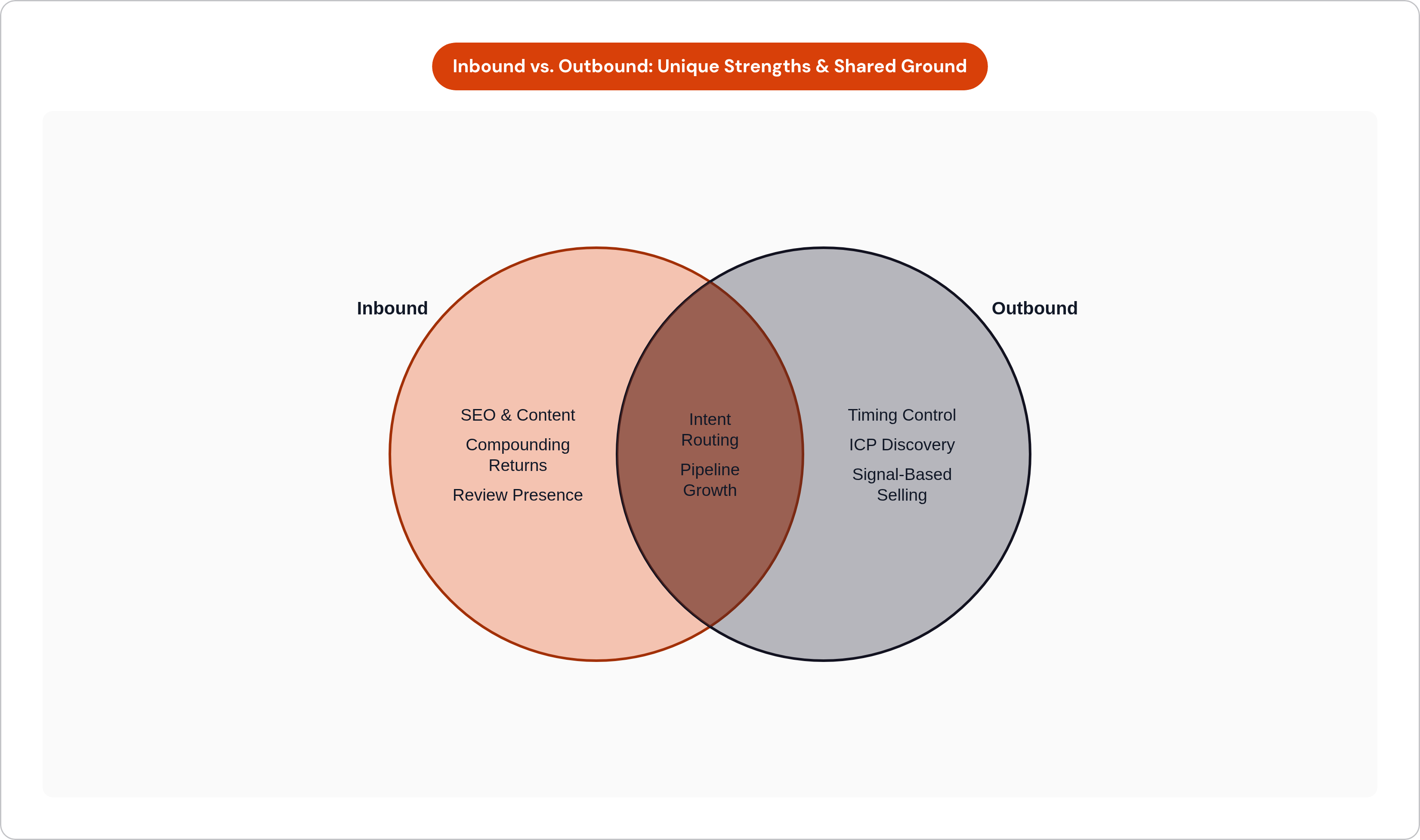
The insight that changes how you think about the inbound/outbound divide is simple and underutilized: inbound signals are outbound triggers. A pricing page visit, a content download, a comparison page click all represent a buying window opening. Outbound is the mechanism that acts on that window before it closes.
What intent signal routing looks like in practice is more operational than conceptual. Accounts showing three or more high-value interactions within seven days should be flagged and routed immediately; spread-out engagement over weeks does not warrant the same response. Multiple contacts from the same account appearing on review pages within forty-eight hours surfaces that account for multi-threaded outreach across the buying committee. A target account posting a VP of Revenue Operations role triggers a personalized outbound sequence within forty-eight hours, because the hiring signal reveals both a priority and a budget allocation.
The companies that have implemented this motion have reported results worth examining. OpenPhone connected inbound signal routing to their outbound workflow, reduced speed-to-lead by 67%, and drove a 17% lift in inbound conversion rates (Default.com, 2025). Rootly used intent-based routing for free trial signups and achieved a 15% increase in product-led pipeline alongside a 23% lift in inbound conversion rates. Runway scaled GTM workflows significantly more efficiently using intent data and increased lead volume 400% within six months. These are not marginal improvements; they suggest that the routing layer between channels is where a meaningful share of conversion efficiency lives, and that most teams are leaving it entirely unaddressed.
The broader pattern has a label gaining some traction: "allbound," meaning the use of inbound behavioral data to inform and personalize outbound outreach so that prospects receive relevant messages at the moment they are already in a buying window. Pipeline efficiency gains from this approach are estimated at two to three times, relative to sequences running without signal context.
What this requires operationally is a connected system where website behavior, CRM activity, and outbound sequencing share data in something close to real time. The fragmented stack, where marketing owns one tool, sales owns another, and the two sync on a weekly export, introduces exactly the delay that destroys the value of a time-sensitive signal. The five-minute conversion lift disappears if the routing takes forty-eight hours. The operational requirement is not a specific toolchain; it is the organizational decision to treat inbound and outbound as a single motion with shared data rather than two separate programs with separate ownership and separate reporting lines.
The inbound versus outbound debate has always been partly a proxy for something else: control versus scale, short-term versus long-term, the founder's instinct to act versus the operator's instinct to build. What I have found, working through this at companies with different ACVs and different runways, is that the debate tends to dissolve once the routing layer is in place. Outbound gives you the speed to learn what works. Inbound gives you the leverage to scale what you have learned. The interesting question is not which you choose; it is how quickly you can connect them.