CRM Integration Depth as an AI Outbound Tool Evaluation Criterion
Deep CRM integration separates AI tools that improve from ones that degrade.

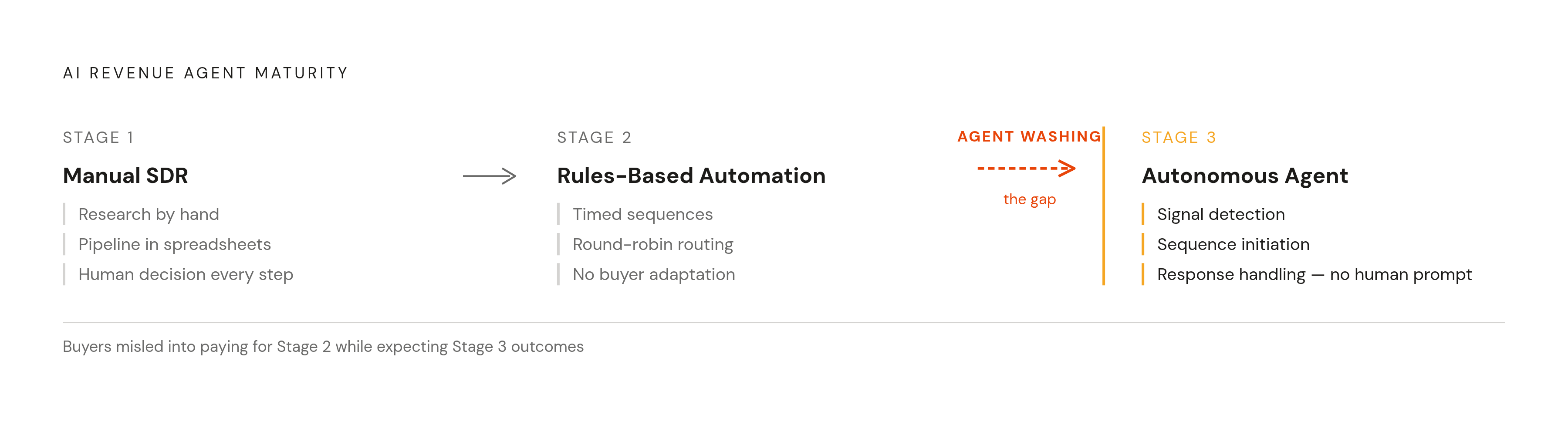
The term "AI revenue agent" has become common enough to blur past usefulness. At its most precise, it describes autonomous systems that execute outbound sequences, score leads, optimize pipeline routing, and manage follow-up without constant human intervention. But the category contains a wide maturity spectrum, and conflating stages of that spectrum is how teams end up paying for something that fails to match what they actually need. I have watched this happen with enough early-stage GTM teams to recognize the pattern before the invoice arrives.
At one end is manual SDR work: research by hand, pipeline tracked in spreadsheets, every touchpoint requiring a human decision. The next stage introduces rules-based automation, timed sequences, round-robin routing, predictable cadences with no adaptation to buyer behavior. The far end of the spectrum, which a meaningful number of early adopters are beginning to reach in specific pipeline segments, is fully autonomous revenue agents managing entire outbound workflows from intent signal detection through sequence initiation through response handling.
Gartner has warned explicitly about what it calls "agent washing": the pattern of marketing rules-based automation or basic AI assistants under the language of agentic systems. The label does not confer the capability. Evaluators who skip this distinction will pay for intelligence they are not actually getting.
The performance data is worth examining without the vendor gloss. Salesforce's 2026 State of Sales report found that 83% of sales teams using AI reported revenue growth in the past year, compared to 66% of teams that don't, a 17-point gap. That sounds decisive until you read the counterweight: nearly 8 in 10 organizations report no significant bottom-line gains from AI so far. Category-level adoption is not the same as category-level results. The gap between those two figures is not random, and it is not explained by feature differentiation. It follows a structural pattern. Teams that see gains are, more often than not, running AI on top of clean, current, fully attributed data. Teams running it on top of the opposite rarely see the same returns. That is precisely where the CRM integration argument begins, and where most vendor conversations conspicuously stop.
Why CRM Integration Depth Determines Whether an AI Outbound Tool Compounds or Just Costs Money
An AI outbound tool is only as intelligent as the data it operates on. This sounds obvious. It is also almost universally ignored during vendor evaluations, which tend to focus on sequence flexibility and send limits rather than what happens to the data after a message goes out.
The dirty data problem is not hypothetical. More than half of CRM managers believe their data accuracy falls below 80%, meaning most sales teams are working off a degraded foundation without fully recognizing it (Validity's 2023 State of CRM Data Health report). The degradation is not static; it compounds, a process CRM practitioners refer to as data decay. Bad CRM records corrupt the sequences layered on top of them, those records corrupt the AI models trained on historical activity, and the forecasts drawn from those models inherit the same errors. What begins as a hygiene problem becomes a strategic blind spot.
Attribution is the most immediate casualty. Without bidirectional sync between the outbound tool and the CRM, managers cannot reliably identify which sequences, messages, or channels generated pipeline or influenced revenue. Outbound becomes a cost center with no feedback loop, activity measured by volume because outcome cannot be traced. One-way push creates gaps that surface as attribution errors at quarter-end, long after the underlying problem can be corrected.
Here is where I want to push against the clean version of this argument, because the compounding logic runs in both directions and that second direction matters. A tool with shallow CRM integration does not simply fail to improve; it actively degrades over time as its data diverges from reality. I have seen teams twelve months into a deployment realize their AI agent has been sequencing against job titles that no longer exist, companies that have been acquired, and contacts who replied to a different rep six months ago but whose records never reflected it. By that point, the damage is not a data problem. It is a reputation problem with an entire market segment.
A tool with deep CRM integration improves over time because every interaction, every email sent, every reply logged, every deal advanced, teaches the system something the next outreach benefits from. The difference between those two trajectories, compounded over six to twelve months, is substantial. SDRs currently spend only 28% of their time actually selling, with the remainder lost to research, data entry, and administrative tasks, according to Corporate Visions' 2025 research. Deep CRM integration eliminates much of that overhead structurally, not as a feature benefit but as a change in how the team's time is allocated.
The Specific Dimensions That Separate Shallow Integrations from Deep Ones
"We have a CRM integration" is a statement a vendor can make truthfully and still be describing something nearly useless. I have heard it enough times to treat it as a prompt for follow-up questions rather than a meaningful claim.
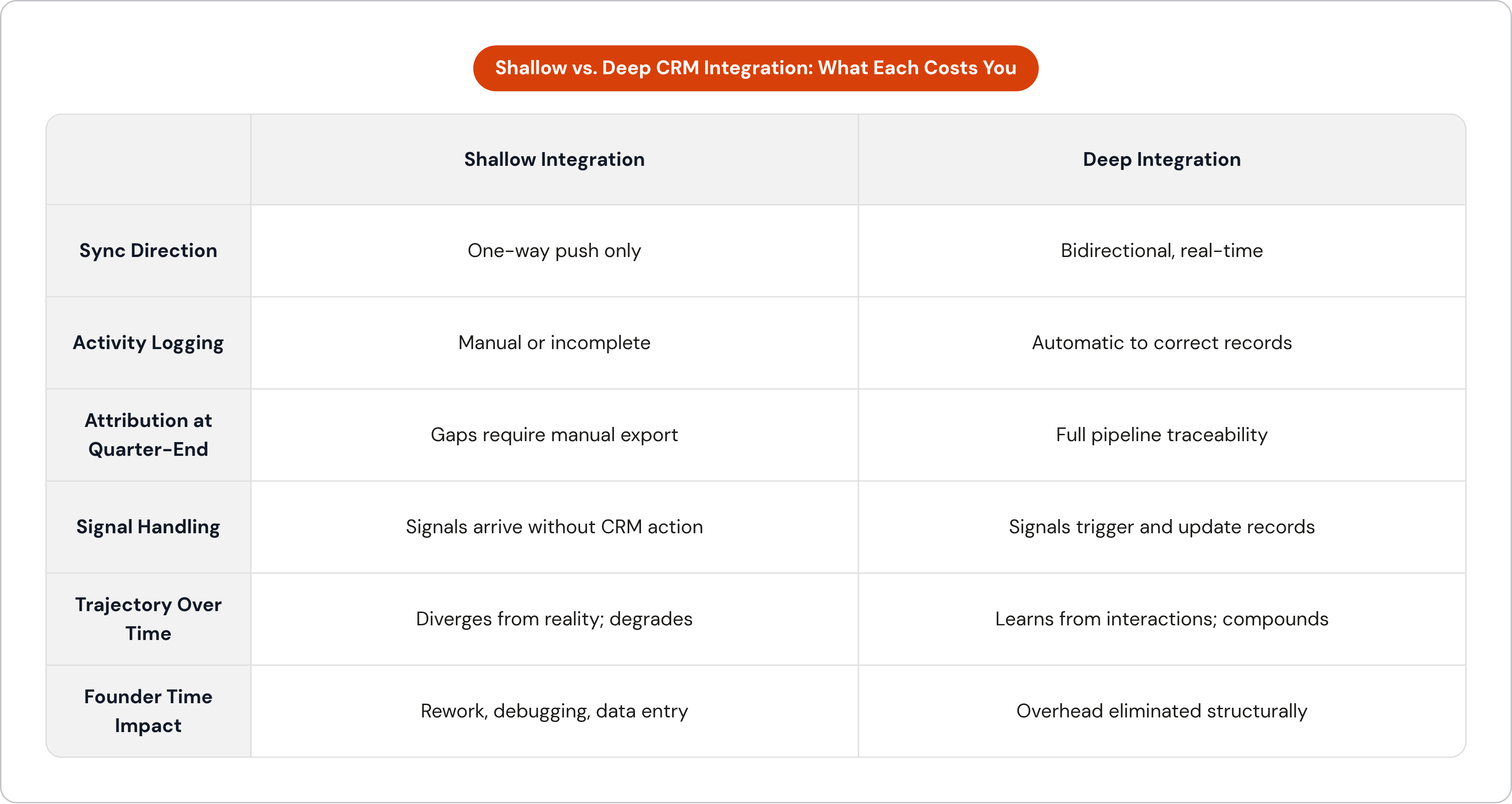
The evaluation standard should be granular: rank by sync directionality, sync latency, and field-mapping depth. Those three variables, taken together, reveal more about a tool's actual utility than any feature matrix. Unify's published evaluation framework identifies six dimensions of integration depth worth working through in sequence.
Sync direction, whether the flow is bidirectional or one-way push, is the first and most fundamental. Sync frequency matters almost as much: real-time sync, scheduled batch, and manual export are not equivalent, and the differences accumulate into meaningful data drift over the course of an active sequence in any sales engagement platform. Object and field coverage determines whether the integration reaches contacts only, or extends to companies, deals, and activities, which determines whether the tool can support meaningful attribution at all. Conflict resolution logic, what the system does when CRM data and outbound tool data disagree, is almost never raised in vendor conversations and is frequently where integrations silently fail. Activity attribution and logging, specifically whether emails, calls, meetings, and tasks are captured automatically to the correct records, separates integrations designed for reporting from integrations designed to avoid scrutiny. Finally, failure handling reveals whether the tool surfaces sync errors or drops records without notification; that distinction determines whether the team knows when the system is broken.
The shallow integration trap has a particular texture. A tool requiring manual field mapping creates the same context-switching burden it claims to eliminate; the work moves from the sequence itself to the configuration layer, invisible and time-consuming. Data governance is a subtler signal. The best integrations mirror CRM permissions, handle personally identifiable information responsibly, and maintain audit trails. Teams that skip this check build compliance debt that surfaces at the worst possible moment.
A practical test worth running during any evaluation: ask the vendor to demonstrate, live, how an outbound email reply flows back into the CRM. Which fields update? How quickly? What breaks if the contact record is incomplete? A vendor who can walk through that sequence in a real account, not a slide, has thought about the problem. A vendor who deflects has not.
Native Integration vs. Synced Integration and What the Distinction Costs You
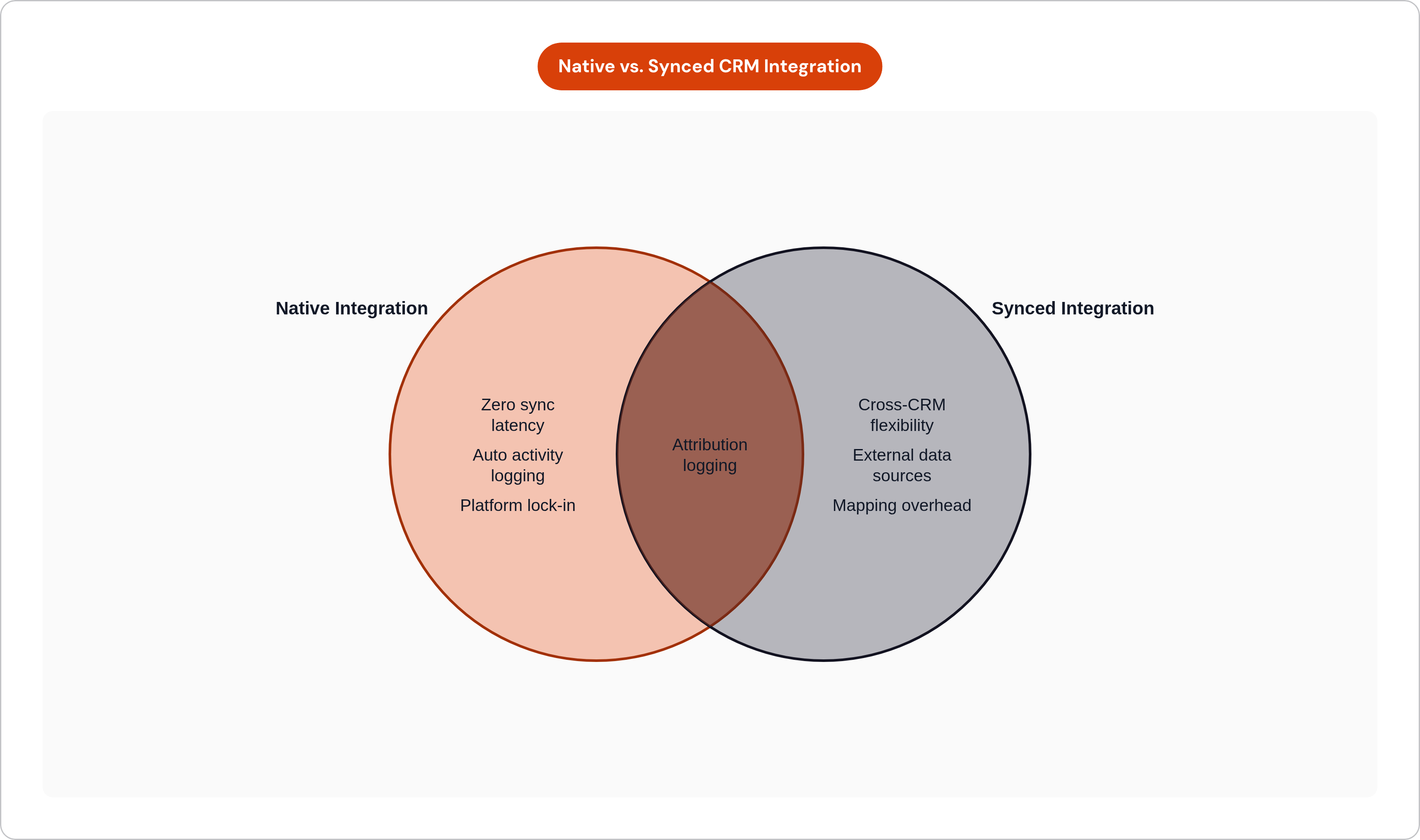
The architecture distinction between native and synced integration is one the industry undersells, partly because vendors on each side have reasons to minimize the tradeoffs of their own model.
Native integration means the AI agent runs inside the CRM itself. HubSpot's Breeze prospecting agent is the clearest current example: it operates directly on the HubSpot Smart CRM, logs every action automatically to contact, company, and deal records, and requires no sync delay or field-mapping configuration. Zero latency, no mapping errors, automatic activity attribution from the moment the tool runs. The tradeoff is equally real: platform lock-in and a ceiling on what the agent can access or do outside the CRM's own data model. If the team's workflow extends meaningfully beyond what the CRM natively holds, native integration can become a constraint rather than a feature.
Synced integration means the tool lives outside the CRM and moves data across a connection. The advantages are flexibility across CRM platforms and the ability to draw on richer external data sources, including tools that ground AI agents across the broader stack, pulling from sources like ZoomInfo regardless of which CRM the team uses. But synced integration introduces sync delays, requires ongoing mapping configuration, and creates failure modes that need active maintenance.
For early-stage and founder-led teams, that maintenance overhead deserves more honest discussion than it usually gets. It is not simply an ops problem. It is time the founder does not have, and the kind of drag that makes a tool feel broken well before anyone diagnoses why. I have watched founders spend more hours debugging sync configurations than the tool ever saved them, and the irony is that the problem was diagnosable before purchase if they had known what to ask.
Neither architecture is universally better. The practical question is whether the team has the operational capacity to maintain a synced integration at depth, or whether the tradeoff of platform lock-in is the smarter exchange given available resources. That judgment depends on stage, stack, and how much the founder values their own time, and those are not abstract considerations.
How CRM Integration Depth Enables Signal-Based Outreach Rather Than Just Automated Outreach
The most significant change in AI-powered prospecting is not AI itself. It is what AI operates on. The shift from static contact data to real-time buyer signals changes what is possible at every stage of the outbound motion, but only for teams whose CRM is actually connected to those signals.
Signals, in this context, are observable events that suggest a person or company is more likely to buy now: leadership changes, funding announcements, hiring surges, competitor complaints surfaced in review forums, technology adoptions, pricing page visits. Firmographic data tells you who might fit your ICP, or ideal customer profile. Signals tell you who is ready and why. The CRM is where these signals need to land to become actionable, because the CRM is where the outbound tool looks when it decides who to contact, with what message, and when.
The performance differential between signal-based and generic outreach is documented. Instantly's 2026 Benchmark Report found that emails using advanced signal-specific personalization achieved an 18% response rate, compared to a generic cold outreach average of 3.4%. That gap is not explained by copy quality alone. It reflects the difference between a message that arrives at the moment of relevance and one that arrives on a schedule the buyer never agreed to.
The CRM dependency of signals is the part of this argument that tends to get skipped in vendor conversations. A pricing page visit means nothing if it fails to trigger on a contact record the outbound tool can see. A job change is a dead signal if the CRM record has not been updated and the AI agent is still sequencing against the previous title. Funding events and hiring surges need to be mapped to account records in the CRM to route correctly into active sequences. Signals without CRM integration depth are just notifications; they generate awareness without action.
Only 25% of B2B companies currently use intent or signal data tools at all, which means the competitive moat for early adopters remains significant. But it exists only for teams whose CRM integration is deep enough to act on what the signals surface. Every signal-triggered interaction that is logged, attributed, and fed back into the model improves the targeting and timing of the next one. That flywheel only runs if the CRM is meaningfully in the loop.
What Founder-Led Teams Specifically Lose When CRM Integration Is Shallow
The founder-led GTM dynamic has a particular structure that makes shallow CRM integration disproportionately costly. The founder is often simultaneously the primary driver of top-of-funnel activity and the closer, which means every insight from a sales interaction needs to flow back into the system for the next outreach to benefit from it. There is no handoff buffer, no sales ops layer absorbing data entry. The feedback loop either runs automatically or it does not run.
The specific losses are worth naming concretely. Closed-won call transcripts that fail to sync to the CRM bury the most valuable ICP intelligence the team possesses, which is what buyers actually said in the conversations that ended in a signed contract. Outbound activity that fails to log automatically means the founder is either doing data entry at 11pm or operating without reliable visibility into what has been touched. Pipeline attribution gaps at quarter-end mean the team cannot identify which signals, messages, or sequences actually drove pipeline, so iteration becomes guesswork dressed as strategy.
The economic argument is direct. A two-person startup using AI tools can, in principle, replicate the output of a much larger GTM team. That efficiency gain is conditional. It depends on the AI operating on clean, current, fully attributed data. Without CRM depth, the efficiency evaporates into rework and manual reconciliation, and what felt like a structural advantage reveals itself as deferred labor, the kind you discover during a board prep call.
The tools that transcribe calls, surface objections, and track sentiment, a category broadly called revenue intelligence, give founder-led teams the feedback mechanism that used to require a dedicated sales ops hire. At early stage, that is not a luxury. It is the mechanism for refining ICP before headcount scales, which means decisions about CRM integration depth in the first year have direct consequences for how accurately the team is targeting in year two. A 2025 State of B2B GTM report drawing on 195 GTM leaders found that 45% plan to increase investment in intent-based outbound. Founders who build CRM integration depth now are building the infrastructure that intent-based motions require; teams that delay will find themselves retrofitting, which is structurally more expensive than building correctly the first time.
The Evaluation Questions to Ask Before Committing to Any AI Outbound Tool
These questions reveal integration depth in a vendor conversation or product trial. They are not answerable with a feature checkbox, which is precisely why they are useful. A vendor who cannot answer them clearly, with a live demonstration rather than a slide, is telling you something important about what the product actually does.
On sync architecture: Is this a bidirectional sync or a one-way push? What is the sync frequency, real-time, scheduled batch, or manual? What CRM objects are covered, contacts only, or contacts, companies, deals, and activities? Ask the vendor to show you, live in their own environment, how a reply to an outbound email flows back into the CRM record. Watch what happens when the contact record is incomplete.
On attribution and logging: How are activities, including emails, calls, meetings, and tasks, attributed to the correct contact, company, and deal records automatically? What does the pipeline attribution report look like at end of quarter? Can a closed deal be traced back to the specific sequence and message that initiated the conversation? If the answer to that last question requires a manual export, the attribution model is not actually working.
On signal and data currency: When a prospect visits a pricing page, how does that event reach the outbound tool and update the contact record? How does the tool handle a contact whose CRM record is incomplete or out of date? Does it surface the gap or silently skip the contact?
On failure and governance: How are sync failures surfaced, through active alerts or through records that simply fail to update without notification? Does the integration mirror CRM field-level permissions, or does it create a parallel data layer the CRM admin cannot see or govern?
The final filter is the simplest. A tool that cannot walk through these questions in a live demo is a tool that will require sustained operational attention to maintain, which is the opposite of what a high-growth team needs. Cardinal, an AI agent platform for outbound prospecting and outreach that consolidates list building, email sequencing, and CRM sync into one system, is one example of where integration depth is part of the product's core architecture rather than a configuration afterthought. The evaluation process itself is diagnostic. How a vendor responds to these questions tells you more about the integration than anything in their documentation, and the discomfort some vendors display when asked to go live, rather than to a slide, is itself an answer.