AI-Generated Outbound Copy Detection and Buyer Fatigue
Skyrocketing email volume has tanked reply rates while buyers instinctively reject generic AI copy.

The economics of B2B outbound broke somewhere around 2023, though most teams didn't notice until their reply rates stopped recovering between campaigns. AI SDR platforms had pumped an estimated four to seven times more cold email volume into B2B inboxes by 2024 and 2025 compared to 2022, per industry analysis, and the supply-side shock did exactly what supply shocks do: it devalued every unit. Instantly's 2026 cold email benchmark report traces the collapse in concrete terms: 8.5% average reply rates in 2019, declining to 5% by 2025, settling near 3.43% in 2026. In SaaS-to-SaaS, the most saturated segment, positive reply rates routinely fall under 0.5%.
Google and Microsoft responded to the volume surge with the strictest deliverability enforcement email marketers had seen in years. Sender reputation infrastructure, including domain health and IP warming history, that teams had spent years building eroded inside of months.
The structural lesson here is worth sitting with. The SDR pod model, built on sequenced templates at volume, didn't collapse because outbound stopped working. It collapsed because the unit economics of low-effort volume broke. When anyone can generate ten thousand "personalized" emails for the price of a coffee, the signal value of any individual email approaches zero. The 1–3% average isn't a floor for the industry; it's a ceiling most senders are trapped beneath. The senders worth studying are the ones treating that number as the starting line.
What Buyers Are Actually Doing When They Sense AI-Generated Copy
Buyers aren't running detection software. That's an important clarification, because it changes what senders actually need to fix.
What buyers are doing is making a fast, mostly unconscious judgment about whether a message reflects human thought about their specific situation. HubSpot's 2025 State of Sales report found that 57% of B2B decision-makers say most sales outreach feels impersonal and irrelevant even as AI-generated volume rises. Gartner surveyed 632 buyers and found that 73% actively avoid suppliers who send irrelevant outreach. The same Gartner data from 2025 shows 61% of B2B buyers now prefer a rep-free buying experience, up from 33% not long before, which means many buyers have formed opinions about a vendor before any outreach arrives. A cold email that feels generic doesn't just fail to convert; it actively confirms the instinct to avoid.
The research on sincerity perception quantifies the problem more precisely. A 2025 study from the University of Florida and USC, published in the International Journal of Business Communication, found that only 40 to 52% of recipients viewed AI-assisted messages as sincere, compared to 83% for messages with low AI involvement. Sincerity, not polish, not cleverness, is the variable being tested. Buyers are pattern-matching against the hundreds of similar messages they've already received, not analyzing prose quality. The recognition is fast precisely because the patterns are consistent.
What makes this damage difficult to track is its cumulative nature. Muting, blocking, and passive ignoring don't show up as bounces or unsubscribes. Deliverability degrades quietly, often visible first in inbox placement rates before open rates move. Reputation erodes over quarters, not overnight. Teams that didn't audit this closely enough in 2024 discovered the problem when their open rates stopped being meaningful.
The Specific Patterns in AI Copy That Trigger Immediate Dismissal
Buyers can't always articulate what they're detecting, but practitioners who've spent time in outbound can name the patterns with precision. Each one below is a signal that no human judgment was applied to this specific recipient.
The hollow opener is the most visible, and it's the first thing that tells a buyer no intent data or real research shaped the message. "I came across your profile and was really impressed," "As a [title] at [company], you must be dealing with," and their variants tell the reader immediately that nothing here required any knowledge of them specifically. The structural uniformity underneath the opener compounds it: subject line introduces a problem, body names a solution, closing states a call to action, cadence repeats at identical intervals. The template is legible even when the surface words vary.
Fake personalization is arguably more damaging than no personalization. Inserting a LinkedIn headline verbatim, echoing a company tagline back at the recipient, or referencing a recent press release without connecting it to a specific implication for the recipient signals effort without judgment. It reads as automated research, not human reasoning.
Then there's the language itself. LLM output has characteristic hedging: "leverage," "empower," "streamline," "solutions," "I wanted to reach out." These phrases carry no information. They could appear in any email to any recipient in any industry. Value propositions stated at the category level, "we help SaaS companies grow revenue," rather than calibrated to the recipient's evident situation and ICP fit, are functionally indistinguishable from a banner ad.
The absence of anything that required actual knowledge is what ties these patterns together. No reference to a recent hire. No connection to a funding round. No observation about a job posting that implies a strategic shift. Nothing that couldn't have been inferred from a job title and a company name. The problem isn't that AI wrote the copy. The problem is that the copy contains no evidence that a human made a judgment about this specific person at this specific moment.
Why the Performance Gap Between Pure AI Copy and Human-Finished Copy Is So Large
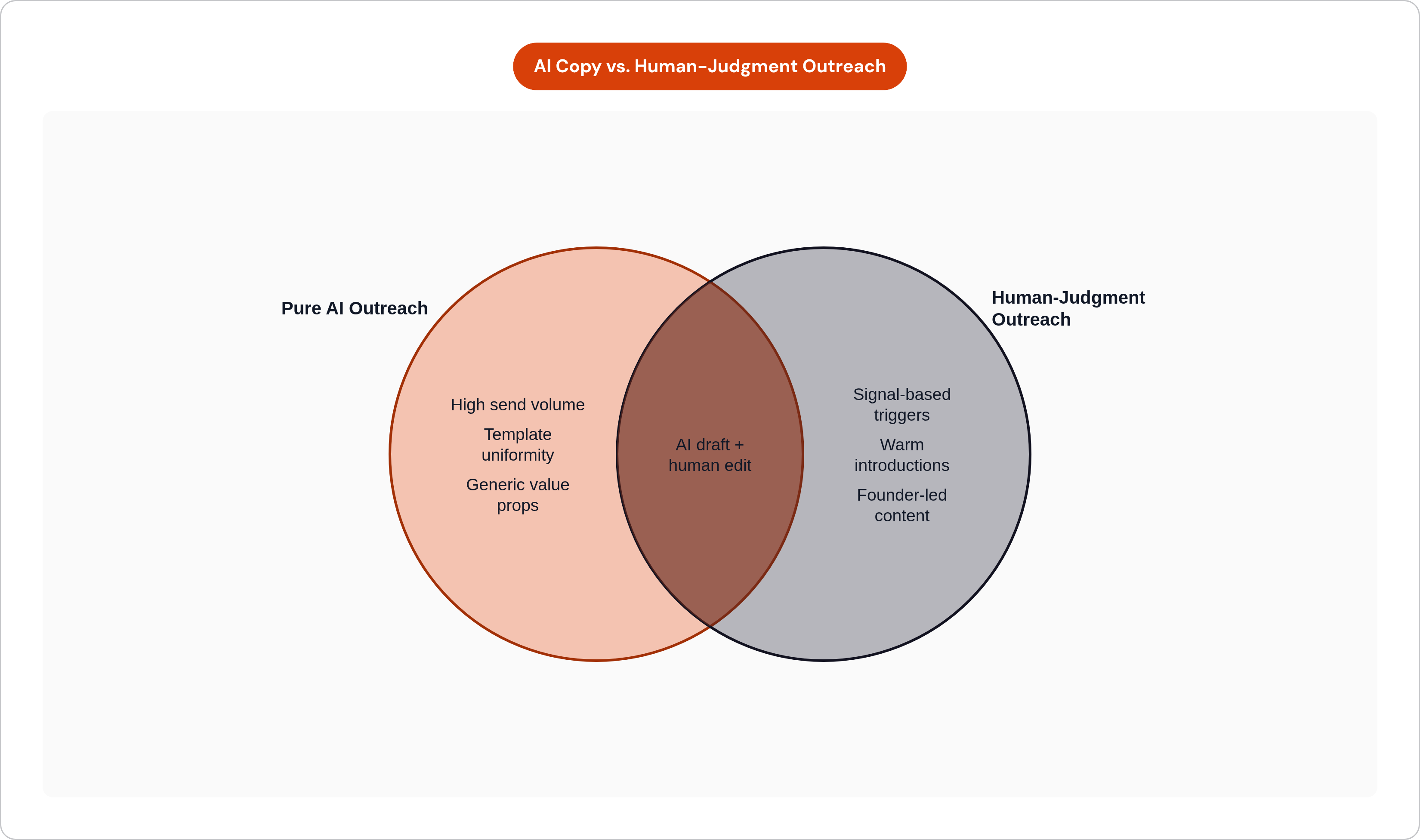
The University of Florida and USC study in the International Journal of Business Communication offers the sharpest empirical frame for this. Fully AI-generated cold emails earned roughly one percentage point fewer replies than human-written ones and were flagged as spam at nearly three times the rate. That's a meaningful gap, but it isn't the most important finding.
The more consequential result is that emails drafted by AI and then finished by a human consistently outperformed both pure approaches on reply rates and inbox placement. The implication challenges a common assumption in the "AI versus human" debate: the question isn't which approach wins, it's how the combination is structured.
"Finished by a human" doesn't mean proofreading for grammar. It means adding the one observation that required actual judgment, a specific trigger, a concrete reference, a non-obvious connection between the recipient's current situation and the sender's angle. That single addition changes the sincerity signal the reader receives. The research doesn't establish an agreed threshold for how much human editing is enough, and that ambiguity matters because it means teams can't mechanize their way to the threshold. The sincerity perception data, 83% for low-AI messages versus 40 to 52% for AI-assisted ones, suggests buyers can sense degree of human involvement even when they can't articulate what's registering.
Warm introductions make the economic magnitude of this gap concrete. Against the same buyer universe that returns 1 to 3% on cold outreach, a warm introduction runs 30 to 50% reply rates. That's roughly a fifteen-to-one ratio, and it quantifies exactly what "demonstrated human judgment and real relationship" is worth in outbound economics. Cold email, executed with human judgment layered in, can't reach warm intro rates, but the gap between 1% and 15% is where the senders winning in this environment are operating.
The practical lesson the research implies without quite stating: the question to evaluate any message against isn't "did AI write this?" It's "does this message show that someone thought specifically about me?"
What Signal-Based Outreach Does That AI Copy Alone Cannot
A signal, in the outbound context, is any observable event that increases buying intent right now. A leadership change. A funding round. A hiring surge in a specific function. A pricing page visit. A competitor complaint surfacing in a public forum. A new technology adoption. Signals matter because they create a window. A message that would have been ignored three months ago becomes relevant today because the recipient's situation changed, and the sender's message acknowledges that change specifically.
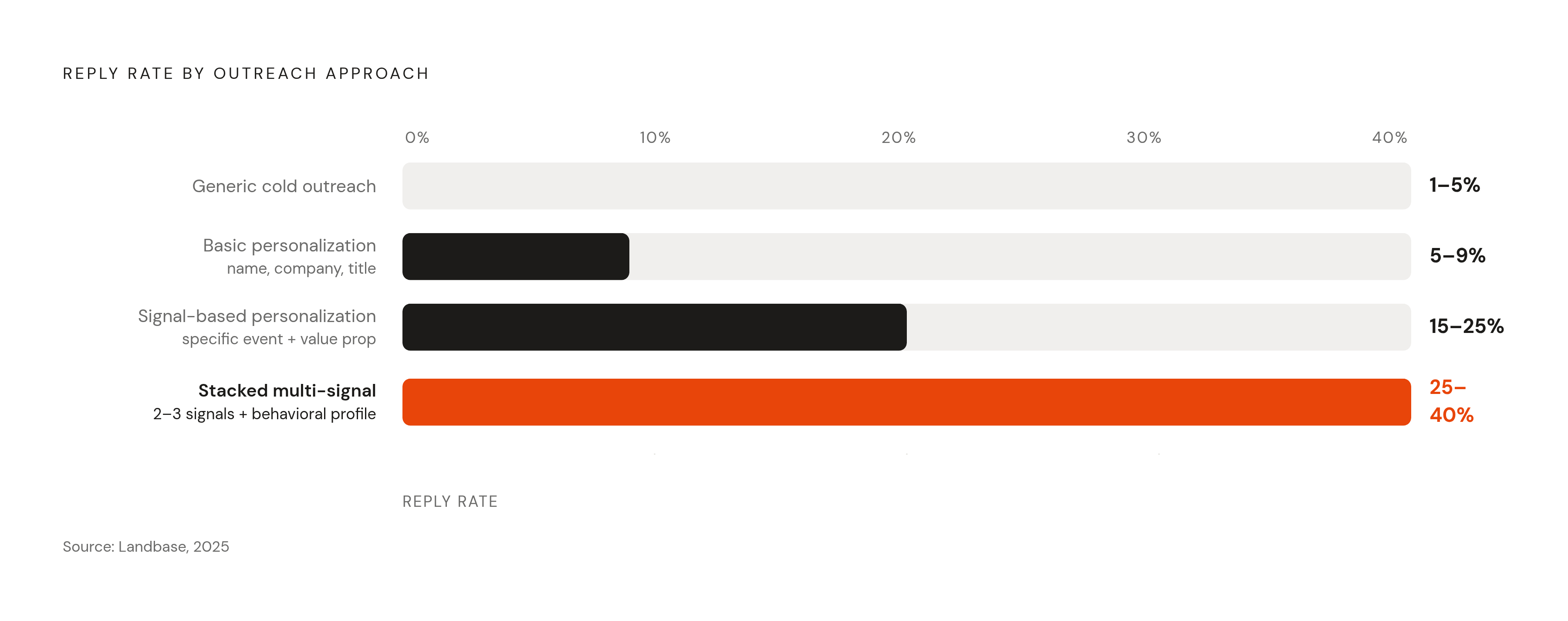
The reply rate gradient, drawn from Landbase's 2025 analysis of intent signal data and related industry benchmarks, makes the structural case. Generic cold outreach sits at the 1 to 5% range, consistent with the 3.43% industry average. Basic personalization, meaning name, company, and title, improves that modestly to 5 to 9%. Signal-based personalization, where a specific event is named alongside a relevant value proposition, moves the range to 15 to 25%. Stacked multi-signal outreach, combining two or three signals with a behavioral profile, produces 25 to 40%. Each step up the gradient represents a higher investment in human judgment and a correspondingly larger return.
Landbase's 2025 analysis also found that organizations using signal-qualified leads report 47% better conversion rates versus traditional lead scoring approaches. Only 25% of B2B companies currently use intent or signal data tools, which means the competitive advantage for early adopters remains real and largely uncontested.
The friction point worth naming: intent data lifts pipeline only when it's fresh, accurate, and connected to execution. DemandScience data shows 91% of marketers use some form of intent data, but only 24% report exceptional ROI. Owning the signal isn't sufficient if the outreach it triggers defaults to the same generic copy patterns. Signal plus generic message still reads as generic. Signal plus specific, human-judgment-infused message is the combination that produces the gradient numbers above.
First-party signals derived from first-party data, including pricing page visits, CRM engagement patterns, and email open sequences, are the most actionable category and the most consistently underused, particularly by early-stage teams that haven't yet wired their own behavioral data into outreach execution. The data is there. The infrastructure to connect it often isn't.
How to Engineer Outreach That Passes the Human-Judgment Test
The correct division of labor between AI and human effort in outreach isn't complicated, though teams routinely invert it. AI handles the repeatable, pattern-heavy work: list building, research aggregation, first-draft structure, sequence scheduling. Humans supply the one observation that required actual judgment. Swapping those roles, having AI attempt judgment and humans review for grammar, produces the worst of both: the efficiency of automation with the sincerity score of a machine.
The "one specific thing" principle is the most actionable frame. Every message should contain at least one detail that could only be there because someone looked at this particular person and made a non-obvious connection. A recent hire that creates a new pain point. A funding announcement paired with a specific use case it implies, not a generic one. A job posting that reveals a strategic priority the company isn't advertising directly. A piece of content the prospect published that connects, with actual reasoning, to the sender's angle. The key word is "non-obvious." If the connection could have been made by anyone with a job title and five minutes of LinkedIn scrolling, it doesn't qualify.
Subject lines should embody the same principle. Specificity outperforms cleverness at meaningful margins. A subject line that names a real event, "Your Series B and the SDR question," for example, outperforms any formula-generated hook because it signals immediately that the sender knows something specific. The recipient's curiosity about how you know, and what you think about it, is itself a mechanism for opening.
The first sentence of the body should make it immediately clear that the sender did something no prompt could replicate without specific input. Name the signal. Don't bury it after a throat-clearing opener.
Length and structure deserve reconsideration. Heavily polished, multi-paragraph templates increasingly register as automated precisely because of their polish. A shorter, slightly rougher, direct note often reads more credibly human. The instinct to optimize for apparent professionalism is working against senders in an environment where professionalism has become a pattern signal for automation.
Video, specifically a custom 45-second Loom for high-priority accounts, has produced three to five times higher reply rates versus text-only outreach in practitioner reporting. The mechanism is straightforward: video is hard to fake, difficult to automate at scale, and functions as proof of human effort before the recipient has read a single word of copy. Multi-channel sequencing, combining email, LinkedIn, and phone, produces three to five times more meetings than email-only approaches, not because repetition converts but because channel variety signals genuine human pursuit rather than automated sequence execution.
Strip every phrase that adds no information. "I wanted to reach out," "I hope this finds you well," "we help companies like yours" should be cut from every message. Any word that could appear in anyone's email should be removed from yours.
Where Creative Tactics Create Reply Rates the Volume Model Never Reached
The 2025 State of B2B GTM survey, with a sample of 195 GTM leaders, rates intimate events, dinners, coffee meetups, micro-gatherings around conferences, as the single highest-impact channel for generating early pipeline conversations. Large conferences also ranked in the high-popularity, high-impact quadrant. The logic isn't complicated: these formats produce conversations that a cold email couldn't initiate because the setting itself communicates real investment.
The "brain trust" tactic operates on a related principle. Inviting ten to twenty industry practitioners into an advisory circle, asking for their input on a problem or a product direction, generates twenty to forty early conversations in a matter of weeks. People who are invited into a process rather than pitched to convert at dramatically higher rates. It's not a trick; it's a different economic exchange. The sender is offering something real in exchange for attention.
Communities, Slack groups, LinkedIn circles, niche forums, operate at a different scale but on the same logic. A referral from a community peer runs closer to warm intro economics than cold email economics, because the social proof of a mutual relationship substitutes for the missing track record.
Founder-led content, specifically LinkedIn, warm outbound, and founder brand, ranks among the top three most effective channels for early-stage GTM in the same survey. Thirty percent of GTM leaders plan to increase investment in founder brand, which suggests the market is recognizing what the data already shows: a prospect who has read your thinking, absorbed your perspective, and chosen to follow your work is in a fundamentally different buying posture than one who received a cold email from a name they don't recognize.
The connective thread across all of these tactics is that each one generates a reply by demonstrating real human interest and specific investment in the recipient. They produce the signal that AI copy at volume cannot. And the compounding effect matters: teams that track which signals, which openers, which channels, and which creative moves produced actual replies build a playbook that sharpens each cycle. Competitors who keep re-sending the same failing templates don't have a volume problem. They have an information problem.
The inversion the data points toward is this: the senders winning in a 1 to 3% average environment aren't optimizing for volume, they're optimizing for reply rate at the message level, and they aren't sending less outbound. They're sending outbound that costs more per message in human judgment and returns multiples more per reply. Volume was never the variable. Judgment was.