Cold Calling Conversion Rate Benchmarks for B2B SaaS
Conversion rates halved in one year, but the real story is who's winning and who isn't.

The current baseline for dial-to-meeting in B2B outbound sits at roughly 2–3%. One meeting per forty dials. That number would have ended a program review five years ago. Now it is the median, and teams posting it feel relieved.
What makes the 2025 data disorienting is velocity. A study across more than 200,000 calls found an average conversion rate of 2.3%, down from 4.82% in 2024. Nearly 50% in a single year. The instinct is to call it a measurement artifact, different denominators, different industries, but the directional signal holds across too many independent sources to dismiss that cleanly. But what if the instinct to explain it away is itself part of the problem?
No single mechanism explains the drop. Call volumes surged industry-wide. Carrier-level spam likely labeling grew more aggressive. Data quality and scripting practices did not evolve anywhere near the pace of volume growth. Buyer fatigue, the cumulative toll of receiving dozens of undifferentiated pitches weekly, crossed some psychological threshold. None of these forces are new; they converged simultaneously, which is what makes the decline feel sudden even though it was not.
More important than the average: the decline is not evenly distributed. High-volume, undifferentiated callers absorbed the steepest losses. Teams with tighter targeting, fresher data, and more specific messaging experienced something notably different. The mean went down; the spread widened. That widening is where the story actually lives.
Sector specificity compounds this further. Technology and SaaS verticals frequently fall below 1% dial-to-meeting, a function of longer sales cycles, more complex buying committees, and higher skepticism among technically sophisticated buyers. Business services tends to run closer to 2.4–2.6%. Benchmarking a SaaS program against a cross-industry average is a category error that produces either false comfort or misplaced alarm, depending on which direction the error runs.
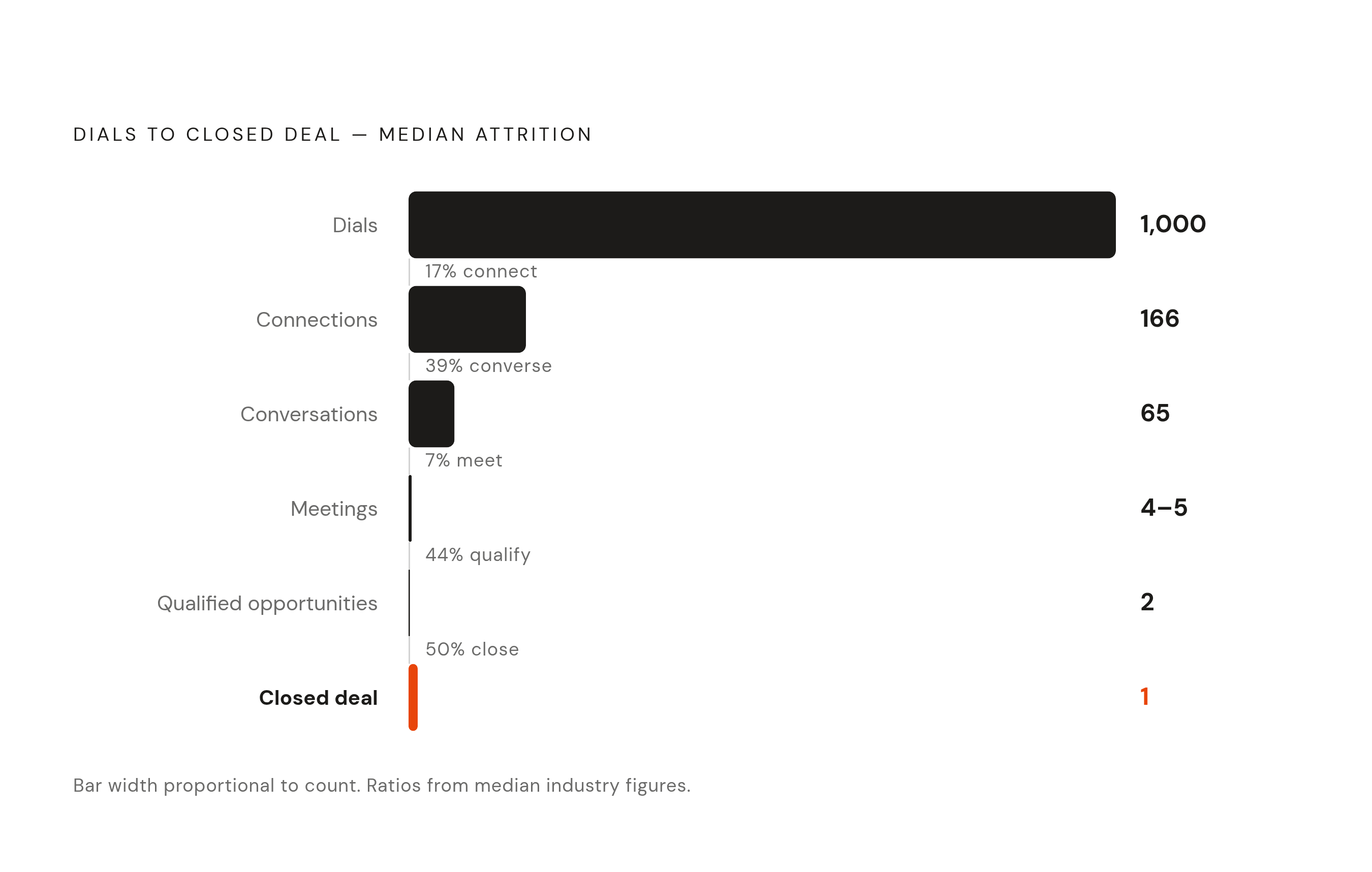
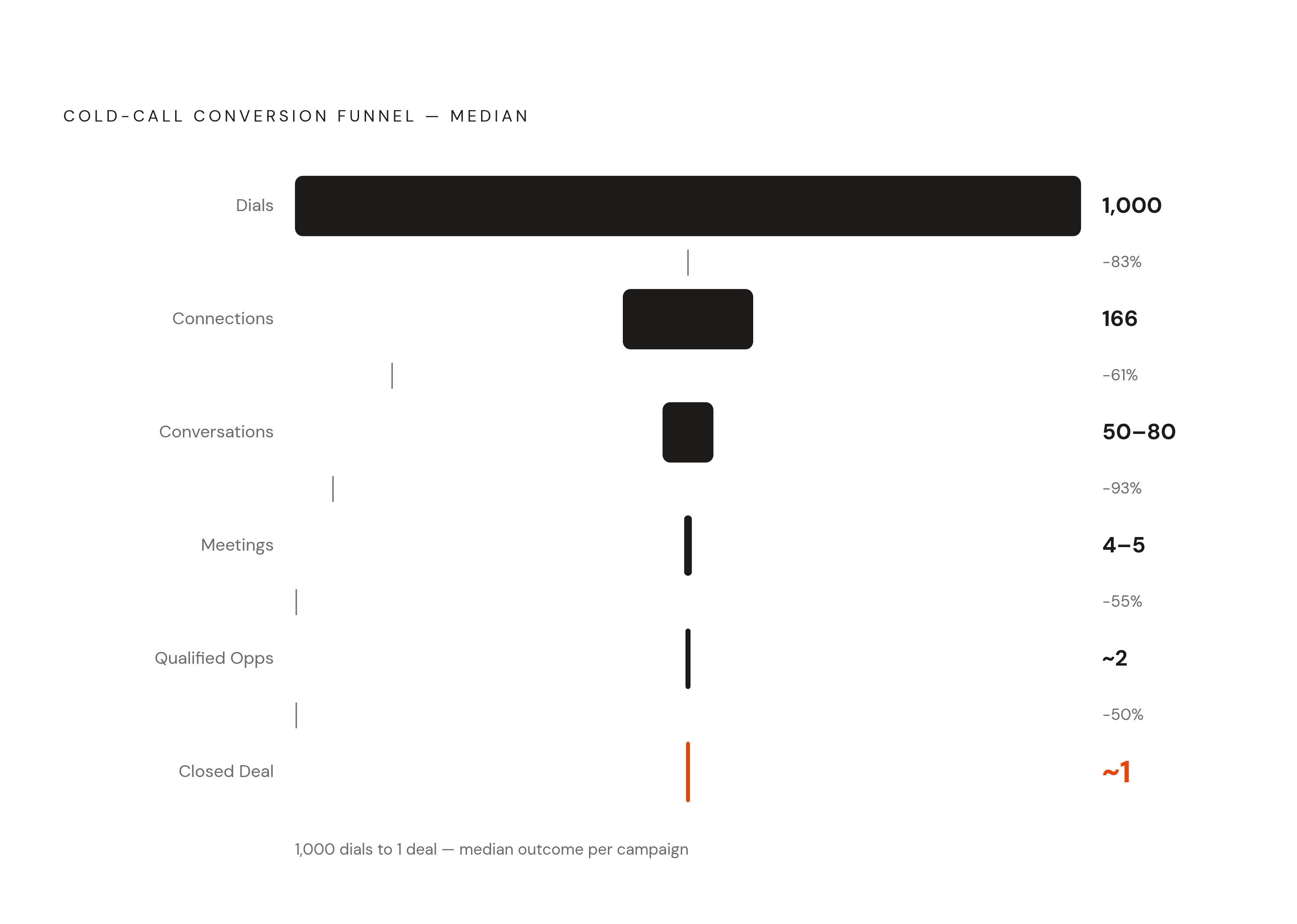
The connect rate problem underlies all of it. Typical connect rates run between 3–10%, with an average of eight attempts required to reach a prospect at all. The funnel math on 1,000 dials: roughly 166 connections, somewhere between 50 and 80 conversations, four or five meetings, approximately two qualified opportunities, roughly one closed deal. That is not a pessimistic scenario. That is the median. Teams that build forecasts without this arithmetic internalized tend to chronically overpromise on pipeline, and the damage compounds quietly over quarters before anyone names the actual cause.
Conversation-to-Meeting Rates and What They Reveal About Rep Quality
Dial-to-meeting is the funnel metric. Conversation-to-meeting is the diagnostic. Separate them and the picture sharpens in ways the blended rate entirely conceals.
A solid conversation-to-meeting rate sits between 4–5%. Below 2% points to bad contact data, weak ICP targeting, or pitch execution that fails to earn the next thirty seconds. Top performers reach 15% or higher, a roughly 3x gap over the mean that territory and luck cannot account for.
Gong Labs data drawn from more than 300 million cold calls provides texture. The average connect rate in that dataset is 5.4%; top-quartile reps connect at 13.3%. Average meeting-set rate per conversation runs 4.6% (Gong Labs, 2024). These are not abstract ranges. They describe the actual statistical distribution of rep performance across an enormous sample, and the distance between average and top quartile carries real budget implications.
What a low conversation-to-meeting rate actually diagnoses depends on the specific failure point. A weak opening is the most common: failing to deliver an immediate, specific call-to-action reason to stay on the call. Poor ICP (ideal customer profile) fit comes next, reaching a live person but not the right one. Generic scripting that references nothing specific to the prospect compounds both. Stale contact data, reaching someone who has changed roles or left entirely, contaminates every downstream metric and is usually the last thing teams think to check.
Here is the inversion that took me an embarrassingly long time to see clearly: a high conversation-to-meeting rate paired with a low dial-to-meeting rate is not a rep performance problem. It is a connect problem. The pitch works; the numbers are not being reached. Conversely, a reasonable connect rate with a low conversation-to-meeting rate is a coaching and scripting problem, not a data or sequencing problem. The two metrics point at entirely different levers, and conflating them produces interventions that fix the wrong thing while the actual problem continues unaddressed. That raises an important question: does your team currently track both metrics separately, or are you working from a single blended rate that obscures exactly this distinction?
How Lead Temperature Reshapes Every Benchmark on the Board
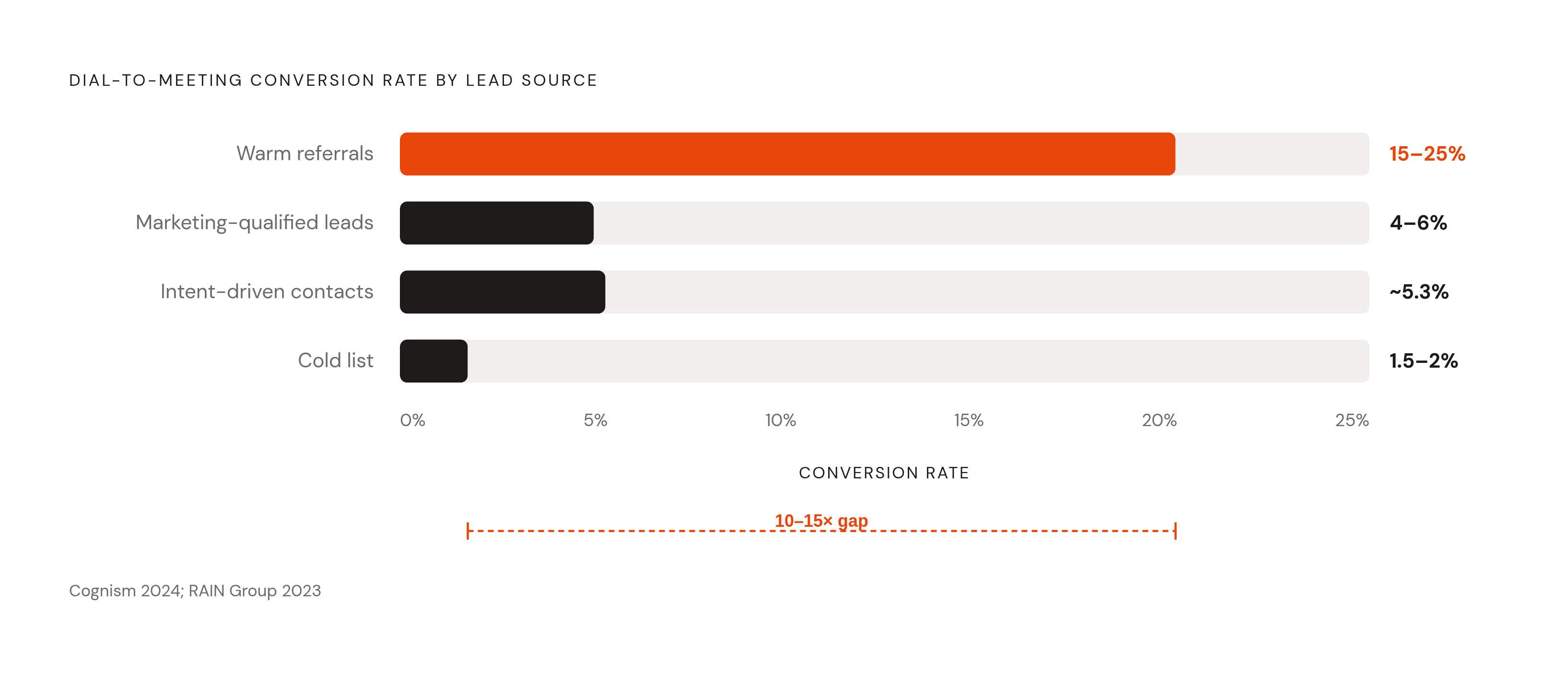
Any benchmark that does not specify lead source is close to useless for planning. The variance across lead temperature categories is not marginal; it spans an order of magnitude.
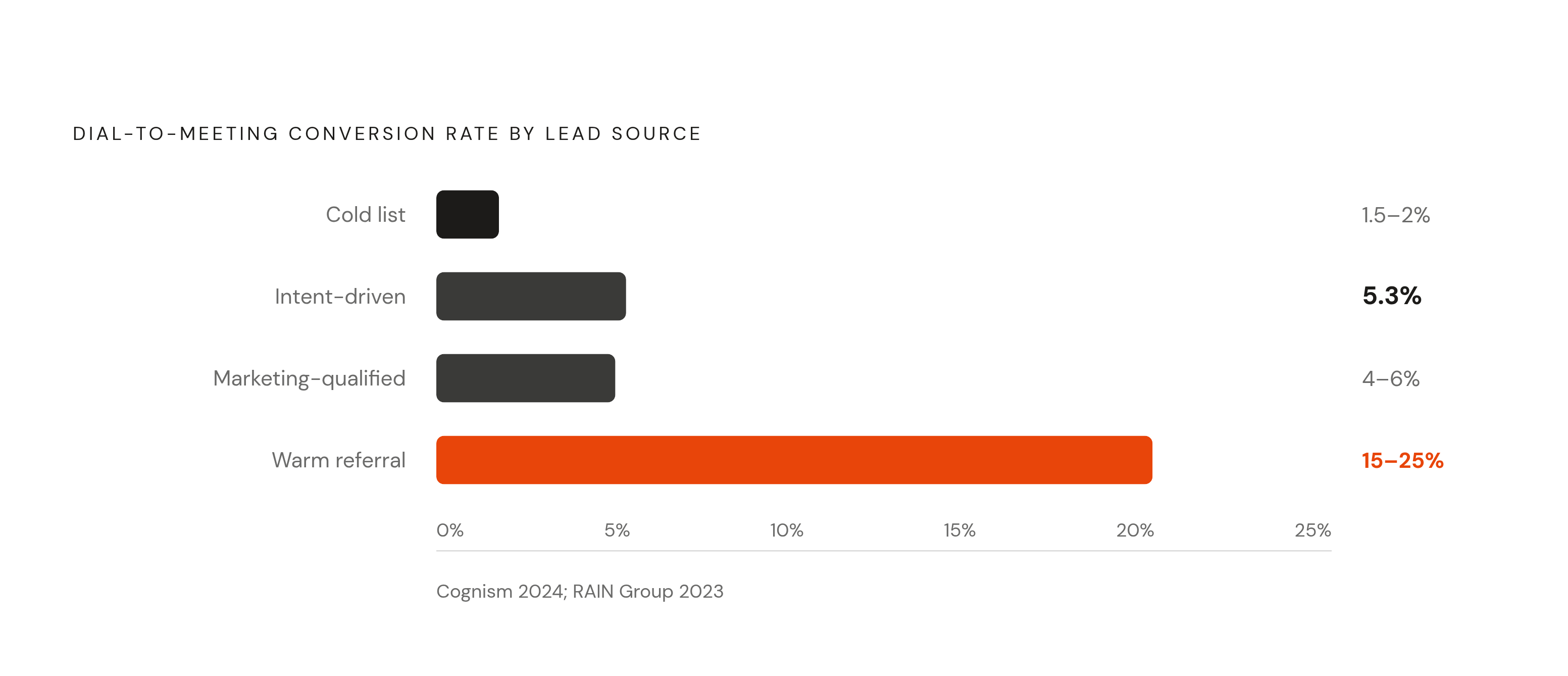
Cold list converts at 1.5–2% dial-to-meeting. Marketing-qualified leads convert at 4–6%. Warm introductions or referrals convert at 15–25% (Cognism, 2024; RAIN Group, 2023). A 10–15x range depending on the quality of relationship and context behind the call.
Intent-driven calls, where the prospect has shown prior interest through a pricing page visit, a content download, webinar attendance, a job change into a relevant buying role, or a funding announcement signaling budget activation, are identified through intent data and convert at roughly 5.3%, more than double the cold-list baseline. Prior interest is a broad category, but each signal meaningfully shifts the probability that a conversation happens and that the conversation converts.
It is also worth considering what this means for benchmark comparisons. A team reporting 5% dial-to-meeting may simply be calling warmer lists. They are not necessarily better at cold calling; they may just have more mature list-building practices or better marketing attribution. Comparing their number against yours without normalizing for lead source produces a misleading gap and tends to generate the wrong conclusions about where to invest.
The channel itself retains real viability among senior buyers. 57% of C-level and VP-level buyers prefer phone contact; 69% of B2B buyers are open to cold calls from new providers during active B2B sales prospecting; 82% have accepted meetings from strategic cold outreach (RAIN Group, 2023). These statistics describe buyers who received a relevant, timely, specific call, not one generated by a mass dialer working through a scraped list. Context is not a nice-to-have on cold calls. It is the admission price.
The practical implication for forecasting: the benchmark that matters is not the category average but your own lead-source composition. What share of your dials are cold list, intent-triggered, and warm? That mix determines your realistic conversion rate, and it is the variable with the most available leverage before you hire a single additional rep.
Timing, Persistence, and the Mechanical Variables That Move Connect Rates
Some conversion variables are strategic; others are mechanical. The mechanical ones are underrated because they feel mundane, but the aggregate effect of ignoring them is not small.
Calling windows matter more than most teams act on. Research consistently finds that dials placed between 8–9 AM and 4–5 PM local time deliver meaningfully higher connect rates than midday calls, with some estimates running 40–50% higher (InsideSales.com, via HubSpot Research, 2023). The mechanism is not mysterious: prospects are between meetings at those hours, not yet in deep work, not locked behind a blocked calendar. Midday calls land in the worst possible slot. A lift of that magnitude on a fixed dial volume represents substantial pipeline increase without adding headcount, which makes the widespread failure to act on this puzzling. Why exactly does this happen so consistently? Likely because shifting call windows requires changing team habits, and habit change has a higher friction cost than most managers account for.
Voicemails present their own calibration problem. The callback rate from a voicemail alone is approximately 1.5%. Live conversations are roughly six times more effective. The naive conclusion is that voicemails are not worth leaving. More accurate: voicemails operate through a different mechanism entirely. Gong data shows cold calling nearly doubles email reply rates, 3.44% versus 1.81%, even when the call does not connect (Gong Labs, 2024). The voicemail primes the prospect to open the follow-up email. It is an attention mechanism, not a booking mechanism, and teams that treat it as a booking mechanism will conclude it does not work.
Persistence is the other persistent blind spot. The data consistently indicates that an average of eight attempts are required to reach a prospect (Gong Labs, 2024). At current conversion rates, that translates to roughly 200 dials per qualified meeting booked. Most teams do not sustain that cadence, which means they are systematically abandoning prospects who were, in fact, reachable.
Data decay quietly destroys list performance without announcing itself. B2B contact data decays at approximately 2.1% per month (ZoomInfo, 2023). A list built six months ago has already lost roughly 12% of its accuracy before the first dial of a new campaign. That degradation produces no obvious error message; it just slowly erodes connect rates, inflates time-per-dial, and undermines morale without a traceable cause, which makes it easy to misdiagnose as a scripting or rep performance problem when the list is simply stale.
Why Multi-Channel Sequences Outperform Standalone Cold Calling
Whether to call is largely settled. The more useful question is where the call sits in a broader sequence and what it references when it lands.
Multi-channel approaches combining calls with email and LinkedIn outreach consistently outperform phone alone; the specific magnitude varies by study, but the finding holds across sources and is supported by the interaction effects visible in Gong's reply-rate data. The effect is not additive. It is multiplicative. Each channel primes the others in ways that isolated channel analysis misses.
A voicemail increases the probability that a follow-up email gets opened. A prior email gives the rep a genuine, non-awkward reason to call, which changes the opening line from "I'm reaching out because..." to something with actual context. A LinkedIn connection or profile view creates a trace of familiarity that softens the cold entry. None of these channels performs optimally in isolation; each borrows lift from the others, and sequence design determines how much of that lift is actually captured.
This has real design implications. Calls should be placed at deliberate points in a sequence, not dropped randomly or treated as a last resort when email goes unanswered. The voicemail, when left, should reference the email thread or LinkedIn touch so the prospect can construct a coherent narrative about who is reaching out and why. Timing between touches in a sales cadence matters too: too rapid a cadence reads as spray-and-pray and triggers the same psychological resistance as robocalling; too slow a cadence loses the continuity that makes a sequence feel like a relationship rather than a broadcast.
For small GTM teams with limited headcount, this reframes the economics. The question is not whether cold calling alone can carry pipeline. At current conversion rates, it cannot sustain a program in isolation. The question is how to deploy the call as the highest-friction, highest-signal touch inside a coordinated sequence, doing work the other channels cannot replicate. But how does this affect our original promise of cold calling as a direct pipeline driver? It does not eliminate cold calling's role — it redefines it as the anchor of a system rather than a standalone tactic.
What Separates Teams That Beat Benchmarks From Those That Don't
Top-performing outbound teams consistently beat the average by 2–3x; the best reach 5–8% or higher on dial-to-meeting. That gap is not primarily a talent story, though talent matters at the margins. It is a systems story, and the separating factors compound each other in ways that make isolating any single variable difficult.
Data quality is the foundation. At 2.1% monthly decay, a stale list is not a mild handicap; it is a structural deficiency that silently degrades every other investment in the program, including headcount, tooling, and coaching. Teams that treat list hygiene and data enrichment as a competitive variable rather than an IT maintenance task see meaningfully different connect rates before a single word of scripting is adjusted.
Specificity is the second factor. Targeted pre-call research, identifying a few relevant, specific facts about a prospect's company, role, or recent activity, has been associated with substantial lifts in conversion (Cognism, 2024). Personalization at that level is achievable at scale with the right workflow, and the return is significant enough that generic scripting is now a deliberate competitive disadvantage, not merely a missed opportunity.
Coaching is the third factor and the most chronically underinvested of the three, at least in my experience observing programs across various company stages. Effective coaching has been linked to meaningful improvements in both conversion rates and revenue per rep (Gong Labs, 2024). The performance gap between average and top-quartile reps in Gong's dataset is largely a coaching gap. The reps at the bottom of the distribution are not failing because of low effort; they are failing because no one has systematically examined their opening lines, their objection handling, or their discovery questions against the calls that actually convert. One might argue that hiring better reps would close this gap more efficiently — but the data does not support that conclusion. Coaching interventions applied to existing reps consistently outperform the returns from recruiting alone.
The 2.3% average cold call conversion rate functions as a gravitational pull for teams operating on stale lists, generic scripts, and infrequent coaching. The cost context makes this urgent: fully loaded cost per lead (CPL) via cold calling runs $300–$500 by most industry estimates, a significant multiple of what cold email costs (RAIN Group, 2023). Those economics hold only when conversion rates are competitive, which requires all three factors operating in combination.
Using These Benchmarks to Build a Reliable Forecast Model
A usable forecast model starts with establishing your own denominator. Does your team track dial-to-meeting, conversation-to-meeting, or both? Both should be tracked; they answer different questions and diagnose different problems. Using only one produces a blind spot in whichever dimension you ignore, and that blind spot persists because there is no obvious symptom until pipeline is already short.
Segment your baseline by lead source before comparing to any published figure. Cold list should be benchmarked against 1.5–2% dial-to-meeting. Marketing-qualified leads against 4–6%. Intent-triggered or warm contacts against 5–25%, depending on signal strength and relationship depth. A single blended rate obscures performance variation across your funnel and makes it nearly impossible to locate where leverage actually exists.
Build backward from pipeline targets, not forward from activity metrics. Define the number of qualified opportunities needed per month. Divide by your actual dial-to-meeting rate, not the industry average, to determine required dials. Then check that number against rep capacity. If the math requires more dials than your team can place, two levers exist: improve conversion rates, or shift the lead mix toward warmer and intent-triggered contacts. The second lever is chronically underexploited at early-stage companies where list-building defaults to scraped cold data because it is simply easier to acquire at volume. Platforms such as Cardinal, an AI agent platform for outbound prospecting that surfaces intent signals and automates enrichment so teams can act on warm contacts faster, exist precisely to close that gap without adding headcount.
Track conversation-to-meeting separately from dial-to-connect specifically to isolate coaching problems from data problems. Low dials-to-connect means the list needs attention. Low connect-to-meeting means the pitch needs attention. Applying a coaching intervention to a data problem, or a list-hygiene intervention to a scripting problem, wastes time and produces no measurable improvement while the actual issue compounds.
Finally, revisit these benchmarks quarterly. The drop from 4.82% to 2.3% between 2024 and 2025 is not an anomaly to discount; it is evidence that the environment shifts fast enough to invalidate a forecast built on prior-year assumptions. The teams that will outperform in 2026 are the ones already treating benchmark calibration as an ongoing operational process rather than a one-time setup task that gets revisited when pipeline misses become undeniable.