Ideal Customer Profile Tightening for Early-Stage Startups
Founder-led outbound reveals which customer segments actually convert and why.

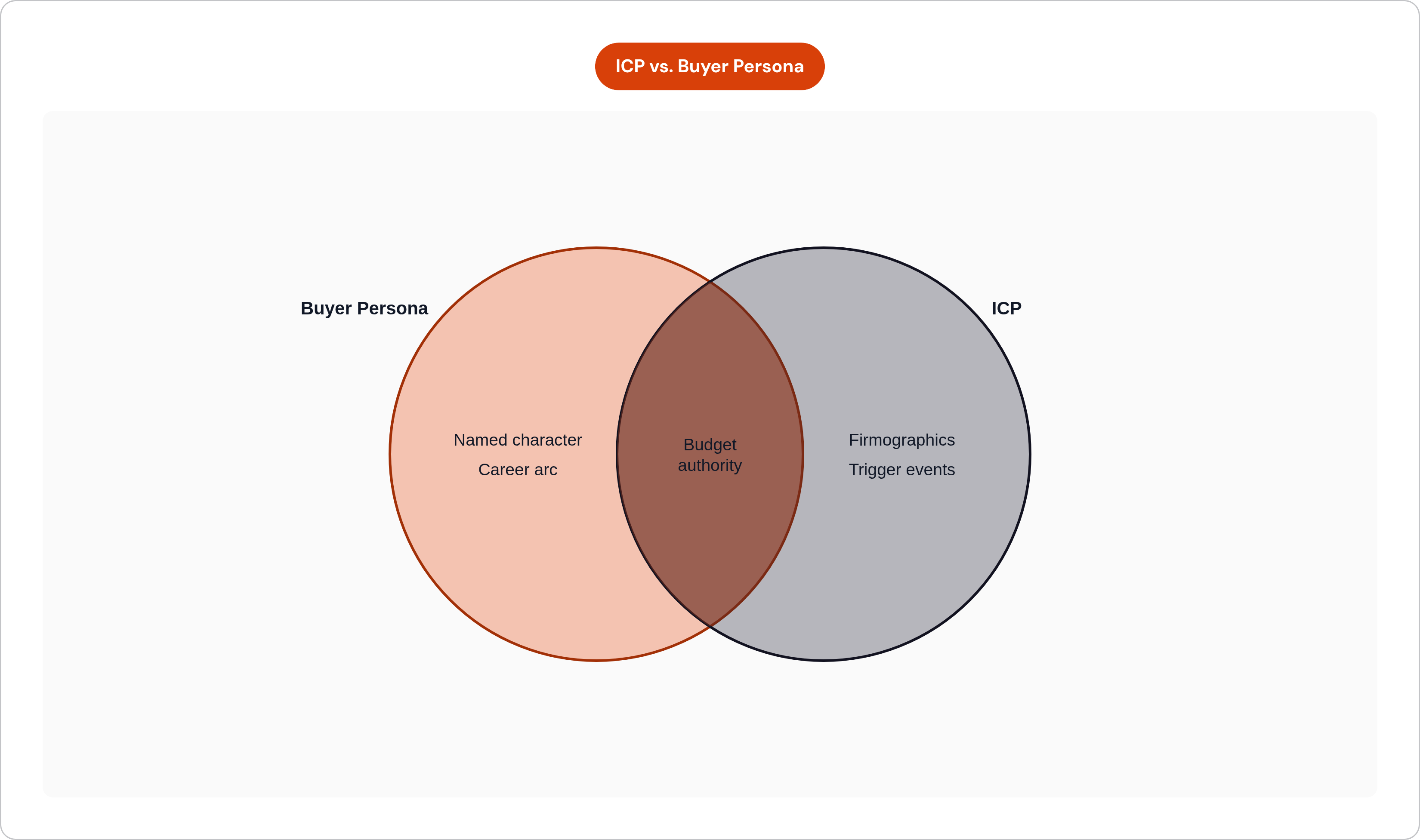
Start with a clarification that most frameworks skip: an ICP is not a buyer persona. A persona is a character with a name, a coffee preference, and a career arc. An ICP describes the category of company most likely to convert, retain, and expand, and the decision-makers inside it who actually control the budget. That distinction is not semantic. It orients the entire exercise toward a segment rather than an invented protagonist.
For a B2B startup, useful ICP components are layered. Firmographics form the outer shell: industry, headcount, revenue range, geography, growth stage. These are table stakes. Technographics add a more useful layer: what tools does this company already use, how integrated is their existing stack, and does your product slot into that stack or require them to abandon something they've already paid for? Budget and authority complete the structural picture. Together, these three layers describe the container. They do not describe the person.
The behavioral and motivational layer is where the work gets interesting and where early-stage teams chronically underinvest. What triggers a company in your target segment to start looking? What does urgency actually look like for this buyer? Which words do they reach for when describing the problem? The fundamental unit of a useful ICP is mindset and trigger, not a firmographic range. Attributes that cause real people to take action in a specific moment are more valuable than a headcount bracket.
One constraint experienced GTM practitioners are fairly uniform on: run one ICP at the early stage. Multiple ICPs fragment product development, diffuse messaging, and leave founders unable to answer "what does your company do" without hedging. When that question produces a winding answer, the underlying problem is almost always ICP, not positioning. Keep the segment as small as necessary to dominate it, establish clear ownership of that space, and expand from demonstrated authority rather than hoped-for breadth — even if that means targeting a fraction of the total addressable market at the outset.
To make this concrete: an ICP built around "founders" is not a useful ICP. An ICP built around Seed-to-Series A B2B tech companies, five to fifty employees, operating in North America, implementing a structured CRM for the first time or visibly frustrated with their current one, is. That level of specificity is uncomfortable to write because it feels like leaving money on the table. What it actually does is make every subsequent decision faster and cheaper, including the decision to say no.
How Founder-Led Outbound Generates the Raw Material for ICP Tightening
Founders should run outbound before hiring any SDR or sales representative. People who have done this don't debate it much. The debate exists mostly among founders who mistake delegation for scale. The first eight to sixteen weeks of founder-led outbound generate ICP clarity, messaging proof, and an objection library that no SDR ramp period can replicate. Skip this phase and you hand your first sales hire a set of problems that should have been cheaper to solve two quarters earlier.
The sequencing logic has a rough shape to it. In the first thirty days, the goal is to lock a hypothesis ICP, run ten to fifteen customer conversations, and refine the narrative until something specific happens: a prospect uses your framing to describe their own problem back to you. That moment, when a buyer repeats your language unprompted, is one of the clearest early signals that ICP and messaging are converging on something real. Days thirty-one through sixty are for building one reliable acquisition loop for that ICP: founder-led outbound, a single partner channel, a targeted content cluster. Days sixty-one through ninety are for adding conversion infrastructure once early validation exists, a tighter demo flow, codified objection handling, a cleaner onboarding handoff. The sequence matters because adding infrastructure before validation is operational debt that compounds quietly until it doesn't.
There is a simple test that cuts through the noise. Can you explain, with evidence, why your last five customers bought? If yes, something repeatable exists to build on. If the answer is different for each of those five, additional spending buys more motion you cannot explain, and motion without explainability is not traction.
Founder-led content is a parallel signal source that gets underestimated. When founders share substantive, specific insight about the problems their target customers face, buyers self-select into the conversation. Those who engage reveal fit. Those who disengage reveal misalignment. Per the 2025 State of B2B GTM report, surveying 195 GTM leaders, LinkedIn, warm outbound, and founder brand ranked as the three most effective early-stage channels, all inherently founder-driven. The same report found meaningful proportions of GTM leaders planned to increase investment in both LinkedIn and founder brand in the coming year.
Research from Forrester has found that ineffective GTM strategies inflate customer acquisition costs substantially. The discovery work done in founder-led outbound is, in effect, a cost-reduction exercise: it makes every subsequent acquisition dollar go further by pointing it at a more precise target.
Reading Wins and Losses as ICP Data: The Pattern Recognition Loop
Every closed-won and closed-lost deal contains ICP information. Most early-stage companies treat deals as revenue outcomes and miss the diagnostic layer entirely.
Across wins, the questions worth asking are: which firmographic attributes appeared consistently in fast closes? What language did buyers use verbatim when describing the problem? What triggered them to respond in the first place? These require going back into conversation notes, email threads, and call recordings and treating them as primary sources. Across losses and non-replies, the questions shift: which segments generated activity but never converted? Where did deals stall, at demo, at procurement, at champion buy-in? Which objections appeared repeatedly from similar company types? Objection clustering by company type is one of the richest and most underused forms of ICP signal available.
Rydoo offers a useful case study. Facing feedback from their customer base, Rydoo revised their ICP to focus specifically on companies operating in countries with complex tax and compliance requirements, prioritized ERP integrations, and targeted finance leaders navigating regulatory complexity. Germany emerged as one of their strongest markets, contributing a significant share of ARR. The data generating that insight was already present in their customer base. The ICP revision was the act of reading it carefully and acting on what it said.
The information needed to tighten your ICP is almost always already in your existing deal history. The barrier is rarely a lack of data. It is a lack of infrastructure to surface the patterns, and a lack of discipline to interrogate the data without flinching at what it reveals.
CRM hygiene is an ICP discipline, not just an operations one. If wins and losses aren't tagged consistently, if deal notes don't capture the language buyers used, if lost reasons aren't coded with meaningful specificity, patterns remain invisible. Selling outside the ICP wastes time and introduces noise into the pattern recognition process, actively distorting the signal. Every off-ICP deal that enters the pipeline corrupts the dataset you're trying to read.
Outbound Reply Rates as a Real-Time ICP Fitness Test
Reply rate is widely tracked. It is less commonly understood as an ICP validation instrument, which is what it actually is when read correctly.
Benchmark data from Autobound's 2026 signal-based selling research provides a useful framework. Generic cold outreach performs at the industry average, which Instantly's 2026 Cold Email Benchmark Report places at roughly 3.43%. Basic personalization, meaning name, company, and title, lifts that meaningfully. Signal-based personalization, where outreach references a specific event tied to a relevant value proposition, reaches reply rates in the fifteen to twenty-five percent range. Multi-signal stacked outreach, combining two or three behavioral or intent signals with a calibrated message, can reach twenty-five to forty percent. The gap between these tiers is not primarily a copywriting achievement. It is an ICP precision achievement. When the right message hits the right segment at the right moment, reply rates reflect that alignment.
Persistently low reply rates on well-constructed outreach are a strong signal that something structural is wrong with the ICP, not the copy. Wrong segment, wrong pain point framing, wrong timing relative to when this buyer is actually in-market. Responding to low reply rates by rewriting subject lines is a common mistake. The prior question is whether the segment being targeted is right at all.
Belkins' 2025 data adds texture: smaller, targeted campaigns to fifty recipients or fewer average a meaningfully higher response rate than larger, broader list sends. Tighter outperforms broader. Only a small fraction of senders personalize every email they send, per the signal-based selling data, which means the competitive return on doing this well remains large and relatively uncrowded.
The practical application is to run outbound segmented by ICP hypothesis variation, testing one industry against another at the same company size range, tracking reply rate and positive reply rate separately by segment. A positive reply rate between one and a half and three percent at a reasonable level of ICP specificity indicates the segment merits continued investment. Segments that persistently underperform warrant a hypothesis revision, not a copywriting sprint.
Behavioral and Intent Signals That Reveal Who Is Actually Ready to Buy
The volume-based SDR model didn't fail because outbound stopped working. It failed because it routed effort indiscriminately across a population where purchase readiness varied enormously, while ignoring the behavioral data that indicates which companies are actually in-market now.
The categories of intent signal that matter most at the early stage are layered. First-party signals come directly from your own product or website: pricing page visits, feature engagement spikes, demo requests, return visits from the same company. A prospect visiting your pricing page is communicating something specific about where they are in an evaluation process. Third-party signals come from external data: job change alerts when a buyer moves to a new role, hiring patterns at target companies such as an SDR posting suggesting a company is building a sales function, competitor engagement data, content consumption in your category. Technographic signals indicate when a company has adopted a new tool that creates a compatibility or displacement opportunity for your product.
Intent-triggered outreach should happen within hours, not days. Signal windows close quickly. A prospect who visited your pricing page yesterday is in a different state of consideration than the same prospect three weeks from now. This is easy to agree with and surprisingly hard to operationalize.
What these signals reveal about ICP over time matters as much as how they're used in individual outreach. Which job titles visit pricing pages without converting? That is a messaging misalignment signal, possibly indicating that the person who experiences the problem is not the person who owns the budget. Which company types trigger the most demo requests? That is ICP confirmation data, pointing toward segments where the problem is acute enough to generate unprompted inbound behavior. Which hiring triggers correlate with fast closes? That is a new ICP attribute worth encoding into prospecting criteria.
Intent-based outbound ranked second among channels where GTM leaders planned to increase investment in the 2025 State of B2B GTM report. The direction of capital allocation is itself a form of market signal.
One tactical approach worth noting: some practitioners run what they call a brain-trust campaign, inviting ten to twenty industry experts into a structured conversation about a problem in their domain rather than pitching a solution. The approach lowers defenses, generates honest signal about how buyers actually think and articulate the problem, and often converts advisors into early customers. Its ICP value is that it functions as qualitative research and lead generation simultaneously, producing the raw language the market uses to describe the problem, which is the raw material for both ICP refinement and messaging development.
How a Connected Platform Closes the Loop Between Signal and ICP Iteration
The feedback loop described across these sections only functions if data flows continuously between where signals are captured, where outreach is executed, and where outcomes are logged. A fragmented stack severs that loop at every junction. Wins and losses tagged in a CRM that doesn't connect to the prospecting criteria used to build the list cannot generate pattern recognition. Intent signals captured in one tool that don't trigger sequences in another create a time lag that erodes the signal's value. Reply rate data that never feeds back into list-building logic produces campaigns that repeat the same ICP mistakes indefinitely, each one generating noise mistaken for learning.
What connected infrastructure enables is a compounding cycle rather than a series of disconnected experiments. List building, intent signal capture, outreach sequencing, and CRM logging operating from shared data means each campaign starts from a more precise ICP position than the last. AI agents executing specific, well-defined sales motions can act on the validated ICP attributes accumulated over prior cycles. Reply patterns and conversion outcomes feed back into which ICP attributes get surfaced in the next campaign and which get retired.
Some platforms are built for this use case, automating list building, outreach sequencing, and CRM syncing in a single environment so that the signal generated by each outbound cycle feeds directly back into the next ICP iteration, rather than requiring founders to manually maintain the connections between several separate tools.
Each iteration cycle, outbound run, signals read, ICP tightened, next run launched, starts from a more precise position than the one before it. Precision accumulates. A company on its fourth ICP version is doing the same work with substantially higher hit rates because every prior cycle contributed to the targeting logic, rather than four times the work of a company on its first.
The ICP Tightening Cycle in Practice: What Versions 2, 3, and 4 Look Like
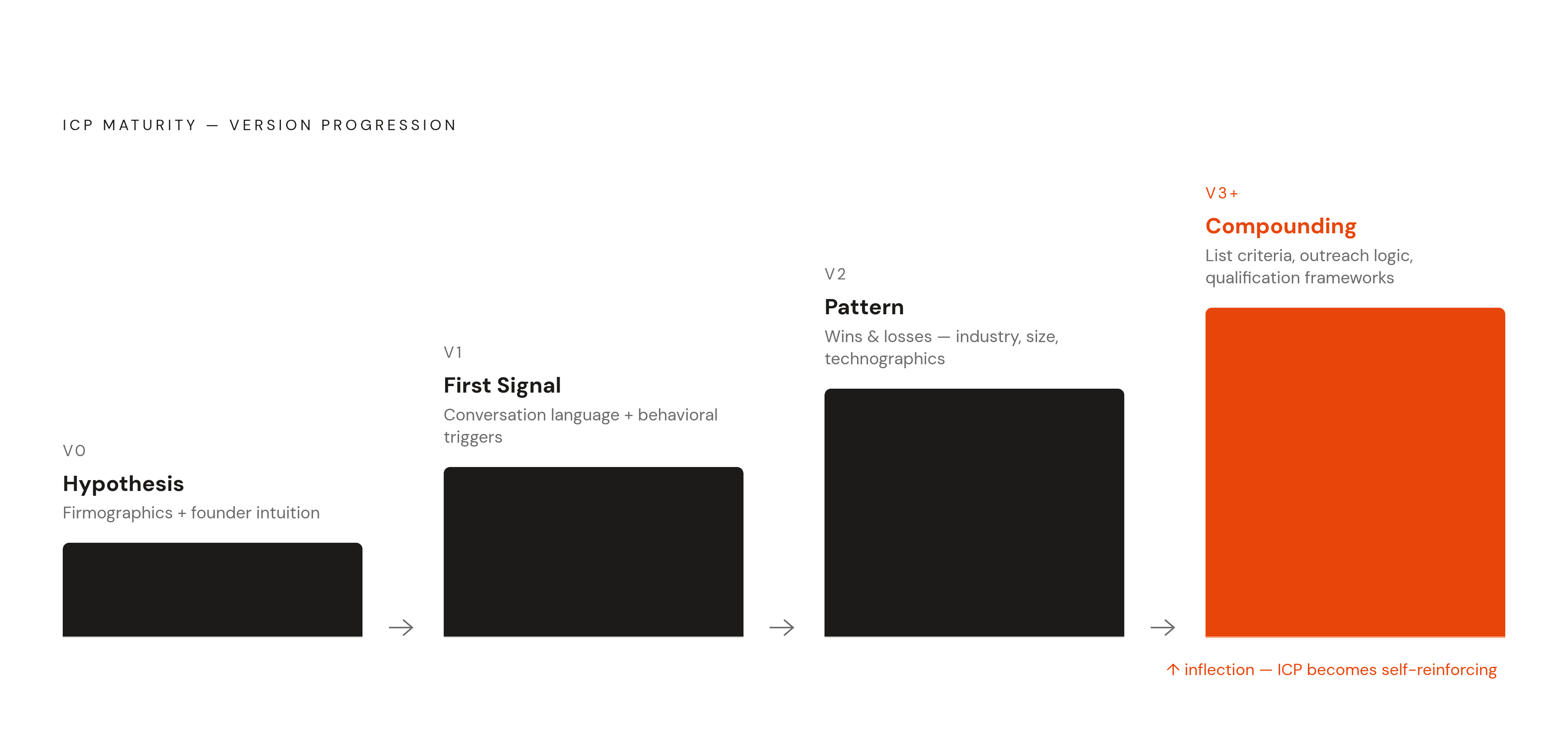
Version 0 is the hypothesis ICP: firmographic assumptions plus founder intuition, used to start conversations and generate early signal. It is not meant to be defended. It is meant to be tested.
Version 1 is the first-signal revision. It incorporates language from early customer conversations, removes segments that generated activity but no conversion, and adds the behavioral or situational triggers that appeared consistently in fast closes. Still imprecise, but grounded in observed data rather than assumption.
Version 2 is the pattern ICP: built from enough wins and losses to see real clusters. By this stage, the ICP should be specific about industry, size range, growth stage, relevant technographic attributes, and the trigger event that makes a prospect actually buy. The trigger event is often the last attribute to crystallize, and frequently the most valuable one. It is also the attribute that tends to produce the most internal resistance, because it commits the team to a narrow view of when their buyer is actually reachable.
Version 3 and beyond is where the ICP becomes compounding. It is encoded into list-building criteria, outreach personalization logic, and qualification frameworks. Each new campaign tests a specific hypothesis rather than simply filling a pipeline. The team is running structured experiments, not working from a static assumption.
Several signals warrant a revision at any stage. Reply rates falling below four percent despite well-constructed outreach suggest ICP misalignment. High meeting-to-opportunity drop-off indicates that conversations are happening with the wrong company profile. Deals stalling consistently at the same stage for a specific segment often reveal a structural mismatch between that segment's buying process and the product's current state. A new cluster of wins that doesn't match the current ICP definition is perhaps the most important signal of all. It may mean the market is redirecting you toward a more valuable segment than the one you originally targeted, and the founders who notice that early rather than defending the original thesis tend to fare considerably better.
The stability signal worth waiting for before scaling aggressively is simpler than most frameworks suggest. Can you explain, with evidence, why your last five customers bought, what attributes they shared, what triggered them to act, and what made them convert faster than others? When the answer is consistent and specific, there is a foundation for a repeatable GTM motion. Until then, more spending buys more noise.