How to Scope an AI Agent's Role So It Doesn't Step on Everything Else
Narrow scope prevents agents from confidently executing in the wrong direction.

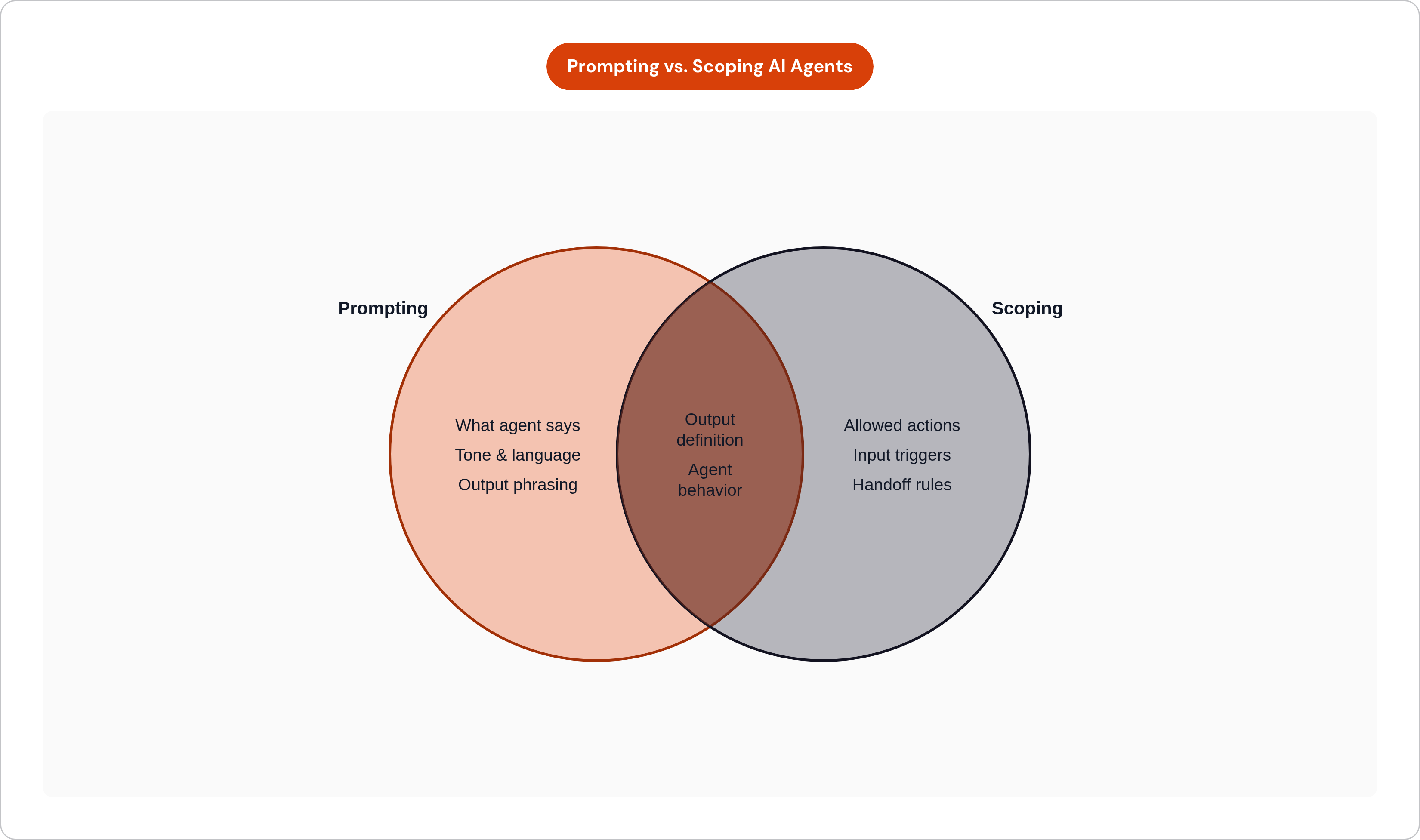
Prompting and scoping get conflated constantly, and the confusion is expensive. Prompting shapes what an agent says. Scoping determines what an agent is allowed to do, when it is allowed to do it, and when it must stop. A well-prompted agent with loose scope executes confidently in the wrong direction. That is a design failure, not a model failure, and the distinction matters because one of those problems is fixable.
A workable scope definition has three components: input, output, and handoff. The input is the exact data or trigger that activates the agent, specific enough that it cannot fire on ambiguous conditions. "Go find prospects" is not an input definition. A named ICP segment pulled from a defined list, or a CRM status change, or a documented signal event, is. The output defines precisely what the agent produces and in what state it leaves the pipeline. A drafted email awaiting human review is categorically different from a sent sequence, and treating them as interchangeable is where things first start to go wrong. The handoff is the moment the agent stops, written down explicitly, not assumed.
There is also a distinction worth establishing early because it governs how strictly scope must be enforced. Sensing agents watch, score, and flag; they stop before execution. Acting agents send, log, and move opportunities forward. A sensing agent that misfires generates noise. An acting agent that misfires sends a bad email to a real person. The arXiv HAIF Framework, published in 2026, puts the underlying problem clearly: AI agents cannot recognize when a task is underspecified in ways that affect the outcome. They execute fluently on incomplete instructions. The boundary the agent cannot self-identify must be written by a human before the agent goes live.
One test I keep returning to: before deployment, can the team write one sentence describing what the agent does and one sentence describing what it does not do? If the second sentence is vague or missing, the scope is not ready.
The Outbound Prospecting Agent: Defining Its Lane
Prospecting is where most teams start with AI agents. Volume is high, the motion is repeatable, and doing it manually is tedious. It is also where scope violations accumulate fastest, because agent competence creates its own temptation. The thing is performing, so why not ask a little more of it?
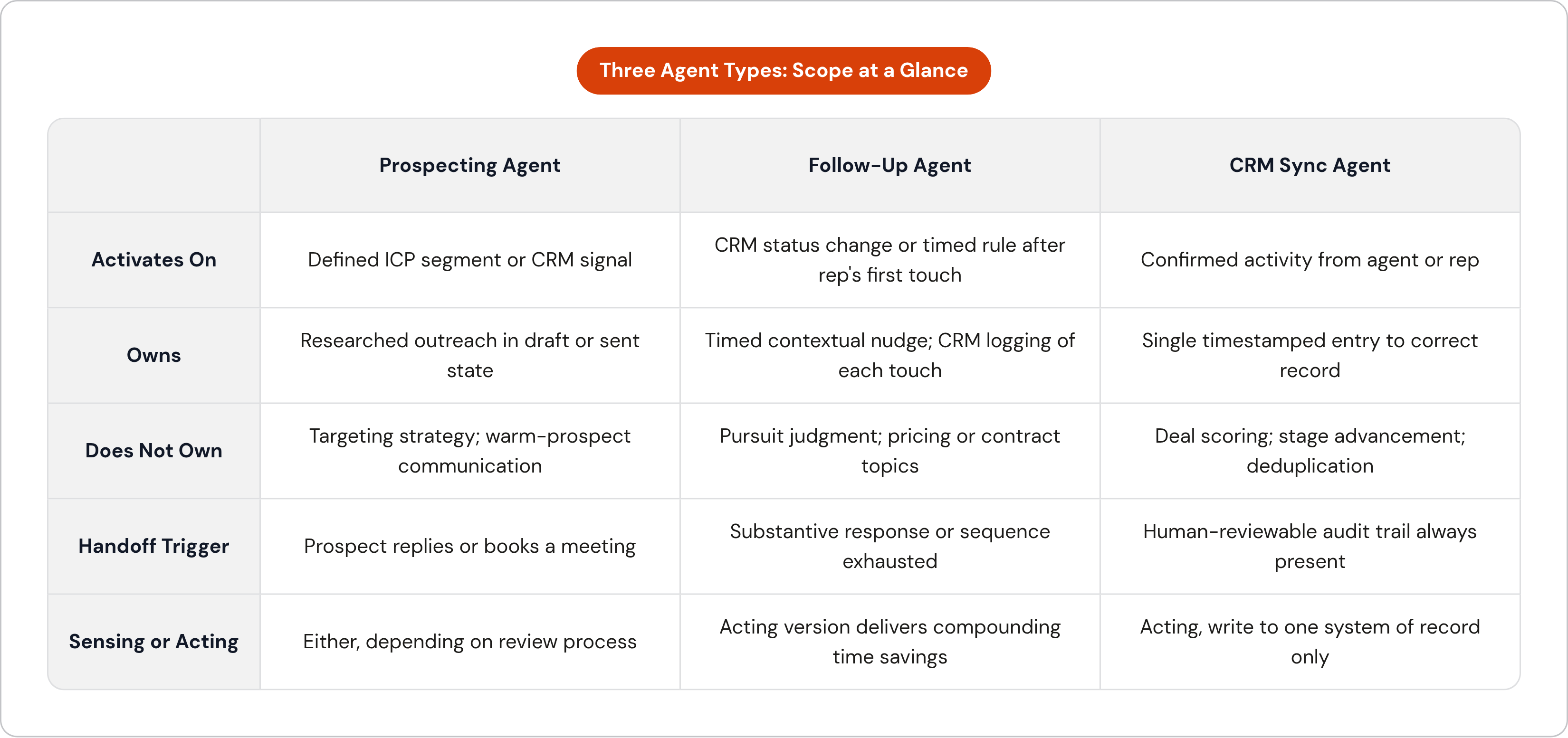
A well-scoped prospecting agent owns a narrow slice: execute against an ICP segment with firmographic and technographic criteria already set by a human, produce researched outreach in draft or sent state depending on the team's review process, and stop there. Targeting strategy is a judgment call. It belongs to the person running the motion, not to the agent executing it.
The violations I see most often follow a pattern. Teams ask the agent to set targeting criteria rather than work from criteria already established. They let the agent reach into accounts where a rep has already begun building a relationship. Most damaging, they run cold outbound and warm follow-up through the same agent, treating them as temperature variations of one task when they require different tone, different timing, and entirely different context. An agent calibrated for cold outreach reaching a warm prospect produces a message that feels off, even when it is technically correct. The prospect cannot articulate why. The rep usually cannot either.
The case of Actively AI is worth examining here. Forbes reported in April 2026 that deals touched by their agents, each built separately per account and trained on historical deal data with a defined research-and-draft role, closed approximately 23% more often than traditionally worked ones. The performance followed from the scoping specificity. Role clarity was a design decision, not an afterthought.
The handoff for a prospecting agent should be unambiguous: the moment a prospect replies or books, the agent logs the activity, tags the record, and exits. Any scenario in which the agent continues engaging after a human has responded is a scope violation the team will pay for in prospect trust, which is not a recoverable currency at the early stages of a relationship.
The Follow-Up Agent: A Different Motion, a Different Scope
Pipeline leaks in follow-up not from lack of intent but from timing failure. A rep who ran a strong discovery call intends to follow up in three days. It happens eight days later, after the momentum has cooled. The follow-up agent exists to close that gap, and its scope is more constrained than the prospecting agent's because the relationship already exists and can be damaged.
The inputs are categorically different. The follow-up agent should activate on a specific CRM status: demo completed with no response in a defined window, a signal event like a pricing page revisit or a deck re-opened, or a time-based rule following an initial reply. It should not activate on a prospect the rep has not already touched. A message that implies prior relationship where none exists is not a neutral error; it signals poor organizational hygiene to the prospect.
What the agent owns: a timed, contextual nudge referencing the prior conversation, CRM logging of each touch so the rep can see current state, and escalation to the rep if the prospect responds with anything beyond a simple acknowledgment. What the agent does not own: any judgment about whether to keep pursuing a prospect, any communication touching pricing or contract terms, anything resembling relationship repair after a friction event.
The sensing versus acting distinction lands differently here than in prospecting. A sensing follow-up agent surfaces fading momentum to the rep; useful, but it stops short of where the leverage lives. The acting version sends the nudge, logs it, and only surfaces the rep on substantive response. That is where time savings compound. The risk is that a poorly scoped acting agent sends a nudge on a deal where the rep was deliberately letting space breathe, or during a negotiation window where silence was strategic. Those errors go out in the rep's name. They are not recoverable by a follow-up message explaining the situation.
Handoff: the prospect re-engages substantively, or the sequence exhausts without response. In the latter case, the agent marks deal stage and surfaces the record to the rep. The decision about what happens next stays human.
The CRM Sync Agent: The Scope Problem Nobody Talks About
CRM sync receives almost no architectural attention, possibly because it is unglamorous, possibly because its failures are quiet. Two agents logging the same activity from different triggers. Conflicting field updates. Deal stages that reflect activity volume rather than pipeline health. These problems compound invisibly until a rep opens a record before a call and finds it does not match what they know about the account.
The sync agent's job is narrow. It takes confirmed activity as input, a sent email, a booked meeting, a completed call, confirmed by another agent or a rep, and produces a single accurately timestamped CRM entry against the correct contact, the correct deal, and the correct stage. It does not interpret outcomes. It does not advance deal stages. It does not merge duplicate records.
The violations worth naming directly: asking the sync agent to also score the deal is a category error; scoring is a separate function with separate logic and separate accountability. Allowing multiple agents overlapping CRM write permissions without clear ownership rules makes the log unreliable. Reps who cannot trust the log stop consulting it, and a CRM that goes unconsulted has negative value because it produces false confidence in pipeline reviews. Allowing the agent to advance deal stages based on activity count rather than human judgment creates a pipeline that looks healthy and is not.
One governing principle for this agent: it should write to one system of record, log one type of event, and leave a human-reviewable audit trail. If a rep cannot reconstruct what the agent did and why, the scope is too loose. BCG's research from October 2025 is useful here: only 10% of AI transformation value comes from the algorithm; 70% comes from people and processes. A CRM that reps distrust erodes the 70% regardless of model quality.
How to Design Handoff Points So Agents and Humans Don't Collide
Every collision in a sales AI system happens at a boundary. The agent runs past the point where a human should have taken over. A rep jumps into an active sequence without stopping the agent. Two agents share jurisdiction without a protocol for who acts first. These are not edge cases. They are the default outcome when handoff points are not explicitly designed.
A clean handoff needs three things. The trigger condition must be specific enough to be unambiguous; not "when the prospect seems interested" but "when the prospect replies with a question or clicks a meeting link." Behavioral triggers are measurable. Sentiment triggers are not. The agent must stop visibly: the rep receives a notification with context, what was sent, what was said, what was logged. Discovering a handoff by accident is a design failure, not an unusual circumstance. Finally, the rep must have a clear mechanism to pause or override the agent's queue. No kill switch means the scope has a hole.
The arXiv Intelligent AI Delegation framework from 2026 identifies bi-directional clarity as essential to effective human-AI collaboration: the agent should not only explain its actions but proactively surface ambiguous situations for human input. That behavior must be designed into the system. It will not emerge from the model.
Workday's global research from August 2025 found that 75% of workers were comfortable teaming with AI agents, but only 24% were comfortable with agents operating in the background without human knowledge. That gap is not a cultural artifact organizations will eventually grow past. It is a design signal. Visible, narrated handoffs are what close it.
Someone needs to hold accountability for where each agent starts and stops, and for resolving conflicts when agent jurisdictions overlap. Whether that is a dedicated person or a shared responsibility, the role cannot be implicit. Reps function as exception handlers when the agent hits a situation outside its defined scope. A regular quality review cadence, whether daily or weekly, catches agent output before it compounds into something harder to fix. A single connected platform enforces handoff rules more reliably than a fragmented stack because rules are set once and honored consistently; in a multi-tool environment, each tool carries its own trigger logic and the conflicts are difficult to trace.
How to Scope Agents When the Founder Is Also the Sales Motion
Founder-led sales breaks standard AI agent frameworks if those frameworks are applied without adjustment. At this stage, the founder's voice, judgment, and relationship credibility are not inputs to a system. They are the product. An agent that impersonates that voice, or dilutes it through volume without quality, is a liability.
What agents can reliably own in this context is specific. Research and list-building for accounts the founder has already decided to pursue: the targeting decision stays human, the research work does not. First-draft outreach that the founder reviews and personalizes before it goes out: the agent compresses time, the founder supplies the authenticity the agent cannot replicate. Follow-up sequences after the founder's first touch, for prospects who have not replied: the agent maintains presence without requiring founder attention at every interval, and the founder re-engages when there is a real signal. CRM logging and deal-stage tracking: this is not where founder time should go.
What agents must not own is equally specific. Strategic account selection belongs to the founder. The pattern recognition involved in deciding which bets to make is not replicable from generic market data. Any communication after a prospect signals buying intent belongs to the founder; that is where trust is built and where errors in tone carry the highest cost. Representing the company's positioning in a real-time conversation requires a kind of situational nuance that cannot be pre-specified in an output definition.
The window between one and ten million in ARR is where this discipline is most consequential. There is enough pipeline to overwhelm a solo founder and not enough revenue to staff a full SDR function. A correctly scoped agent extends founder capacity in that window. An over-scoped one creates relationship damage at the exact moment customer trust is being built for the first time. The rule I keep coming back to: if the founder would want to re-read a message before it goes out, the agent has draft authority, not send authority.
The Iteration Loop: How to Tighten Scope Over Time Without Starting Over
Initial scope definitions are hypotheses. They reflect what the team believes the agent should do, not evidence of what it reliably does. Treating them as permanent configuration decisions is common, and it produces agents whose scope drifts in practice because no one revisits the original assumptions.
From the first week, three things are worth tracking: where the agent fired correctly with a clean handoff; where a human had to intervene, override, or clean up; and where two agents, or an agent and a rep, touched the same record without coordination. Intervention and cleanup events are scope violations made visible. Each one points to something specific that needs tightening, the input trigger, the output definition, or the handoff rule.
A restructuring case documented by Artemis GTM AI in 2026 offers a concrete benchmark. A Series B company moved from ten SDRs at roughly $1.2 million annually generating approximately 180 meetings per month to a human-plus-agent model at roughly $340,000 annually generating approximately 260 meetings per month. That outcome did not arrive at deployment. It arrived through iteration on which tasks the agents could demonstrably own. The final scope reflected accumulated evidence, not the original design.
Weekly, scan override events and misfires for pattern. Monthly, compare agent output quality against the baseline established at launch. Quarterly, examine whether the agent's scope has earned expansion through demonstrated reliability or should contract because it keeps slipping. The underlying orientation matters here: the goal is to automate the right things with increasing confidence, rather than to automate more over time as a default. Scope expansion is something an agent earns.
The teams that navigate this well are not operating more sophisticated models. They treated scoping as an ongoing practice rather than a one-time configuration, and they built the review cadence to support it.