How Intent Data Is Collected and Sourced for B2B Outbound
Intent data quality depends entirely on where the signal actually comes from.

Intent data tells you a company is actively researching something tied to your product right now. That's the whole idea, and it's different from a firmographic checklist saying an account fits your ICP on paper: this is behavioral evidence layered on top of demographic guesswork. Not all "intent" means the same thing, though, and treating a pricing-page visit the same as a bidstream keyword flag is how outbound teams get themselves into trouble.
Spray-and-pray outbound has been broken for a long time, and the reason is almost boring: it ignores timing. You blast a big list with a generic sequence and hope you caught someone at the right moment. Intent data flips that order around, signal first, then outreach. But most conversations about "intent" treat every signal as roughly equal in weight, when confidence and recency swing hard depending on where the data actually came from. First-party, second-party, third-party co-op, and the messier bidstream category each deserve a different level of trust, regardless of how clean the firmographic overlay looks on top of them. Mix them up and you end up chasing noise dressed up as opportunity.
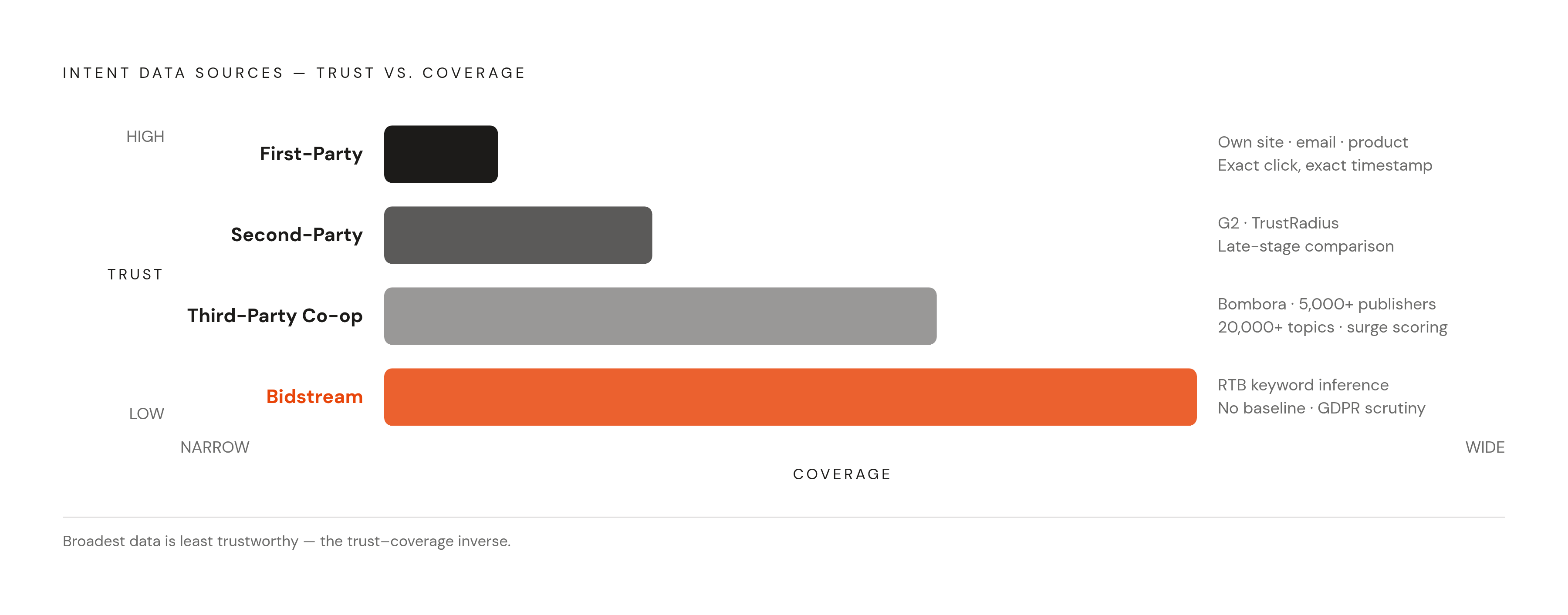
First-party data: signals your own properties generate
This is anything you collect through channels you run yourself: your website, your email program, your product, maybe a community if you're keeping one on life support. Cookies and IP tracking follow a lead across your own pages, showing what they read and whether they came back. Clearbit Reveal and Leadfeeder do IP reverse-lookup, a process called IP-to-company resolution, identifying the company behind anonymous traffic without a form fill. Form submissions and gated content downloads add declared interest with an actual name attached. Email engagement rounds it out, someone opening three messages in a row after weeks of silence tells you something a static list never could.
You control the collection environment here, which is why it sits above everything else in trust. You know the exact page, the exact click, and the timestamp is recorded rather than inferred. There's barely a modeling layer guessing in between.
The pricing-page visit is the clearest case. Someone loading that page is making a buying gesture that registers as purchase intent, and good practice treats it that way: outreach inside 24 hours, naming the specific page, while it's still fresh in their head.
Coverage is the catch, and it's a real one. First-party data only tells you about accounts that already found you, so it says nothing about the buyer circling your category who's never touched your site. Sharp and precise, sure, but a thinner slice of the market than anyone would like.
Second-party data: high-confidence signals from platforms where buyers are already comparing
Second-party data comes from a partner's platform, licensed under an actual agreement rather than scraped out of an ad auction. G2 Buyer Intent is the clean example: it captures companies actively comparing software on G2's review pages. A company reading a competitor's G2 profile is evaluating something specific, and that context is hard to argue with.
There's still a ceiling on what it tells you. The account-level signal is strong, you know the company is looking, but you don't know who inside that company is doing the looking. TrustRadius operates on similar review-site activity, capturing accounts engaged in active comparison behavior.
Because the signal sits late in the buying journey, these in-market accounts earn fast, specific outreach instead of a slow nurture drip. This might be the most actionable data type in the whole stack precisely because there's so little room to misread it. The tradeoff comes back to coverage: second-party data only reaches buyers who use review platforms, which skews toward software categories with a strong review culture and leaves everything else thin.
Third-party data from content co-ops: how Bombora and similar networks build their signals
Third-party co-op data runs on a pooling model. A network of B2B publisher sites shares anonymized, account-level content consumption data, so participating publishers are effectively telling each other what topics their shared readers are chewing through. Bombora is the name most tied to this category, tracking content consumption across more than 5,000 B2B sites.
The mechanism worth understanding is the "surge" score. Every account builds a historical baseline of consumption on a topic over time, and a surge only fires when consumption spikes meaningfully above that baseline, a real deviation from an ordinary blip. Bombora runs this topic surge methodology across more than 20,000 topics with firmographic filters layered on top. That baseline comparison is what separates co-op data from plain keyword matching, which flags any mention of a term regardless of whether it reflects a real behavior change.
The compliance angle matters here, and it's the thing that becomes the whole story two sections from now: co-op participants and their readers have agreed to the data sharing. That consent basis draws a real line between this and bidstream collection.
Here's the wrinkle. So many platforms license Bombora's underlying signal that buyers often end up comparing the same raw data wrapped in different dashboards with different logos on them. Differentiation increasingly lives in what a platform does with the signal, and AI classification is where that shows up. Intentsify processes more than 1.1 trillion intent signals a month, running NLP and large language models to weight signals against specific value propositions rather than broad keyword buckets. That's a decent preview of where the competitive line in this space is moving: toward processing precision, away from raw collection volume.
Bidstream data: what it is, how it's collected, and why its signal quality is contested
Bidstream data comes out of the real-time bidding (RTB) process behind programmatic advertising. Every time a user loads a page with an ad slot, an auction fires in milliseconds, and the page's content and URL get broadcast to bidders competing for that impression. Intent providers harvest that stream and infer what a company might be researching, based on nothing more than what pages its employees happened to load.
The case for bidstream is scale. RTB auctions fire across nearly the entire ad-supported web, so coverage is enormous in theory. But how much does that coverage actually matter if the signal underneath it is thin?
There's no historical baseline in bidstream data, so a single page load looks identical to weeks of sustained research; the system can't tell due diligence apart from a link clicked off a friend's text message. Because the inference runs on keywords rather than engagement depth, a company can get flagged as "surging" after one employee reads one article. That produces a higher false-positive rate than co-op data, which at least weighs recency and depth against each other.
The compliance fault line matters just as much. The UK's ICO and Belgium's APD have both issued guidance suggesting bidstream collection, as commonly practiced, doesn't hold up under GDPR. In the US, Congress has pushed the FTC to look into privacy violations across the RTB ecosystem, so this is live regulatory exposure on both sides of the Atlantic, worth weighing now rather than later. A 2024 Pipeline360 survey found 67% of B2B marketers ranked data compliance and accuracy as a top priority, which tracks with the scrutiny bidstream keeps drawing.
So what does this mean day to day? Know whether your intent provider sources from a consent-based co-op or from bidstream, because that changes how much confidence you should put in the signal and how much legal exposure you're carrying. Ask the vendor directly. Any vendor confident in their own sourcing should have a straight answer ready, no hedging.
How AI and NLP are changing the classification layer across all three sources
The old classification model was a keyword list. A company consuming content that happened to contain a predefined term got flagged on that topic, context be damned. The newer model, built on natural language processing (NLP) and large language models trained against specific product positioning, catches relevance even when the exact keyword never shows up. A company researching "data residency requirements" can now connect to a cybersecurity vendor's intent model even if it never typed "data security software" anywhere. Semantic understanding is replacing string matching, and that shift runs through first-party, second-party, and third-party data alike.
A related problem cuts across all three layers: account-level signal versus contact-level signal. Most third-party data, and a good chunk of second-party data, tells you a company is researching without naming which human inside that company is doing it. Contact-level intent, where it exists, names the actual person and works far better for personalizing outreach, but it's much harder to collect at scale. Some platforms try to go further still and surface the buying group itself, the committee, not just one account or one name.
There's a broader aggregation trend underneath this too. Modern platforms increasingly pull from more than 25 real-time buying signals at once, G2 intent, job changes, funding announcements, champion tracking, and more, and route each one automatically to whichever play fits it. Raw signal volume matters less than how those signals get weighted, combined, and turned into an actual next step. That's the layer where platform choice actually shows up in results, not the size of the feed.
Signal types that translate most directly into outbound actions
Pricing page visits sit at the very top of the list. It's the highest-intent first-party signal there is, close to a near-purchase moment. Job postings in a key role tell you a company is investing in a function your product serves, signaling budget and direction at once. Funding announcements open a spending window that decays fast, and tiered outreach works best here: founders in weeks one through four, newly hired executives in weeks four through twelve.
Tech stack changes, new tool adoption or churn away from a competitor, signal active re-evaluation in an adjacent category. Compliance deadlines create urgency imposed from outside the company, independent of whatever's actually on its own roadmap. Champion job changes surface a warm buyer sitting inside a cold account, someone who already knows your product and just walked into a new building. Review site activity closes things out as late-stage comparison behavior on G2 or TrustRadius.
Speed decides whether any of this turns into a meeting. A five-minute delay on a high-intent signal can cost you the deal outright; value bleeds out of that signal every hour it sits untouched.
There's a ceiling here too, and it's worth saying plainly: signal-based outbound only reaches accounts showing intent at a given moment, a fraction of any total addressable market. Cold outreach to the broader ICP still has to run alongside it, as a complement.
The personalization principle underneath all of this gets underused more than it should. If a prospect is reading content about a specific pain point, lead with that pain point directly instead of a generic pitch. Timing and relevance beat the token-based routine, "Hi {{FirstName}}, noticed you're at {{Company}}," most of the time.
How the three layers work together in practice, and where each one earns its place
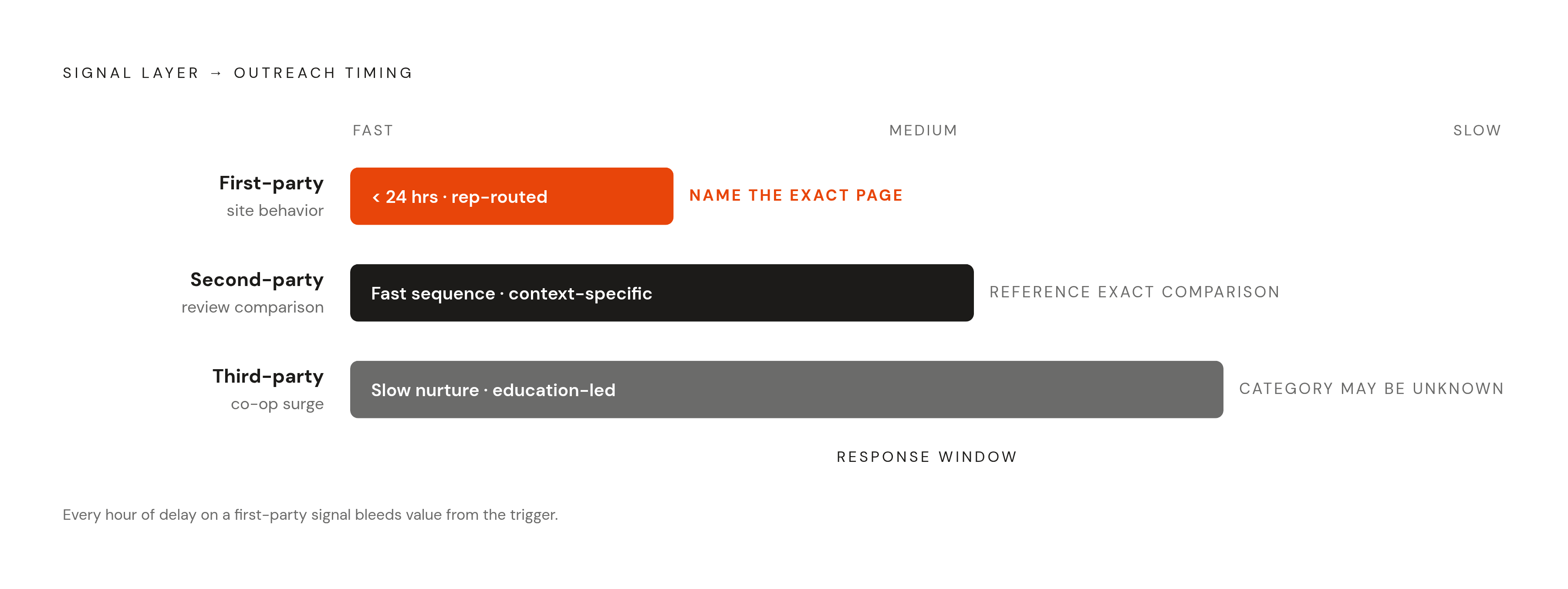
These three layers cover different ground rather than competing with each other. First-party is highest confidence and smallest in coverage: accounts already aware of you. Second-party is high confidence and late-stage: accounts actively comparing options in your category. Third-party is broadest in coverage and earliest in stage, catching accounts just starting to poke around topics adjacent to your product.
A layered stack lets a team prioritize by confidence tier instead of treating every signal the same. First-party triggers deserve immediate, rep-routed outreach. Second-party signals deserve fast, context-specific sequences that reference the exact comparison behavior observed. Third-party surges deserve earlier, education-led touches, since the prospect might not even know a solution category exists for their problem yet, let alone that they're being watched.
Here's a practical snag for teams scaling fast. What happens when you're running three separate tools, one for first-party tracking, one for review-site intent, one for co-op subscriptions? You end up with three data models, three routing workflows, and three separate places where a signal quietly falls through a crack nobody's watching. A single platform pulling in all three layers removes that fragmentation, and it matters more as signal volume grows, not less.
There's a bigger shift underneath all of this. A Salesforce survey from March 2024 found that 84% of global marketers now rely on customer, first-party, and transactional data to build audience insights, part of an industry-wide move toward owning the signal layer instead of renting it from someone else's ad stack.
For a founder-led or early-stage GTM team, the sequencing question mostly answers itself once you look at it this way. You don't need all three layers on day one. Start with first-party, which you probably already have if your site gets any traffic worth mentioning. Layer in second-party once review-site activity starts mattering to your category. Add third-party co-op data once your ICP is precise enough that surge scores mean something instead of adding noise to a dashboard nobody checks.
One thing gets lost when people obsess over sourcing. The value of intent data lives less in the data itself and more in how fast and how specifically you act on it. A team running sharp plays with fast routing beats a team sitting on richer data but slower follow-through, and it won't be close.