Real-Time Personalization Using LinkedIn Activity as an Outbound Signal
Job changes and social engagement reveal buying intent faster than static prospect lists.

LinkedIn activity, the likes, comments, shares, job changes, and profile views most outbound teams scroll past without a second thought, tells you more about buying intent than any job title or company size filter ever will. A person who just changed jobs or left a comment on a competitor's post is handing you information in real time, and most sales orgs still can't be bothered to catch it before it's gone. What follows is a working breakdown of which signals actually predict a reply, how fast each one decays, and how to build something that catches them before the window shuts.
Most outbound teams still run on static filters: job title, company size, industry, maybe a technographic layer if someone paid for Clearbit (or an outbound platform like Cardinal that handles enrichment as part of a broader prospecting motion), and none of it qualifies as intent data. None of that tells you whether the person on the other end is in motion right now. LinkedIn does. A comment on a competitor's post, a pricing mention buried in a status update, a job change that lands in your Sales Navigator feed, these are earlier and more honest than a form fill, because the person hasn't decided to talk to a vendor yet. They're just reacting to their own situation, out loud, in public. Cold list outreach lands acceptance rates of 10 to 20%, while signal-based targeting reaches 40 to 60%, and the best-run campaigns push past that into 60 to 70% territory. That gap should stop anyone running a pure cold sequence in their tracks.
Platform economics are forcing the issue too. LinkedIn has tightened Open InMail limits significantly, so brute-force volume just isn't a workable strategy anymore for most sellers. Relevance is the only lever left standing. LinkedIn's share of B2B pipeline isn't shrinking to match that cap, either: the platform still generates roughly 80% of B2B social leads and converts visitors to leads at 3.6 times the rate of Facebook. Most teams keep pointing all that effort at static lists instead of the people who are actually moving.
The five LinkedIn signals worth tracking, ranked by predictive strength
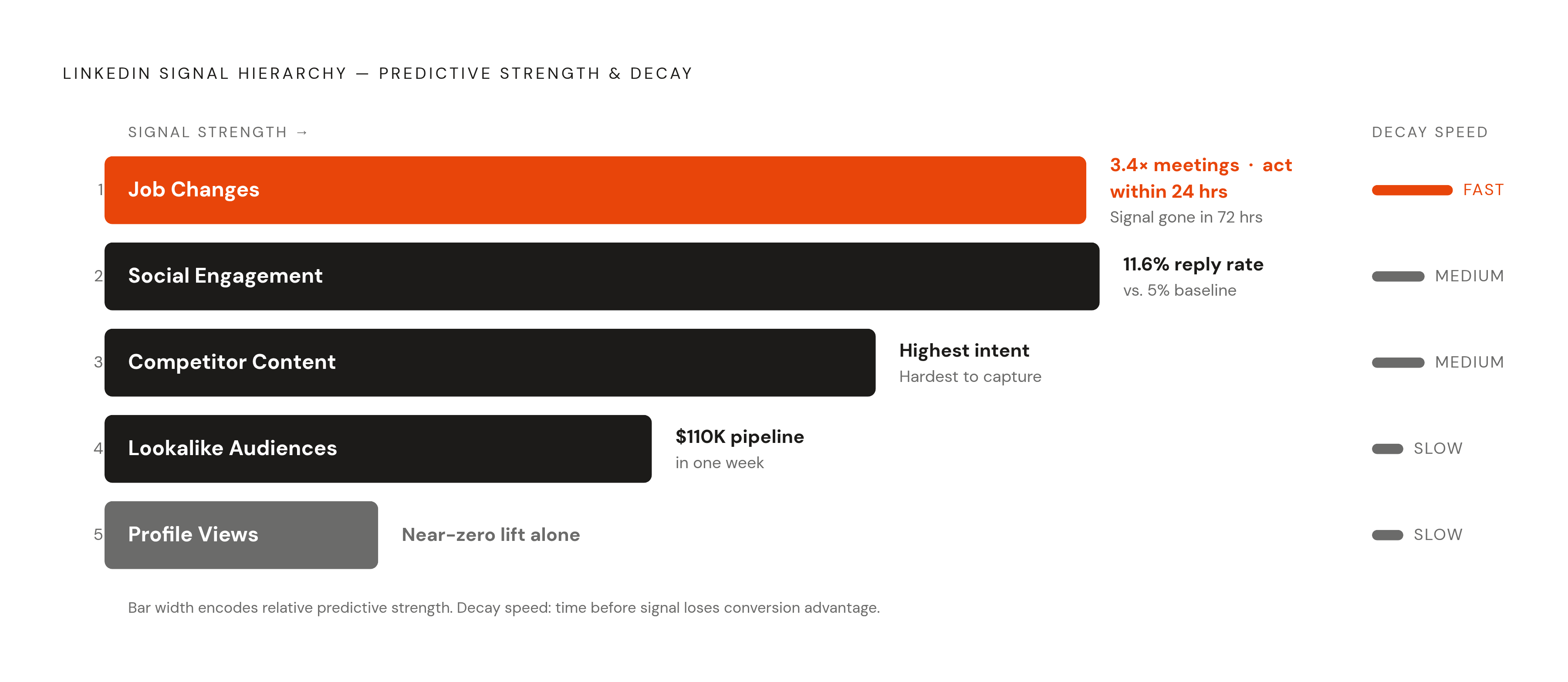
Not every signal deserves the same reaction. Treat a profile view like a job change and you're burning the one resource you can't buy back with a prospect: their patience for being pitched.
Job changes sit at the top, and it's not close. A VP of Sales 90 days into a new seat is shopping vendors whether she says so or not; she's three times more likely to reply than a peer who's been in the same role for three years with nothing pushing her to change anything. Reps who act on job-change alerts within 24 hours book 3.4 times more meetings than reps who batch these and work through them once a week, though the catch is that this signal decays fast, usually inside 72 hours of becoming visible.
Social engagement ranks just below it. Likes, comments, shares on relevant content, whether it's a rival's post or plain category commentary, mark someone in active research mode. One social-follower play landed an 11.6% reply rate against a 5% baseline, better than double, which is hard to write off as noise.
Competitor or peer content engagement deserves its own tier, even though it overlaps with social engagement, because the intent underneath it runs sharper. Someone commenting on a direct competitor's post is close to raising a hand. Capturing this without tooling is the real problem; most reps never even see it happen, which is exactly why it's so underexploited relative to how predictive it is.
Lookalike audiences sit in the middle. There's no live intent event here, just firmographic and technographic overlap with your closed-won accounts, though one lookalike play generated $110,000 in pipeline within a week of launch, so the tier clearly has value. It works best as a volume layer, something to fill gaps when the higher signals above run thin.
Profile views come last, and alone they're close to useless. No data shows a reply-rate lift from a profile view by itself, but stack it with something else, say a profile view the same week as a job change, and it starts to mean something. On its own it's just a timestamp with no story behind it.
Worth naming what to drop entirely: "Open to work" badges, raw follower growth, skills endorsements. None of these carry directional intent; they tell you something happened, not that a decision is forming anywhere.
How signal decay makes timing the most important variable
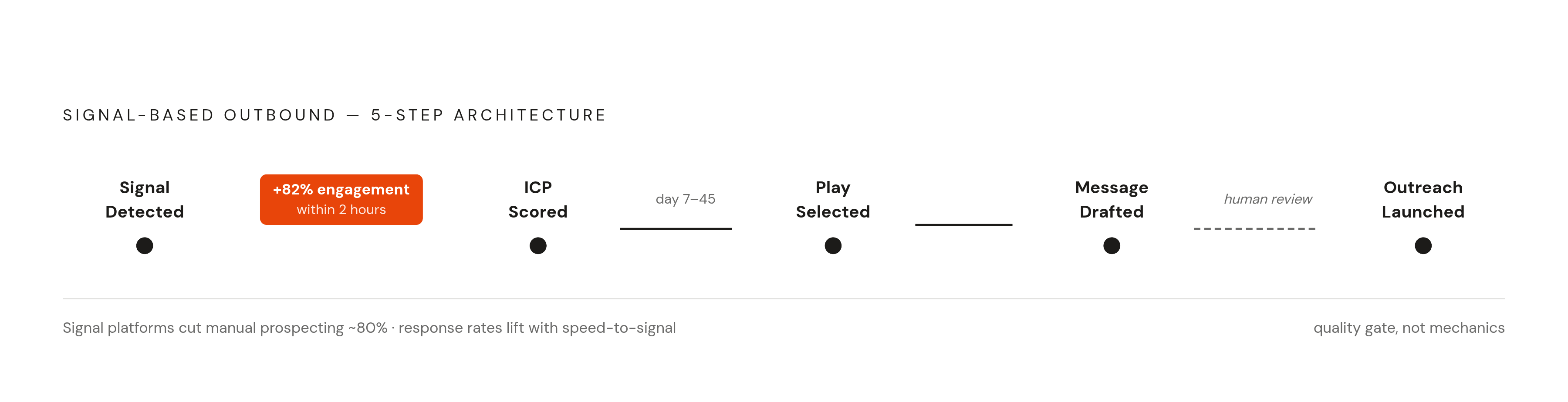
Signals rot. A job change alert is sharp and worth acting on inside 72 hours; by day four it's cold enough that reaching out starts to feel like you've been reading someone's mail. Messages sent within two hours of signal detection get 82% higher engagement than anything sent after a delay.
Speed has its own limits, though, and this is where the instinct to fire off a message immediately actually works against you by collapsing the buying window before it even opens. The real window for a job-change trigger runs from day 7 to day 45 of someone's new tenure, not day one. Why the gap? In week one, a new hire is orienting, learning names, figuring out where the coffee machine is, and by day seven they've started sizing up what actually needs to change in their new role. By day 45 they're forming real opinions about vendors, though probably haven't locked anything in yet. Reach out on day two and you're noise; reach out on day 60 and somebody else already has the relationship.
This is why manual monitoring fails, and not occasionally; it fails structurally. A rep scrolling LinkedIn notifications by hand, then getting around to outreach three days later because Tuesday got away from her, is the single most common failure pattern in this whole motion. The signal isn't wrong, it's just dead by the time anyone touches it.
Timing has to match channel to signal type too. A job change calls for a LinkedIn connect request first, then email on day three of the new tenure. Social engagement calls for a LinkedIn DM paired with a same-day email. A pricing-page visit from an account that fits your ICP is the highest-urgency case of all; that one earns a phone call within 24 hours, no exceptions. A lookalike account with no recent event gets an email-only sequence, no manufactured urgency, because faking urgency where none exists just reads as desperate.
Timing, in other words, is an infrastructure problem before it's ever a copywriting one, and that's the piece most teams skip past entirely.
Building a systematic signal capture and routing workflow
Knowing which signals matter and actually acting on them fast enough are two different skills. Most teams are decent at the first and genuinely bad at the second, because there's no built path from "LinkedIn notification appears" to "sequence fires."
Signal stacking is the foundation worth building first: pair one LinkedIn behavioral signal with one website or product signal before you try to scale volume. A job change plus a pricing page visit is your highest-urgency, multi-channel trigger. Competitor content engagement plus a firmographic match to your ICP earns a same-day LinkedIn DM. The goal is somewhere between 15 and 25 signals per ICP segment, pulled from job postings, funding announcements, tech stack changes, and intent data, so you end up with an actual trigger map instead of a static list gathering dust in a spreadsheet.
Tooling spans a real spectrum here. Native LinkedIn Sales Navigator alerts catch job changes and profile views fine, but every review is manual and there's no automated routing; a human still has to see it and decide to act on it. Dedicated signal platforms automate capture, scoring, and sequencing straight off LinkedIn behavioral data, and teams running these report cutting manual prospecting time by roughly 80% while their response rates go up at the same time, which is the part that surprises people. AI revenue agent platforms that fold list building, signal capture, and sequencing into one system cut out the handoff latency that kills timing in the first place, and that matters most for founders and lean go-to-market teams who can't justify buying a separate tool for every single step in the chain.
Capture speed alone doesn't solve it, though. Routing matters just as much: a signal landing in the right rep's queue within minutes is still wasted if that rep has no pre-built play to run against it. The real architecture looks something like this: signal detected, ICP fit scored, play selected, message drafted, outreach launched, with a human reviewing message quality instead of babysitting the mechanics of every single step along the way.
How to write the message once you have the signal
Personalized LinkedIn messages get 93% higher acceptance rates than generic outreach, and personalized InMail runs 10 to 25% response against under 1% for templated mass sends. Signal-driven outreach timed to buying triggers, what practitioners call trigger-based outreach, pulls 15 to 25% response rates against 1 to 2% for generic templates. The pattern holds across every dataset in this piece: context beats volume, and it isn't close.
The rule that matters most once you're actually writing: reference the context behind the signal, never the tracking mechanism that surfaced it for you. "I saw you just started at [company]" reads as surveillance, and most people flinch when they read it. "I noticed you're building out the sales function at [company]. We've worked with teams in similar early stages" reads as relevance instead. The prospect needs to feel like you earned the right to reach out, not that you've got a dashboard open with their name on it.
Each signal type wants its own message shape. A job change should acknowledge the transition directly and offer something tied to the first 90-day mandate; the new hire is trying to prove judgment to a new boss, not shop for tools yet. Social engagement should reference the actual topic they engaged with, not the fact that they clicked like, and tie your value to the conversation they're already having with themselves. Competitor engagement is trickier: leave the competitor's name out of it entirely. Position around the category problem the prospect is visibly researching instead, and let them draw the connection on their own.
One practitioner's numbers tell the story cleanly: static list outreach on a given audience pulled 3 to 4% reply rates. The same audience, worked through real-time job-change signals instead, jumped to 18%. Same people, same offer, different trigger, and that's the entire argument in one sentence, really.
Keep the message short enough to read comfortably off a phone notification, one clear ask, no more than one link. The signal already did the qualifying work for you; the message just has to open the door.
The signal commoditization problem and how to stay ahead of it
Here's the part nobody likes to say out loud: as signal-based outreach turns into the norm rather than the edge case, competitors start pulling from the same vendor data and hitting the same "high intent" accounts at the same moment. The prospect gets five nearly identical messages in one afternoon, and the signal that felt like an edge a year ago turns into just another flavor of spam, better timed but still spam.
Three things separate the teams staying ahead once that happens. Freshness is the first: being first to act on a signal, even by 30 minutes, over a competitor pulling from the same source, is a real edge and it's measurable. Specificity is second: narrow, proprietary signals, a comment buried in a niche Slack community, a specific reply in a thread rather than a generic like, are far less crowded than the top-level intent data every vendor is already selling to everyone. Message quality is third, and it's the hardest one to fake. Best-in-class signal-based programs see response rates in the 30 to 45% range, while generic outreach sits at 1 to 3%. That gap only holds when the message is genuinely specific, not just fast.
The real dividing line right now has less to do with who has access to AI, since almost everyone does at this point, and more to do with how they're actually using it. The biggest performance gap sits between teams using AI to churn out templates, which is common, and teams using AI to personalize per prospect off real-time data, which is still rare. According to linkednav.com, that second group produces reply rates 3 to 5 times better than the first, using the same tools with wildly different results.
The practical takeaway: put your effort into fewer, sharper signals instead of chasing wider coverage. A well-built message against a narrower, less-crowded signal beats a generic message against a widely shared one almost every time you run the comparison.
Where AI agents fit into a signal-based outbound motion
There's real tension sitting underneath all of this. Writing a genuinely signal-specific message takes time and thought, but the decay window on most signals runs in hours, not days, which is exactly why personalization at scale requires automation. A human-only workflow, no matter how disciplined the rep, can't close that gap at any real volume; the math just doesn't work.
AI agents earn their place here as the thing that executes a well-defined play fast enough to matter, working alongside judgment rather than replacing it: capture the job-change signal, score it against ICP fit, draft a role-specific message referencing the transition context, send the connect request on day one and the email on day three, all without a rep manually managing every single step. Gartner's 2025 Sales Technology Survey found 75% of B2B sales organizations expect to use AI-driven outbound automation by 2026, up sharply from 20% in 2023. That's not a niche adoption curve anymore; it's becoming table stakes.
Teams moving toward fully autonomous, AI-driven revenue agents are increasingly leaving manual signal review behind as the gap in outreach performance continues to widen. The gap between teams automating the full path from signal to message and teams that don't is widening, not closing.
The right way to think about this: the agent owns capture, scoring, timing, and the first draft. The human owns the play logic, reviews message quality across small test cohorts before anything goes wide, and adjusts the signal stack based on what's actually converting. Full autonomy without that review step carries real risk; a poorly configured agent can push off-brand or even non-compliant outreach at scale before anyone catches it. Testing in small cohorts first isn't optional, it's the standard guardrail for a reason.
For founder-led and early-stage teams especially, the case for consolidating into one platform is pretty straightforward. Every handoff between separate tools, one for signal detection, another for list building, a third for sequencing, is a place where a signal can quietly rot while nobody's watching it.
A repeatable playbook for four common LinkedIn signal triggers
Each play below covers the signal, how to capture it, the timing window, the channel sequence, and what the message should anchor on.
Play 1, New Hire at an ICP Account. Signal: a job change into a buyer persona role at a target company. Capture through Sales Navigator alerts or a dedicated signal platform. Act within 24 hours of detecting it, but hold the actual outreach for days 7 through 14 of their tenure. Sequence: LinkedIn connect request on day one of outreach, email on day three, follow-up email on day seven. The message should acknowledge the mandate that comes with a new role and offer one specific, useful thought tied to what they're probably building right now.
Play 2, Competitor Content Engagement. Signal: someone at a target account likes or comments on a direct competitor's post. Capture manually for small lists, or through a signal platform once you're at scale. Window: 24 to 48 hours. Sequence: LinkedIn DM followed by a same-day email. Anchor on the category problem, not the competitor by name; position around whatever they're clearly in the middle of evaluating.
Play 3, Relevant Topic Post or Comment. Signal: an ICP prospect publishes a post or leaves a comment directly relevant to your category. Capture through keyword monitoring in the LinkedIn feed or a signal platform built for it. Window: 24 hours. Sequence: a LinkedIn DM that references the specific point they made, not just the fact that they posted, followed by an email if there's no response within a few days.
Play 4, ICP-Fit Account With No Recent Event. Signal: no live behavioral trigger, but strong firmographic and technographic overlap with your closed-won accounts. Capture through a lookalike model built off your existing customer base. Window: no urgency required, so there's room for a longer, more patient cadence. Sequence: email-only, spaced out, no forced urgency in the copy since none actually exists. This play exists to fill volume when the higher-tier signals above are running thin, and the cadence should read that way: informative, not pushy.
Four plays, four different rhythms, and the common thread isn't the tooling, and it isn't even the exact timing windows; it's the discipline of matching how fast you move and what you say to what the signal is actually telling you. Get that wrong, and even perfect timing reads as noise.