Technographic and Stack Change Signals for Outbound Targeting
Catch prospects mid-evaluation when stack changes happen, before vendors lock the deal.

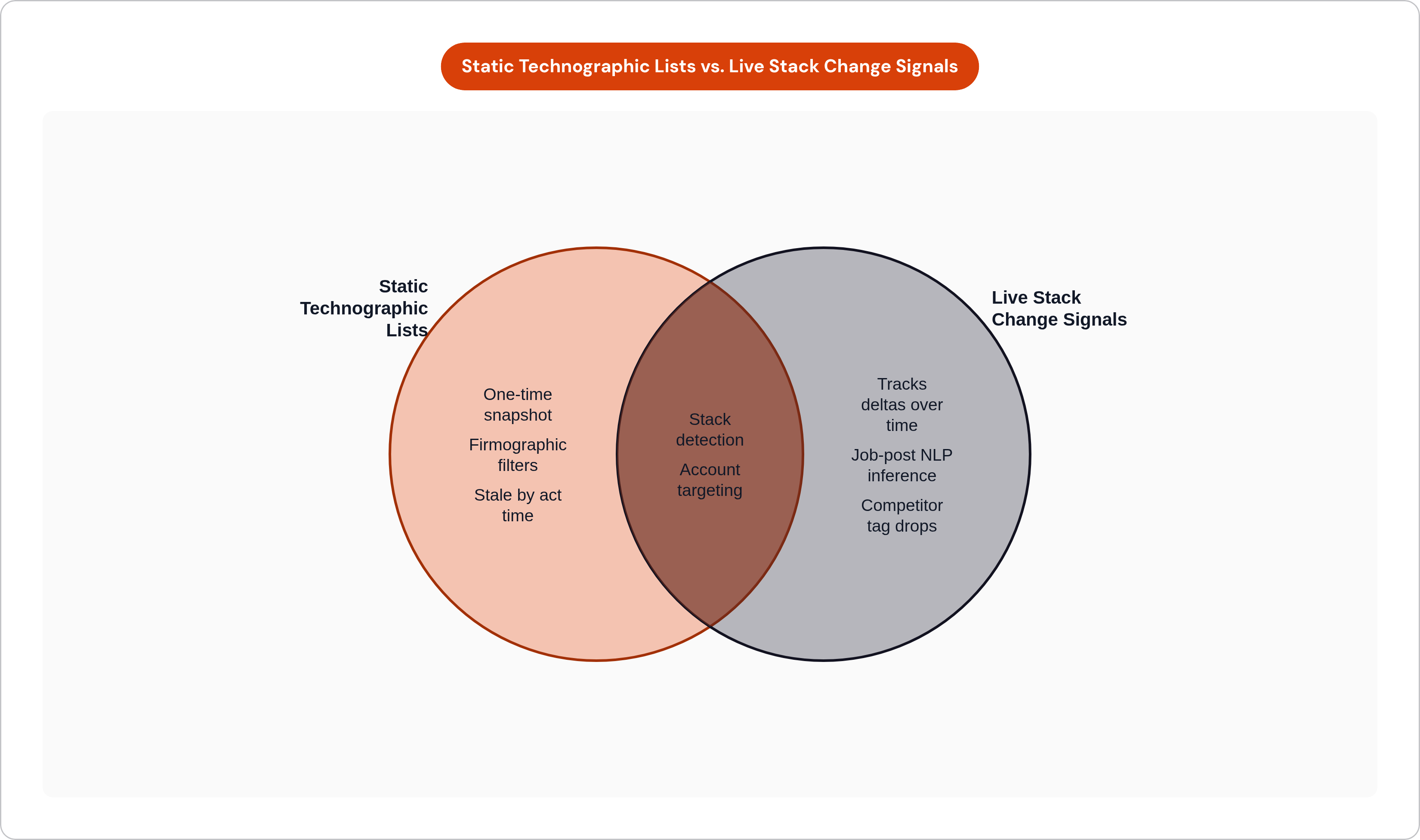
Technographic data tells you what software a company runs. Track the changes over time instead of pulling one static list, and it tells you something better: when that company is buying, which is the core promise of intent data. Timing beats the filter, pretty much every time I've watched it play out.
Most teams pull a technographic list once, "companies on Salesforce," "accounts running HubSpot," and call that the target list for the quarter. That's a snapshot, and a stale one by the time anyone actually acts on it. The live version asks a different question. Not what do they run, but what changed last week. That shift from filter to feed is basically the whole difference between technographics that inform targeting and technographics that drive timing.
So what's actually getting captured under the hood? Detected tools, infrastructure choices (AWS versus Azure versus GCP), the dependencies between systems, and the deltas between all of that over time. A company that added Segment last week sits in a completely different buying posture than one that's run the same six-tool stack for two years without touching it. The first one is mid-decision. The second is dormant, at least on that front, and treating both the same at list-build time throws away the one variable that actually predicts when to reach out.
Where do these signals come from? Web crawlers like BuiltWith scan public-facing site code for tracking pixels, tags, and scripts, while browser tools like Wappalyzer fingerprint a site on the fly. Job-posting NLP, which is the approach TheirStack takes, reads hiring language to infer tools nobody bothered to put on the website. Change-log providers like Coresignal and PredictLeads sit on top of all of it, tracking what showed up and what quietly disappeared. Each method catches a different slice of the stack, and the plays later in this piece depend on knowing which method catches which signal.
The outbound timing problem technographic signals solve
Most outbound arrives too late. By the time a rep sends a cold email, the buying group has usually already ranked its preferred vendors; 6sense's 2025 Buyer Experience Report puts the vast majority of buying groups ranking vendors before they've talked to a single salesperson, the bulk of that research happening in the dark funnel where no rep ever sees it. Outreach landing after that ranking is locked in isn't really outreach. It's a Hail Mary into a game that's already decided.
So what happens when a signal catches the buyer mid-evaluation instead of after the decision's made? The rep isn't fighting an incumbent's inertia anymore. They're one of the voices actually shaping the shortlist.
The reply-rate spread makes the case better than I can. Generic cold outreach with no personalization sits in low single digits for replies. Basic personalization, a name, a company, a title, nudges that up a little but doesn't touch the fundamental math. Signal-based outreach tied to something that actually just happened is a different category: practitioner reporting puts reply rates for signal-based outreach meaningfully higher when the message references a real, recent event. Stack two or three signals together, and some reported cases push toward 40%. Those numbers come from people running actual campaigns, not lab conditions, so treat them as directional rather than gospel. Even so, the gap between cold and signal-stacked runs an order of magnitude, and anyone who's sent both kinds of campaigns already feels it before the reply-rate report ever loads.
There's a deliverability backdrop that makes all this less optional than it sounds. Inbox providers tightened enforcement in 2025, and volume-based outbound, the kind that treats reply rate as a numbers game instead of a relevance game, got hit hardest. Precision targeting stopped being a nice-to-have and became something close to a requirement just to land in the inbox at all. The risk of irrelevant outreach is real and well-documented: buyers increasingly write off senders before a real conversation ever gets a chance to start.
If timing and relevance are the two levers that actually move outbound performance, the next question is obvious: which signals reliably tell you the moment is right? Stack changes sit in a class of their own here.
Why stack changes are the highest-signal timing indicator in outbound
A stack change isn't a guess about intent. It's a recorded fact: money changed hands, a vendor got picked, a project went live. Compare that to firmographic filters like headcount or industry, which describe a company's shape but say nothing about what it's doing right now. Stack changes describe action.
Three kinds of change event, or sales trigger events, show up in the data, and each points to a different play. An addition, a brand-new tool appearing where nothing sat before, tells you the team just opened a capability, and adjacent purchases tend to follow close behind. A replacement, one tool vanishing while another takes its slot, is a competitive displacement opportunity: the company just proved, with an actual purchase decision, that it'll walk away from a vendor when it's unhappy enough. A migration in progress, visible through job posts seeking migration experience or a tool tag gone dark with no replacement showing up yet, is the narrowest and most valuable window of the three. The deal is open. Nobody's locked it up yet.
A stack change beats most other signals on specificity for a simple reason. A funding announcement tells you a company has money to spend, not where it's going. A stack change tells you exactly which category they're investing in, this week, with a dollar figure attached to a real vendor relationship instead of a press release.
The window is tight, too. Stack changes often surface within days of the underlying decision, and reaching a prospect inside that window instead of three weeks later is frequently the difference between landing on the shortlist and showing up after ink's already dry on a contract. Job postings deserve close attention here, because a listing for a "Salesforce Admin" or a "dbt engineer" is often the earliest sign a stack decision's been made, sometimes visible before any crawler catches the change on the company's own site. TheirStack's approach, running NLP over job postings specifically to infer backend and internal tooling, reaches tools that never show up in a browser fingerprint at all: data warehouses, internal dev tools, anything living behind a login. For B2B software sellers, that's frequently the exact part of the stack that matters most.
One more pattern to watch: a competitor's tag disappearing from a company's website, visible through BuiltWith's change history, signals churn in progress. Teams that aren't specifically watching for tag disappearance miss this almost entirely, because a gap in the data doesn't announce itself the way a new tag does.
Four outbound plays built directly on technographic signals
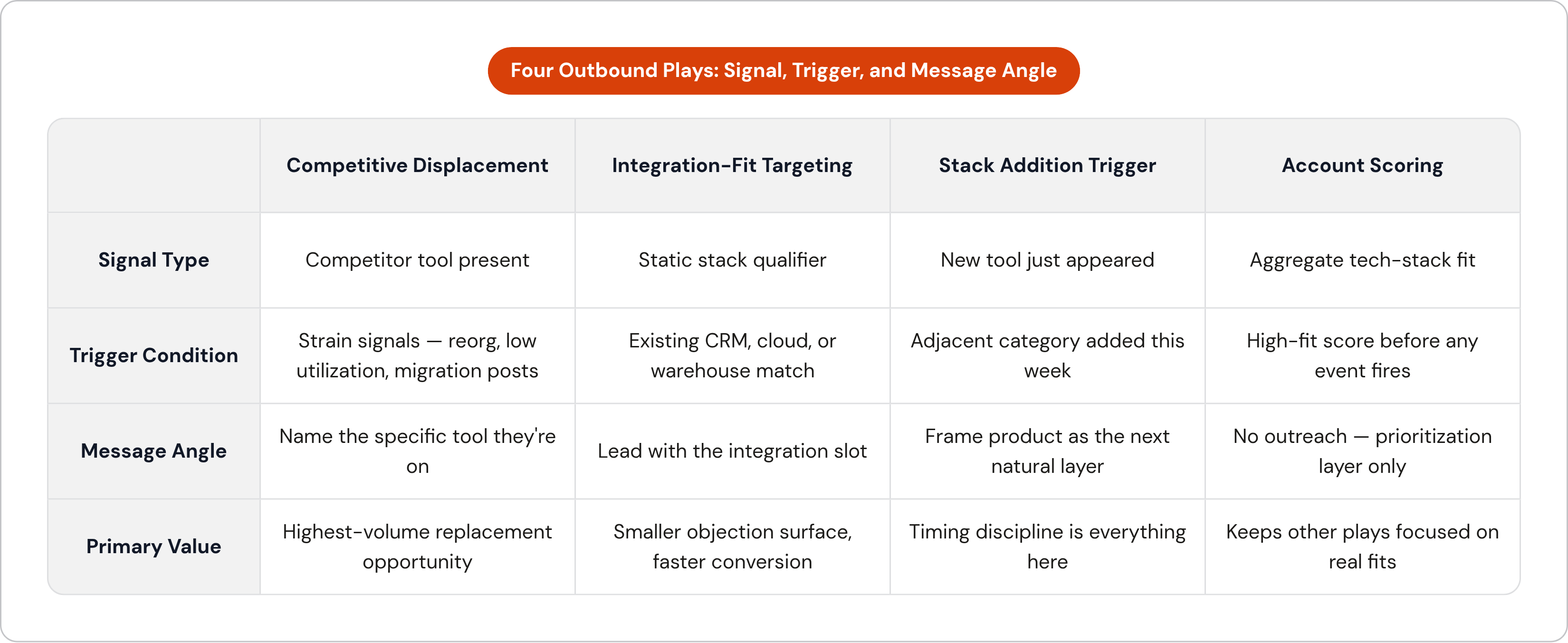
Four distinct plays fall out of all this, each one pairing a signal type with a message angle and a trigger condition.
Competitive displacement targets accounts running a direct competitor's product, but the trigger isn't the competitor's presence by itself. It's evidence of strain: low utilization signals, a recent reorg, a job post seeking "migration experience," a renewal date sitting on the calendar. The message should open by naming the tool they're on. Vague "are you happy with your current solution" copy reads as a mass blast; naming the specific product tells the reader someone actually looked. Gartner data cited in this context puts over 60% of B2B software purchases in the replacement-buy category, which makes this the highest-volume opportunity for any product with a clear set of named competitors.
Integration-fit targeting works differently, because it isn't built on a change event at all. It's a static qualifier: does the account already run the CRM, cloud, or data warehouse your product plugs into? These accounts convert faster because there's no architectural rebuild needed. The fit is obvious on both sides, so the objection surface shrinks on its own. The message should lead with the integration itself, showing the prospect their world already has a slot the product fits into.
Stack addition as an adjacent-purchase trigger fires when a new tool just showed up in a category next to what you sell. A company that just deployed a new CRM is, almost by definition, rebuilding or expanding its revenue motion, and adjacent purchases tend to follow inside a fairly predictable window. The message should acknowledge what they just deployed and frame the product as the next natural layer on top of it. Timing discipline matters more here than in any other play; a signal that's a week old is a live opportunity, but the same signal at three months old reads as a cold call wearing a disguise.
Account scoring with technographic weighting isn't really an outreach play at all. It's a prioritization layer Score the whole total addressable market on tech-stack fit against your ideal customer profile against your ideal customer profile before any signal event fires, so when a timing signal does hit a high-fit account, the team already knows it's Tier 1 and can move without pausing to research first. PredictLeads reports teams using technographic data for account-based marketing (ABM) see 28% higher conversion and are 50% more likely to hit revenue goals. HubSpot's 2026 numbers show a 27% reduction in sales cycle length and a 34% improvement in conversion for teams using tech-stack data. Scoring is the unglamorous half of this system. It's also what keeps the other three plays from burning speed on accounts that were never going to fit in the first place.
How to stack signals so technographic data doesn't stand alone
One signal is a flag. Two or three correlated signals start to look like a pattern, and pattern is what separates maybe from probably actively buying right now.
Picture a company running Salesforce that's hiring a RevOps lead this month and has had multiple anonymous visitors hitting a vendor's pricing page over the past week. No single one of those data points justifies a sharply specific outreach angle on its own. Together, they describe a company in motion, and a company in motion is a stronger target than any one signal standing alone.
Several signal types layer well with technographic change data. Hiring signals matter twice over: new headcount in a function shows operational expansion there, and tool-specific job posts often reveal a stack decision that's already been made but hasn't hit the crawlers yet. Funding events matter because fresh capital means fresh budget, and paired with a stack change, the funding tells you roughly where that budget is headed. Second-party intent data, the kind G2 and other review sites expose through category-page activity, shows active evaluation happening in public view. First-party behavioral data, pricing page visits, demo requests, downloads on integration-specific content, rounds out the picture with direct account-level interest.
Signal quality is a real, widely felt problem, not a hypothetical one. DemandScience's 2026 State of Performance Marketing survey, drawing on roughly 750 senior marketing leaders, found 70% named signal quality their top challenge. The fix isn't a better single source. It's combining sources so no one noisy feed throws off the whole read.
Clay is worth naming directly here, because it's become the infrastructure that makes multi-signal stacking workable for smaller teams. It ships native signal detection and lets teams pull in additional providers from a large library inside the same table, so stack detection, intent scoring, and message routing happen in one connected workflow instead of getting stitched together across five separate logins.
The stacking logic extends to account history, too. A company that's switched vendors once, visible in change logs as a documented replacement event, is statistically more likely to switch again down the road. Prior migration behavior is itself a signal worth weighting, not just a footnote in the account record.
The tools that surface technographic and stack change data in 2026
It helps to sort these by the job each one does rather than treat them as interchangeable rows on a vendor comparison sheet.
For web-crawl breadth, catching what's installed on a site right now, BuiltWith remains the broadest option. It tracks an enormous number of sites and technologies and functions as most teams' starting point for public-facing stack detection. Wappalyzer is the strongest free option, running as a browser extension that's genuinely useful for one-off account lookups during prospecting rather than bulk list-building.
For historical change detection, catching what changed and exactly when, Coresignal is built specifically around historical stack change events, which makes it a natural fit for competitive displacement campaigns where the change log itself is the product. PredictLeads covers similar ground with a framing built around ABM use cases. BuiltWith's own change-history feature tracks tags appearing and disappearing over time, which is what powers the "competitor tag went dark" signal mentioned earlier.
For job-posting inference, catching the internal and backend tools no crawler will ever see, TheirStack runs NLP over hiring language to infer tools from job descriptions. The limitation is real: it only works when a company is actively hiring for that function, so treat it as a strong complement to crawl-based methods rather than a full replacement for them.
At the enterprise end, HG Insights combines several detection methods into one system and is typically found at the enterprise end of the market. Demandbase runs a full-stack ABM platform tracking a very large volume of signals monthly across a wide set of intent topics, and it is widely cited as a leading option for enterprise ABM teams.
The consolidation argument for technographic enrichment matters more than it sounds like it should. Running BuiltWith for detection, Coresignal for change history, TheirStack for job-post inference, and a separate tool for sequencing means four logins, four data syncs, and four different places something can quietly break before a message ever goes out. For founder-led and early-stage teams especially, one connected system that ingests the signals, scores the accounts, drafts the angle, and routes the sequence removes most of those failure points. Autobound's 2026 data found only 24% of teams report exceptional ROI from their intent data investment, and fragmented tooling, the kind that forces a human to hand off manually between detection and outreach, is a big chunk of why that number sits where it does.
Where AI agents change the speed and scale of signal-based outreach
Here's the failure mode that undoes even good signal detection: latency. A team spots a stack change on Monday and doesn't get a message out until Friday, and by then most of the timing advantage documented earlier in this piece has already evaporated. Detecting a signal fast and acting on it fast are two different capabilities. Most teams only ever built the first one.
AI agents close that gap by removing the human handoff between detection and send. An agent watches the technographic change feed continuously instead of on a weekly review cadence, and when a qualifying event fires on an account that's already scored highly, the agent drafts a message using the specific stack context and routes it for send or for a quick human review. Follow-up sequences, CRM field updates, meeting scheduling, all of that can move forward without a rep manually triggering each step.
The adoption curve is moving fast enough that sitting it out has real cost. Deloitte's 2025 research projected 25% of enterprises had already deployed autonomous agents that year, with adoption expected to reach 50% by 2027. Gartner separately projects 33% of enterprise software applications will include agentic AI by 2028, up from under 1% in 2024. A Workato-sponsored Harvard Business Review survey of 600 technology decision-makers in 2025 found 86% planning to increase agentic AI investment over the next two years. Put together, that's not a trend you get to watch from the sidelines. It's turning into table stakes, and early-stage teams building signal-based outbound today should design plays to be agent-executable from the start rather than bolting agents on after the fact.
The right framing for founders is specificity, not scale for its own sake. An agent should run one well-defined play at a time, the competitive displacement sequence, or the integration-fit sequence, or the stack-addition trigger, rather than one monolithic system trying to achieve personalization at scale across every signal type at once. Specific play design keeps agent output on-brand and trustworthy. A vague, catch-all agent is far more likely to send something off-tone at volume before anyone catches it.
That risk is worth sitting with for a second. Autonomous agents running at scale can do real damage if misconfigured, because an off-brand or non-compliant message sent to a thousand inboxes at once is a much bigger problem than the same mistake made by one rep on one email. Small test cohorts and a human review pass before broad deployment aren't optional caution. They're what protects the sender reputation this whole signal-based approach is built to earn in the first place.