Buying Trigger Categories and Outbound Use Cases
Timing beats fit: map six trigger categories to outbound plays that actually close deals.

A buying trigger is an event that shifts a prospect's priorities or frees up budget that wasn't there last week. This piece maps six categories of triggers to six different outbound plays, because most GTM teams treat "trigger-based outreach" as one motion when it's actually six motions wearing the same name tag.
Fit tells you almost nothing about timing. A company can match your ICP, your ideal customer profile, down to headcount, industry, and tech stack, and still be eighteen months from any real evaluation. Knowing a company looks like your best customer is a fact that sits still; knowing they're ready to buy is a fact that moves, and the gap between those two things is where most cold outbound quietly dies. Trigger-based outreach closes that gap, not because the copy gets smarter, but because the timing anchors to something that actually happened in the account's world this week or this month. The categories below only make sense once you accept that fit and readiness are different questions, answered by different data.
The six trigger categories and what makes each one distinct
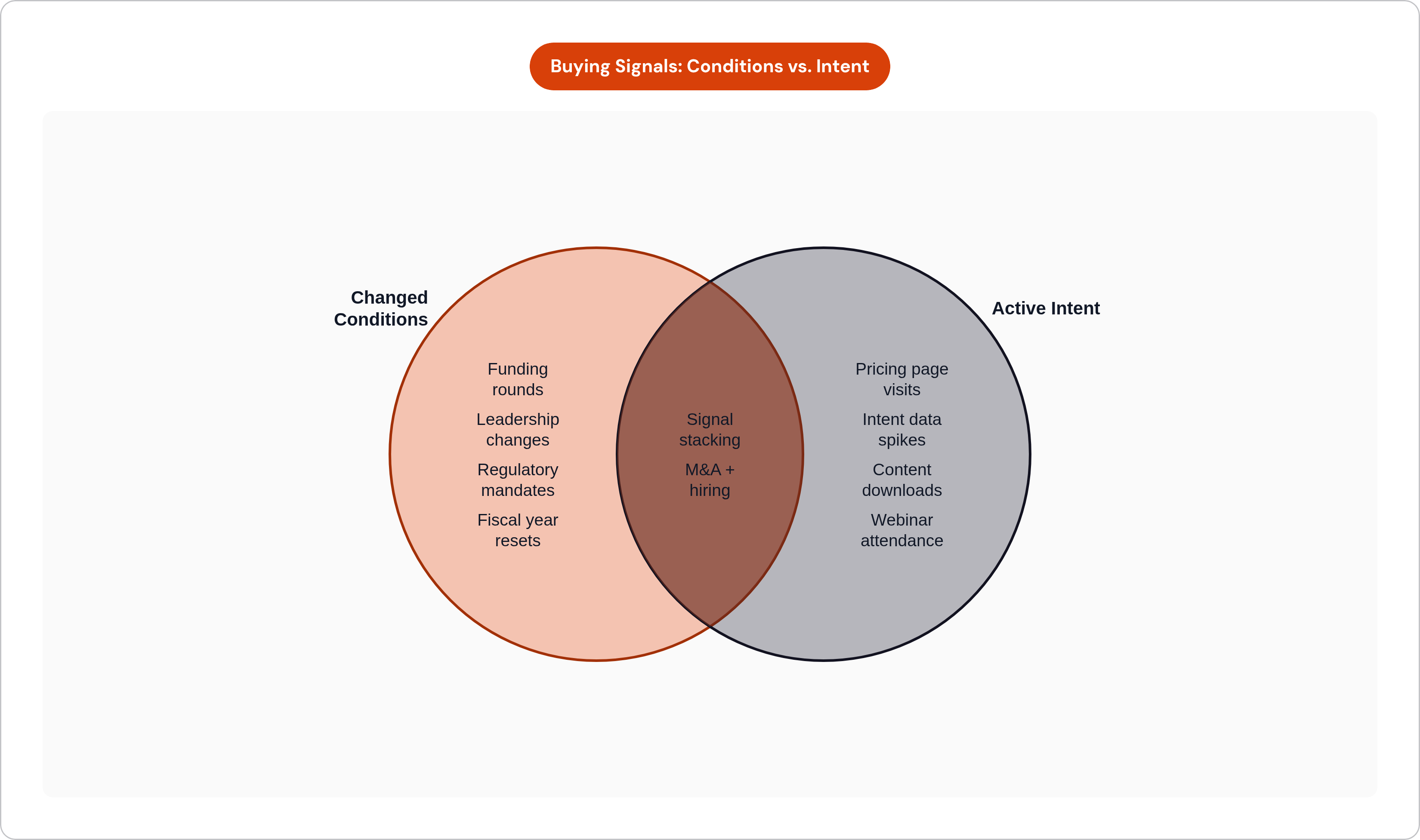
Six categories cover most of what shows up on a trigger dashboard: financial, organizational, market, operational, regulatory, and digital. Lumping them together under one "trigger" label hides more than it reveals, because each carries its own buying logic and its own clock.
Financial signals cover funding rounds, fiscal year cycles, budget resets, and revenue milestones; money has either moved or is about to. Organizational signals cover leadership changes, M&A, and restructuring, situations where decision-making authority just changed hands. Market signals track competitive pressure: a rival's launch, a company entering or exiting a category. Operational signals show up in hiring surges, tech stack swaps, and AI adoption pushes, meaning the company is actively building something. Regulatory signals are compliance deadlines and new mandates, hard external dates that don't bend for anyone. Digital signals are the behavioral layer underneath all of it: pricing page visits, content downloads, event attendance, intent spikes on G2 or similar sites, and other buying signals that reflect in-market activity.
Here's the distinction that actually matters for prioritization: some categories tell you buying conditions changed, others tell you buying intent is active right now. A funding round changes conditions; it says nothing about whether anyone at the company is currently looking at vendors. A pricing page visit is the opposite case: intent is live, but conditions like budget, authority, and timing stay unknown. Teams that run this well tier their outreach by proximity to an actual purchase decision, not by how easy the signal was to pull off a dashboard. A trigger that implies near-term budget movement should outrank one that only implies general interest, even when the general-interest signal is louder.
Signal stacking changes the math entirely, and it's worth sitting with why. New funding paired with a hiring surge in demand generation roles isn't twice as strong as either signal alone; it's closer to an order of magnitude stronger, because the two corroborate each other. One says the money exists, the other says they're already spending it on growth. The plays below are built for each category on its own, but the best accounts on any list are usually the ones where two or three of these categories land on the same company in the same month.
Financial triggers: when fresh capital or a budget reset is the opening
Financial triggers rank high because they're the least ambiguous. The company is provably in motion: money has been raised, allocated, or freed up, and there's now organizational pressure to spend it.
Take a funding round. A company that just closed a Series B faces immediate pressure to show growth that matches the capital raised. The money exists, and so does the mandate to deploy it fast. The mistake most reps make is congratulating the founder. Skip that part entirely. The stronger play connects the capital directly to what growth at that stage actually requires, whether that's scaling an outbound motion, hiring a second sales team, or replacing a tool that can't handle the new volume. Timing matters more than most reps assume: the window after a funding announcement tends to close in days, not weeks, because every vendor selling into that space is watching the same funding databases you are, and signal decay is real. And the right contact usually isn't the founder who raised the round. It's the operator who will actually spend it: a CRO, a VP of Sales, a Head of GTM.
Fiscal year resets work differently because they're predictable well in advance, which means they reward planning over speed. Companies frequently evaluate new vendors in the weeks around a new fiscal year, so showing up before that reset, ahead of any RFP, puts a seller in the consideration set before a competitor even notices the trigger fired. The framing here should lean less on product and more on a plain question: what does success look like next fiscal year? That's a different conversation than a pitch, and prospects tend to answer it honestly.
Public companies offer a signal most sellers skip entirely. An earnings call where a CFO or CEO talks about investing in sales productivity or modernizing GTM infrastructure is, in practice, a public budget announcement. Quoting that language back in outreach, using their own words instead of paraphrasing, creates a level of relevance a generic funding-based email can't touch. Few reps actually listen to the calls, though. Probably because it takes more effort than pulling a name off a funding database, and effort is exactly what separates outreach that gets ignored from outreach that gets a reply.
Organizational triggers: how leadership changes and M&A create a defined buying window
New executives create the highest-conviction organizational trigger available, often called an executive change trigger, and the logic behind it is almost mechanical. A new CRO, VP of Sales, VP of RevOps, or CTO typically arrives evaluating existing vendors, introducing tools they've trusted before, and looking for quick wins to justify their hire. That usually means auditing existing vendors, cutting tools that aren't earning their renewal, and bringing in whatever they trusted at their last company. New leaders tend to make purchasing calls early in their tenure precisely because early wins build credibility, and credibility is the one currency a new executive needs most in their first ninety days.
The play, then, is obvious once you say it out loud: reach out in the first few weeks of a start date, not after the decisions are already locked. Message framing matters more here than in almost any other category. Acknowledging the transition and the implicit mandate without sounding presumptuous is a real skill; something closer to "teams rebuilding X function typically run into Y in the first quarter" respects the situation without pretending to know their specific plan. And the target is always the new leader directly. Reaching out to their predecessor's old contact wastes the motion; that relationship died the day the org chart changed.
M&A activity is trickier because it points two directions at once. The acquiring company usually needs to consolidate vendors across a newly expanded footprint, which builds pressure to standardize on fewer tools. The acquired company, meanwhile, often needs to align with the parent's existing stack, which forces a re-evaluation of tools they were perfectly happy with a month earlier. Both sides represent a real trigger, but the plays diverge sharply depending on which side you're approaching. Timing follows the announcement; the integration-planning window that opens right after is the actual moment to land in someone's inbox, not the deal-close date itself.
Restructuring announcements deserve the same scrutiny. When a company reorganizes publicly, budget doesn't vanish, it moves. A team that never had spending authority might suddenly have it; a team that held budget for years might lose it entirely. Mapping the new org chart before sending a single message is table stakes here, not a nice-to-have.
The mistake that keeps showing up across almost every organizational trigger is treating it as a backdoor into a deal that already stalled. A new VP of Sales is not a chance to resurrect last year's dead opportunity with their predecessor. It's a genuinely new conversation with a genuinely new decision-maker who has zero context on why the last deal died, and that's an advantage worth protecting rather than squandering.
Operational triggers: reading hiring patterns and tech stack changes as intent signals
Job postings work as a live feed into what a company is building, and by extension, what tools they'll need to support the build. This category rewards specificity over almost anything else, because the signal itself is indirect. Nobody posted a job listing to tell you they're about to buy software; you have to make that connection yourself.
A cluster of SDR and demand-gen hires signals a company scaling its outbound motion, which opens a direct conversation around sales sequencing infrastructure or list-building tools. A surge in data engineering or machine learning roles signals investment in technical infrastructure, relevant to a different set of adjacent products entirely. The credibility of the outreach depends almost entirely on how specifically it names the pattern. "I noticed you're building out your outbound team" reads as informed; "companies like yours often need X" reads as a template, and prospects can tell the difference in about two seconds.
Tech stack changes run on similar logic but compress the timing further. When a company swaps CRMs, that single change opens a buying window for every tool that integrates with the new system; a company adopting a new marketing automation platform is, almost by definition, about to have conversations about sequencing and data enrichment. Technographic data tools surface these swaps, but the value decays fast, because adjacent purchasing decisions cluster around the same implementation cycle. Miss the window and the account has often already locked in its stack for the next year or two.
AI adoption is the newest entry in this category, and honestly, nobody's fully figured out how to read it yet. Companies publicly committing to AI initiatives in GTM or operations are signaling budget, and more importantly, a willingness to evaluate infrastructure they might have dismissed a year earlier. Hiring for AI-specific roles or naming AI initiatives in press releases and job postings are both traceable, if noisier than the other operational signals.
Operational triggers ask more of the writer than financial or organizational ones do. The signal is inferred, not stated outright, so the message has to connect the dot between what got observed and why it matters right now. That's harder to write, and it's also why so few competitors bother doing it well.
Market and regulatory triggers: using external pressure as the reason to reach out now
Competitive pressure creates urgency the moment a rival launches a new product, enters an adjacent market, or lands a high-profile customer win. Everyone competing against that company suddenly has a reason to be nervous, and nervous companies talk to vendors.
The framing matters a lot here. Referencing a competitor's move and pivoting straight to "your competitor is ahead of you" reads as fear-mongering, and prospects tend to discount fear-based pitches almost on instinct. The stronger version names the shift and positions the outreach around how similar companies are responding to it, which keeps the tone confident rather than alarmist. Competitor launches are trackable through press releases, news alerts, and basic social listening; none of it requires proprietary data, just the discipline to actually watch for it.
Regulatory triggers run on a completely different clock. A compliance deadline is a hard external event; the prospect can't negotiate it away or push it to next quarter. New mandates in data privacy, financial reporting, or industry-specific regulation open a defined window in which a solution has to get evaluated and implemented, whether the company feels ready or not. Leading with the deadline itself, instead of a feature list, tends to outperform almost any other opener in this category: "your compliance deadline for X is approaching" does more work than a paragraph about product capability. This only holds, though, if the seller actually understands the regulation being referenced. A vague or wrong citation damages credibility faster than silence would, because it signals the outreach was templated rather than researched.
What connects market and regulatory triggers is that the urgency comes from outside and the prospect already knows about it. Nobody needs to manufacture pressure here; it exists independent of the outreach. The seller's job is just to connect pressure that's already there to a specific answer, which is an easier job than creating urgency from nothing, so long as the seller resists the pull toward fear instead of confidence.
Digital and behavioral triggers: when a prospect's own actions signal readiness
Digital triggers are observable actions: pricing page visits, content downloads, webinar attendance, repeat site visits, spikes in third-party intent data. What sets this category apart from the other five is that the prospect already started a buying process, whether they'd call it that or not. The seller isn't inferring readiness from something that happened somewhere else; they're responding to it directly.
Pricing page visits sit at the top of this category for a simple reason: browsing a homepage is curiosity, visiting a pricing page is evaluation. Someone is doing math. The response window here is tight — evidence points to a roughly 48-hour gap before a trigger goes cold — and the outreach itself needs a light touch, something like "I saw your team was exploring X" rather than anything that sounds pulled from a surveillance log. The line between helpful and invasive is thin in this category, and crossing it kills the conversation before it starts.
Event attendance offers a gentler version of the same logic. Someone who sat through a relevant webinar or walked the floor of an industry conference has voluntarily engaged with the exact problem a product addresses. Referencing that gives outreach a shared context a cold email doesn't have. It isn't cold; call it continuous.
Third-party intent data, pulled from review sites, comparison pages, and industry publications, usually means a prospect is researching the category broadly rather than a specific vendor, making it a top-of-funnel signal rather than a bottom-of-funnel one. That's a weaker signal than a pricing page visit, but still a real one, and often the earliest sign that an account is entering a buying cycle at all.
One rule governs this entire category: personalization isn't optional. A generic follow-up sent in response to a high-intent action wastes the signal completely, because the prospect can tell within a sentence whether the outreach actually knows what they did or is just riding a template. The message has to earn the connection between the action observed and the outreach sent. Skip that step and the trigger might as well not have fired.
Timing and the response window: why the category determines how fast you move
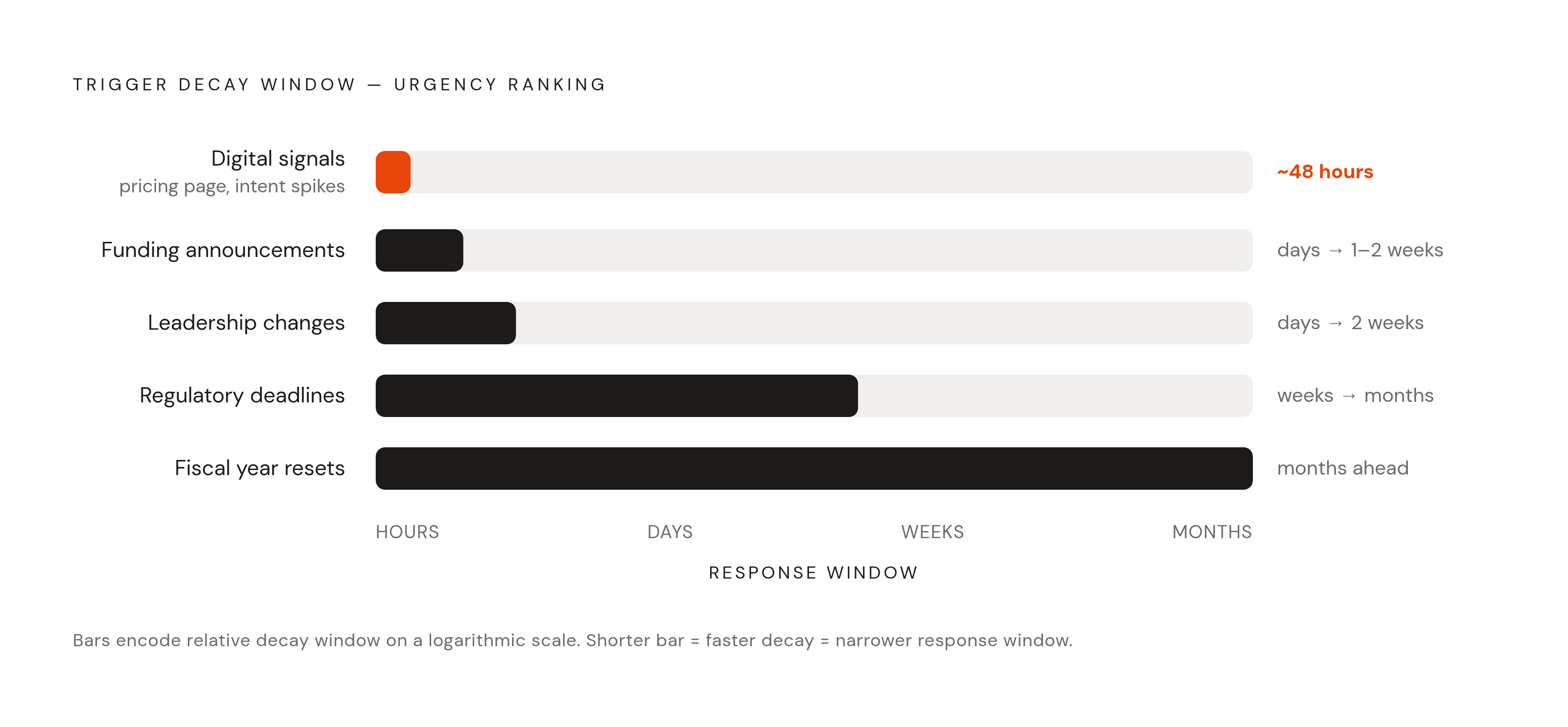
Not every trigger decays at the same speed, and that's the single most operationally important fact in this whole framework. Digital signals, the pricing page visit or the intent spike, decay in hours, because the prospect is mid-research right now, and every passing hour is an hour closer to them finding an answer somewhere else. Funding announcements and leadership changes decay slower, over days to a couple of weeks, but competitors are watching the same databases, so the practical window still stays narrow. Regulatory deadlines decay over a much longer arc, weeks to months, tightening sharply the closer the deadline gets. Fiscal year resets are the outlier: fully predictable, plannable months in advance, rewarding preparation over speed.
One rule holds across all six categories: the closer a trigger sits to active budget movement or active research, the faster the response has to be. That sounds obvious once you say it plainly, but it carries a real infrastructure problem most teams underestimate. Manual monitoring, a rep checking a funding database or scrolling LinkedIn for job changes, can't keep pace with signals that decay in hours. By the time a rep finds the signal, researches the account, and drafts a message, the window has often closed, and the prospect already moved on to whichever vendor noticed first.
That's the argument for automated trigger monitoring, and it deserves to be said plainly rather than hedged: real-time alerts across multiple signal categories at once, with outreach going out the same day a signal fires instead of the following week when someone finally opens a spreadsheet, changes the odds in a real way. Signal stacking sharpens this further. When two or three triggers hit the same account inside a short window, the combined signal gets both stronger and more urgent, which means the right response to a stacked signal is faster action, not more deliberation. Teams that slow down to "get the message perfect" on a stacked signal are, in effect, handing the account to whoever moves first.
Building the outbound play for each trigger: message framing, channel, and motion
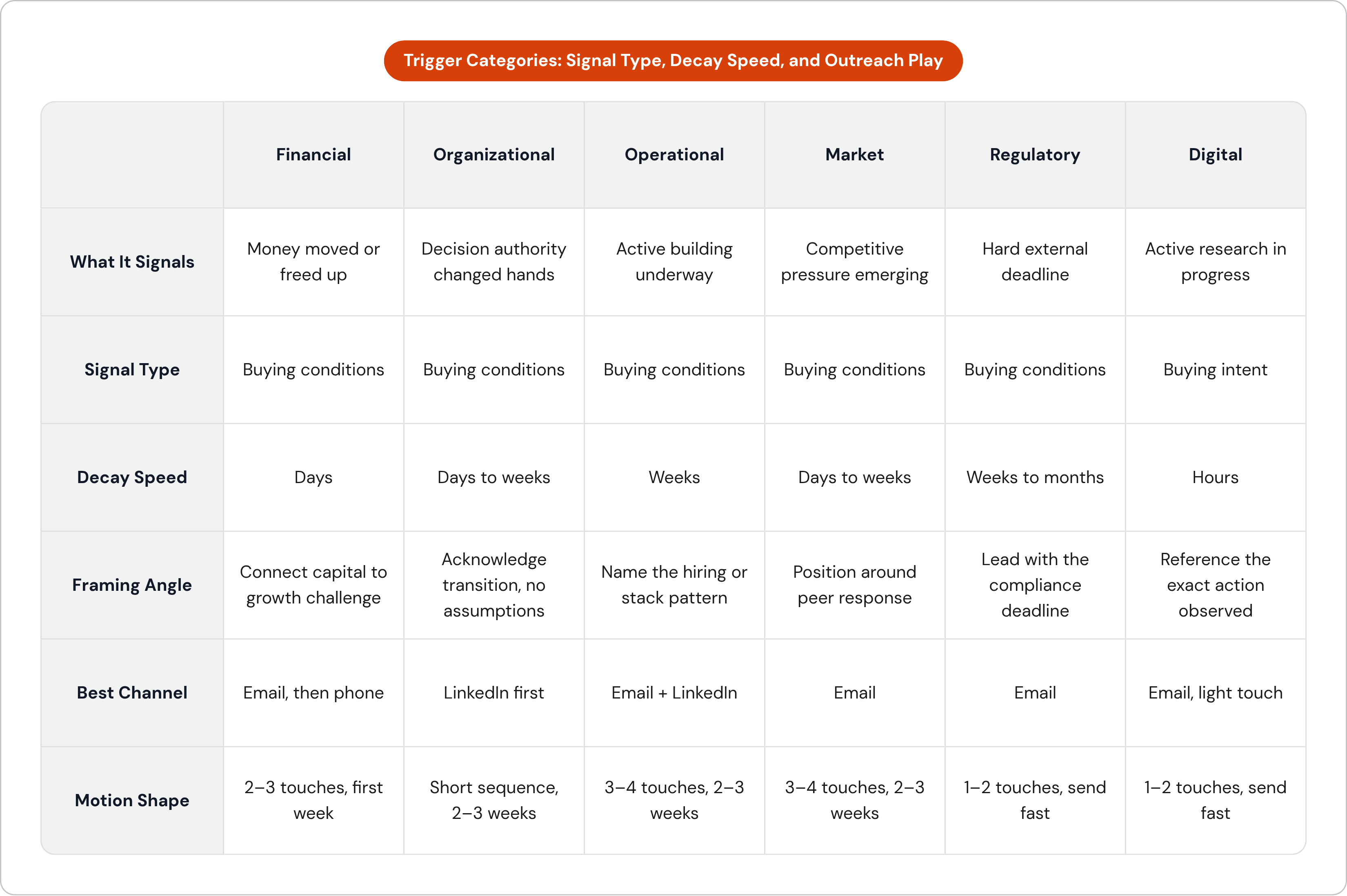
Three variables shift depending on the trigger category: framing, channel, and motion. Framing is the angle that makes the trigger matter to the prospect. Channel is where the message lands, email, phone, LinkedIn, or some sequence stitching them together. Motion is the shape of the outreach itself: a single touch, a short sequence, or a longer nurture track.
Financial triggers reward speed and directness. The framing should connect the capital or budget event to a specific growth challenge it's likely to fund, making the trigger itself the reason the conversation is worth having now instead of a footnote. Email works well as the first touch for funding-based outreach, with phone reserved for higher-value accounts where the timing pressure justifies going more direct. The motion should stay tight: two or three touches inside the first week, because the window on financial triggers, funding rounds especially, closes fast and doesn't reopen.
Organizational triggers ask for a softer touch, since a new executive is absorbing an enormous amount of information in their first month and doesn't need another cold pitch piled on top. Framing should acknowledge the transition without pretending to know their priorities yet. LinkedIn tends to outperform cold email here, since a new leader is often actively building a professional network in a new company, and a thoughtful connection request reads differently than an unsolicited pitch. The motion can stretch a bit longer, a short sequence spread across two or three weeks, since the relevant window is the executive's first quarter rather than a single announcement day.
Operational and market triggers sit in the middle. Framing has to do real interpretive work here, connecting an observed hiring pattern or competitive move to a specific implication, since the signal itself doesn't announce its own relevance the way a funding round does. Email carries most of the weight, with LinkedIn added in when a specific hiring manager or new team lead surfaces from the job postings themselves. The motion should run as a moderate sequence, three to four touches over two to three weeks, giving the message room to build the case gradually instead of front-loading everything into one email that assumes too much.
Regulatory and digital triggers sit at opposite ends of the urgency spectrum but share one rule: the framing should never manufacture pressure that isn't already there. Regulatory outreach leads with the deadline and lets the specificity of the compliance knowledge carry the credibility; digital outreach leads with the exact action observed and keeps the tone light rather than clinical. Channel choice for digital triggers should lean toward whichever medium feels least like surveillance, often email with restrained personalization rather than a phone call that can feel intrusive given how little context the prospect volunteered. And the motion for both should stay short: one or two touches, sent fast, because both categories run a real risk of feeling stale the moment the window passes.
None of these plays swap in for each other, and walking through all six side by side is really the point. A funding trigger treated like a job-posting trigger gets the timing wrong; a pricing page visit treated like a fiscal year reset gets the urgency wrong in the opposite direction. The category isn't a label you slap on a lead record. It's the instruction manual for how fast to move, what to say, and who to say it to.