Account-Based Selling for SDR Teams Replacing Volume Outbound
Account-based selling replaces volume outreach as SDR math breaks down.

Something structural broke in outbound sales around 2024. Account-based selling, run as an actual operational discipline instead of a slide deck philosophy, is the fix teams keep landing on. Emergence Capital's 2025 survey of more than 560 B2B software companies found that 36% cut SDR or BDR headcount that year, the highest reduction rate of any sales function, while only 19% grew those teams. Another large share are merging SDRs and BDRs into hybrid roles entirely. This isn't a hiring freeze story. It's a math problem catching up with a model that stopped working years before anyone said so out loud.
The old volume equation used to hold up fine. Eighty emails plus 50 calls got you roughly 3 meetings booked, a ratio SDR leaders could build a quota around without much guesswork. That doesn't hold anymore. Cold outreach response rates have dropped below 5% industry-wide, and the reasons stack on top of each other instead of acting alone: inbox providers keep tightening spam filters, buyers have run out of patience for the generic "quick question" email, and now AI-generated outreach has flooded every inbox with messages that look personalized but aren't. That last one is burning off whatever tolerance buyers had left faster than the first two problems would have managed on their own. Put them together and volume outbound isn't just less effective. Look at the actual unit economics and it starts to look structurally unprofitable.
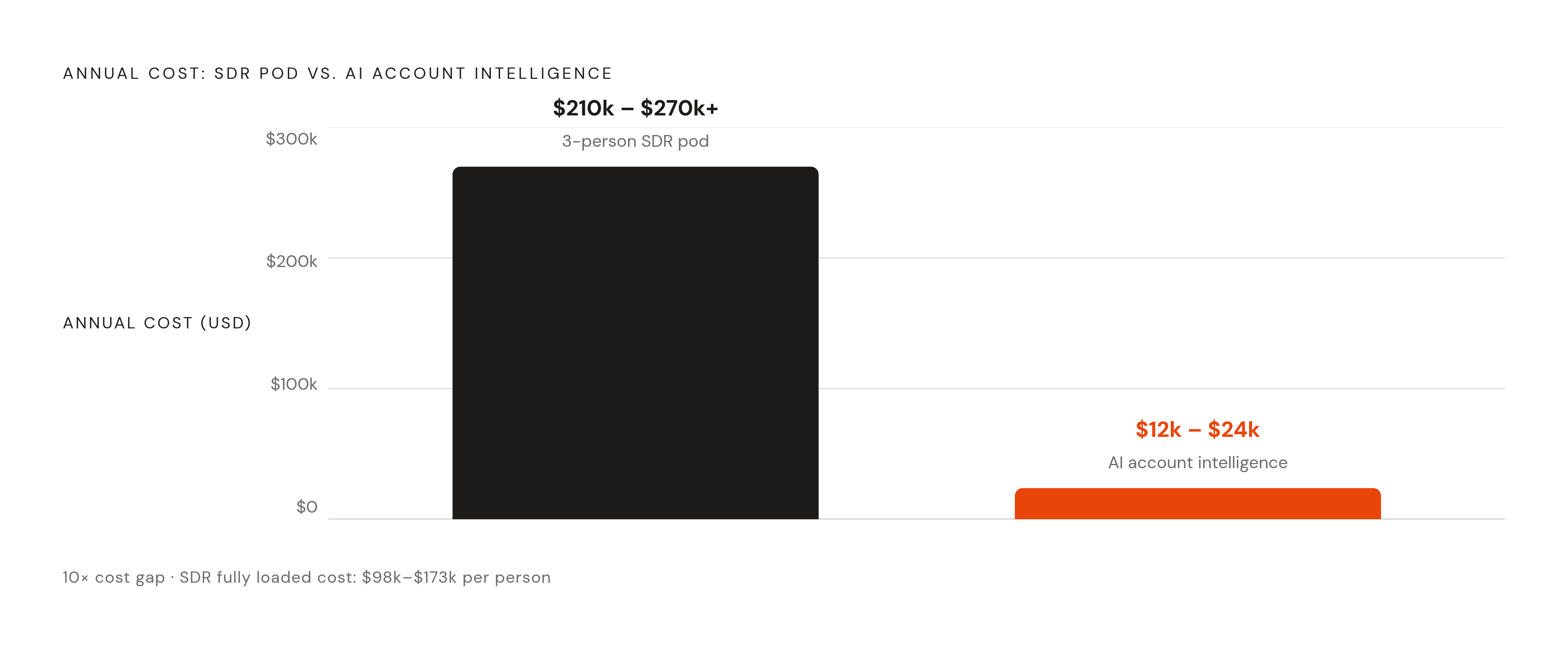
The cost side doesn't help the case, either. A fully loaded SDR, once you count benefits, tools, management time, and the months it takes a new hire to actually start producing, runs somewhere between $98,000 and $173,000 a year. A standard three-SDR pod costs a company $210,000 to $270,000 or more annually, for a function that produces fewer qualified meetings every quarter it operates. Compare that to AI-powered account intelligence tools running $12,000 to $24,000 a year, doing research work that used to mean a human sitting there combing through LinkedIn and news alerts one account at a time. That gap alone should make any VP of Sales stop and ask what those SDR hours are actually buying.
The talent numbers point the same direction, and they read like a structural shift rather than a rough year. Internal promotion rates for SDRs dropped from 34% in 2020 to 16% in 2024, according to the Bridge Group's SDR Metrics Report, alongside median tenure sitting around 1.9 years and annual turnover running 34% to 40%. A team churning through reps that fast can't build the account knowledge account-based selling depends on. You can't compound relationship intelligence on an 18-month rep lifecycle. Volume outbound is dying because its economics never survived close scrutiny; the data just showed up late to confirm it.
What account-based selling actually requires operationally, and where most teams misread it
Account-based selling and volume outbound are different motions built for different unit economics, and treating them as swappable is where most of the confusion starts. ABS earns its overhead in a specific zone: deal sizes above $100,000, a total addressable market of only a few hundred to low thousands of realistic accounts, sales cycles running 6 to 18 months, and buying committees with 5 to 9 stakeholders in the room. Volume outbound earns its keep somewhere else entirely, where ACV is low, the TAM is large, and cycles close in weeks. Run an ABS motion on a transactional segment and you're wasting money on research nobody needed. Run volume outbound against an enterprise segment and you're burning accounts you'll never get a second shot at.
Here's where most teams get it wrong, and it happens so often it barely registers as a mistake anymore: they don't actually switch motions. They bolt light personalization onto their existing volume sequences, call the result "ABM lite," and wonder why performance doesn't move. What you get is worse than either pure approach. The personalization dilutes the raw efficiency that made volume outbound work at scale, but it never reaches the research depth real account-based selling needs to earn a reply. A list that should convert well, given proper account selection and research, ends up converting at a fraction of its potential, because the list-building work and the account intelligence underneath it never got done. You pay for ABS and get spray-and-pray back.
There's also a dual-segment reality most companies avoid looking at directly. Plenty of them have two real ICPs at once, which means they need two separate workflows, not one blended process trying to do both jobs badly. A mid-market motion selling into a large number of accounts at low ACV on a 30-day cycle is a legitimate volume outbound play; running ABS there is an expensive overreaction. An enterprise motion targeting 200 accounts at high ACV on a 9-month cycle sits at the opposite end, where ABS is the only rational choice. Forcing both segments through one sequencing tool and one quota structure produces a weak version of each motion instead of a strong version of either.
So what does ABS actually come down to once you strip out the conference-talk language? Four things, really: tiered account lists built and agreed on before any sequence goes live, role-specific contact mapping across the whole buying committee instead of one contact per account, entry points triggered by real signals instead of a calendar template, and success metrics measured at the account level instead of the individual activity level. None of that is complicated as a concept. Most teams skip it anyway, because it's slower than opening a sequencing tool and hitting go, and slower doesn't look good on a Monday pipeline review.
How to build the account selection layer that makes everything else work
Account selection is where ABS execution actually starts. Everything downstream, the sequencing, the messaging, the channel choice, depends on getting this layer right first, and it's also the layer most teams rush through to get to the "real" work of sending emails.
Start with the ICP-to-account-list translation. Firmographic fit comes first: industry, headcount band, revenue stage, tech stack signals suggesting a company can actually use and afford the product. But firmographic fit only tells you who could buy, not who's in market right now. Behavioral fit layers on top, narrowing the firmographically qualified list down to accounts actually showing signs of active evaluation. When your TAM is genuinely under 1,000 realistic accounts, this precision stops being optional. You can't burn a generic email on an account you'll need again in six months. The universe you're working from is small enough that every wasted attempt carries a real cost.
Intent signals belong at the center of account selection, not floating around the edges as a nice-to-have field filled in after the fact. Champify's 2025 research found accounts with active buying triggers converted at a 37% win rate, a gap wide enough to change how a whole team spends its week. This isn't a fringe tactic anymore, either. Cognism research found 75% of B2B sales engagements in 2025 started from signal-based triggers, which means signal-first selection is already the majority approach among the teams actually winning deals.
Which signals matter most at the selection stage? Worth tracking these separately instead of folding everything into one generic "intent score." First-party signals: pricing page visits, demo requests, repeat visits from a known account's IP range. Third-party signals: job postings hinting at budget or team expansion, tech install or uninstall data, funding announcements. Relationship signals: a past champion changing jobs, a new executive landing at a target account. Each one tells you something different about timing, and a team that treats them as interchangeable loses the nuance that makes signal-based selection work at all.
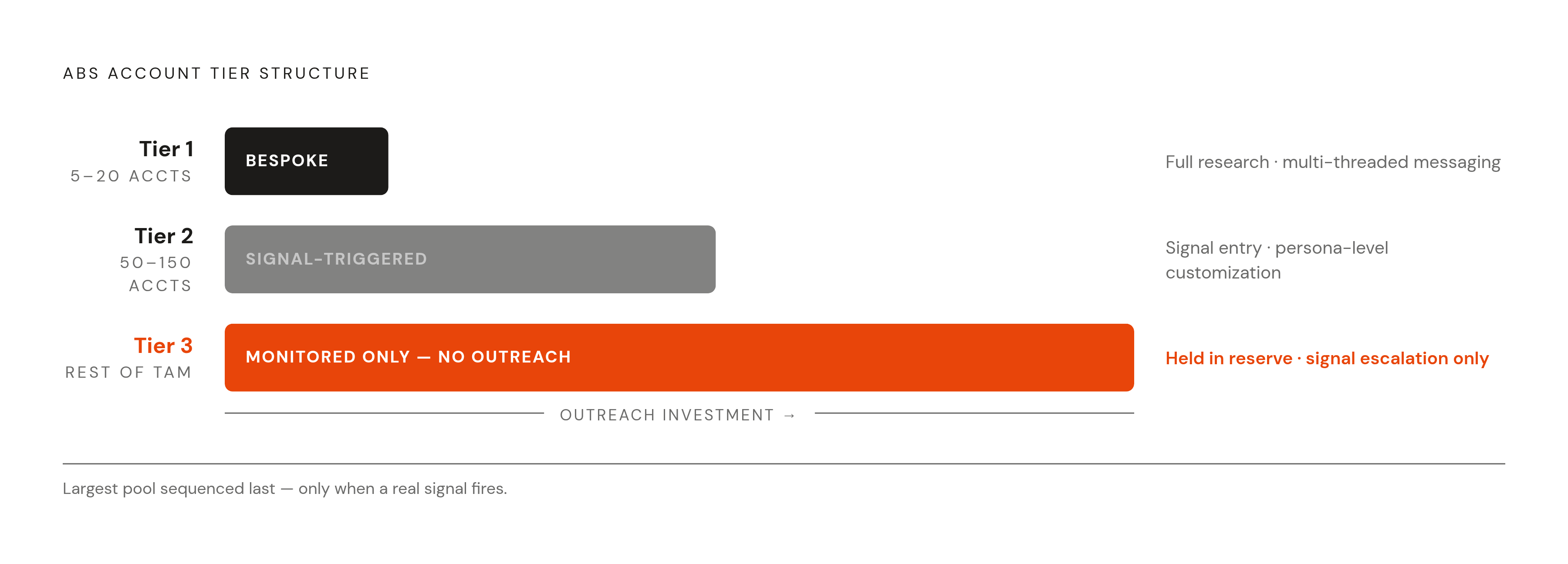
Once the list exists, not every account on it deserves the same investment. Tiering forces that discipline before sequencing starts, not after. Tier 1, usually 5 to 20 accounts, gets full research and multi-threaded, custom messaging built for each individual stakeholder. Tier 2, somewhere in the 50-to-150 range, gets signal-triggered entry with persona-level customization rather than fully bespoke messaging. Tier 3, the rest of the TAM, gets watched for signal escalation and isn't actively sequenced at all until something changes. That last tier matters more than it sounds like it should; it's the pool an account graduates out of when a real trigger fires, not a list you've simply given up on.
Sequencing built around buying signals rather than activity cadences
Volume outbound sequences run on the calendar: day 1 email, day 3 call, day 7 LinkedIn touch, regardless of whether anything has actually happened at the account. ABS sequences run on events instead. The trigger sets the entry point, the specific angle of the message, and how urgently it goes out. That's a fundamentally different design principle than "touch number four happens on day 10."
Consider what that looks like in practice. A pricing page visit from a known target account should trigger same-day outreach referencing the specific product area someone was looking at, not a generic "checking in" note. A new VP of Sales hired at a target account opens a window in their first 30 to 60 days where outreach framed around what they're likely being tasked with fixing lands far better than it would six months later, once they've settled into existing vendor relationships. A competitor announcing a price increase or an end-of-life notice on a product opens a 48-hour window where reaching out to their customer base reads as timely instead of opportunistic. None of these fit neatly into a fixed calendar cadence, and trying to force them into one defeats the point.
Multi-threading matters here in a way volume outbound never had to deal with. A buying committee of 5 to 9 stakeholders can't be reached through a single-contact sequence, no matter how well the email is written. ABS sequences map each contact to their role in the decision, economic buyer, champion, technical evaluator, end user, and each thread stays aware of what's happening on the others. That coordination at the account level, rather than a pile of independent touches that happen to land at the same company, is what separates real multi-threading from just emailing more people.
Channel sequencing in ABS tends to narrow rather than expand, too. LinkedIn does the early visibility work: a comment on relevant content, a connection request with real context attached. Email carries the substantive ask, anchored specifically to whatever trigger justified the outreach. Phone comes in as follow-up on emails that got opened or clicked, or gets reserved for high-priority Tier 1 accounts where a live conversation is worth the SDR's time. Direct mail or executive gifting stays limited to Tier 1 only, because the economics of a pricey gift box only pencil out against a handful of accounts worth six or seven figures.
Activity metrics don't disappear in this model, but their job changes. In volume outbound, "80 calls a day" is the metric, measuring effort, not outcome. Here, activity becomes a sequence health check instead of the goal itself. An SDR making 25 calls a day, each backed by real account intelligence and tied to an actual signal, can match or beat the output of the rep dialing 80 generic numbers. Incredible Health is a documented case of this: they grew quarterly new meetings by 50% without adding a single SDR, just by giving the existing team better intelligence on which accounts to prioritize and when.
How the SDR role itself changes when the job is research and orchestration, not volume generation
The shift is already visible in the org charts. That same 36% headcount reduction figure from Emergence Capital's 2025 survey sits alongside a reporting-line change: Available data shows 80% of BDR and SDR organizations now report into Sales leadership, up from 60% in 2022. Tighter integration with revenue operations and pipeline forecasting isn't a future trend at this point. It's the direction teams have already moved, whether or not the job descriptions have caught up.
So what does the SDR actually do differently? The core work shifts toward identifying and interpreting buying signals, mapping stakeholder relationships inside target accounts, and briefing AEs with real account-level context before that AE ever picks up the phone. That reads more like a research analyst's job description than a traditional BDR's. The value an SDR creates now shows up in the quality of the intelligence they hand off, not the number of touches logged in Salesforce by Friday afternoon.
One data point is reshaping team structure faster than almost anything else in this shift. Salesloft's CRO research found AE-sourced deals convert three to four times better than SDR-sourced meetings, a gap large enough that some teams are restructuring around it instead of treating it as a curiosity. Rather than cutting the SDR layer outright, the pattern taking shape has AEs owning outreach directly into Tier 1 accounts, while SDRs handle Tier 2 sequencing and watch Tier 3 for escalating signals. The SDR's job, in this setup, becomes cutting down the AE's research burden so the AE can spend more of their own time on the outreach that actually closes.
The skills that used to define a good SDR and the skills that matter now barely overlap. Objection handling volume, phone stamina, speed running a template, that's what got measured before. Now it's signal interpretation, depth of account research, the ability to map a multi-stakeholder buying committee accurately, and enough writing skill to produce outreach specific enough that it couldn't have been sent to any other account. That's a genuinely different hire, and it's fair to wonder whether the interview process at most companies has actually caught up to it yet.
Comp and quota design have to follow, or the incentive structure fights the motion it's supposed to support. Calls per day and emails per week measure the wrong thing once the job is research and orchestration. Better metrics: qualified meetings booked specifically from the target account list, accounts that moved from Tier 3 into Tier 2 because a signal fired, stakeholders successfully mapped within each Tier 1 account. A team still paying out on call volume while asking reps to do ABS-style research is asking for a rep who quietly ignores one instruction to hit the other.
Where AI agents fit into an ABS motion — and what they should not be asked to do
The adoption curve here is steep enough to treat as infrastructure rather than experiment. Deloitte's 2025 research put autonomous agent deployment at 25% of enterprises that year, with that figure projected to double to 50% by 2027. That's not a pilot program timeline. That's a technology moving from early adoption to default expectation inside two years.
Where do these agents actually earn their keep inside an ABS motion? Prospecting agents monitor intent signals (job changes, funding rounds, tech installs, content engagement) and surface net-new accounts matching the ICP without a human manually building lists in a spreadsheet. Outreach agents run the trigger-based sequences described earlier, personalizing at the account level using enriched data and following up automatically without a rep having to remember to check back in three days. CRM agents update fields based on what actually happened in an interaction, flag accounts whose engagement is escalating, and route those signals to the right rep or AE in real time instead of sitting in a report nobody opens until Monday. Qualification agents score inbound responses and website behavior, sorting the accounts genuinely ready for a human conversation from the ones still in early research mode.
The productivity numbers behind this are worth taking seriously rather than filing under vendor marketing. Gartner's 2025 research found sales teams using AI reported 47% productivity increases and 12 fewer hours of manual work per week, time that used to disappear into list-building and manual research. The same research found autonomous agents compressing deal cycles by 25% to 30% through faster qualification and follow-up. Workato's internal deployment of 28 sales agents, handling opportunity enrichment, quote generation, and meeting follow-ups, produced deals that moved through pipeline stages up to 20% faster when the underlying data was agent-enriched, handing five to seven hours a week back to individual sellers.
But there's a catch, and it matters as much as the enthusiasm does. Gartner has flagged what it calls "agent washing," the gap between what gets marketed as an agent and what the product actually does. Chatbots, robotic process automation, and basic AI assistants are getting labeled "agents" when they don't clear the bar. A real agent acts on its own, holds state across multiple interactions, and responds to signals without a human re-prompting it at every step. A decision-tree chatbot does none of that, no matter what the landing page says. Teams that buy an "AI SDR" that's actually a templated auto-responder are going to reproduce volume outbound's exact failure, just with a shinier label on the invoice.
There are also things AI agents shouldn't be handed in an ABS motion. Tier 1 account outreach, where relationship history and credibility are genuinely on the line, still needs a human's judgment on tone, timing, and what's actually at stake in that specific relationship. Governance matters as much as capability here: any agent with access to customer data needs defined permissions and a human approval gate before it takes a high-value action on its own. The guardrails aren't a compliance afterthought. They're part of what makes the deployment trustworthy enough to use on accounts that actually matter.
The agent's job is to amplify the SDR's account intelligence, surfacing what a human would have taken hours to find and acting on the parts that don't need judgment, while leaving the relationship judgment itself with the rep.
The stack an ABS team actually needs — and the consolidation case against adding more tools
Volume outbound built a sprawling tool stack because each point solution solved one narrow slice of the problem: list building, sequencing, deliverability, enrichment, CRM, reporting. Seven tools, sometimes more, stitched together to run a single motion, each with its own login, its own data format, its own monthly invoice.
ABS doesn't need fewer categories of function so much as it needs those functions actually talking to each other, which volume-era tooling was never built to do. Intent signal aggregation is the clearest example. First-party signals like website behavior and product usage, third-party signals like job changes, funding announcements, and tech installs, all need to land in one unified view of an account instead of three separate dashboards a rep checks individually before writing a single email. A signal that arrives in a tool nobody opens might as well not exist at all.
That's the consolidation case, stated plainly. Every additional point solution is another place account context gets lost, another login a busy SDR skips on a Tuesday, another data format that has to get reconciled before anyone can act on what it's showing. The teams making ABS actually work aren't the ones with the most tools bolted together. They're the ones where account intelligence, signal detection, and outreach execution sit close enough to each other that a real trigger turns into a real touch within hours, not whenever someone happens to notice it buried three tabs deep.