Account-Based Sales Strategy for Seed-Stage Startups
Founders can run account-based sales without the enterprise budget or overhead.

Pick a short, hand-chosen list of companies, research each one on its own terms, and send outreach nobody could mistake for a template with a first name dropped in. That's the whole idea. No sales hire required, no six-figure ABM budget, no twelve weeks of runway spent finding out the outbound was aimed at the wrong companies the entire time. CB Insights has tracked startup failure rates for years, and weak go-to-market sits near the top of that list, right next to running out of cash outright. Scaled down to fit an actual founder's actual week, account-based sales solves a problem most seed companies don't even notice until the pipeline's already bone dry.
Get the enterprise picture out of your head first. Big-company ABM means a cross-functional team, coordinated display campaigns, someone in marketing ops mapping buying committees inside Salesforce. Nobody at seed stage has that, and nobody needs it either.
Strip it down and here's what's actually left: a tight list of accounts matching your best-fit profile, each one researched by hand, with a message built around that specific company instead of a persona or a job title. List first, message second. Flip that order and you're back to spray-and-pray outbound, which, if you look closely, is what most "personalized" cold email turns out to be anyway.
Founders tend to think of themselves as placeholders here, someone holding the fort until there's budget for an AE. But a founder who built the product and lost actual sleep over it can describe the problem in a way that carries. A prospect reading a cold email can usually tell the difference between a rep cycling through value props and a founder who means every word of what they wrote at 11pm.
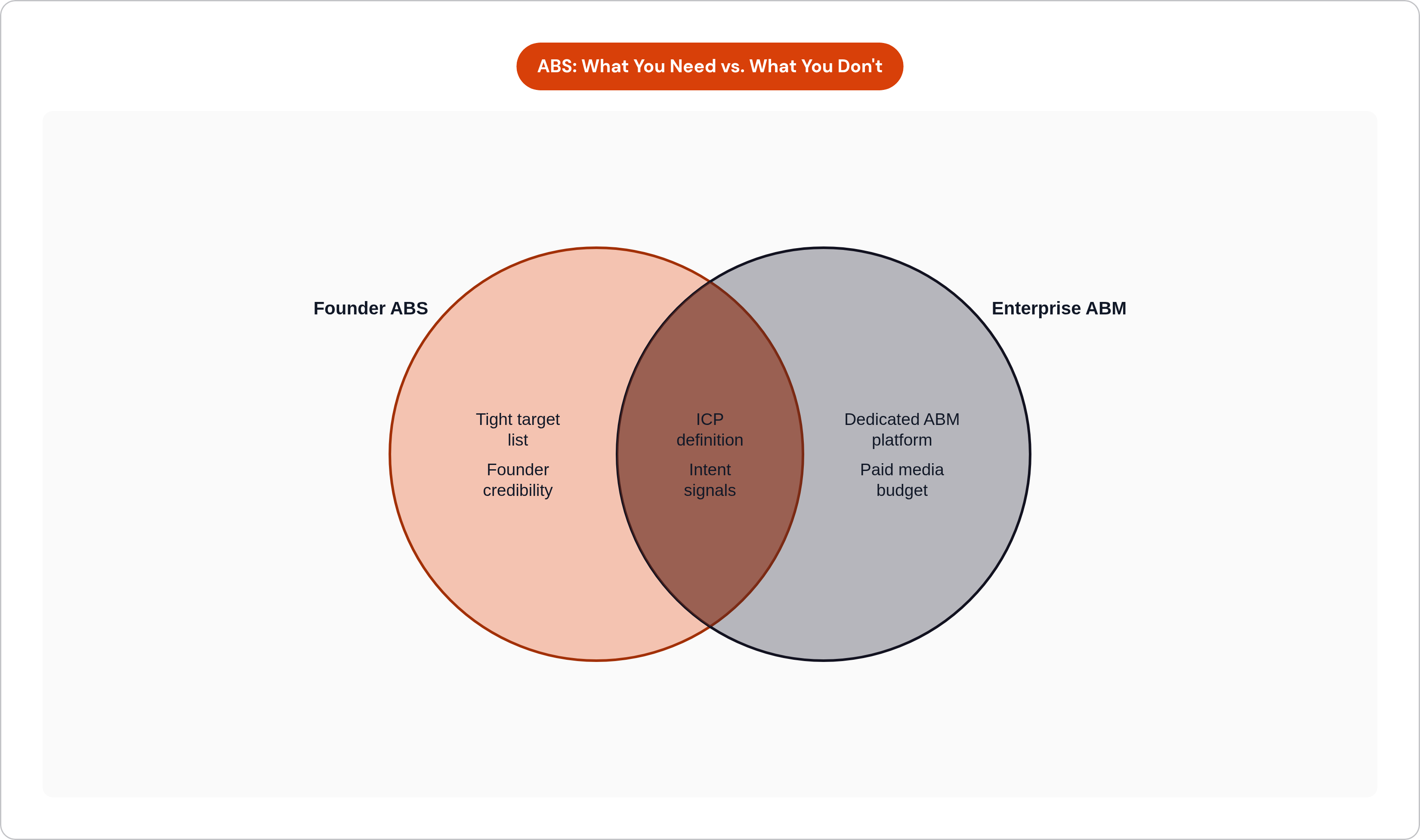
What ABS doesn't need matters just as much as what it does. No dedicated ABM platform, no content team churning out account-specific landing pages, no paid media line item eating into runway. Careful execution against a correct list beats something bigger and unfocused most weeks of the year. Which raises the actual first problem, and it's not a small one: getting that list right in the first place.
Building an ICP tight enough to generate a real target list
"Mid-market SaaS" is a direction, not a Tuesday morning email. A vague ICP produces a vague list, and a vague list produces outreach that reads like it was written for nobody in particular, because it was.
Firmographics are the floor here: company size, funding stage, revenue band, geography, vertical, the core filters any ICP scoring exercise starts with. Technographic data tells you more than most people expect walking in; a company running a specific billing tool or CRM signals budget assumptions and buying behavior, not just a product preference someone happened to pick one afternoon. Then there's a structural question that gets skipped constantly, and it shouldn't be. Does this account even have the role that buys your product? A twelve-person startup with no ops hire isn't buying an ops tool, no matter how sharp the email is. Behavioral buying signals close the loop: recent hiring in a relevant function, a fresh raise, a visit to your pricing page. These are what turn a firmographic match into something worth acting on this week instead of next quarter.
Treat the ICP as something that sharpens with every conversation, not a slide finalized in month one and filed away forever. A common failure mode: founders inherit the buyer persona built for the pitch deck, the one meant to answer an investor's market-size question, and never actually check it against a real closed deal. If you've got three or four customers already, reverse-engineer from them instead. What the ones that closed have in common, and what the ones that went cold were missing, beats a market-sizing slide every time you run the comparison honestly.
Keep the list small. Dozens to low hundreds, something you could read line by line in a spreadsheet without losing your place halfway down. The moment it needs a database instead of a spreadsheet, it's stopped being an ABS list and turned into something else.
Using intent signals to decide when to reach out, not just who to reach
Getting the list right is half the job. Timing is the other half, and it's the half that gets treated as an afterthought more often than it should. A perfectly researched account contacted at the wrong moment is still a wasted email, and the fit was real; the trigger just wasn't there yet.
First-party signals are the clearest: pricing page visits, repeat views on one product page, a demo request from someone sitting near your main contact at the same company. Second-party signals come from what a company's doing in public, hiring especially. A job listing for a head of sales ops means that company's about to build out sales infrastructure, and that's often the exact moment your product starts mattering to them. Third-party signals, the kind B2B intent data providers track, show category-level research activity across a company, a rough proxy for "we're shopping for something like this right now." Event triggers, funding news, a leadership change, a new product launch, mark the moments when a company's priorities are visibly shifting under them, whether they've announced it publicly or not.
Trigger-based outreach converts better than the same message fired off cold on a random Tuesday, and that much probably doesn't need a citation. You don't need a scoring model to benefit from it either; a handful of live signals in a given week is enough to re-rank the list, telling a founder who gets a call this week and who waits until next month. Small thing, and most founders never bother building it into the process anyway.
How to structure outreach that earns a response from a specific account
Signal tells you when. The message still has to earn the reply, and that's where real ABS separates from templated outreach in a way the recipient notices almost immediately, usually within the first sentence.
Start the email with something true about the account: a hire they just announced, a raise, a product launch, a job posting hinting at a new priority forming somewhere inside the company. The problem framing has to fit that company's actual stage, not some generic pain point that could describe half the market and therefore describes nobody in it. Social proof works when it comes from a company that looks like the target: similar size, similar vertical, similar moment in its life. Telling a 40-person Series A company what you did for a 2,000-person enterprise account does almost nothing for them, since they can't map that story onto their own, and honestly, why would they try?
Channel mix matters more than most founders assume going in. Email carries the sequence, but LinkedIn as a second surface and phone as a third raise response, since an account seeing you show up in more than one place tends to take the whole thing more seriously. A multi-channel cadence of six to eight touches over two to three weeks is usually enough to stay present without becoming the sender someone eventually mutes out of irritation. Each follow-up needs a genuinely new angle: a new piece of evidence, a different framing, rather than the same ask with "just following up" bolted onto the front of it, which is maybe the laziest sentence in all of B2B email.
There's room to go less conventional than the standard "got 15 minutes?" ask, too. Inviting a target account into a short peer conversation or an advisory chat lowers the wall in a way a demo pitch never quite manages; it reframes the whole exchange around ideas instead of sales. Leading with one real insight about their own market, something they genuinely didn't know yet, does similar work.
None of it matters if the email bounces before it lands, though. Unverified contact data produces bounce rates that quietly wreck domain reputationand email deliverability, and that damage doesn't stay contained to the one send it came from, dragging down everything that follows. Skipping verification to save twenty minutes today can cost months rebuilding a sender reputation later, and that's a trade nobody makes on purpose once they've seen it happen.
Running ABS as a founder without a sales team or a complex stack
A founder's time is scarcer than the company's cash in these early months. The whole motion has to bend around that constraint instead of pretending it isn't real.
A workable week splits roughly into four pieces, though the boundaries blur in practice more than any framework likes to admit. Research: review signals, update account priority, pull new accounts into the active tier as intent shows up. Outreach: write and send a small batch of genuinely personalized first touches, favoring quality over volume even when volume feels safer in the moment (it usually isn't). Follow-up: move existing sequences forward, answer replies as they land, sometimes at 9pm because that's when the reply came in. Then a short review at the end of the week: what got opened, what got a reply, and what might explain the gap between the two.
There's a trap that shows up constantly here. A list-building tool, a separate sequencer, a separate CRM, a separate enrichment tool: that's four places holding pieces of the same account data, and a founder ends up spending scarce hours stitching tools together instead of actually selling. It's rarely obvious how much this costs until a founder tries to answer one simple question about one account and has to check three different tabs to do it, and by tab three has forgotten what the question even was.
One sales engagement platform handling list-building, enrichment, sequencing, and CRM logging together removes most of that overhead. Fewer tabs, fewer context switches, a weekly loop that stays fast enough to actually learn from instead of just survive. Some platforms are built around this idea, letting founders set up AI revenue agents that run the repeatable pieces, prospecting, outreach, follow-up, CRM sync, without the founder gluing together four point solutions by hand on a Sunday night. Whatever tool a founder actually picks, the test underneath it stays the same: does it cut down the number of places you have to look to understand one account?
Agents handle repeatable execution well, but founder judgment still governs the calls that actually matter. Keep human approval on the high-stakes decisions, which accounts get tiered as strategic, who gets the first outreach to a named target, then let the agents run the defined sequence once that call's been made. The founder's hours go where a real human read on tone and objection still counts for something, the stuff that never shows up cleanly in a transcript no matter how good the transcript is.
Measuring what matters and iterating toward a repeatable motion
Measurement at seed stage isn't for a board deck. It's closer to pattern recognition, and the only real test of a metric is whether it answers "what do I do differently next week?" If it doesn't clear that bar, it's decoration.
A few numbers carry more weight than the rest. Account-level reply rate matters more than open rate, since open rate gets gamed by tracking pixels in ways reply rate simply can't fake. Meeting-to-opportunity conversion answers a different question: are these meetings turning into real pipeline, or just pleasant conversations that go nowhere afterward? Pipeline concentration, how many target accounts have actually moved into active pipeline, might be the single best leading indicator of whether the ICP itself is right or needs another pass. Win-loss by account type feeds straight back into ICP refinement, and whatever predicted a closed deal deserves more weight in the next round of list-building, while whatever didn't should probably get dropped.
Run the loop short: every two to four weeks. Look at what the data actually shows, cut the sequences and account types that aren't converting, sharpen the message for the ones that are, and write the pattern down somewhere so nobody has to relearn it next quarter from scratch, including the founder themselves six months from now.
The real goal at seed is a documented motion: a written ICP, a sequence with an actual track record, call recordings someone has genuinely sat down and reviewed for what worked and what fell flat. That's what makes the motion transferable the day the first salesperson walks in the door, and it's also what makes a founder's answer credible when an investor asks how go-to-market survives without them personally running every send. Every honest pass through this loop leaves behind a sharper ICP, a sequence converting a bit better than last time, and a small set of reference customers who become their own prospecting asset: proof that companies just like the next target got a result worth repeating.