Reply Rate Benchmarks for Targeted vs Broad Outbound Sequences
Targeted campaigns beat broad blasts by multiples on reply rate.

The most direct levers on reply rate are campaign size and list quality, and the gap between them is not marginal. Hunter.io's analysis of millions of cold emails found that deep personalization drives meaningfully higher reply rates and that smaller, tightly targeted campaigns substantially outperform broad blasts. This holds consistently across industries, not as an occasional tendency but as something closer to a structural feature of how buyers filter unfamiliar senders.
Meeting booking rates follow the same gradient. Signal-personalized outreach books meetings at a multiple of the rate generic campaigns achieve. Apollo's practical guidance for 2026 makes the operational implication explicit: benchmark by ICP segment, not total database size. An SDR sending a small batch of tightly matched emails to a well-defined ICP segment should expect a fundamentally different result than one blasting thousands of loosely screened contacts. Treating those two activities as comparable is where most diagnostic conversations go wrong, and I've sat in enough pipeline reviews to find that confusion dispiriting.
Volume and targeting pull in opposite directions. Teams need to decide which metric they are actually optimizing before they build a sequence, because chasing both simultaneously tends to produce mediocre performance on both dimensions. I've watched more than a few teams convince themselves they could have it both ways. They could not.
Some high-volume, low-ACV motions do generate pipeline at scale, and that counterpoint deserves acknowledgment. Broad outreach is not categorically wrong. It requires accepting lower per-contact returns, higher infrastructure cost, and greater deliverability risk, and the math only works if the unit economics support the motion. For most enterprise or mid-market teams, the unit economics fail to support it.
Where Industry and Vertical Change What "Good" Looks Like
Industry variation in reply rates is material, not noise, and conflating verticals is one of the more persistent sources of bad benchmarking I've encountered. Consulting achieves among the highest average reply rates across all B2B categories. Healthcare also substantially outperforms the overall mean. SaaS is consistently the hardest vertical to work, with below-average reply rates even in well-executed programs and roughly one to two meetings booked per hundred emails sent in a healthy outbound program.
A SaaS founder hitting a modest reply rate should read that number differently than a consultant hitting the same figure. The consultant may be underperforming. The SaaS founder is likely doing something right. Segment-specific benchmarks matter more than platform-wide averages precisely because the range of "normal" is wide enough that the average actively misleads.
Sender type shifts the baseline further. Founder-led outbound carries inherent credibility and perceived relevance that SDR-driven outreach generally lacks. Founder sequences should be benchmarked at 8% to 15% positive reply rates, with above 5% already indicating meaningful message-market traction. Reply-to-meeting conversion is also higher for founder outbound than for SDR-driven sequences, which means reply rate alone understates the motion's total value when founders are sending.
The right diagnostic question before declaring a sequence underperforming is whether the comparison is even valid. Vertical, sender type, and campaign size all determine what "on track" means. Benchmarking a founder-led SaaS sequence against a platform-wide average produces a number that is nearly useless for any practical decision.
How Personalization Depth Creates a Tiered Reply Rate Stack
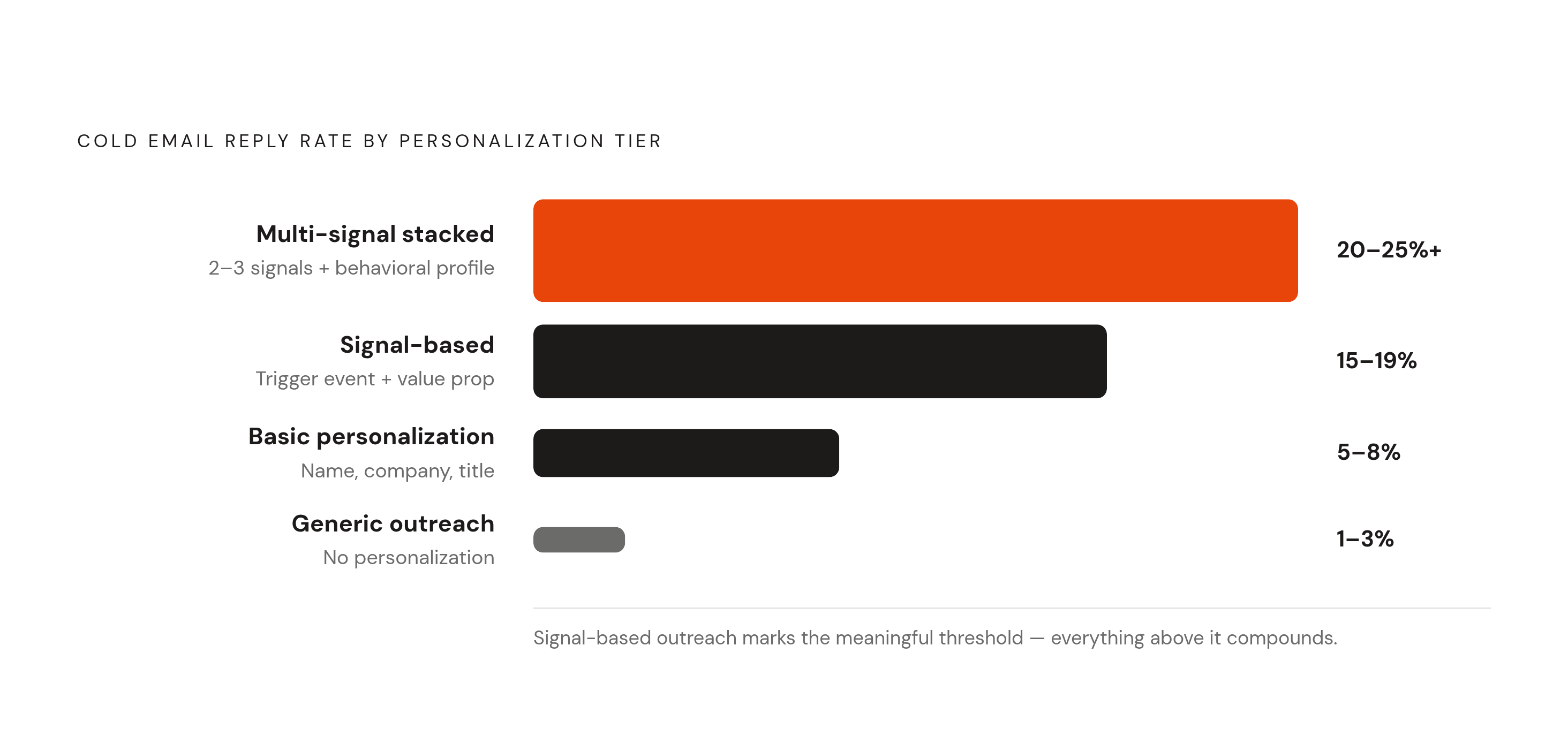
Personalization is not a single variable. It operates in layers, and each layer produces a measurably different outcome. This is something the field keeps rediscovering, usually after a round of disappointing results from template-based outreach.
Generic cold outreach, which also tends to damage sender reputation over time, clusters around a low single-digit platform average. Basic personalization, name, company, and title dropped into a template, performs above that average but is now commoditized; the large majority of sequences currently do this, which means its marginal value has compressed significantly as adoption spread. Signal-based personalization, outreach anchored to a specific triggering event paired with a directly relevant value proposition, reaches substantially higher territory. Available data puts this tier in the mid-to-high teens. Multi-signal stacked outreach, two or three signals combined with a behavioral profile, sits at the highest tier and outperforms single-signal approaches by a meaningful margin.
Only a small fraction of active senders personalize at the signal level consistently. The competitive advantage for teams that do remains significant precisely because adoption is still limited, though that window will not stay open indefinitely. These things rarely do.
A distinction the field is increasingly drawing matters here: intent data is not the same as signals. A company visiting a pricing page is intent data, not a buying signal. A new CRO being hired, a direct competitor raising a round, SDR headcount surging at a target account: those are signals. Signals carry context that intent scores lack, and they predict buying motion more accurately because they describe a change in a prospect's situation rather than a snapshot of a single behavior at a point in time.
Merge-tag personalization is table stakes. Teams still treating first-name and company-name insertion as a differentiated strategy are competing on a variable the market absorbed years ago.
Which Signals Move Pipeline and How Quickly They Decay
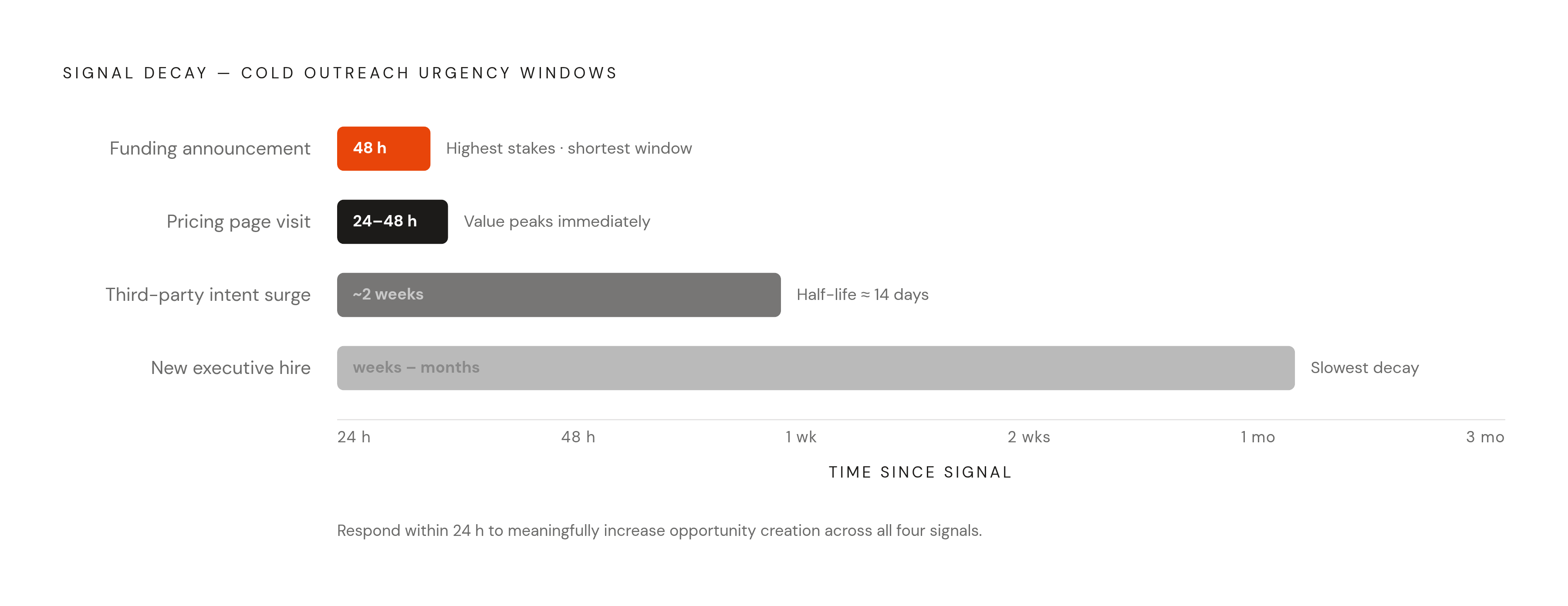
Not all signals produce the same pipeline impact, and the timing of activation matters as much as the signal type. This is the part that most teams underweight, often because their tooling makes it easy to collect signals and difficult to act on them quickly.
Leadership changes are among the highest-value triggers available. New executives typically re-evaluate vendor stacks within months of appointment, and the window opens when the hire is announced publicly. Funding announcements carry the highest relevance in the first 48 hours; companies in active growth mode are buying tools and headcount, and that window closes fast. Hiring surges, particularly in SDR or revenue operations (RevOps) roles, indicate a company actively building a sales motion and likely evaluating the tools that motion requires. Tech stack changes, detectable through tools like BuiltWith or HG Insights, create displacement windows that are real and time-limited. Competitor funding or displacement events create an opening for outreach anchored in contrast.
Signal decay is operationally critical and widely underappreciated. Pricing page visits lose most of their value within 24 to 48 hours. Funding announcements peak in the first 48 hours. Third-party intent surges decay roughly by half within two weeks. New executive hires create a window measured in weeks to a few months, rather than an open-ended one. Teams that act on intent signals within 24 hours see meaningfully higher opportunity creation than slower responders. Speed of activation is not a nice-to-have; it is part of the signal strategy itself.
Lead411 raises a counterpoint worth examining: many providers conflate engagement signals with revenue signals. Teams should validate which signals actually correlate with booked meetings in their own pipeline data before scaling a signal stack built around vendor definitions. The correlation is category-specific, sometimes company-specific, rather than universal. I have seen teams invest heavily in a signal type that made intuitive sense and produced almost nothing in their particular market. Validation before scaling is not optional.
Only a small fraction of B2B companies currently use signal data tools systematically. The competitive moat for early adopters remains wide, and it will compress as adoption accelerates.
Hook Type and Sequence Structure as Within-Campaign Performance Levers
Hook type is the single largest within-campaign variable available to a sender. The difference between the best-performing and worst-performing hook structures is roughly 2x on reply rate, which makes it more consequential than most variables teams spend considerably more time debating.
Timeline hooks, structured around compressed achievement windows and specific metric progressions, consistently outperform problem-statement hooks in the benchmark data. The gap holds across consulting, healthcare, and SaaS verticals. Problem-statement hooks underperform partly because they are overused; buyers have pattern-matched the structure and filter it out faster. The cognitive shortcut that once made "Are you struggling with X?" land now works against it. Buyers have read that sentence ten thousand times.
Optimal email length is under 80 words. Shorter forces clarity and specificity, both of which correlate with higher reply rates. The constraint is a feature, not a limitation.
Sequence length dynamics follow a clear pattern. Single-email campaigns have the lowest reply rate of any sequence structure. The first email in a sequence captures 58% of total replies; follow-ups account for the remaining 42%. Four to seven emails is the range that maximizes total reply rate. The 3-7-7 sales cadence pattern, touchpoints on days three, seven, and seven, captures the large majority of replies within the first ten days. Additional follow-ups beyond that point offer diminishing returns, and most teams have experienced the awkwardness of a seventh follow-up that was clearly optimistic.
Multi-channel sequences outperform single-channel outbound by a wide margin on qualified meetings booked. LinkedIn, phone, and email each carry different response dynamics and reach buyers in different modes. Treating email as the entire sequence leaves a measurable fraction of replies on the table.
What AI Tooling Actually Does to Reply Rates, and Where It Falls Short
AI SDR platforms are a fast-growing market category with documented wins in specific use cases: pipeline generated at scale, reply rates above industry average in well-configured deployments. These outcomes are real. The question is where, and under what conditions, and the answer is more qualified than the vendor marketing suggests.
Where AI augmentation clearly works: research, list building, signal monitoring, message variation testing, CRM enrichment. The productivity gains in these applications are real and substantial. Where fully autonomous AI outreach underperforms: AI used to write and send actual outreach without human oversight has consistently failed to match human-quality reply rates at scale. Sender reputation degrades as volume scales agentically. The failure rate among AI SDR implementations is significant; only a small fraction survive past the first year. The ones that do tend to have precisely defined target profiles before the first campaign runs. Vague targeting produces low-relevance outreach regardless of how capable the underlying model is. The technology amplifies the upstream decision; it does not fix it.
Hybrid models, where AI handles research, drafting, and signal monitoring while humans review and personalize final outreach, produce the strongest documented results for higher-ACV motions. The human review layer is not inefficiency. Removing it to save time is a trade most teams regret, because it is what preserves the reply rate differential that signal-based personalization creates in the first place.
Named autonomous AI SDR tools currently operating in the market include 11x (Alice for outbound, Julian for voice, priced at roughly $5,000 per month or $60,000 annually), Lindy, and Salesforce Agentforce. Signal loss and sequence inconsistency in multi-tool setups are common failure modes, and a unified architecture reduces both. That is a legitimate structural consideration when evaluating any tool in this category.
AI amplifies the returns of good targeting decisions and compounds the damage of bad ones. I have not seen a deployment where that dynamic failed to hold.
A Decision Framework for Choosing Between Targeted and Broad Sequence Design
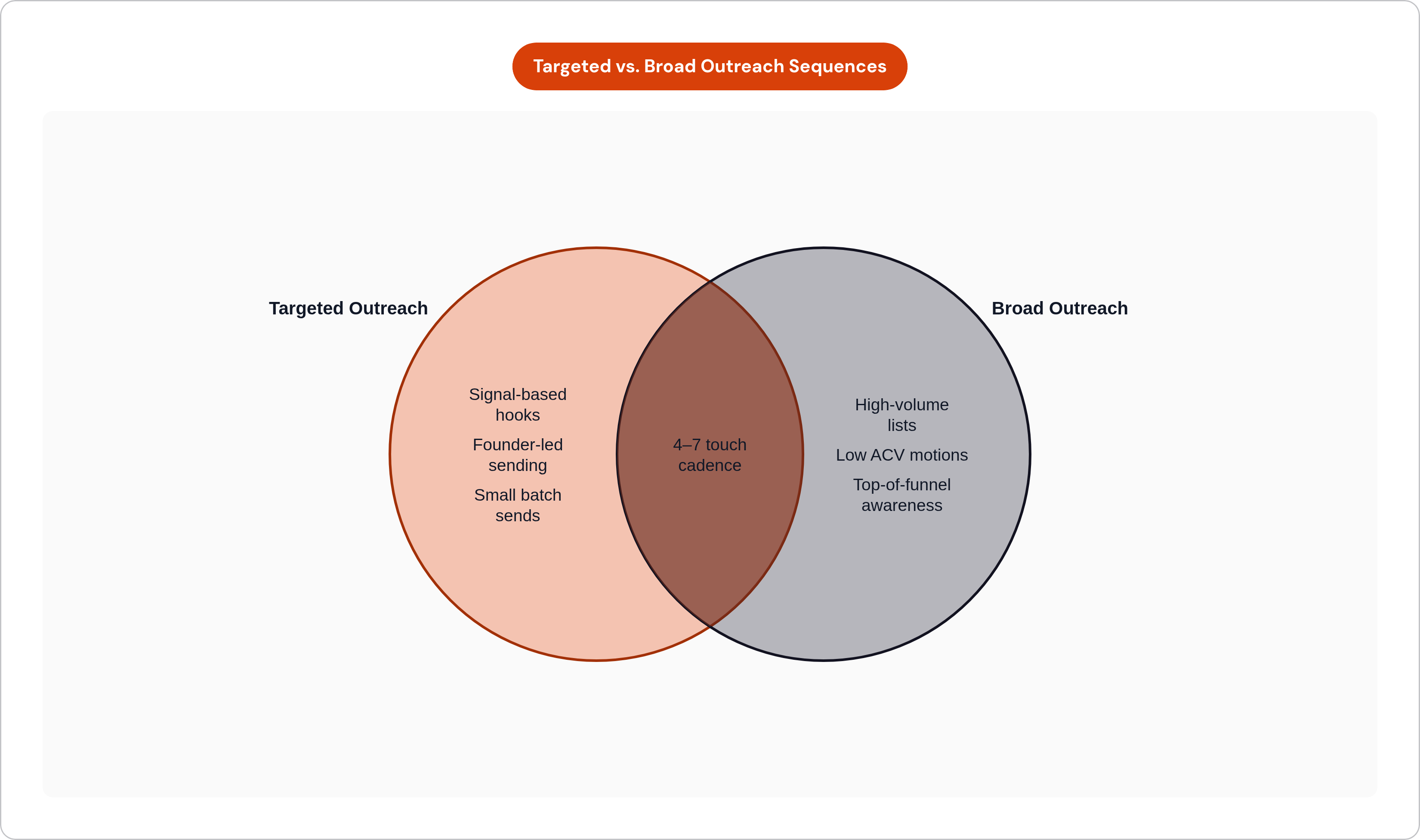
The data does not say to go targeted in all cases. It says the tradeoffs are now quantifiable, and teams should make the choice deliberately rather than by default or inertia. Most teams I've worked with defaulted into one approach without ever consciously choosing it.
Targeted sequences are the right design when ACV is high enough that a single meeting justifies significant per-contact investment; when outreach is founder-led, where sender credibility amplifies personalization returns; when a specific signal creates a narrow, time-limited window that generic outreach cannot address; or when the GTM motion is early-stage and reply signal is as valuable as the meeting itself, because it is still validating the ICP.
Broad sequences can still make sense when the motion is low-ACV and high-volume, where per-contact economics favor throughput over precision; when the goal is top-of-funnel awareness rather than immediate meeting bookings; or when the vertical has a naturally high baseline reply rate, as in certain consulting and professional services categories, where even generic outreach performs above the platform mean.
The sequence design checklist that follows from the benchmark data: define the ICP tightly before building the list and send in small batches. Stack signals before writing the hook, identifying the triggering event first and building the message around it. Choose hook type deliberately, since timeline hooks outperform problem hooks in most verticals. Keep the first email under 80 words. Plan four to seven touches across channels with the heaviest weighting on days one through ten. Benchmark reply rate against the right comparison: vertical, sender type, and campaign size. Iterate on what wins and cut what does not; reply rate data from each sequence is signal about ICP fit, not only about message quality.
The low single-digit platform average is not a ceiling. It is what happens when teams treat targeting as optional. The data shows consistently that teams who treat it as the primary variable operate in a different performance range entirely, and the distance between those two ranges is not shrinking.