Multi-Channel Precision Outbound Beyond Cold Email
Sequence matters more than channels—personalize the order and timing, not just the message.

Cold email reply rates have been sliding for years, and the cause isn't mysterious. Decision-makers get well over a hundred sales emails a week, most with zero personalization past the first-name merge field. The usual fix is to bolt on more channels: add LinkedIn, add a call step, throw in some video. That fixes the wrong variable, and the real problem is cadence and sequencing logic, since almost nobody gets that part right on the first few tries.
I've watched outbound change shape over the last few years in ways that still catch experienced reps off guard. The old model, big SDR teams firing the same template through five channels, is dead weight now. Deliverability got harder, buyer patience dropped, and AI-generated noise flooded every inbox almost overnight. Stack more channels on top of a broken sequence and you've just built a bigger version of the same mess. What follows is about the logic underneath: what each channel actually does, when it should fire, and why so many teams run the order backward without noticing.
What "multi-channel" actually means, and where most teams go wrong
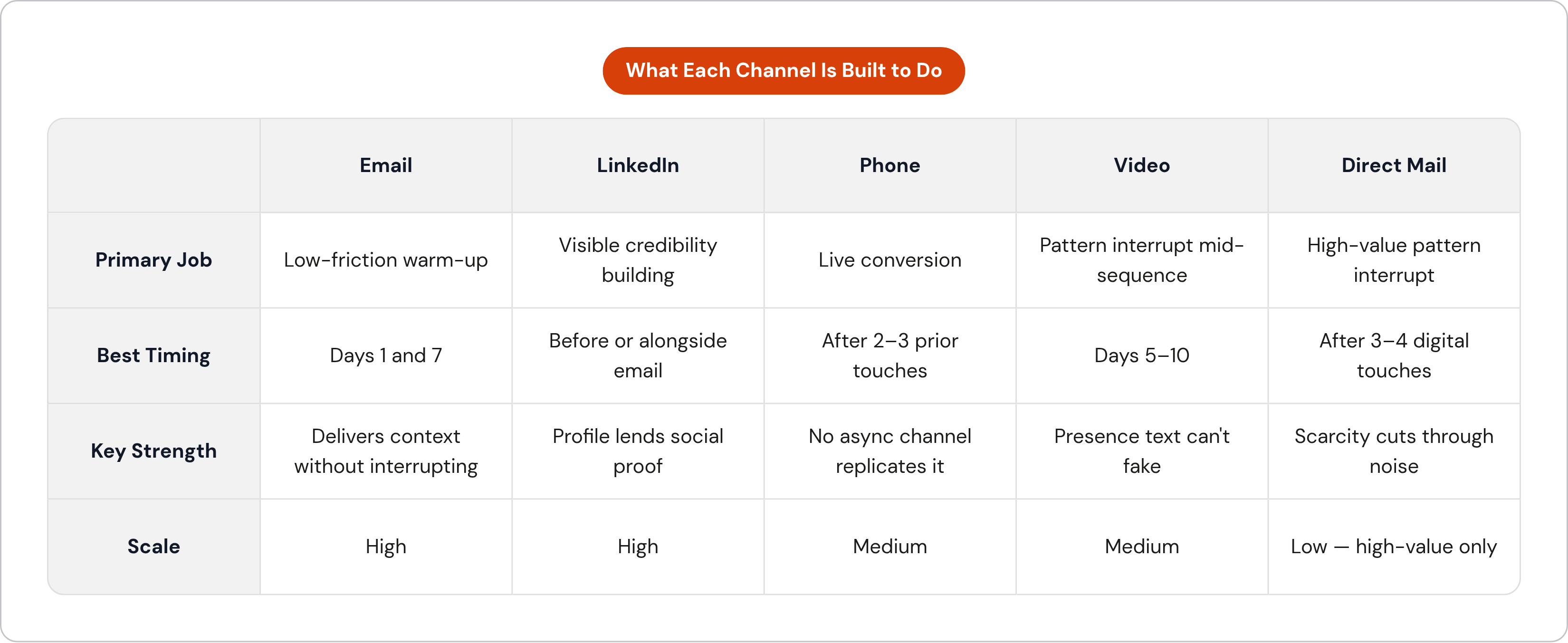
Ask a sales team what their multi-channel motion looks like and you'll usually get some version of: send the email, wait, hit LinkedIn with the same message if nobody replies, maybe throw a call in somewhere. That's one campaign copy-pasted across three pipes, and it fails for the same reason email-only fails: no specificity, no timing, no real distinction in what each channel is supposed to do.
So ask a simpler question first. What is each channel actually good at?
Email is low-friction warm-up. It hands over context without asking anyone to stop what they're doing. LinkedIn builds visible credibility before the cold ask lands; the prospect sees your face, your title, your mutual connections, all before you've asked for anything. Phone is where deals convert. It's a live interruption, and no async channel replicates that, for better or worse. Direct mail and video work as pattern interrupts, saved for accounts where standing out justifies the extra cost.
Choreography means each channel fires at the right moment for the right person, not all at once and not on a coin flip. A well-timed touch in one medium chips away at the "cold" in cold outreach, and channels warm each other up when the order is deliberate rather than accidental. Research on outbound keeps landing on a similar rough finding: it takes several touches across channels before a meeting converts. Each channel gets one job, run in sequence, distinct from the one before it, and matched to the ICP you're actually targeting.
How LinkedIn, phone, video, and direct mail each earn their place in the sequence
Start with LinkedIn. Direct messages there pull roughly double the response rate of cold email, and the reasons aren't complicated. It's a professional setting, the sender's profile is checkable, and most people simply get fewer LinkedIn messages than emails clogging their day. LinkedIn's job is early and light, running before or alongside the first email touches, a warm-up for the cold open rather than a stand-in for it. A profile view and a connection request are quiet signals; the prospect sees your name twice before your message ever lands in their inbox. Comment on something they posted before you've asked for anything, and you've added a touchpoint email can't fake.
Phone had a real comeback, and the data backs it up. Cognism pulled dial data from tens of thousands of calls in 2024 and found dial-to-meeting rates roughly doubling year over year, which cuts hard against the "cold calling is dead" line you hear in every LinkedIn comment section. The call's job is conversion, and it should land after email and LinkedIn have already put your name in front of someone at least once. Timing inside the channel matters too: late afternoon windows tend to beat mid-morning on connect rates and overall call-to-connect ratios, for reasons nobody's fully nailed down. Calling off a live signal, someone visited your pricing page an hour ago, someone just opened your third email, converts noticeably better than working down a cold list in alphabetical order.
Video belongs in the middle of the sequence, on days five through ten rather than day one. A sixty-second personalized clip, shot through something like Vidyard or Loom, tends to pull stronger response than plain text, but timing decides whether it lands well. Trust hasn't been built yet on day one, and a stranger's face showing up in your inbox before any other touchpoint just reads as odd. Later in the sequence, that same video reads as effort, carrying presence text can't fake.
Direct mail is the outlier here, because it doesn't scale and isn't meant to. Save it for high-value accounts where the cost per unit is justified by deal size. Physical mail cuts through precisely because almost nobody sends it anymore; scarcity is the mechanism, not the paper stock. It works best late, after three or four digital touches have already put your name in front of someone. A package sent cold, with no prior context, lands as noise with a bigger budget behind it. Sent after someone's already seen your name on LinkedIn and opened two emails, it reads as genuine intent instead.
The signal logic that determines when each channel fires
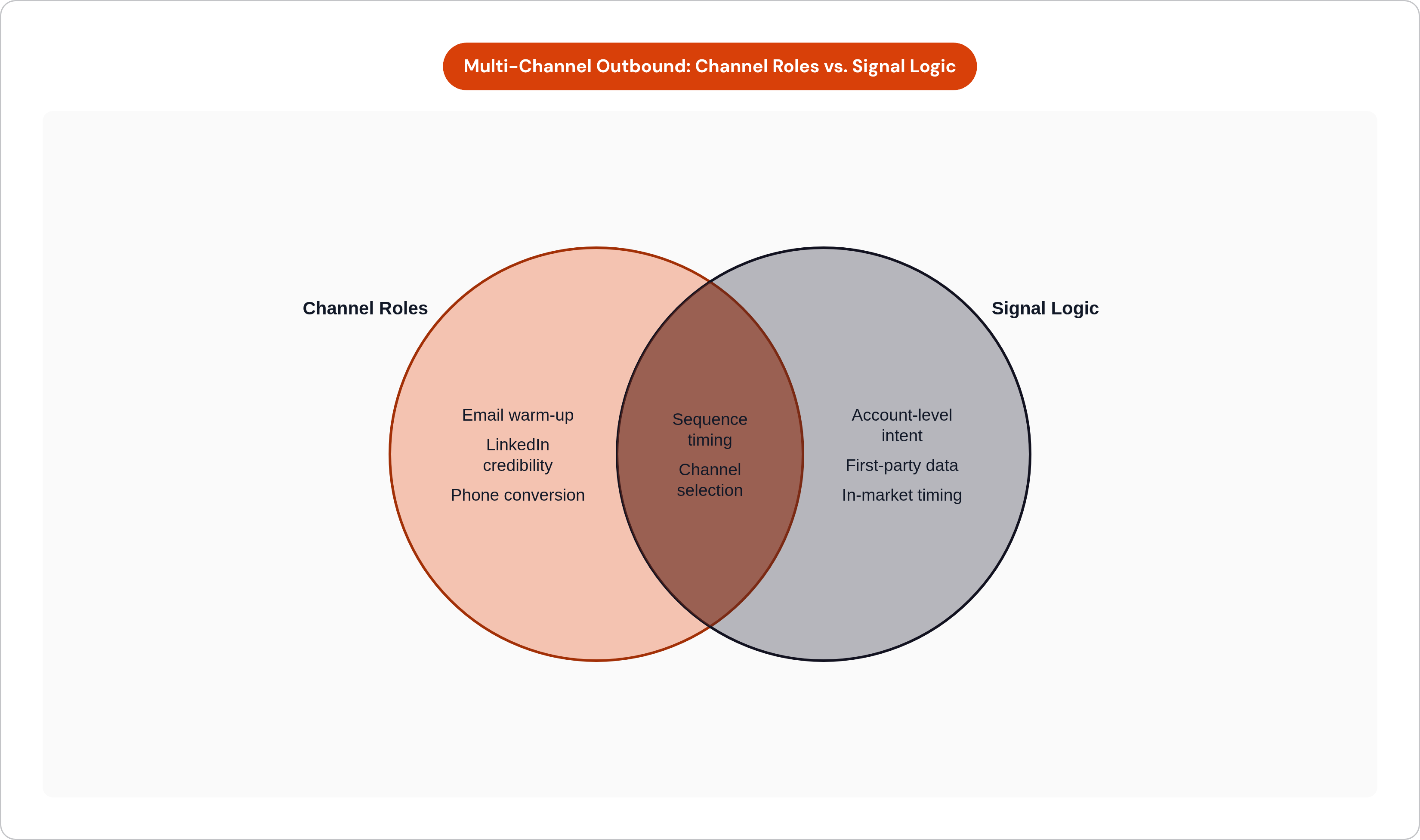
None of this works without signal. A sequence with no signal logic behind it is still spray-and-pray, just spread across more surfaces than before. Signal answers the one question a sequence alone can't answer: is this person actually in-market right now, or are you just guessing and hoping the volume covers for it?
Account-level signals look like topic spikes tied to a category, job postings in a relevant function, technology getting installed or ripped out, a funding round closing. Person-level signals get more granular: pricing page visits, email open and click patterns, someone on the prospect's team viewing your reps' LinkedIn profiles, a job change into a role that suddenly makes them relevant to your pitch. First-party signals, the ones off your own site and your own CRM, carry the most confidence. Third-party intent data, which tracks buying signals across the broader web, surfaces accounts you haven't touched yet at all, which is its own kind of useful.
Gartner's 2025 survey on B2B buying behavior found that a large majority of buyers actively avoid vendors who send them irrelevant outreach. That's a step past simply ignoring an email; a mistimed message at volume doesn't just waste this attempt, it burns the next one too. 6sense's 2025 research adds a second wrinkle: most buying groups, often called the buying committee in enterprise deals, have already picked their vendor shortlist before they ever talk to a salesperson. A sequence triggered by a real signal has a shot at reaching someone before that shortlist locks in. An untimed one usually shows up after the decision's basically made, which is a hard thing to admit if you've spent a quarter building the sequence.
That logic maps onto channel choice pretty directly. A warm account-level signal with no known contact yet calls for something low-commitment, a LinkedIn connection request paired with a light email. A known contact hitting the pricing page calls for speed: a personalized email followed by a same-day call. A contact who's gone dark after two touches calls for a pattern interrupt, video, or, for a high-value account, direct mail. Signal tells you urgency and channel. Account value tells you how much to spend on the touch itself.
Designing a sequence that treats touchpoints as compounding rather than repeating
Studies on outbound conversion keep landing somewhere around eight to twelve touchpoints across channels before a cold prospect converts. Email alone hits diminishing returns long before that, usually around the third or fourth message, which explains why email-only sequences flatten out the way they always do.
Here's roughly what a compounding sequence looks like in practice. Day one: a LinkedIn profile view plus a connection request with a short, specific note, not a template. Day three: the first email, short, tied to an actual signal or something the prospect posted themselves. Day five: a LinkedIn message if the connection went through, a different angle entirely, not a rehash of the email copy. Day seven: a second email that adds a case example or reframes the problem, never a bare "just following up" nudge. Day nine: the call. By this point your name has surfaced three times across two channels, so the call lands warm by comparison instead of ice cold. Day twelve to fourteen: either a video message or a final email, a real close attempt or a break-up note that leaves the door open without slamming it.
The rule underneath all of it is simple to say and hard to actually follow: every touch has to move the conversation forward, never repeat the ask. That's the mistake that kills most sequences, treating each new message as a reminder instead of a new piece of value. Personalization doesn't need hours of research per contact; it needs one true, specific detail per touch, a post they wrote, a role change, a problem their category is dealing with this month. Keep the sequence tight enough to run at real volume, but specific enough that two different verticals never see identical copy landing in their inbox.
Founder-led and early-stage teams actually have an edge here, and it's easy to overlook when you're staring at headcount spreadsheets. A founder personalizes at a level a scaled SDR team structurally can't reach, and buyers trust a founder's voice more than a rep's by default. That shows up directly in reply and conversion numbers, so it's worth building the early sequencing strategy around that fact instead of around hiring faster.
Where AI revenue agents fit into multi-channel execution
Running all of this by hand, across hundreds of accounts at once, is close to impossible for any team. That's the actual case for automation here, specifically automation built for this exact job rather than repurposed from something adjacent.
AI revenue agents are autonomous systems built to run distinct sales tasks without a human clicking approve at every single step. They watch for signals, pick the channel, time the outreach, and log the activity across the sequence as it runs. Gartner draws a useful line here: real agents act on changing conditions on their own, while a lot of what gets labeled "agentic" is a chatbot or a basic automation script wearing new branding. That distinction is worth sitting with once real accounts and real pipeline are running through the thing.
Where agents genuinely earn their keep: watching first-party signals like pricing page visits and firing the next touch immediately, routing a contact into the right sequence variant based on firmographic and behavioral fit, keeping activity synced across LinkedIn, email, and CRM without anyone logging it by hand, and running A/B tests across sequence steps to find which channel pairings actually convert instead of guessing. Agents shouldn't run unsupervised on your highest-value accounts, in high-stakes conversations, or on anything touching brand voice or compliance risk. Those need a human approval gate, no exceptions.
Platforms built around agents doing specific, narrow jobs tend to hold up better in practice than one system trying to automate everything at once. Some platforms are built this way, with distinct agents assigned to distinct motions: one for outbound sequencing, one for research, one for CRM syncing, one for scheduling, all inside a single connected platform rather than duct-taped together across seven separate tools. Qualified's Piper agent handles inbound conversion across web, email, and voice. HubSpot's Breeze agents sit natively inside the CRM for teams that want one system covering the whole customer lifecycle. The consolidation point matters more than it sounds like it should: splitting multi-channel execution across five disconnected point tools, rather than running inside a single sales engagement platform, tends to recreate the exact coordination failure a badly built sequence creates on its own, a pile of steps that never actually add up to anything.
How early-stage and founder-led teams should approach multi-channel differently
Multi-channel doesn't need headcount. It needs sequencing logic and the right tooling behind it, and a founder running a tight three-channel sequence against a well-defined ICP will beat a team of SDRs blasting five channels with zero real choreography behind any of it, most of the time.
The 2025 State of B2B GTM report, which surveyed close to two hundred GTM leaders, found LinkedIn, warm outbound, and founder brand rated as the top channels for early-stage companies specifically. That's not an accident, since those are the channels where trust and specificity carry the most weight, and founders walk in with more of both than a rep hired last month.
The sequencing principle for founders comes down to one thing: prove one ICP and one message before adding a second channel. Outbound shows results within weeks, while inbound takes months to build, and a founder who needs meetings booked next quarter doesn't have months to spare. Resist the pull toward direct mail or elaborate signal tooling before a basic email-plus-LinkedIn sequence is already converting on its own, reliably, without heroics.
Founder-led content on LinkedIn counts as a channel in its own right, and a lot of founders underrate it until it starts working. Show up consistently with something specific and honest to say, and prospects recognize your name before any sequence fires on them at all, which shrinks the familiarity gap that multi-channel outreach exists to close in the first place. One cheap, underused move at the seed stage: invite a small group of target prospects into something that isn't a sales call, an advisory conversation, a roundtable, anything that isn't a pitch dressed up as a favor. It builds pipeline while lowering defenses in a way cold outreach structurally can't.
Watch for the failure mode where early activity gets mistaken for a repeatable playbook. A lot of early wins come straight from a founder's personal network and raw hustle, and that source dries up the moment the sequence needs to scale past that one founder's calendar. The real job in those early months is figuring out what's actually repeatable before pouring budget or headcount into any single channel too early.
Measuring whether the choreography is working
Reply rate per channel is a thin headline number by itself. Meeting conversion rate per sequence variant matters more, because channel-level numbers look great in isolation and still mislead everyone if nobody traces them back to actual pipeline generation and closed revenue.
Track contribution at the sequence level instead. Which touchpoint tends to precede the reply or the booked call most often? Which channel pairings, email into LinkedIn, email into a call, convert best, and for which ICP segments specifically? Where do prospects tend to go quiet: right after the first email, after the call attempt, after the video lands in their inbox?
None of that measurement means much if the signals feeding your sequences are stale to begin with. Low-confidence data triggering your sequences just means your performance numbers are reflecting bad inputs, and it's easy to blame the wrong thing when the dashboard looks off. DemandScience's research on intent data found only a minority of marketers using it report genuinely strong ROI. That points to execution as the variable separating the teams that win from everyone else running the same tools.
Review sequence performance every two or three weeks, since a quarterly cadence is too slow to catch anything useful. Whatever's winning gets reinforced fast, and whatever's losing gets cut before it quietly drags down a full quarter's worth of outreach. Running all of this inside one connected platform instead of across five separate tools makes that feedback loop far easier to actually see: email opens, LinkedIn response timing, call outcomes, and CRM updates sitting in one place instead of getting stitched together by hand across five different dashboards at the end of every week.
The sequence never really finishes. It just gets tighter, one cycle at a time, and whoever checks the numbers most often usually wins that race.