Spray-and-Pray Outbound Deliverability Damage
Untargeted bulk emails destroy sender reputation faster than you can see it happening.

Sender reputation is not a fixed score that mailbox providers assign and periodically review. It is a continuously updated signal, recalculated in near real-time based on how recipients interact with your mail. Opens, replies, forwards, moves from spam to inbox: all of these push the signal upward. Deleting without opening, and especially hitting "Report Spam," degrades it. The feedback loop compounds quickly, and it compounds in whichever direction your list quality and targeting precision point it.
The damage is not visible where most people are trained to look. It accumulates silently in the gap between "delivered" and "placed in inbox," a distinction most outbound reporting never surfaces as inbox placement rate. An email recorded as delivered has cleared the receiving mail server. Whether it reached the inbox, the promotions tab, the spam folder, or a folder the recipient never opens is a separate question, and the answer to that question is where pipeline leaks before a conversation is ever possible. Sales leaders looking at strong delivery rates in a dashboard are, quite often, looking at the wrong number. I have been in rooms where this took an uncomfortable amount of time to explain.
Spray-and-pray bends this feedback loop in the wrong direction by design. Low relevance generates low engagement; low engagement drives higher complaint rates; higher complaint rates produce worse inbox placement. There is no natural floor. The loop runs until the sending infrastructure is effectively silenced, and volume spikes accelerate this independently of content quality. Mailbox providers interpret sudden high-volume sends from a new or recently warmed domain as a statistical pattern associated with spam behavior, the same posture they apply to known spam trap hitters and blocklisted senders. Most practitioners learn this from experience rather than documentation, usually after the damage is already accumulating.
Homogeneous content adds another layer of exposure. Sequences pushing functionally identical messages to hundreds of recipients are increasingly detectable at the content-pattern level. What passed undetected a few years ago now generates flags that erode placement across subsequent sends, not just the campaign where the flag was first triggered. The pattern-recognition systems these providers deploy have matured faster than most outbound programs have adapted to them.
Bounce rates act as an accelerant throughout. High bounce rates signal poor list hygiene, and that signal is not campaign-specific: it degrades the domain's sender reputation broadly, worsening inbox placement on every subsequent send. Teams using purchased or unverified lists routinely drive bounce rates above safe thresholds without registering that the damage extends well beyond any single campaign.
One characteristic of this problem deserves explicit attention. A damaged domain reputation does not reset during inactivity. Pausing sends stops the active deterioration but does not reverse what has accumulated. Rehabilitation requires deliberate action, not rest, which raises the question most teams avoid until it is too late: if inactivity does not help, what does recovery actually require?
The spam complaint thresholds that turn infrastructure damage into a permanent block
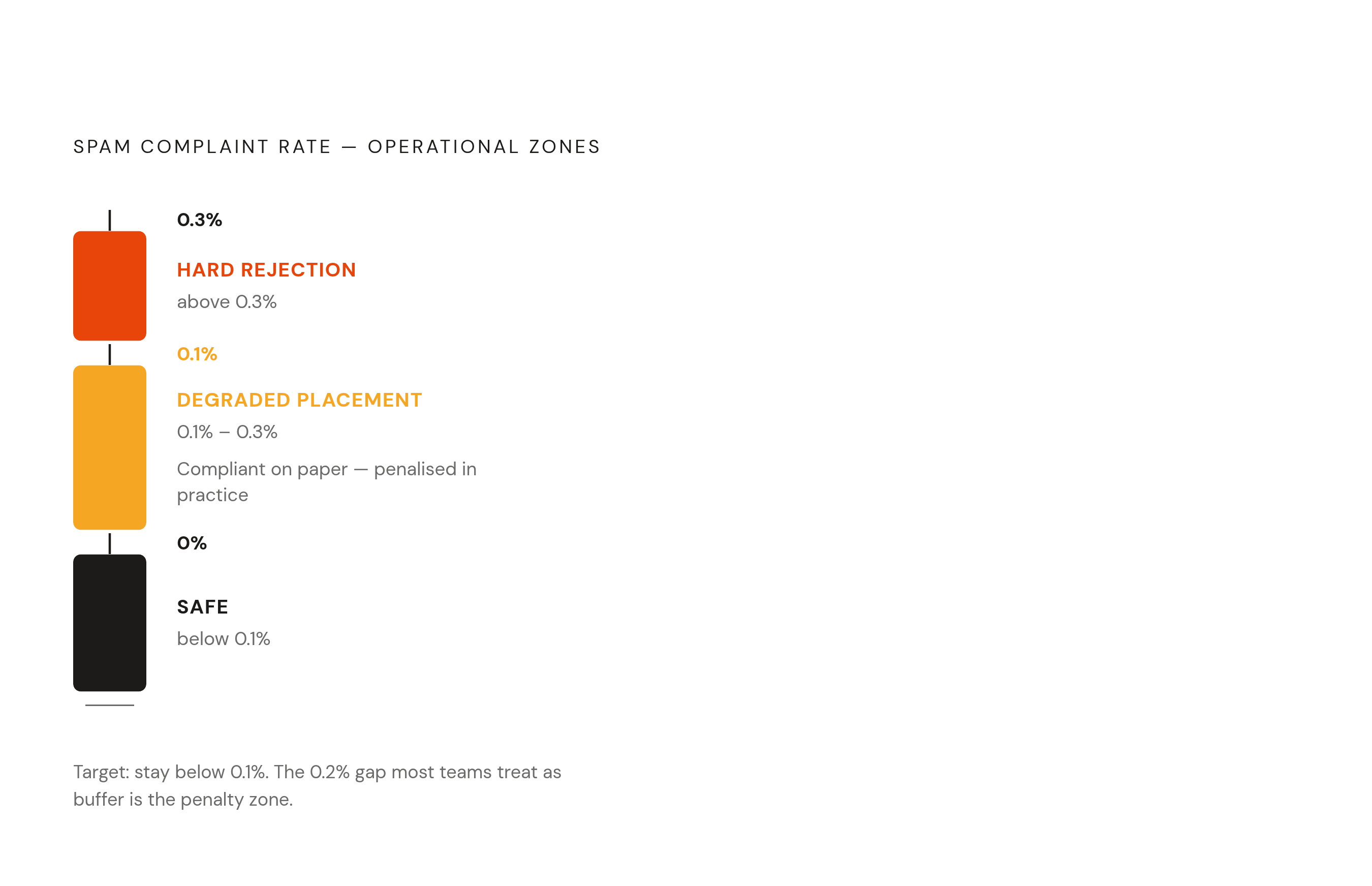
In 2024, Google and Yahoo formalized requirements that had previously functioned as recommendations. Bulk senders now face hard enforcement: proper SPF, DKIM, and DMARC authentication; spam complaint rate limits; bounce rate caps; functional one-click unsubscribe compliant with RFC 8058. The shift moved the penalty from spam-folder routing to outright rejection. Microsoft followed with equivalent enforcement in May 2025, closing what had functioned as the last significant workaround for senders who had not updated their authentication and compliance practices. All three major providers now operate under materially similar enforcement regimes, and the window for treating this as a future concern has closed.
The published spam complaint threshold sits at 0.3%. That number functions as a hard ceiling, not a safe operating target. The practical target is closer to 0.1%, because approaching the published limit leaves no margin for variability and triggers progressively worsening placement before the threshold is technically breached. Three complaints per 1,000 emails hits the hard limit. That ratio is easier to produce than most teams expect.
Cold outreach generates more spam complaints than any other email category for a structural reason. Recipients who do not recognize the sender, did not request the email, and cannot immediately identify its relevance have a binary behavioral choice: ignore or report. Many report. This is not primarily a function of how offensive the copy is; it is a function of how irrelevant the targeting is. A recipient who clearly fits the profile of someone who should receive the message may still delete it, but they are far less likely to hit "Report Spam." A recipient who clearly does not fit that profile will do so at a meaningfully higher rate. Whether the copy is elegant or clumsy matters far less than whether the contact was the right person to receive it at all.
Teams that treated the 2024 announcement as a future concern rather than an immediate operational change saw steep deliverability drops within a single quarter. For teams that missed the window, the work now is recovery.
Domain isolation and warmup as the minimum viable protection against reputation bleed
The primary company domain should not carry cold outbound volume. The primary domain carries cumulative trust built through brand communications, transactional emails, and existing customer correspondence. It is valuable precisely because it is hard to rebuild once damaged. Sending cold outbound from it accepts a risk whose downside is disproportionate to any volume-based upside, and yet this remains one of the most common structural mistakes I encounter.
Secondary sending domains, registered specifically for cold outbound, isolate that risk. Naming conventions that signal a connection to the brand without being the primary domain serve this purpose adequately. Any reputation damage those domains incur stays contained; the primary domain remains clean regardless of what happens downstream in the cold program.
Warmup is the step that determines whether a new sending domain survives first contact with a real campaign. Mailbox providers interpret a new domain sending volume as suspicious by default; the warmup process is how a domain earns a baseline of trust before it carries live campaign load. Skipping domain warmup, or compressing it to look like it happened, is the most common reason new sending domains are flagged immediately. Some teams treat warmup as an optimization step they can defer. What they are actually accepting, without quite naming it, is domain abandonment as operating overhead. A few of them discover this pattern the hard way, more than once, before they change it.
Multi-mailbox distribution, spreading volume across several mailboxes per sender, is a legitimate tactic for staying within safe per-mailbox daily limits. It extends the window before infrastructure damage accumulates; it does not prevent that damage if the underlying list quality and relevance problems remain unaddressed. It is a buffer, not a solution.
Clean infrastructure paired with low-quality, high-volume, poorly targeted sends will degrade at exactly the same rate it would have without the infrastructure work. Domain isolation and proper warmup create a clean slate. What happens to that slate is determined entirely by what gets sent afterward.
How list quality determines whether good infrastructure survives contact with a campaign
The purchased-list problem is well understood in principle and routinely underestimated in practice. Bought lists introduce several distinct categories of deliverability risk simultaneously. Unverified emails generate hard bounces. Role-based addresses prefixed with "info@" or "support@" are typically monitored by multiple people or automated systems, and they generate complaints at higher rates. Spam traps, addresses maintained by inbox providers and blocklist operators specifically to identify senders with poor hygiene, generate immediate and severe reputation damage on contact. None of these risks are visible before sending. They all materialize in the reporting afterward, when the damage is already done.
Bounce rates are the visible signal most teams track, but the reputation damage extends beyond what bounce rate alone reflects. Inbox providers are not evaluating individual sends in isolation; they are building a model of sender behavior over time. A pattern of elevated bounce rates marks a sender as one whose list quality warrants skepticism, and that skepticism applies to subsequent sends even when those sends go to a different, cleaner list. The history follows the domain.
The scale of the spam problem provides useful context here. Roughly 47% of all email traffic globally is classified as spam or unwanted. Inbox providers are calibrated, by necessity, to be aggressive. Their default posture is suspicion. Any signal that a sender's list quality resembles the behavioral profile of spam, whether bounce rate, complaint rate, or sending pattern, activates that aggression. Teams operating with clean infrastructure but dirty data are, in effect, self-reporting to inbox providers that they belong in the spam category.
List hygiene is not one-time work. Email verification before sending removes addresses that will bounce or hit traps. Immediate removal of hard bounces prevents a single campaign's damage from compounding across future sends. Suppression of anyone who has unsubscribed or filed a complaint removes the contacts most likely to generate future complaints. Re-verification of aged lists accounts for email address churn, which is substantial; addresses go invalid, get repurposed, or become traps over time. Each of these steps is less complicated than the consequences of skipping it.
Why reply rates are falling even when emails land in the inbox
Per Instantly's 2026 benchmark data, the average cold email reply rate across billions of sends now sits at roughly 3.43%. That figure spans teams doing high-precision, signal-based outreach and teams sending undifferentiated volume to purchased lists, which means it obscures more than it reveals. The median spray-and-pray sender is operating well below it.
There is a mechanism connecting relevance failure to deliverability damage that most practitioners have not fully internalized. Recipients who receive emails clearly not written for them, not relevant to their current situation, not informed by any observable signal about their actual circumstances, do not simply ignore those emails at a higher rate. A meaningful share hit "Report Spam." That action feeds directly into the complaint rate that governs inbox placement. Relevance failure is not just a reply-rate problem; it is a complaint-rate problem that loops back into infrastructure damage. Treating these as separate issues is part of why teams keep solving the wrong one.
The homogeneity problem has a technical dimension as well. Sequences sending functionally identical messages to hundreds of recipients are increasingly detectable by the pattern-recognition systems mailbox providers deploy. The same message sent at scale, even a well-written one, begins to resemble the structural profile of bulk spam at the content level. The content may not be offensive; the pattern is suspicious. Inbox providers are optimized to detect the pattern, not evaluate the prose.
What buyers now expect is relevance and specificity as baseline conditions, not differentiators. Generic outreach is not received as neutral; it is received as a signal that the recipient is an entry in a list rather than a person being contacted for a specific reason. The behavioral response to that perception, ignoring or reporting rather than replying, is rational from the recipient's perspective and systematically destructive from the sender's.
The reply rate gap between generic and signal-based outreach
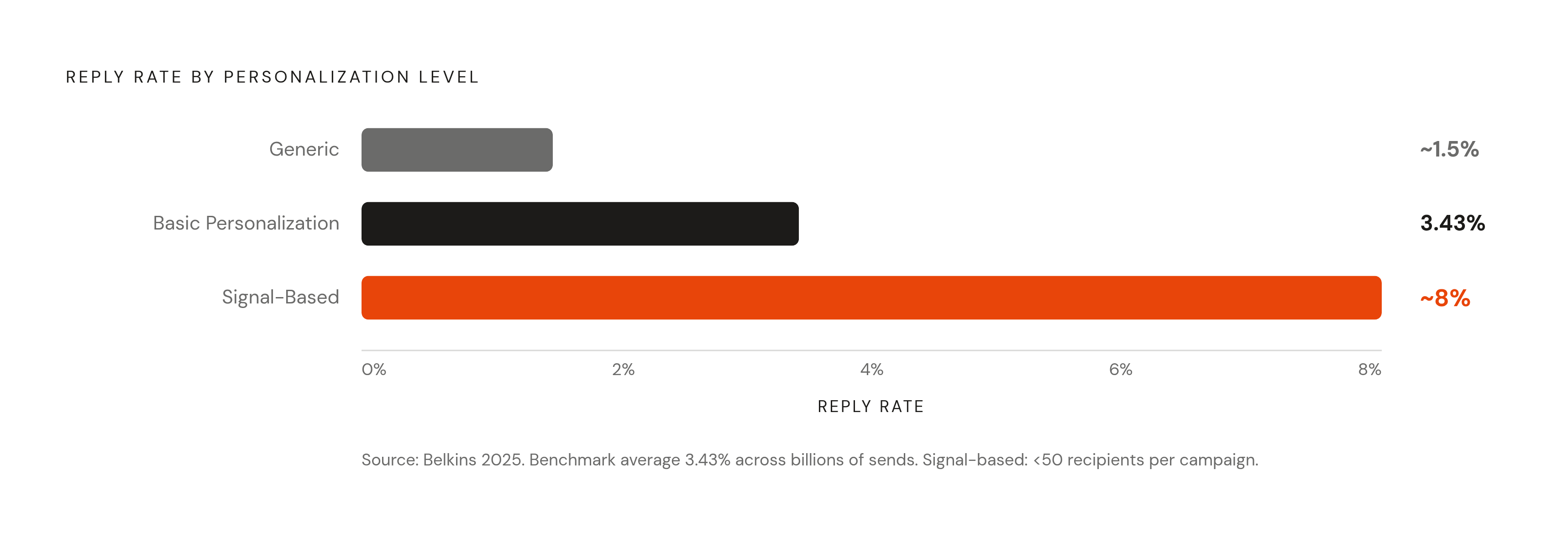
The personalization ladder in cold outreach has a wide spread between its rungs, and I find that most teams seriously underestimate how wide. Generic batch-and-blast templates sit at the low end, producing reply rates in the low single digits. Basic personalization, inserting name, company, and title, moves the number modestly. Signal-based outreach, where the message is specifically tied to an observable trigger relevant to the recipient's current situation, produces meaningfully higher rates. The gap is not incremental; it is structural, because the underlying mechanism differs. A template personalized with a first name is still a template. A message written around a specific event in the prospect's world is something else entirely.
Belkins' 2025 B2B cold email research offers a useful data point. Campaigns sent to smaller, tightly targeted lists of roughly 50 recipients or fewer averaged reply rates more than twice those of larger-list campaigns. The finding aligns with what the mechanism would predict: smaller lists imply tighter targeting; tighter targeting implies higher relevance; higher relevance produces fewer complaints and more replies. Volume does not operate neutrally with respect to precision. It actively works against it.
The competitive landscape matters in evaluating this. The majority of senders remain at the low end of the personalization ladder. Only a small minority personalize every email with signal-specific context tied to the recipient's actual circumstances. That concentration at the bottom means the performance advantage for teams operating at the signal-based level remains substantial. It is not yet an arms race; the asymmetry still exists for teams willing to build the workflow that signal-based outreach requires.
Higher reply rates and lower complaint rates are produced by the same targeting discipline. The behaviors that generate replies, sending relevant, timely, specific messages to the right contacts, are the same behaviors that minimize complaints. They are the same mechanism observed from two different vantage points. Recognizing that has real implications for how outbound programs should be designed and measured, because it means the teams optimizing for inbox performance and the teams optimizing for reply rates should be doing identical things.
What a buying signal actually is and why timing determines whether it's worth acting on
Firmographic data, company size, industry, geography, revenue range, describes who might fit your ideal customer profile. It tells you who could be a relevant prospect; it says nothing about who is currently in a moment where outreach is likely to land. Signals close that gap. They are observable events or behaviors indicating that a prospect is actively experiencing a condition your product addresses.
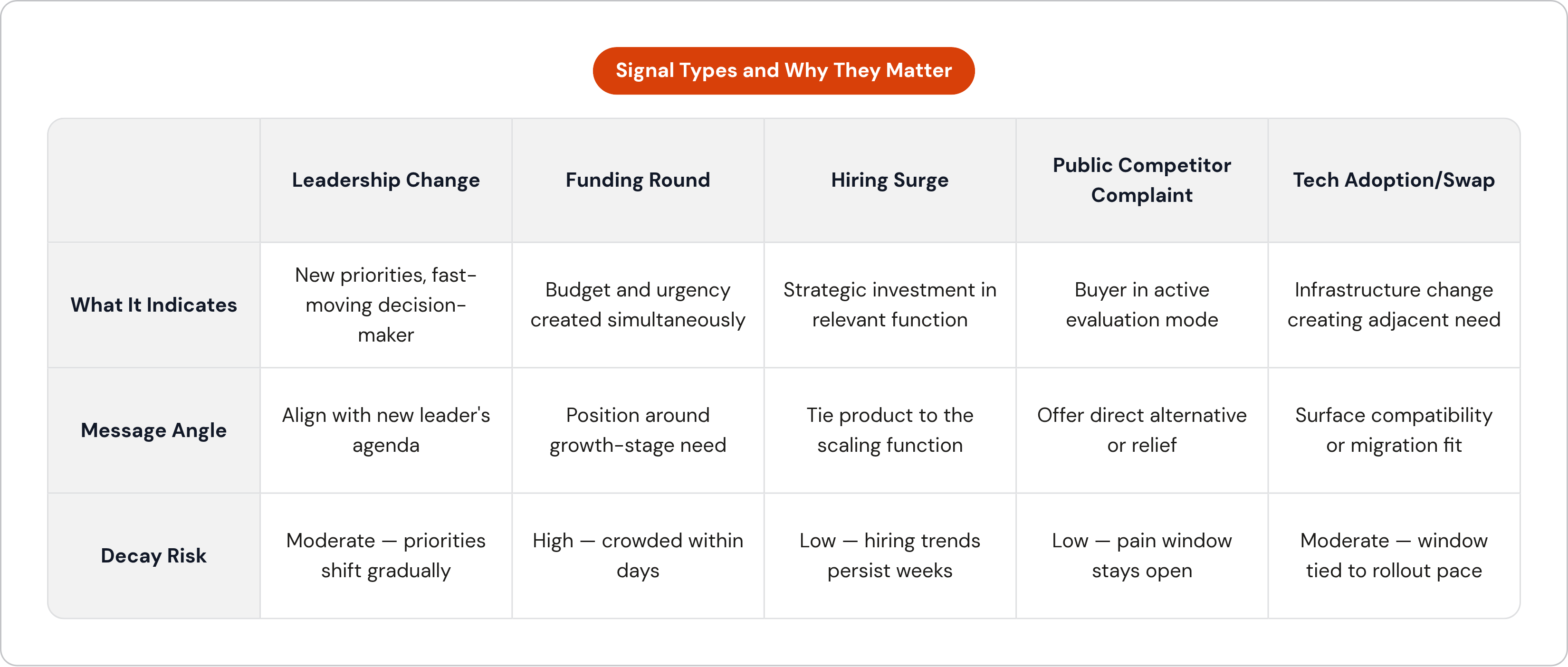
The range of actionable signals is wide. A leadership change brings new priorities and a decision-maker with an incentive to move fast. A funding round creates budget and urgency simultaneously. A hiring surge in a specific function indicates strategic investment in an area where your product may be relevant. A competitor complaint surfaced publicly reveals a dissatisfied buyer in active evaluation mode. A technology adoption or swap signals infrastructure change that creates adjacent need. Each is an observable trigger that makes a specific message, tied to that specific event, more relevant than any message derived from firmographic fit alone.
Timing is where most teams underinvest, and where the real value of a signal either gets captured or evaporates. A funding announcement is maximally actionable on the day it publishes. By day 30, every competitor with access to the same intent data source has seen it and reached out. The signal has decayed; what was a differentiated trigger has become a crowded channel. Per Landbase's 2025 analysis, only roughly a quarter of B2B companies currently use intent or signal data tools, which means the competitive advantage for teams that do remains substantial, provided execution is fast enough to matter.
That execution gap is where intent data most often fails in practice. Buying the data is not the same as getting ROI from it. The distance between them is a verified contact, fast outreach triggered by the signal, and a message specifically written around that signal rather than a generic template that happens to mention the trigger. Intent data attached to slow outreach, unverified contacts, or undifferentiated copy produces results indistinguishable from spray-and-pray. The signal was present; the execution failed to use it.
Operationally, signal-based outreach demands a tighter workflow than volume-based sending: smaller lists, faster triggers, more specific copy, more rigorous contact verification. That profile is also exactly the profile that protects sender reputation. The discipline required to do signal-based outreach well is the same discipline that keeps complaint rates low and engagement rates high.
How AI tools either fix the spray-and-pray problem or make it worse at scale
The first generation of AI SDR tools was largely sold as a volume multiplier. More emails, faster, with less human effort. The outcome was predictable in retrospect: spray-and-pray at machine speed produces spray-and-pray outcomes at machine speed. Reputation destruction that would have taken months to accumulate manually happened in weeks. Teams that adopted these tools aggressively in the expectation of reply-rate improvements often saw the opposite: steeper declines, faster email deliverability collapses, and reputation damage that outlasted the campaigns that caused it.
The broader pattern is worth sitting with. SDR tool investment rose across the industry. Email volume rose. Average reply rates continued declining. The optimization target was output, measured in sends per day, sequences running, activity logged. The actual lever, the quality of judgment about who to contact, when, and with what message, was not addressed by adding automation. In many cases it was made worse, because automation removed the friction that had previously forced at least minimal targeting decisions. These tools were efficiently solving the wrong problem.
Organizations seeing consistent results from AI-assisted outreach built their tools around a different design principle. The agent executes a specific play, triggered by a specific signal, sent to a specific contact, with a message explicitly tied to that signal. Crucially, the agent also decides, based on context, when not to reach out. An agent that contacts every prospect matching a firmographic profile is replicating spray-and-pray with better infrastructure. An agent that contacts a specific prospect because a specific observable event just occurred, and constructs a message around that event, is doing something categorically different. The restraint is not a limitation; it is the feature.
One might argue that the gap between AI adoption and AI results is primarily a tool quality problem, but the evidence does not support that framing. A large majority of organizations report no significant bottom-line gains from their AI investments so far, a pattern that holds across industries and use cases. Teams with consistent results share a recognizable profile: signal detection paired with verified contacts, fast and specific outreach, and continuous iteration on what generates positive engagement. That discipline also protects deliverability. Both problems share a root cause, and tools that address the root cause rather than the symptom are the ones that actually move numbers.
Rebuilding a damaged sending reputation and what a clean outbound infrastructure looks like going forward
Damaged domain reputation does not self-repair with inactivity. The intuitive response to discovering a deliverability problem is to pause and hope the situation normalizes. It does not. The pause stops the bleeding; it does not close the wound.
Rehabilitation requires active steps, executed in sequence, with patience for a process that resists compression. Audit current complaint rates and bounce rates first, to establish a clear baseline of how severe the damage actually is. Isolate all cold sends immediately to secondary domains if that separation is not already in place. Verify and clean lists before resuming any sends; re-entering the market with the same data that caused the problem will reproduce the problem. Re-warm sending infrastructure on the secondary domains, starting at low volume and increasing gradually over several weeks. Re-enter campaigns at low volume with tightly targeted, signal-triggered sends, monitoring complaint and bounce rates continuously and adjusting before problems compound again.
Email authentication is the non-negotiable baseline that precedes all of this. SPF, DKIM, and DMARC are now enforced requirements at Google, Yahoo, and Microsoft. Any outbound program operating without proper authentication is not running a suboptimal deliverability strategy; it is running one that will eventually produce hard rejection. The enforcement infrastructure is live and has been for some time.
Monitoring should be ongoing practice, not incident response. Sender score, complaint rate, and bounce rate warrant continuous tracking on a schedule that allows early detection before problems compound, using tools like Google Postmaster or Microsoft SNDS. Catching a negative trend early is substantially cheaper than recovering from a full degradation, and teams that track these metrics as operational hygiene maintain a meaningfully better baseline than teams that check only when something breaks. The compounding works both ways: consistent clean sending builds reputation steadily, just as consistent dirty sending destroys it.
What clean outbound looks like going forward is structurally simple to describe and difficult to execute: smaller lists, signal-triggered timing, domain isolation, verified contacts, continuous iteration on what generates positive engagement. This operating model does not produce the volume metrics that look impressive in a weekly dashboard. It produces reply rates, complaint rates, and sender reputation that make every subsequent campaign easier to land.
I have watched teams rebuild from bad situations. The ones that succeed share one characteristic: they stop optimizing for activity and start optimizing for the quality of each individual contact. That shift is harder than it sounds, because it means accepting that less volume, executed with discipline, is the more productive path. Most dashboards are not built to reward that conclusion. Most managers are not trained to celebrate it. But the underlying dynamics do not care what the dashboard shows.