Account-Based Prospecting vs Broad List Outbound
Volume and precision require different TAM sizes, deal complexity, and ICP maturity to work.

Broad list outbound begins with a persona: a target title, an industry, a company size band, essentially a broad ideal customer profile (ICP) applied at the contact level. You pull contacts from ZoomInfo, Apollo, Cognism, or something similar, load them into a sales engagement platform, and run a cadence across a large pool. The underlying bet is statistical. Enough of that list is feeling the pain right now, and reaching them before a competitor does is the whole game. Throughput is the advantage; volume is the mechanism.
Account-based prospecting works from the opposite direction. You start with a curated set of named companies, evaluate them at the account level, and only then identify which individuals within those accounts warrant engagement and how. Fewer accounts, precisely selected, engaged with credible relevance, will yield higher conversion and larger deals than a volume play. That's the thesis, anyway. Whether it holds depends entirely on conditions most teams haven't assessed before choosing sides.
One distinction worth preserving before going further: account-based prospecting and account-based marketing are not the same thing. ABP is a sales-side motion. ABM requires marketing alignment, coordinated content, paid channels, and shared attribution. Conflating them causes teams to wait for marketing buy-in before running outbound they could have started last quarter.
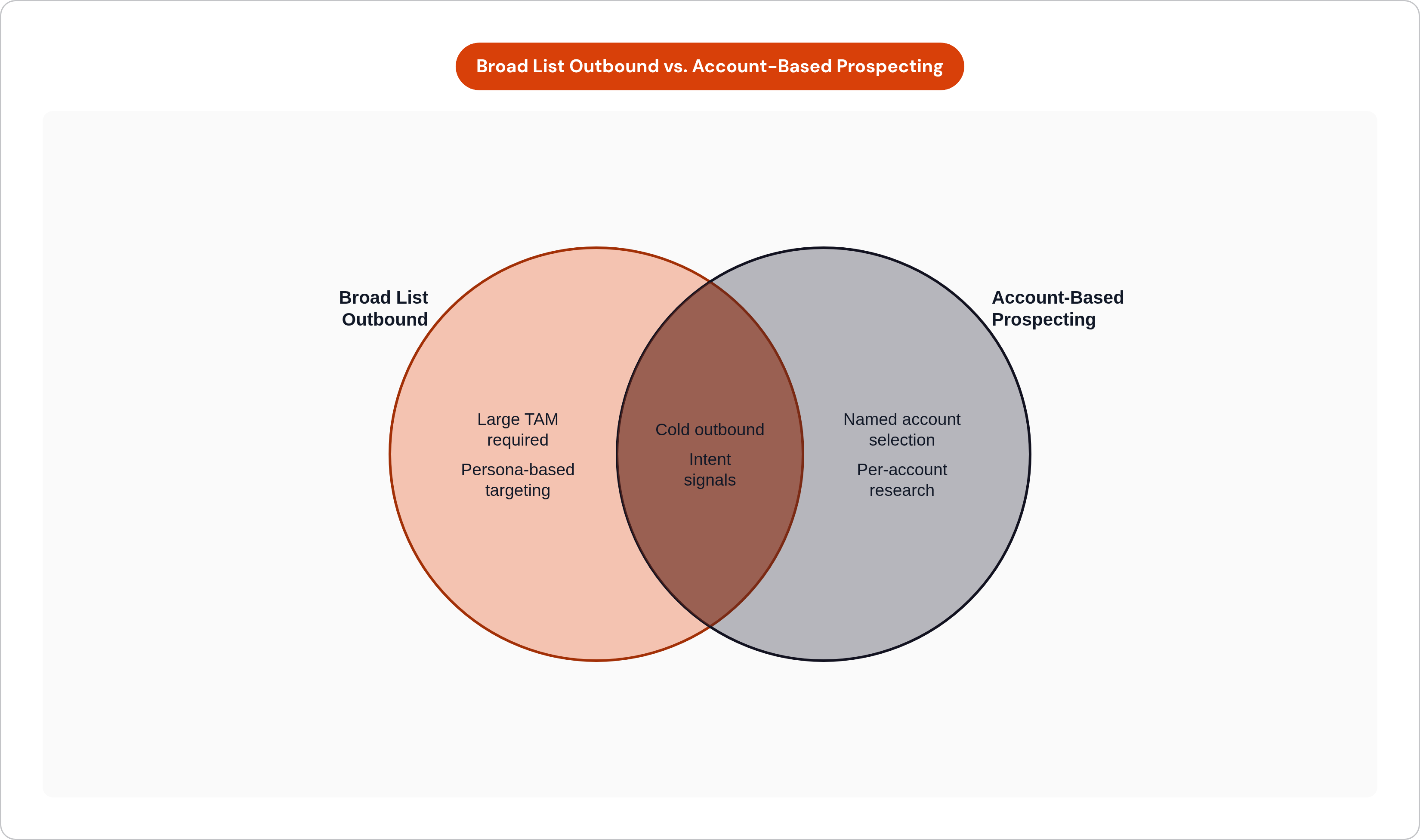
Both models are outbound. The meaningful difference is the unit of targeting: a persona pool versus a named account, and the depth of pre-engagement research that decision implies.
How TAM size sets the ceiling on what's viable
A tight ICP, one where a small number of companies fit, makes broad outbound self-defeating. You exhaust the list quickly and burn the only accounts that matter, often before your product or messaging is ready for them. In a small addressable universe, each account relationship is, in a meaningful sense, irreplaceable.
When the addressable market runs into the tens of thousands of companies, volume-based approaches become rational. Statistical conversion across a large pool produces meaningful pipeline without destroying individual account relationships, because plenty of untouched accounts remain.
A diagnostic question that clarifies this faster than most frameworks: if every company in your total addressable market (TAM) converted tomorrow, would that be a real business? If the math breaks down at full conversion, the list is too large and the ICP isn't real. If the math produces a company worth having, the list is roughly calibrated.
Niche markets resolve toward ABP more often than not. Industries with specific regulatory constraints, companies replacing an entrenched incumbent, buyers requiring a particular technical environment: the addressable list is short by definition. Broad volume applied here is not just inefficient; it is actively destructive to the only relationships your business can survive on. I've watched teams in heavily regulated verticals run Apollo sequences into their entire TAM in a single quarter, wonder why their pipeline dried up, and only retrospectively realize they'd already touched every account once with something generic. Recovering from that is harder than it sounds.
TAM is also not static. As a company proves a wedge and expands its addressable universe, shifting toward higher-volume motions becomes legitimate. The model should evolve with the market, though in practice it rarely does without someone forcing the reassessment.
How deal complexity and buying process length shift the math
Low annual contract value (ACV), fast decision cycle, single buyer: broad list outbound can work even at modest conversion rates, because the economics close quickly and volume compensates for reaching unqualified contacts.
High ACV, multi-stakeholder buying committee, extended evaluation: that logic inverts. Each failed account is expensive, not just in sales time but in research investment, relationship capital, and a consumed slot in a finite account universe. The question in complex deals isn't whether you can get a reply; it's whether you can build credibility across a buying committee, often called a procurement or evaluation group, over weeks or months. A high-volume sequence that surfaces a reply from the wrong person in the wrong account wastes something you can't easily recover.
Broad-list logic collapses in complex buying environments because the model assumes you can absorb the waste. In enterprise or highly specialized mid-market sales, you often can't.
There is a middle ground, though it requires straightforward arithmetic rather than instinct. Mid-market motions with moderate ACV and two or three stakeholder decisions benefit from a tiered approach: not pure volume, not full ABP for every account. The economic test is multiplication. Multiply your average conversion rate by your average deal value, then compare it against the cost of research and personalization per account. That arithmetic determines where ABP investment pays off and where it over-engineers the motion. Most teams skip this calculation entirely and make the choice based on what their last company did.
ICP maturity as a prerequisite for making the choice at all
A vague ICP degrades both models. Broad outbound reaches too many people who will never buy. ABP selects accounts based on guesswork rather than pattern. Neither failure belongs to the model; it belongs to the ICP definition that preceded it.
Early-stage companies often can't run true ABP yet. They haven't closed enough deals to know which account characteristics actually predict conversion. The classic early-stage playbook is to run founder-led outbound across a moderate, thoughtfully filtered list, then study who bought, who engaged, who ghosted. The ICP emerges from that data. First outbound campaigns are partly prospecting and partly ICP research, and framing them only as pipeline activities misses their intelligence value entirely.
Signs an ICP is mature enough for ABP: you can predict, before outreach, which companies are likely to have the budget, the problem, and the internal champion, and you're mostly right. Signs the ICP still needs work: your best customers share few obvious characteristics, or your team can't agree on who the ideal customer actually is. The latter is more common than people admit.
Founders who've run the customer conversation phase and tightened their problem language until prospects repeat it back have done the ICP work that makes ABP viable. That compression of problem language is the signal. Until it exists, the selection rigor ABP requires doesn't have a foundation to stand on, and what looks like ABP is really just slower, more expensive broad outbound with better-looking decks.
Intent signals as the practical bridge between the two models
Intent signals, whether pricing page visits, relevant job changes, technology stack additions, hiring patterns, or funding announcements, reveal which accounts in a broad universe are actively in a buying motion right now. This collapses the volume-versus-precision tradeoff in a useful way: you maintain a wide potential universe but concentrate deep personalization on the accounts signaling readiness.
A tiering model emerges naturally from that data. Accounts matching all ICP criteria and showing active signals receive full account-based treatment: multi-stakeholder research, highly personalized messaging, multi-channel sequencing. Accounts matching ICP criteria without active signals receive moderate personalization and lighter sequencing, monitored for signal changes. Accounts loosely matching ICP with no signal receive minimal investment or are excluded entirely.
The operational implication is a shift in how the core question gets framed. "ABP or broad list?" is often better answered as "which tier does this account belong to today?" That's a dynamic classification, not a one-time model choice. An account visiting your pricing page mid-sequence should trigger a different next step than the same account going cold. Automation that adjusts based on behavioral signals makes this tiered logic workable at volume without requiring constant manual reclassification, though I'd note that most CRM configurations don't actually support this in practice without deliberate setup work.
What the conversion evidence actually says about each model's performance ceiling
Broad outbound's baseline reply rate on untargeted cold email campaigns is low by industry consensus. Large, generic sends consistently underperform smaller, filtered ones, a pattern reflected in Belkins' 2025 B2B data, which shows a clear gap between campaigns targeting undifferentiated lists and those incorporating signal-based targeting.
Intent-layered targeting consistently outperforms demographic-only targeting on conversion to meetings. Per RollWorks data, companies with mature account-based approaches see meaningfully better deal closure rates and revenue growth over multi-year periods compared to those relying on broad demographic outreach alone.
The ceiling on broad outbound isn't effort; it's signal-to-noise. Buyers receive more automated outreach than ever, and volume without relevance accelerates both opt-out behavior and deliverability degradation, a compounding problem that erodes the infrastructure future campaigns depend on.
The ceiling on ABP is throughput. Even with AI-assisted research and personalization, there's a finite number of accounts a team can work in full account-based mode. That ceiling is lower than most teams expect when they first adopt the approach.
Pipeline velocity is where ABP's advantage compounds. Sales and marketing touchpoints coordinated around named accounts move prospects through pipeline substantially faster than uncoordinated broad outreach. The time-to-close difference matters even at lower top-of-funnel volume, because speed of revenue has its own economic value, one that doesn't show up cleanly in pipeline reports but does show up in cash flow.
The straightforward read: broad outbound still generates meaningful pipeline for many teams, but at lower engagement and conversion rates. It's a volume play, and the math only works when the TAM is large enough to absorb the waste.
Where each model breaks down in practice
ABP breaks down in characteristic ways. The most common is account selection based on gut feel: teams pick companies they find interesting or familiar rather than accounts most likely to convert, and the rigor that justifies the model gets quietly abandoned. Over-investment in research at the expense of outreach volume is almost as common; teams spend so long preparing for conversations that pipeline dries up while they're still reading LinkedIn profiles. Treating ABP as a list-building exercise without pairing it with active outbound sequencing is a subtler version of the same problem. And running ABP before the ICP is proven is, in effect, broad outbound with extra steps and a more elaborate justification for the slower pace.
Broad list outbound has its own failure modes, and some are harder to recover from. Burning through a finite market is the most dangerous: for small TAMs, a high-volume campaign can permanently damage every account relationship before product-market fit is clear, leaving no clean accounts to re-engage once messaging improves. Email deliverability collapse follows unsophisticated volume sends; sender reputation deteriorates on primary domains without warmed infrastructure and authenticated secondary domains, and that damage persists well beyond the current campaign. There's also a cultural failure that's easy to miss from the outside: teams begin optimizing for activity metrics, emails sent and reply rate, rather than meetings booked and pipeline created. Volume becomes the goal rather than the mechanism, and the team loses the thread of what the motion was actually supposed to produce. I've seen this happen within a single quarter of launching a new outbound program, and it's remarkably difficult to reverse once the incentive structure has calcified around the wrong numbers.
How to decide which model your GTM motion needs right now
Start with the addressable universe and map it against your go-to-market (GTM) motion before anything else. How many companies fit your ICP? A small universe points toward ABP. A large one opens the door to volume approaches filtered by intent.
Consider deal complexity and ACV next. High complexity and high ACV make per-account investment economically justified. Low ACV with fast decision cycles favors volume, with the caveat that "fast decision cycle" needs to be verified by actual sales data rather than assumed.
ICP maturity comes third and is often the dealbreaker. If you can't reliably predict who will buy before you contact them, run a structured outbound round to generate that intelligence before committing to a pure ABP model. The first campaign is research as much as it is pipeline, and treating it otherwise is a category error.
Early-stage and founder-led teams should default toward a moderate, well-filtered list with strong personalization and founder voice: not pure broad volume, not full ABP, because the first goal is learning who buys. Teams with a proven ICP and a relatively small addressable market should move toward ABP with intent-signal triggers; every account matters too much to risk with generic outreach. Teams with a large TAM and a mid-market or transactional motion should use broad outbound with intent-based tiering, wide coverage, and concentrated personalization where signals indicate readiness.
Sequencing discipline matters regardless of model. Most deals require multiple touches before a prospect engages, and most teams abandon the sequence too early. Persistence paired with relevance is a competitive advantage in either approach.
The model isn't permanent. Reassess as ICP matures, as TAM expands, and as conversion data reveals which accounts actually close. In practice, most teams don't do this without external pressure forcing the conversation.
Running both models simultaneously without fragmenting the motion
The practical hybrid is a tiered account universe. The top tier receives full ABP treatment. The middle tier receives intent-triggered personalization. The broad base receives automated, lighter outreach. One motion, three intensities, though the coordination required to execute this cleanly is consistently underestimated.
What breaks the hybrid is disconnected tooling: account intelligence that doesn't flow into sequencing, signals that don't update contact tiers automatically, CRM data lagging behind actual activity. The coordination cost eats the efficiency gain. What makes it work is a unified environment where list intelligence, signal monitoring, sequence execution, and CRM sync operate together, so a pricing page visit by a tier-two account automatically escalates it and triggers a different next step without manual intervention, which is precisely the problem Cardinal, an AI agent platform for outbound sales that consolidates prospecting, enrichment, sequencing, and CRM sync into a single connected system, was built to solve. Most teams believe their stack does this; fewer actually verify that it does.
The teams that improve fastest aren't the ones who picked the right model on day one. They're the ones who reviewed what converted, cut what didn't, and sharpened account selection and messaging every cycle. The 2025 State of B2B GTM Report reflects a broader convergence: intent-based outbound investment is increasing among GTM leaders, suggesting that practitioners are arriving at the hybrid logic because the data supports it.
For lean teams and founders, the hybrid model is now operationally achievable without large headcount. AI agents handling research, sequencing, follow-up, and CRM updates make it possible for a small team to run account-based precision at the top of the funnel while maintaining broader market coverage. The coordination problem that once made hybrids impractical at small team sizes has largely been addressed by the current generation of tooling, though "largely" is doing real work in that sentence; the implementation still requires someone who understands both the logic and the plumbing.
The choice between ABP and broad list resolves, in practice, into a question of where each account sits in your system today, and whether that classification gets revisited when the account's behavior changes. Most teams set the tier once and forget it. That's where the model quietly fails, not with a dramatic miss but with a slow drift toward irrelevance that's easy to rationalize until the pipeline numbers make it impossible to ignore.