outbound tools favored by Y Combinator portfolio companies
Founders skip the AI SDR until they know who to sell to and how to reach them.

Y Combinator has funded 113 sales-category startups as of 2026, and across that portfolio a specific outbound stack has taken shape. The constraint is blunt: a two-person team with no SDR and no runway to spare can't afford to guess wrong, and the wrong guess shows up fast, a blacklisted domain, a list nobody replies to, a CRM that learns nothing from the last hundred emails sent. This piece maps that stack and takes a position most "best tools" roundups won't touch: the sequence in which the stack gets assembled matters as much as the stack itself, and founders who buy the AI SDR before the ICP is proven are buying speed they have no use for yet. That's the wrong purchase order, and it's also the most common one.
The founding constraint that shapes every tool decision: no SDR team, limited runway, need pipeline now
YC now tells founders to hold off on specialized growth hires until $2M to $5M in ARR. That's a scheduling constraint with teeth: outbound has to work before anyone exists whose job is to run it. In the Winter 2026 batch, 14 companies hit $1M ARR by Demo Day, and they got there by shipping product fast and letting automation carry distribution instead of staffing a sales floor that didn't exist yet.
There's a phrase circulating inside YC that captures the mood: "tokenmaxx, don't headcountmaxx." The expectation is that teams build AI-native operations from the start rather than hiring their way around the gap. That reframes the tool question entirely. Every choice has to work at founder-scale, meaning one or two people running the whole motion from list to reply, with nobody else around to catch what breaks.
Why outbound over inbound at this stage? Feedback speed, mostly. Outbound lets a founder pick exactly who to talk to, test messaging in real time, and generate pipeline in weeks instead of waiting quarters for content and SEO to compound into anything. Every reply, or every silence, is a data point about whether the positioning and ICP assumptions actually hold up, and few other channels teach that lesson this fast or this bluntly.
How the standard early-stage outbound stack is actually structured
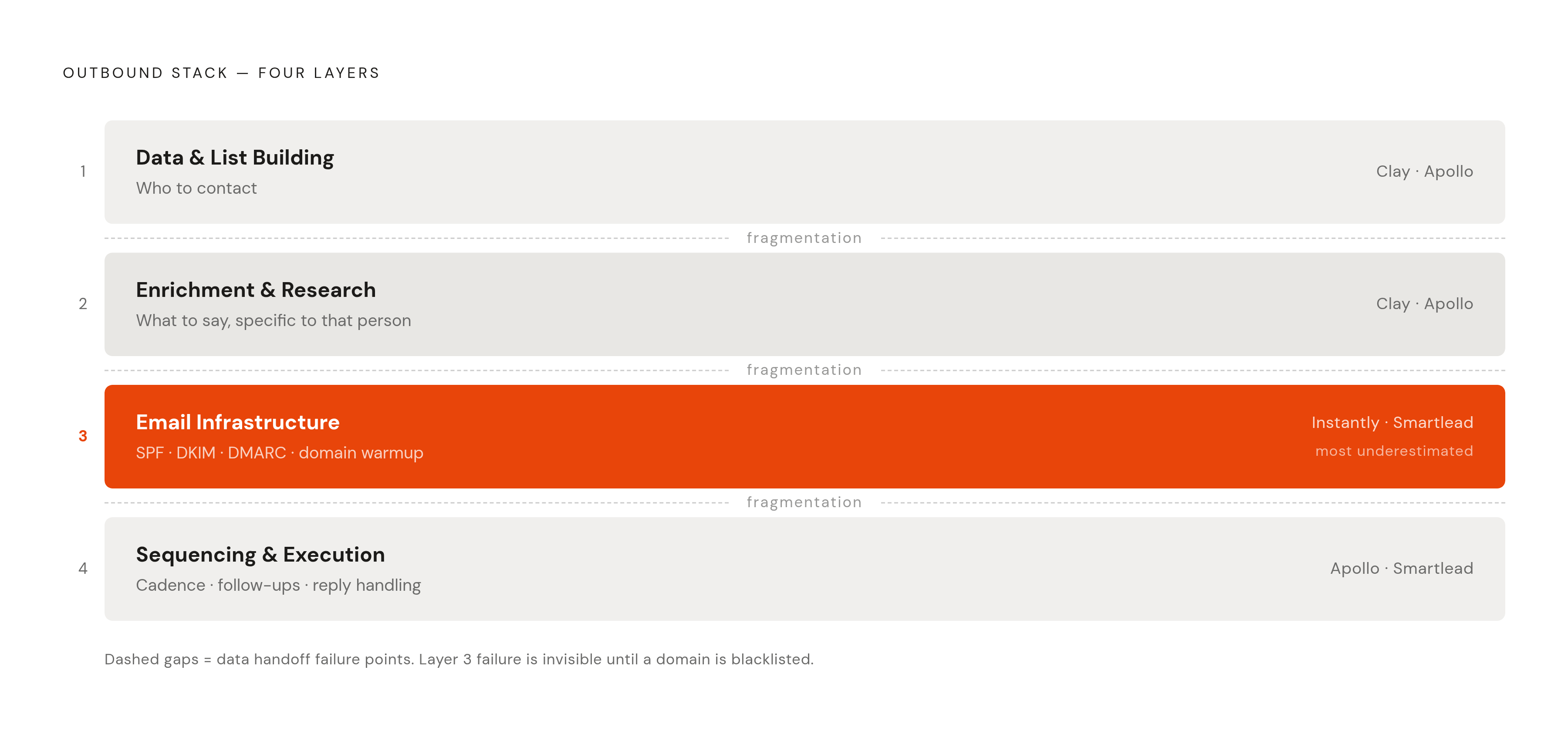
Strip the branding away and every outbound stack breaks into four layers: data and list building, which covers who to contact and how to find them; enrichment and research, which covers what to say that's specific to that person, not a template with a first name swapped in; email infrastructure, the plumbing that gets the message delivered instead of filtered into a spam folder nobody checks; and sequencing and execution, the cadence, the follow-ups, the reply handling.
The traditional approach fills each layer with its own point solution, and the fragmentation tax that results is real, not theoretical. Data doesn't move cleanly from the enrichment tool into the sequencer, sequences break when a CRM field doesn't map right, and attribution disappears somewhere between the third tool and the fourth, unnoticed until the numbers stop making sense. Founders end up spending more time maintaining integrations than running campaigns, exactly backwards for a team with no headcount to spare on plumbing.
Best-in-class tools stitched together with Zapier sound appealing on paper, but in practice they demand maintenance a two-person team doesn't have hours for. A unified platform, one system spanning multiple layers, tends to be faster to stand up and harder to break, even if it means giving up some control over how the data gets sliced. For a founder with no SDR team, that tradeoff usually wins, and skipping the comparison is how a promising quarter gets spent on API mapping instead of calls.
The data and enrichment layer: Clay as the de facto standard, Apollo as the simpler alternative
Clay has become close to a universal default among data-literate YC founders, and for good reason: it's a flexible enrichment layer that pulls from dozens of data sources and lets a founder build lists through custom logic instead of a fixed set of filters. What makes it fit this cohort is that it rewards specificity. A founder can layer hiring data, tech stack signals, funding events, and job changes on top of each other to build a list that reflects an actual ICP, not just a keyword search on a company database that spits out 40,000 names and calls it targeting.
Apollo serves a different founder, and treating the two as interchangeable starting points obscures more than it reveals. It's all-in-one prospecting and sequencing at a lower price, deployable in an afternoon. That fits someone who needs to start sending today and refine targeting later, rather than someone trying to perfect the targeting before the first email goes out. Its database and its built-in sequencer live in one interface, which cuts setup time substantially; the tradeoff is less enrichment depth than Clay, and less room to build custom signal logic on top of raw contact data.
Framing this as Clay versus Apollo misses how founders actually use them, though. Many run both: Clay handles enrichment and research, Apollo or a separate sequencer handles execution. They aren't competing for the same job, and founders who treat the choice as either/or usually burn a month of setup time chasing a comparison that was never the real question. Pick a side here and the decision is trivial; the actual skill is knowing which layer each tool is supposed to own.
The email infrastructure problem most founders underestimate until it burns them
The outbound playbook that worked in 2023 gets a domain blacklisted in 2026. Google's and Microsoft's authentication requirements changed deliverability at the protocol level, not at the margins. Google now returns 550 rejection codes for senders missing proper SPF, DKIM, and DMARC configuration. Microsoft requires all three once a sender crosses 5,000 emails a day, a threshold active outbound campaigns can reach quickly.
The setup serious YC outbound teams run now looks fairly standardized: multiple secondary sending domains, never the company's primary one, with SPF, DKIM, and DMARC configured on each, and several mailboxes per domain, each with a real name, a photo, a signature, and a proper warmup period before sending at real volume. Tools like Instantly and Smartlead built entire categories around exactly this, domain rotation, warmup pools, inbox placement monitoring, because the underlying problem is mechanical, not stylistic.
Founders who skip this step tend to blame messaging when reply rates crater, and that's usually the wrong diagnosis — the domain got flagged before authentication was ever verified. The domain got flagged, the emails never landed, and no message, however sharp, survives a spam folder it never had a chance to escape. Platforms that bundle infrastructure into the sequencing product remove this failure mode almost entirely. The real question before picking a tool is whether cold email deliverability infrastructure comes built in, or whether a founder has to bolt it on and hope the DNS records got configured right the first time.
Where intent signals fit in — and why the best-performing outbound now starts with them
Among the signals founders chase, one outranks the rest by a wide margin: champion tracking. When someone who used a product at their old company moves to a new one, they're substantially more likely to buy again. That's close to the strongest single predictor available to an early-stage GTM team, and lists that ignore it in favor of firmographic filters are leaving the highest-conversion segment on the table, untouched, in favor of a broader spreadsheet that looks more thorough.
Other signals matter, just with less force, and lumping them in with champion tracking as though they carry equal weight is a common mistake. Pricing page visits and repeat site traffic should trigger immediate, personalized outreach rather than sit unread in a dashboard until someone remembers to check it, job changes at target accounts, a new VP of Sales, a new Head of Growth, often reset buying decisions entirely, recent funding rounds put a company into active buying mode, and new-hire announcements can signal a budget unlock before a company even posts an RFP. A company hiring five SDRs at once is a company about to start caring, urgently, about outbound tooling, and that urgency is exactly the window a small list should target first.
Apollo, Clay, and dedicated buyer intent data platforms like 6sense, Bombora, and G2 Buyer Intent all surface these signals, with different depth and different lag time. The practical lesson for a small team: build a small list of accounts showing two or more signals at once, and sequence that list first, before the broader one.
Gojiberry, a YC company, built its entire product around this exact thesis, finding buyers who show intent before a rep ever reaches out, and according to Y Combinator reported reply rates 2 to 5 times higher than traditional outreach as a result.
AI SDR tools: what they actually do, which YC companies are building them, and when they make sense
The portfolio isn't just using AI tools; it's building the ones the rest of the market is evaluating. Roughly 66% of YC's Winter 2024 batch integrated AI into their product, and roughly 60% of the Spring 2026 batch mentions AI or agents directly in its one-liner. Worth sitting with for a second: the people building AI SDRs and the people who'd buy one are drawn from the same pool of founders, solving the same staffing problem from opposite sides of the same transaction.
Gojiberry, mentioned above for its intent-signal thesis, reached $2.8M in ARR bootstrapped before it ever entered YC, and its product folds signal discovery, enrichment, sequencing, and reply handling into one continuous motion instead of separate steps a founder has to stitch together by hand. Other YC companies have taken narrower paths, building vertical AI agents for industries where generic outbound tooling tends to underperform because the buying language and the org charts don't look anything like a typical SaaS account.
The cost math explains a lot of the enthusiasm, and it's worth being blunt about the gap. A fully loaded US-based human SDR runs well over six figures a year, needs a three-to-six-month ramp, and stays roughly 14 months before turning over, while AI SDR products are priced anywhere from a few hundred to a few thousand dollars a month depending on vendor and tier. That gap doesn't mean every founder should reach for one immediately, though, and this is where a lot of teams get the sequencing backwards, buying the automation before they've earned the right to scale anything.
Here's the actual rule: an AI SDR makes sense once the ICP is well-defined and the messaging is already proven, at which point volume is the real bottleneck and automation removes it. It makes far less sense while the ICP is still being discovered or the messaging still needs iteration, because these tools amplify whatever's already working and amplify whatever's broken just as efficiently. Pointing an AI SDR at an unproven message just means failing faster and louder, with a bigger bill attached, and that's the mistake worth naming directly: buying the AI SDR too early is a bet against a founder's own ability to diagnose why a message isn't landing.
RevOps practitioners have flagged real friction here too: inconsistent output quality, annual contracts that lock founders in before they know if the tool fits, and the persistent, faintly embarrassing problem of AI-written emails that read unmistakably as AI-written. Worth noting where the investor money is actually flowing: toward AI that decides and personalizes based on proprietary data, CRM history, call transcripts, past engagement, more than toward AI that just generates copy. That data layer, not the copywriting, is where the real defensibility sits. Any founder evaluating these tools on copy quality alone is asking the wrong question, and will pick the wrong vendor because of it.
What YC founders actually use to run sequencing and CRM sync — the execution layer
For sequencing itself, several sales engagement platforms including Instantly, Smartlead, and Apollo's built-in sequencer are common across early-stage stacks, each optimized for a slightly different tradeoff between deliverability focus and workflow richness. Sequencing, though, isn't where most early-stage stacks actually fail. CRM sync is, and founders underestimate this layer more consistently than any other, mostly because it fails quietly instead of loudly.
Here's the mechanism, worth walking through because it's so easy to miss in real time. Data lives in the sequencer, gets a note added, maybe a status change, and never makes it back into the CRM in any structured way, so nothing compounds. The next campaign starts from the same blank slate as the last one, because there's no clean record of what messaging worked or which signals actually converted into a call.
Ergo, a YC-backed company, was built directly around this failure. The company was built around the quiet failure mode where calls collapse into missed follow-ups and stale CRM records, the kind of problem that doesn't show up until a deal that should have closed goes cold instead. Ergo's first version unlocked $75,000 in contracts that were otherwise stuck; it now covers the full bottom-of-funnel motion, from first conversation through expansion, without manual admin work in between. Salesgraph, a YC-backed company, tackles the adjacent problem, the context an AE needs between calls: pre-call research briefs, post-call next steps, who's actually sitting on the buying committee. Salesgraph reports its product automates roughly 99% of that between-call work.
The compounding problem is the real cost of skipping this layer, and it's easy to underestimate until it's already cost a quarter. If the CRM doesn't reflect what's actually happening in outbound, a founder can't iterate with any precision; there's no way to know which message worked, which signal predicted a close, or where a deal quietly stalled somewhere between call three and call four. Platforms that connect sequencing to the CRM natively, rather than through a manual export or a fragile Zapier chain, remove that blind spot. The stack starts documenting itself, which is the entire point of building one in the first place.
The practical playbook a founder can extract from how YC companies have assembled these tools
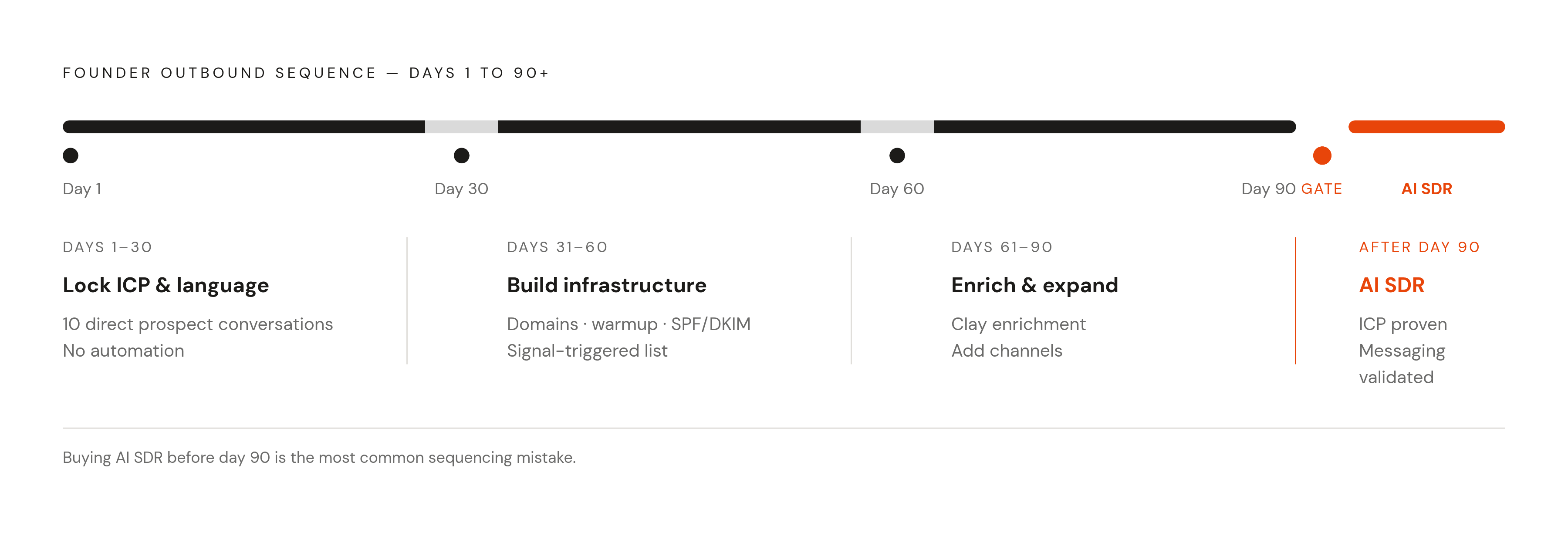
Pull the pattern together and a rough sequence emerges, one that repeats across YC GTM motions closely enough to treat as a default rather than one option among several.
Days one through thirty: lock the ICP and the problem language through direct conversations with ten real prospects, and tighten the narrative until those prospects start repeating the founder's own phrasing back to them, unprompted. Nothing gets automated yet, and that's deliberate; This is founder-led sales operating as it's supposed to, and the signal quality it generates is exactly what automation will later need to run on. this is founder-led sales in its purest form, and the data it generates can't be replicated by a tool. If the message doesn't work manually, it won't work at scale either; it'll just fail faster and generate worse data about why.
Days thirty-one through sixty: build the infrastructure first, secondary domains, warmup, full authentication, before a single email goes out at volume. In parallel, build one signal-triggered list instead of a broad one, using champion tracking, recent funding, or hiring patterns as the filter that decides who gets contacted first.
Days sixty-one through ninety: add enrichment depth, Clay or something equivalent, once it's clear which signals are actually converting, and only then start layering in channels beyond email.
The consolidation question comes down to what a founder values more, and the pattern across YC companies gives a fairly clear answer even if it isn't universal. Speed and fewer tools to babysit push toward a unified platform; custom signal logic and raw data flexibility push toward a modular stack assembled from best-in-class pieces. The pull across the portfolio runs toward consolidation, though, because founders want fewer tools that share context, and fewer places for data to quietly fall out of sync. Platforms like Cardinal, which combine data enrichment, sequencing, and CRM sync into one system, address exactly this fragmentation tax, and represent one credible answer to a problem that's shown up in nearly every section of this piece.
An AI SDR earns its place only after messaging is proven and the ICP has stabilized, and that ordering is the single point worth taking away if nothing else survives the rest of this piece. It works best as a scaling tool, applied once the fundamentals hold; pointed at unproven messaging, it tends to automate something that was never going to work, just with more speed and less signal about why it's failing. The transition out of founder-led sales follows similar logic: it happens when win rates, CAC, and sales cycle length have stabilized enough to be predictable, at which point the playbook gets codified and handed to a technical operator who understands the automation, not just the contact list.
What YC companies have actually demonstrated, across 113 sales-category startups and however many more still iterating in private, is that the tool matters less than the motion built around it. A coherent, signal-driven outbound process run on three well-chosen tools beats a bloated stack assembled without a clear plan for what happens after the first reply comes in. That gap doesn't close by buying more software; it closes by getting the order right.