Founder-Led Outbound at Scale: Transitioning to a Sales Team
Document the founder's playbook before hiring a sales rep to avoid costly handoff failures.

Founder-led outbound works until the founder runs out of hours in the day, and that ceiling arrives faster than most founders expect. Building a sales team means transferring instinct, judgment, and improvisational moves into something a rep who's never met the customer can actually execute. Here's where most founders get it backward: they hire a senior sales leader before any of that transfer happens, hand them a blank slate, and call it a strategy. That's a sequencing error with real consequences. Skipping the documentation step doesn't just slow the org down; it means the org stalls completely the moment the founder stops taking every call.
Early-stage buyers are buying access to the person who built the product: someone who can speak to the roadmap with total conviction and rewrite a contract term mid-call if that's what closes the deal. That's a different sale than the one a rep closes six months later, and founders who treat the transition as a headcount question tend to watch pipeline evaporate the moment they step back. A senior VP of Sales hired straight from a company where the demand already existed will not manufacture that same conviction out of a title, and this is the single most common way the transition fails: the résumé hire, made before anything's written down, dropped into a job that requires context nobody gave them.
Reading the signals that the transition is genuinely ready to happen
Revenue targets are a weak test here, and founders lean on them anyway because they're easy to measure. Ask instead whether qualified opportunities, meaning deals that fit the ideal customer profile (ICP), are hitting the floor because there's no time to work them, not because they're bad fits. If the founder is triaging good leads out of necessity rather than judgment, that's bandwidth failure, and bandwidth failure is exactly the problem a first sales hire solves. Revenue targets only confirm the bottleneck after it's already cost you deals.
Customer count is a rougher marker but a useful one. Somewhere around 10 customers functions as a rough floor before bringing on a rep, though more is better. That gap separates a product that closed a few friendly logos on founder charm alone from one with a pattern repeatable enough to actually teach someone else.
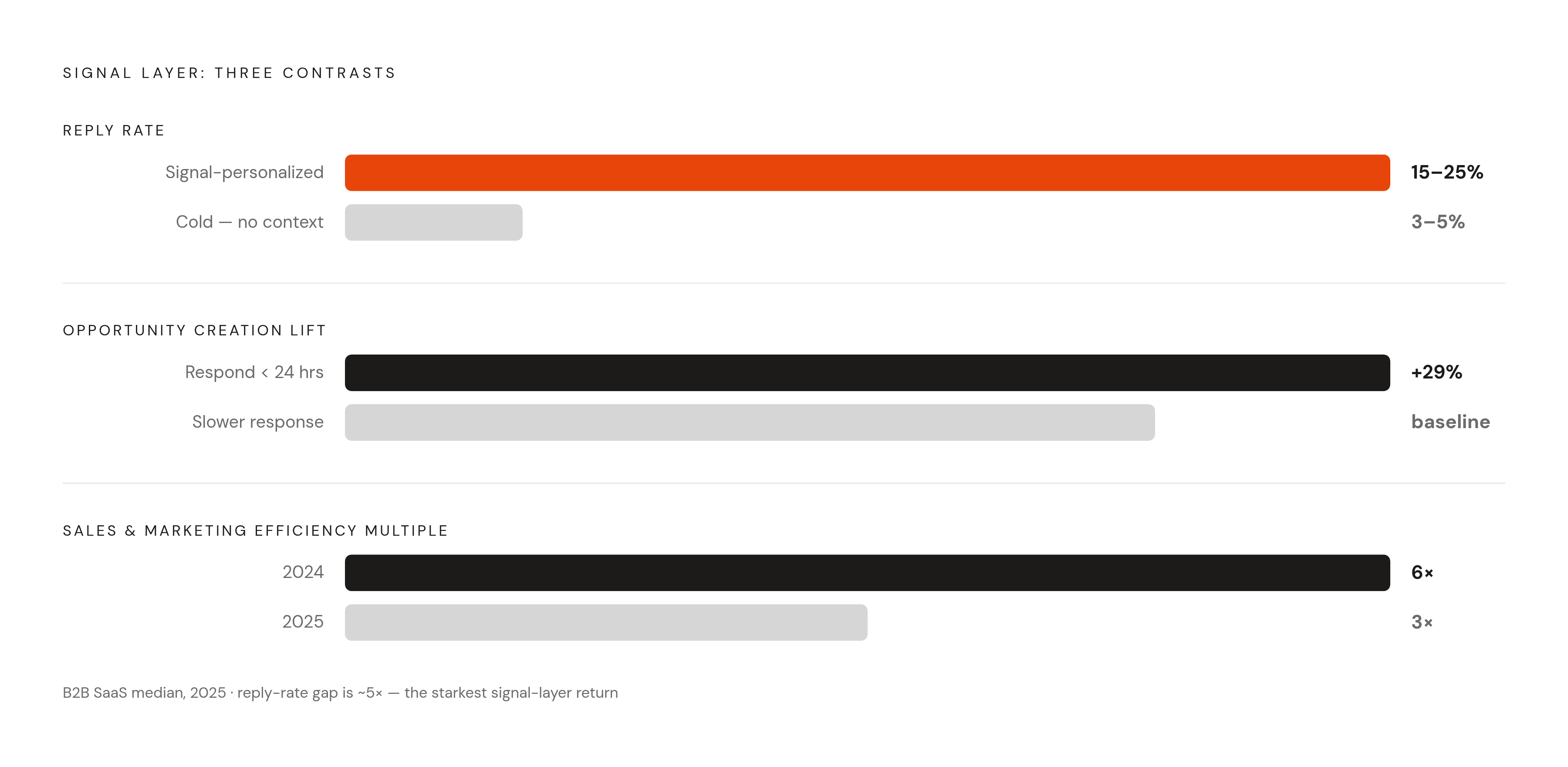
Hiring too early costs more than a bad quarter, and this is the part founders underestimate most. Hire before the motion is proven and the clock doesn't pause; it resets, stacking a rep's ramp time on top of the founder's own learning curve that never finished compounding. The sales efficiency ratio makes the timing question sharper still. In 2025, the median B2B SaaS sales and marketing efficiency multiple dropped to 3x, down from 6x the year before, meaning a startup spending $150K on sales and marketing is now generating roughly $450K in new annual recurring revenue (ARR) where the same spend once returned closer to $900K. Hire into that kind of margin compression before the motion is repeatable, and the new rep accelerates burn instead of growth.
So what does "not ready" actually look like from the inside? The founder hasn't closed enough deals to say with confidence which plays consistently work. The ICP is still shifting deal to deal. Messaging hasn't settled into anything stable enough to hand off. Drop a rep into that fog, and a setup problem gets misread as a talent problem.
Documenting what the founder actually does before anyone else runs it
Here's the pattern that kills a lot of first sales hires: the founder brings in someone with a strong résumé from a much larger company, and that person shows up expecting an existing process, a functioning team, a brand people already recognize. None of that exists yet. The hire struggles for a specific reason, and it's not a personal one: there was nothing concrete to plug into, a structural gap dressed up as a shortcoming that gets pinned on the wrong person.
So what has to exist before that first rep ever sends a cold email? Start with the ICP, precise enough to actually test: firmographic details, technographic signals, behavioral patterns, not a vague persona defined by job title and headcount range. Next to it belongs a list of trigger events that have historically signaled a prospect is in-market, things like a funding round, a new VP hire, a hiring spree in a specific department, an expansion announcement. These patterns are learnable, provided someone actually writes them down instead of trusting memory to hold them.
Messaging is trickier, because the messaging that converts rarely lives on the website. It's the line the founder throws into the third email of a thread, after the prospect goes quiet, the one that gets a reply when nothing else has. That line needs to land in a doc somewhere. It can't stay half-remembered by the one person who said it once.
Objection handling deserves the same treatment: the same three or four pushbacks that show up in nearly every deal, and the exact phrasing the founder uses to answer them, not a generic rebuttal pulled from a sales training deck. Sequence structure matters just as much, what touch happens when, on what channel, and what job each step is actually doing, because a touch with no stated purpose is just noise with a send button attached.
And the hack moves need their own line item, maybe the most important one on the list. Founders bend the product or the pitch constantly to close edge cases: a custom integration promised on the fly, a pricing exception carved out mid-call. Reps don't need to replicate these moves exactly. They need to know these moves exist at all, so an edge case doesn't turn into a dead deal simply because nobody told the rep that flexibility was ever on the table.
None of this needs a 40-slide deck nobody reopens; a lean sales playbook survives contact with an actual workweek. Call recordings, annotated email threads, a written objection-handling guide, a one-page sales-qualified lead checklist, that format survives contact with an actual workweek. But get the ICP wrong at this stage, and the sharpest objection-handling guide in the world won't save the pipeline. The playbook is only as good as the targeting underneath it, which is the whole reason ICP work has to come first instead of getting treated as a formality on the way to the real work.
Worth restating plainly, because it's the entire point of this phase: the founder's judgment has to become something a rep can consult mid-deal, a reference they flip back to, rather than a black box they're forced to reverse-engineer while an opportunity is live and slipping away.
Building the sequence and signal layer the team will actually inherit
Everything the founder has been running on gut feel now needs to become explicit, on paper, testable by someone who wasn't in the room when it worked the first time.
That starts with a defined multi-touch outbound cadence, somewhere in the range of four to six touches across email, LinkedIn, and phone, each one doing a specific job. Touch 3 exists to surface a particular objection. Touch 5 tries a different angle after silence. Neither is an unlabeled placeholder just filling a slot in a cadence tool. Alongside the sequence sits a messaging library organized by ICP segment, built as a starting point a rep customizes, not a script read verbatim off a page. Underneath both sits a trigger-event monitoring system built on intent data, something watching for the signals that mattered before, routing them to the right rep, with a clear expectation for how fast that rep acts once a signal lands.
Speed matters here in concrete terms. Teams that act on intent signals within 24 hours see something like a 29% lift in opportunity creation compared to teams that respond slower, and that gap is the difference between a warm signal and a cold one by the time outreach actually lands in an inbox. Signal-personalized outreach, sent when a rep is working off something real like a trigger event or a specific piece of context, lands reply rates in the 15 to 25% range. Cold email sent without that context sits at 3 to 5% industry-wide. That's roughly a fivefold gap, and it only exists because the signal layer was running before the rep hit send. Skip that layer and a rep is just guessing at relevance while posting cold-email numbers and wondering why the sequence isn't converting.
Which raises the obvious trap: spray-and-pray. Smaller, well-targeted lists with real personalization beat large generic blasts on conversion, and they protect domain reputationand email deliverability too, something a blast approach erodes quietly over months until deliverability craters for no obvious reason. This can't be left to individual rep judgment or good intentions, because someone on the team always wants to send more. Write it into the playbook as a rule that overrides that temptation outright. Don't leave it as a suggestion a rep can talk themselves out of on a slow week.
Where do AI agents actually fit? List building, sequence execution, CRM logging, signal routing, these are places automation carries real weight, freeing the rep to spend time reading a prospect's actual situation and adapting the pitch in real time. The agent runs the motion; the rep closes it. One detail worth being blunt about: fragmented tooling, a separate list builder here, a separate sequencer there, a CRM that talks to neither, creates the exact gaps where a hot signal gets lost or arrives too late to matter. The cleanest transitions happen when that stack consolidates into one workflow a rep can see end-to-end, instead of hopping across four tabs hoping nothing falls through a crack nobody's watching.
Who to hire first and how to structure the ramp
The first hire should be an individual contributor who can execute a defined motion. Founders who reach for a VP title first are usually solving for their own comfort, not the company's actual need, and that's worth saying plainly because it's the second most common way this transition fails. There's a playbook to prove out here, and hiring a manager before the motion works means hiring someone to manage nothing.
A rough gut check worth applying honestly: would the founder buy from this person in a first meeting? If the answer isn't an immediate yes, that rep is going to struggle carrying the founder's credibility into a market that's used to talking to the founder directly, and will notice the substitution.
Hire two reps, not one. This is the part founders skip to save money, which is exactly backward. A single rep gives no real signal about what's actually working; if that person struggles, it reads as a talent problem, full stop, and the founder never finds out whether the playbook itself was the actual issue. Two reps running in parallel turn the ramp into something closer to an A/B test, with messaging, sequencing, and approach all comparable side by side. Two reps struggling in different ways points at a system problem instead, which is a far more useful thing to catch early than to discover eighteen months and three failed hires later.
Ramp expectations need honesty from day one. Three to six months is a realistic window before a first hire is fully productive, even handed a genuinely clean playbook. First-year quota should land around 50 to 70% of what the founder was closing solo, because the playbook transfers but the relationship depth built over years of founder-to-founder trust doesn't come with it. Quota should ramp gradually over six to twelve months rather than landing at full weight on day one; nothing about this motion is instant, and pretending otherwise just sets a new hire up to look like a failure when the real issue was always the timeline.
The founder's job during this stretch is to stay present without hovering. Staying in deals for six to twelve months, not to close them but to watch closely where the playbook holds and where a rep starts improvising or stalling, is how the next version of the playbook gets written. That gap between what's documented and what actually happens live is data, and it's the only data that matters right now. Pull back too fast and that data disappears along with the founder's presence in the room.
Running the early sales team without rebuilding founder dependency
The first six months exist to learn, cleanly and specifically, which parts of the playbook hold up without the founder in the room and which parts quietly depended on the founder the entire time.
That learning happens through tracking from day one, not month four once someone finally gets around to setting up a dashboard. Deal stages, sequence performance by individual touch, reply rates broken out by ICP segment, signal-to-meeting conversion: what isn't measured can't be iterated on, and a playbook that never changes after the first hire is a playbook quietly going stale while everyone assumes it's still working.
The iteration loop is simple to state and harder to actually run: keep what wins, cut what doesn't, sharpen the thing every cycle. The playbook stays a living document well past the first rep's start date. Worth saying plainly: a rep who flags what isn't working is worth more long-term than a rep who quietly compensates for a broken step and never mentions it, because that second rep's silence just hides the gap for the next hire to trip over blind.
There's real urgency behind all this. Gartner's 2025 sales survey found that 61% of B2B buyers now prefer a rep-free buying experience, narrowing the window for relevant, well-timed outreach a little more with every quarter that passes. A team running stale messaging against a static ICP in that environment loses ground quarter over quarter, not because the reps got worse, but because the market moved and the playbook didn't.
One cultural flag worth watching for: if reps keep escalating deals to the founder because the playbook simply doesn't cover a scenario, fix the gap in the playbook rather than treating it as a reason to keep the founder permanently on call. Ongoing founder involvement in every deal, indefinitely, defeats the purpose of the transition entirely, and the whole thing collapses the moment founder involvement becomes the standing workaround for a system nobody finished building.
None of this holds up in isolation, either. Demand gen has to keep feeding the top of the sequence, CRM hygiene has to keep anything from quietly falling through the cracks, and a retention and expansion motion needs to be in place to actually capture the value the outbound team is opening up. Skip that infrastructure and even a genuinely good outbound team generates revenue that leaks out the back before it compounds into anything durable.
What does a well-transitioned team look like at the end of this? Reps running the full motion on their own, no founder shadow required, with the founder reviewing performance data on a regular cadence and updating the playbook as patterns shift underneath it. The next hire ramps faster than the first one did, for a specific, structural reason: the system they're stepping into already exists, tested, documented, and no longer living only in the founder's head.