AI Outbound Calling Agents for B2B Prospecting Teams
AI agents handle qualification at scale while humans close deals that demand judgment and trust.

Cold call success rates for average human teams sit at just 2.3%. That number, not some vague sense that outbound has gotten harder, is why B2B prospecting teams have started handing calls to AI agents instead of hiring more human dialers. This piece walks through what these systems actually do, where they fit in a sales motion, and how a team avoids the trap most of them fall into: automating the same bad targeting at ten times the speed.
Start with the math, because the math is what forces the decision. A human rep makes somewhere between 33 and 52 calls a day, and no amount of coaching or caffeine changes the fact that a person can only dial a phone so many times before the day ends. Meanwhile, the buyers on the other end have gotten sharper about defending their attention. Reps are neither lazy nor undertrained here. The volume required to hit pipeline targets now exceeds what a human body can physically execute, at the exact moment buyers are getting better at ignoring generic noise. Automating outbound calling is no longer the hard part. Doing it without making every call more irrelevant than the last is the actual problem to solve.
What an AI outbound calling agent is (and what makes it different from a robocall)
A robocall plays a recording at you. An AI outbound calling agent talks with you, and the two are built on entirely different architectures. Modern voice agents listen to what a prospect says, generate a response in real time, handle pushback, ask qualifying questions, and route the call to a live rep when the conversation calls for one. A pre-recorded message is a one-way broadcast. An AI calling agent runs a live, two-way exchange, built on natural language processing that parses the actual words coming back at it rather than waiting for a touch-tone response.
Walk through what happens on a single call and the distinction gets concrete. The agent dials from a contact list or a CRM trigger, so the call is usually prompted by something specific, such as a form fill, a lapsed renewal, or a signal buried in the account record. A synthesized voice opens with framing tied to that context rather than a flat script. The prospect responds, and NLP processes that response as it comes in. From there the agent follows a conversation flow, handling objections, asking qualification questions, collecting information, and closing the call with an action, whether that's booking a meeting, transferring to a rep, logging the outcome to CRM, or queuing a follow-up.
A lot of teams get tripped up here. They assume conversational sophistication buys the agent some kind of regulatory exemption. Conversational sophistication does not buy the agent any kind of regulatory exemption. The FCC clarified that AI-generated voices count as "artificial or prerecorded voices" under the TCPA, according to Percepture's analysis. So the fact that the agent can hold a conversation does not exempt it from the regulatory frame that governs a recorded message. That's not a dealbreaker, but it's a design constraint that belongs in the build from day one, not bolted on after a complaint lands. The teams getting real results treat this as a division of labor rather than a replacement for the sales rep: AI qualifies, humans close, and the sales conversation simply starts somewhere different than it used to.
The volume and speed advantages that separate AI calling from human-only outreach
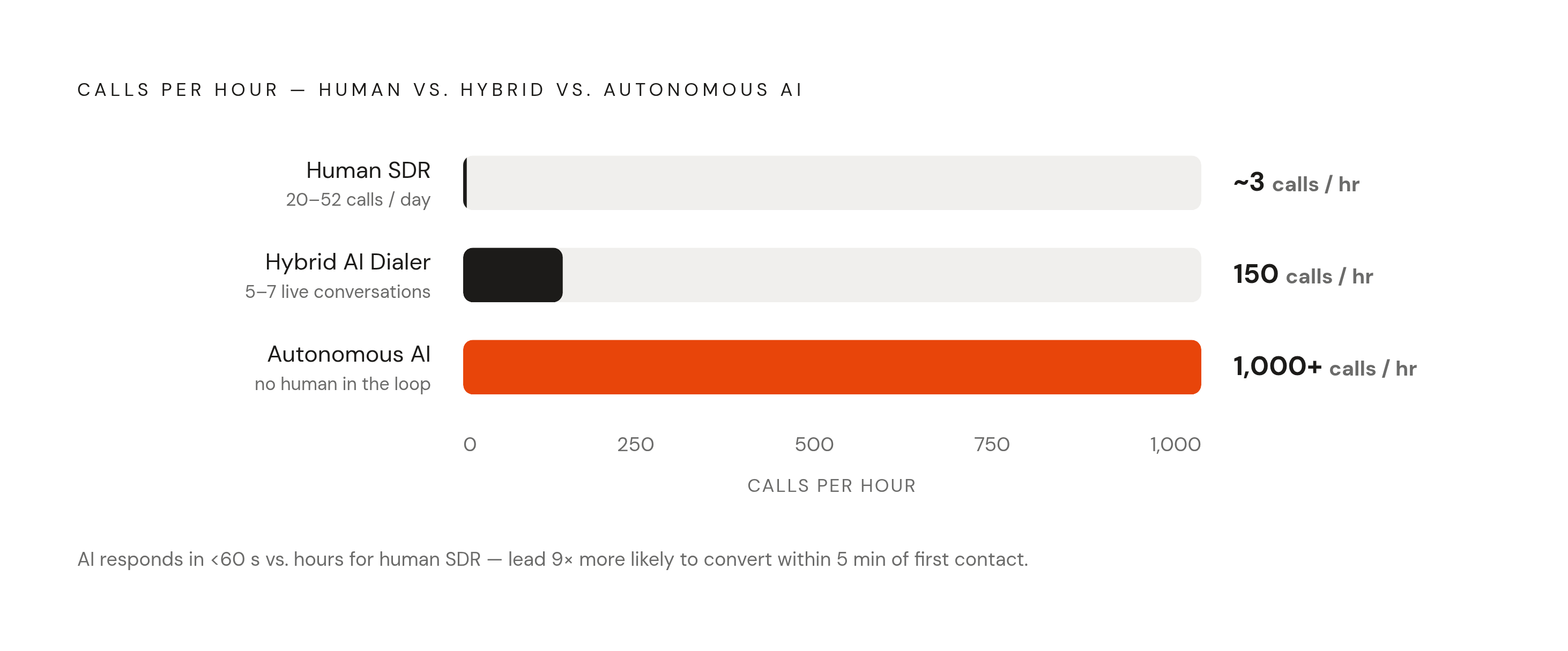
Scale is the first advantage, and it isn't subtle. AI agents can make somewhere between 100 and over 1,000 calls an hour, against 20 to 30 calls a day for a single human rep. Even in a hybrid setup, where an AI-powered dialer assists a rep rather than replacing the call outright, teams unlock around 150 dials an hour with 5 to 7 live conversations, versus 1 to 2 manually. That's a different-order-of-magnitude shift. That's a different order of magnitude.
Speed matters just as much, maybe more. Responding to a lead within 5 minutes makes it 9 times more likely to convert, and an AI agent can respond in under 60 seconds, at any hour of the day or night. Calling a lead at minute one instead of hour four is often the entire difference between winning the deal and never getting the callback. No SDR team staffs a 2am Sunday shift to catch a lead the second it comes in. An AI agent doesn't need to be asked to.
None of this is the interesting part, though. Volume and speed are table stakes now, the price of entry rather than the differentiator. What actually separates a good deployment from a bad one is what the agent does once it has an actual human being on the line. The next section picks up there.
The role of AI calling agents in the B2B prospecting motion
In the working model, AI handles repetitive qualification and routing at scale, and humans keep the conversations that need negotiation, trust, or a judgment call a machine can't make. That split isn't arbitrary. It maps to where each side genuinely has the advantage, and getting the split backwards is the single fastest way to burn a good prospect list.
AI calling earns its keep in a handful of specific plays. Lead follow-up is the clearest one: calling an inbound form fill within minutes, before a competitor's rep even sees the notification land in their inbox. Cold outreach at volume is another, working a large prospect list to surface the leads worth a human's time rather than asking a rep to burn hours dialing cold names one by one. Appointment reminders and confirmations cut no-shows without pulling a person off other work, and re-engagement campaigns for lapsed accounts run at a volume no human team could sustain without burning out. A qualification pass, gathering budget, timeline, and decision-authority data before the first human call, means the rep who eventually picks up already knows who they're talking to.
What AI calling isn't built for is just as instructive, and this is the part most vendor pitches gloss over. Complex, multi-stakeholder negotiations that depend on relationship depth still need a person. A prospect who's expressed frustration or is escalating a complaint needs a person, immediately. And anything requiring genuine creative problem-solving, or the authority to make an exception, has no business being handed to an agent, however adaptive its dialogue gets on a demo call.
Voice works best as one instrument in a coordinated set, not as the whole orchestra. Fluid AI's enterprise model, for instance, ties voice together with email, chat, and WhatsApp into a single orchestrated motion, so a call that goes unanswered can be followed up across other channels automatically. That coordination is where a lot of the actual value lives. The single decision that makes a program succeed or turn into a complaint is the handoff moment: when, exactly, does the AI step back and put a human on the line? Programs that get this wrong, either handing off too late or never briefing the rep on what was already discussed, tend to break down fast, no matter how good the underlying voice technology sounds on a demo call.
How AI calling agents process conversations and take action in real time
Three layers of technology run at once, and each is doing something distinct. Speech synthesis and recognition handle the audio itself: producing a natural-sounding voice and transcribing what the prospect says as they say it. Natural language understanding sits on top of that, parsing intent and sentiment rather than matching keywords, so the agent can tell "not interested" apart from "not interested right now, call back in Q2." A workflow and integration layer connects whatever happens on the call to the systems that matter: CRM fields, calendar bookings, follow-up queues.
That third layer is arguably the one that turns a phone call into something a sales team can actually use. Qualifying data, objection notes, next-step triggers, all of it logs automatically, without a rep opening a CRM tab and typing notes from memory after the fact. Anyone who's watched a rep's call notes degrade by Friday afternoon knows what that manual step looks like in practice, and it isn't pretty.
The better enterprise platforms take personalization further by pulling from CRM history mid-call, so a high-value prospect gets referenced by their own product usage, a relevant ROI figure, or an industry-specific case study, per Fluid AI's documentation. That's a meaningfully different call than one running off a generic script. The prospect can tell within the first fifteen seconds whether the caller, human or otherwise, actually knows anything about their business.
A learning loop runs in the background too. Every call gets captured and analyzed, scripts get adjusted based on what worked and what didn't, and timing strategies refine based on when prospects are actually answering the phone. Some platforms now layer in programmable SMS alongside voice, so an unanswered call triggers a text with an appointment confirmation or a payment reminder, per Retell AI's reporting. That kind of infrastructure, built quietly into today's calling platforms, is the direct predecessor to something bigger. Gartner projects agentic AI will resolve 80% of common service issues without human involvement by 2029.
The compliance and legal frame that every B2B team must build before dialing
None of the speed or scale advantages matter if the program gets a team sued, or flagged by a carrier as a spam source. The baseline is the FCC's February 2024 ruling: AI-generated voices are treated as artificial or prerecorded voices under the TCPA, and sounding conversational creates no exemption, per Percepture's analysis.
B2B teams sometimes assume calling a business number sidesteps consumer protection law. That assumption is only partly right, and the part that's wrong is the expensive part. Plenty of calls to businesses are exempt from federal Do Not Call provisions, true. But TCPA rules, state-level laws, and recording consent requirements still apply depending on the number type, the jurisdiction, and the purpose of the call. "It's a business call" is not, on its own, a compliance strategy. Treating it as one is how programs end up in front of a regulator.
Four things protect a program legally and protect the relationship with the prospect at the same time: identify the company clearly when the call opens, explain why the call is happening, offer an easy way to opt out, and use disclosure language that's actually been reviewed rather than improvised on the fly. Building around these means keeping consumer and B2B contact lists separate, since consent logic differs between them, maintaining suppression lists and audit trails that can be produced if ever questioned, and mapping call programs to specific jurisdictions before launch, since state recording laws vary in ways that catch teams off guard every year.
Legal compliance is only half the frame, though, and the half that gets all the attention isn't the half that actually kills programs. B2B buyers avoid suppliers sending irrelevant outreach often enough that an agent can be fully TCPA-compliant and still torch the relationship, if it's calling with a generic script that has nothing to do with the prospect's actual situation. Relevance is its own kind of compliance. What a team should actually measure here is connect rate, opt-outs, qualified meetings booked, compliance flags per campaign, and cost per meeting, per Percepture's guidance. Raw dial counts measure activity. These other numbers measure whether the activity is doing anything at all.
Evaluating AI outbound calling platforms: what the category offers
The category isn't a niche experiment anymore. Contact center AI is growing at a 21.3% compound annual rate, per Markets & Markets data cited by Aloware, and Deloitte's research projects that 25% of enterprises will have deployed autonomous agents in 2025, with that figure doubling to 50% by 2027. It's a fast-moving market. It pays to evaluate vendors on specific dimensions rather than getting swept up in whichever one runs the slickest demo.
Conversation quality is the obvious one: how naturally the agent handles an unexpected answer, an interruption, or an awkward pause. CRM and API integration determines the actual lift required, since a platform that needs custom engineering to connect to Salesforce or HubSpot is a very different commitment than one with native integration out of the box. Compliance tooling, suppression list management, consent tracking, disclosure enforcement, audit trail generation, should be built in rather than assumed to exist. Human handoff design deserves real scrutiny too: does the agent brief the rep on what already happened before transferring, or does the rep pick up cold and start fumbling? Analytics need to surface in a form a sales manager can actually act on, something the dashboard nobody opens after week two fails to deliver.
A few named platforms show how the category has split. Aloware's AloAi voice agent positions itself as a B2B outbound platform with native CRM integration into Salesforce and HubSpot, built around speed-to-lead and round-the-clock dialing. ElevenLabs' Conversational AI leans on voice quality and natural language handling, with a setup process oriented toward agent training before deployment. Retell AI markets itself on deployment without needing an engineering team, and supports programmable SMS follow-up sequences alongside voice. Fluid AI targets enterprise buyers scaling from hundreds to hundreds of thousands of calls, with multi-channel orchestration across voice, email, SMS, and LinkedIn built into a single agent layer.
One caution to sit with here. TechCrunch reported allegations concerning customer logo accuracy and performance claims at 11x, a prominent AI SDR provider, which led to leadership changes at the company, per Monday.com's blog coverage. That episode is a fair reminder that published case studies and active, checkable customer references aren't always the same thing. Any team evaluating a vendor in this space should verify the latter directly instead of taking a logo wall at face value, and if a vendor resists a reference call, that resistance is itself the data point.
For teams running a founder-led or high-growth go-to-market motion, where outbound calling needs to connect to list building, email sequencing, and CRM sync rather than sit off to the side as its own island, a platform that treats voice as one agent inside a connected motion beats stacking yet another standalone dialer onto an already fragmented stack. Stacking disconnected point tools is precisely how most of these programs quietly fail, not because the individual tools are weak, but because nothing between them talks.
Deploying an AI calling agent without just automating noise
Everything above is instructive, but none of it builds a working program by itself. Deployment is where teams either extract real pipeline value or automate the same noise at a much higher volume. Scale amplifies whatever targeting logic drives it, good or bad, in equal measure. That's the entire risk, in a single sentence.
Start by defining the motion before touching a single setting on the agent. Is this a speed-to-lead follow-up? A cold qualification pass through a large list? A re-engagement campaign for lapsed accounts? An agent asked to vaguely "do outbound" produces noise. An agent built around one specific, well-defined play produces results a team can actually measure.
From there, tier the contact list before a single number gets dialed. Top-tier accounts, the ones showing active buying signals, deserve full personalization, with the agent pulling account-specific CRM context directly into the conversation as it happens. Mid-tier accounts that are a strong fit but less urgent get moderate personalization, framed around industry and role rather than individual account history. The broader list gets lighter treatment, focused mainly on qualification and routing instead of a tailored pitch nobody has time to write anyway. This tiered structure matches investment to signal strength, letting a single rep or agent work through far more prospects each month without sacrificing quality where it actually matters.
Build the handoff before launch, not after the first bad transfer teaches the lesson the hard way. Decide in advance exactly which signals trigger a move to a human rep, whether that's expressed interest, a specific type of objection, or a direct meeting request, and make sure the agent briefs the rep with whatever qualification data it already collected on the call. CRM fields need mapping ahead of time so every outcome logs automatically, with no rep left backfilling notes from memory on a Friday afternoon.
Then measure the right things. Connect rate. Qualified meetings booked per campaign. Opt-out rate, which works as a rough proxy for whether the outreach is landing as relevant or just noisy. Cost per qualified meeting. Compliance flags per thousand calls. BCG's research found that the sharpest improvements appear in campaigns where prospecting, qualification, and outreach agents feed data back into each other as a connected whole, which is really the whole argument of this piece in miniature: the technology only pays off when it's built as a system, with every part deliberately fitted to the others.