AI SDR vs Human SDR for Outbound at Early-Stage Startups
Hybrid outbound beats pure AI or pure human in early-stage go-to-market motion.

The AI SDR versus human SDR debate gets framed as a binary choice: pick one, staff around it, move on. That framing is wrong, and the data backs this up. Outbound at early-stage companies works best as a hybrid motion where AI handles the volume and admin work, and humans handle the conversations that actually turn a stranger into pipeline. Getting that split right, not picking a side, is the real go-to-market decision founders face in 2026.
It's easy to see why the binary framing took hold. Budget pressure pushes founders toward whatever promises pipeline without headcount, and the pitch of an AI SDR working nights and weekends without complaint is genuinely seductive when every dollar of burn matters. But comparing an AI SDR to a human SDR head-to-head is a bit like comparing a delivery van to a salesperson: one moves volume, the other builds relationships, and the two barely overlap in what they're built to do. The real question isn't which one wins. It's how a founder divides the work between them.
That the category exists at all, and at the scale it does, says something about how durable this shift is. MarketsandMarkets projects the AI SDR market growing from a multi-billion-dollar base in 2025 to several times that size by 2030, a strong compound annual growth rate. That's not a feature cycle or a funding-driven bubble. That's infrastructure being built for a permanent change in how outbound gets done. This piece stays focused on early-stage and founder-led teams, generally under $2M ARR, because the calculus here looks nothing like enterprise procurement. A large sales org evaluating an AI SDR platform is solving a different problem than a two-person founding team trying to book its first fifty customer calls.
What AI SDRs actually do in 2026, and where they stop
The category has matured past simple email blasting. A modern AI SDR platform handles prospecting, sequence execution, reply triage, meeting booking, and CRM logging, often end to end with no human touching a single step. That's a meaningful shift from where the tools sat even two or three years ago, and the strength actually lives in specific places.
Volume is the obvious one. An AI SDR can run outbound at a scale no individual rep could sustain over a full quarter, sending, tracking, and following up across thousands of contacts without fatigue. Ramp speed backs this up in a way that should get a founder's attention: the Bridge Group's 2026 ramp survey found AI SDR tools reaching a first booked meeting in 24 days, against 142 days for a newly hired human SDR. That gap is not small. It's nearly six times faster, and for a startup burning cash every month waiting for a new hire to become productive, that difference alone explains a lot of the enthusiasm.
Consistency keeps follow-ups and prospecting running without the lapses that show up in human sales orgs. An AI SDR doesn't have a bad Monday, doesn't forget a follow-up sequence, and doesn't quietly stop prospecting once quota gets hit for the month, a pattern that shows up more often in human sales orgs than most sales leaders like to admit. For structured, repeatable tasks (inbound lead qualification, FAQ routing, CRM enrichment) AI is unambiguously faster and, frankly, better suited to the job than a human rep doing the same rote work.
Where it falls short is just as concrete. Field testing from Outbound Sales Pro found AI voice agents still read as noticeably robotic on cold calls: tone, pacing, and the improvisation needed to get past a gatekeeper remain squarely human advantages. Multi-threading a relationship across a buying committee, the kind of work that requires tracking who cares about what and adjusting the pitch accordingly, isn't something current AI SDR tools do well. Neither is reading emotional context mid-conversation and shifting in real time, or picking up the kind of qualitative intelligence (an offhand objection, a competitor mention, a shift in tone) that never makes it into a CRM field because there's no field for it.
There's a counterweight here. A significant share of AI SDR tools get cancelled within their first year, a turnover rate that observers suggest rivals or exceeds that of the human reps they were bought to replace. The most common cause isn't the AI failing at its job. It's poor data quality scaling bad targeting: an AI SDR sending a large volume of emails a month to the wrong ICP compounds bad targeting far faster than a human SDR working at a fraction of that volume could. Fully autonomous outbound, it turns out, is a harder problem for AI to solve than inbound qualification. The category's real strength sits closer to the top of the funnel than most vendor marketing wants to admit.
What human SDRs do that volume metrics don't capture
Every human sales call generates something a spreadsheet can't hold: the objection nobody scripted for, the competitor name a prospect drops without thinking, the specific phrase a buyer uses to describe their own pain. Organizations that automate outbound completely lose this feedback loop, and it's not a small loss. It's the mechanism by which a pitch gets sharper over time.
For deals that involve a real buying committee and a meaningful price tag, trust isn't a nice-to-have layered on top of the pitch. It's a prerequisite for the deal closing at all. Multiple stakeholders need to be convinced across different conversations and different channels, and that kind of relationship-building doesn't compress into a sequence of automated touches.
Voice inflection turns out to be a real performance lever, not a soft skill footnote. Field observations indicate a trained human SDR working from the exact same script as a colleague can produce meaningfully different results purely through tone and pacing, a gap AI voice agents haven't closed. Same words, different outcome, and the difference is entirely in delivery.
Nowhere does this matter more than in the founder-as-SDR phase, which is close to universal for companies before they hit real scale. The founder carries the deepest product knowledge in the building, and every sales conversation they run feeds that knowledge straight back into the roadmap. Founder-led sales typically runs through the early ARR milestones before a repeatable playbook is established, and that window isn't arbitrary. It's the period when a company doesn't yet know who its customer is, and the founder's judgment in live conversations is the fastest way to find out. Practitioners widely cite LinkedIn, warm outbound, and founder brand as the most effective early-stage channels. All three depend on relationships, not sequences.
Skip this layer too early and the cost shows up later, quietly. The playbook never gets written down because nobody was forced to articulate it. The ICP never gets properly validated because nobody was in enough conversations to notice the pattern. And the first real sales hire walks into a system with no institutional memory, forced to rediscover by trial and error what the founder already learned and never wrote down.
The performance data on hybrid pods vs. pure configurations
RevOps Co-op's benchmarks give a clean answer to the "which one wins" question, and the answer is neither, alone. A pod structured around one human SDR per two AI SDR seats books substantially more meetings per dollar than a pure-AI configuration, and even more than a human-only pod. That's the hybrid thesis in a single data point.
The tradeoff that produces that number matters, because it's not free efficiency. Apollo and ZoomInfo's 2026 outbound benchmarks put human baseline volume at 1,150 outbound touches per rep per month, against an AI-augmented mean of 7,400, a 6.4x jump. But reply rates moved the other way, from 4.7% on the human baseline down to 2.9% on the AI-augmented volume. More sends, lower response rate per send. That's not a contradiction so much as a reminder that volume and precision pull against each other.
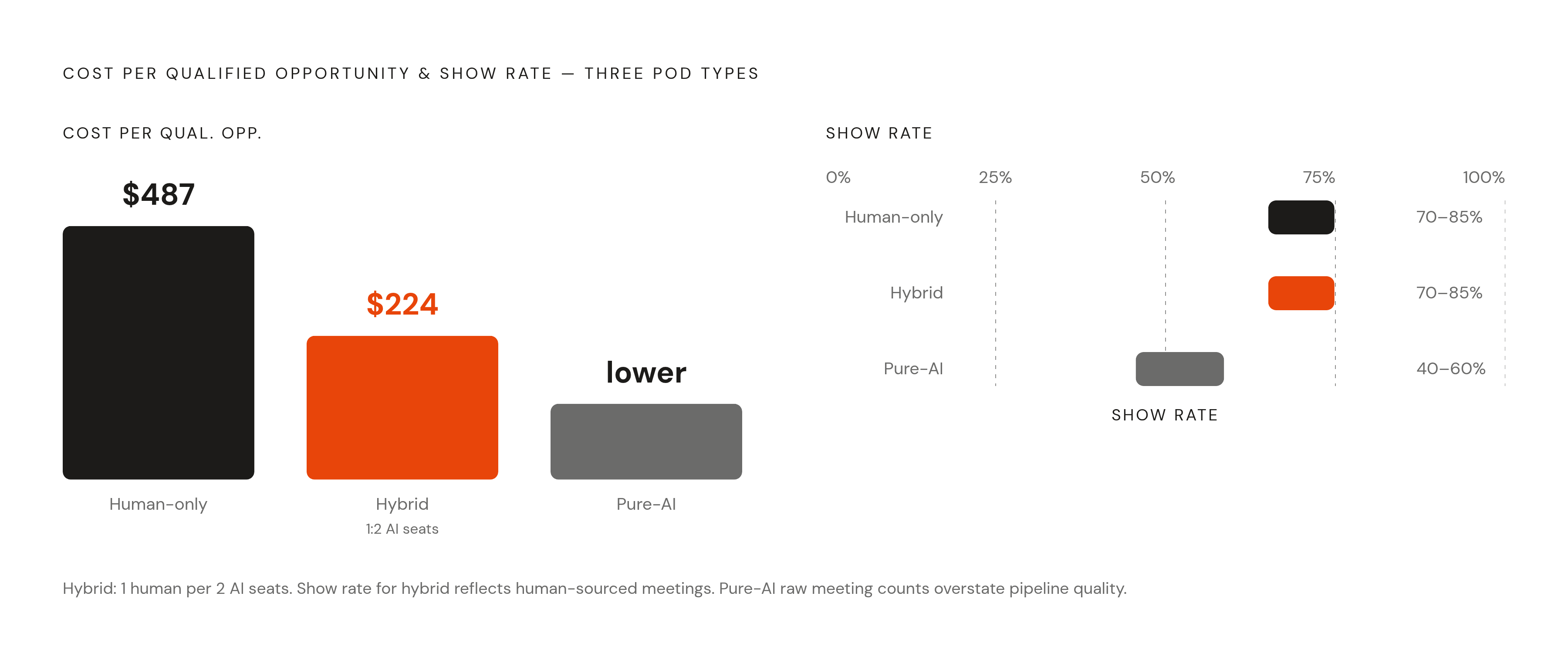
Cost per qualified opportunity still comes out ahead in the hybrid model: $487 for human-only pods against $224 for hybrid pods, according to Bridge Group's 2026 SDR Metrics report. That's a real, meaningful gain. It's also a long way short of the "AI eliminates the SDR budget" pitch that shows up in a lot of vendor decks.
The meeting show-rate gap adds a wrinkle. Reported show rates for meetings sourced by one automated system run in the 40% to 60% range, against 70% to 85% for human-sourced meetings. So raw meeting count from a pure-AI setup overstates the pipeline quality actually showing up on the calendar. Booking a meeting and having someone show up to it are two different metrics, and pure-AI configurations tend to look better on the first than the second.
Adoption numbers put this in context without prescribing an answer. Enterprise B2B teams running at least one AI SDR in production hit 41% in Q1 2026, up from 12% a year prior, a genuinely fast climb. SMB adoption, by contrast, is 14%, up from 2%. That spread isn't an accident. Data infrastructure, deliverability tooling, and a functioning RevOps layer are prerequisites for scaled AI SDR use, and a lot of early-stage companies simply don't have them yet. Gartner's forecast adds a useful caution here: AI agents are expected to outnumber human sellers tenfold by 2028, yet fewer than 40% of sellers are projected to report an actual productivity gain from it. Scale, on its own, doesn't create pipeline.
The division of labor that makes a hybrid model work in practice
A large majority of an SDR's time historically goes to research and administrative overhead, not selling. That number is the whole argument for the hybrid model in one sentence: AI should absorb that 70%, and humans should own the conversations and relationships that actually close deals.
In a lean early-stage stack, AI should own list building and contact enrichment against a validated ICP, the initial cold email sequences and follow-up cadences, reply triage that flags positive signals for a human to pick up, CRM logging and meeting scheduling, and intent signal monitoring (pricing page visits, job changes, hiring triggers) paired with immediate first-touch outreach. All of that is structured, repeatable work with a clear right answer.
Humans need to own anything synchronous: phone calls, video calls, live chat. Objection handling and negotiation stay human. Multi-threading a relationship across a buying committee stays human. And critically, reading the qualitative signal that never shows up in sequence data, then feeding it back into messaging, ICP definition, and product direction, has to stay a human function, because there's no automated path for that feedback loop yet.
None of this works, though, if the tools it depends on are fragmented. The one-human-per-two-AI-seats structure delivers its best economics when the tooling is connected end to end. Separate point solutions for list building, email infrastructure, sequencing, and CRM recreate exactly the coordination overhead the AI layer was supposed to remove, just shifted from a human doing manual work to a human doing manual handoffs between platforms.
Deliverability is the structural ceiling nobody budgets for early enough. Aggregate sender data from Smartlead and Instantly shows domain reputation collapse from over-sending capping a meaningful share of attempted AI SDR deployments within their first 90 days. Google and Microsoft moved to weight engagement signals more heavily in their filtering across 2024 and 2025, which means a generic blast to a purchased list doesn't just hurt reply rates anymore, it damages the sending infrastructure itself, sometimes for months. Practical discipline here means starting a new mailbox at a low daily send volume, ramping gradually, and keeping hard bounce rates tightly controlled. Skip the ramp and the domain can end up flagged before the campaign even gets going.
There's a compliance layer too, one founders tend to skip past. AI-generated outreach that mimics human interaction raises real compliance questions, and the regulatory picture in multiple jurisdictions is still evolving. Fully autonomous outbound configurations carry more exposure here than augmented-human setups do, which is one more reason the human layer isn't just a performance choice. It's a risk-management one.
When to lean harder on AI, and when to keep the human layer heavy
Deal size is the cleanest signal available for making this call. For shorter sales cycles and lower average contract values, AI SDR economics are hard to argue with: a meaningfully lower monthly license cost against the fully loaded annual cost of a human SDR hire. That math settles itself pretty quickly for a founder watching runway.
For deals running through a multi-stakeholder buying committee at a higher ACV, the calculus flips. Human SDRs augmented with AI tools produce better pipeline quality and higher conversion in that environment, and the relationship cost that makes those deals slower to close is also what makes them stick once closed.
Stage matters as much as deal size. Before the ICP is locked and the playbook is actually written down, heavy AI automation just scales mistakes faster. Bad targeting at 7,400 emails a month does more damage, and does it faster, than bad targeting at 1,150. Once the playbook is proven and the ICP validated, AI can take over the repeatable execution while the human layer keeps refining signal on top of it.
Vertical adoption rates work as a decent proxy for how much autonomy makes sense in a given market. B2B SaaS leads verticals in production adoption of AI SDR tools. Healthcare IT sits at a notably lower adoption rate, where compliance considerations play a role. Government and public sector trails all of these by a wide margin. The pattern tracks trust and compliance requirements pretty closely: the more scrutiny a buyer's industry faces, the less autonomy the outbound motion should carry.
The trigger for shifting toward heavier AI use isn't a calendar date. It's win rate, CAC, and sales cycle length stabilizing into something predictable. Before that point, the founder's judgment in live conversations remains the single best data-collection mechanism the company has access to, and automating it away too early just means learning the same lessons later, more expensively. The old model of stacking twenty reps on templated sequences and running pure volume is already dead, killed by deliverability limits, buyer fatigue, and the sheer amount of AI-generated noise now hitting every inbox. The real alternative to pure-AI outbound isn't more human reps doing the same volume game. It's smaller, signal-driven lists with a human closing the loop.
Building the hybrid motion on a connected platform rather than a patched stack
Most founders who try to build this hybrid model end up assembling it from parts: one tool for list building, another for email infrastructure, another for sequencing, another for intent signals, another for CRM. Each tool is fine on its own. Together, they create exactly the kind of coordination overhead the AI layer was supposed to eliminate, just moved from prospecting work to integration work.
A connected platform closes that gap in a few specific ways. AI agents can run distinct, well-defined plays (an outbound sequence, reply triage, meeting booking, a CRM sync) without a human manually shuttling data between systems. Intent signals, a pricing page visit, a job change, a competitor mention, can trigger immediate, personalized outreach instead of sitting in a spreadsheet until someone remembers to check it. A single data layer means the human SDR picks up a conversation with full context on what the AI already did, rather than starting cold. And the whole system gets to iterate: sequences that convert stay, sequences that don't get cut, and the improvement compounds cycle over cycle instead of resetting every time someone opens a new tool.
Forrester's 2026 predictions put a number on where this is heading: 63% of revenue leaders expect a single agentic system to own sequencing, research, reply triage, and meeting briefs by the end of 2027, collapsing what's currently a stack of six to eight separate point tools into one. That consolidation direction already looks like consensus among the people running these motions day to day, not a prediction anyone's arguing against.
The category includes a range of approaches that each work on their own terms. Some platforms, like 11x and AiSDR, take a fully autonomous agent approach to outbound. Landbase positions itself around signal-led GTM execution rather than pure volume. Among newer entrants, Gojiberry (a YC-backed company built around an AI GTM brain that handles everything from intent identification through meeting booking) and Nex (built for complex, high-volume GTM workflows, backed by HubSpot founder Dharmesh Shah) represent the newer wave of infrastructure aimed at this exact problem. And the broader outbound stack still leans on component tools: Clay for data enrichment and orchestration, Smartlead and Instantly for email sending infrastructure, Apollo as an all-in-one database and sequencer. Each solves a piece of the puzzle that SMB teams otherwise have to stitch together by hand.
The better question when evaluating any of this isn't which tool sends the most email. It's whether the platform lets one or two people run a complete outbound motion, from list to booked meeting, without rebuilding the handoff logic between tools every quarter. That's the actual bottleneck at early stage, and it's a coordination problem before it's a volume problem.
The real payoff of getting the hybrid model right doesn't show up in the first 90 days of cost savings, tempting as that number is to chase. It shows up a few cycles in, when every round of AI execution paired with human conversation has sharpened the signal a little more: a tighter ICP, a more precise playbook, a pitch that's been tested against real objections instead of guessed at in a vacuum. That compounding is the actual argument for hybrid. Not that it's cheaper on day one, but that it gets smarter on day ninety.