Outbound vs Inbound for B2B Revenue at Early Stages
Outbound reaches your first customers faster than inbound can, and teaches you more.

Inbound marketing rests on three foundations: domain authority, content volume, and a known audience. A pre-product-market-fit company has none of these, and building them takes quarters, not weeks.
SEO compounds slowly. A new domain publishing its first posts is not competing for meaningful search traffic in any reasonable time horizon. Paid inbound can close some of that gap, but competitive B2B keywords carry cost-per-click figures that make efficient acquisition nearly impossible without a validated ICP, or ideal customer profile. Budget burns against visitors who were never going to buy, and the feedback is indirect: you learn that someone didn't convert, not why, not what they were actually looking for, not which objection made them leave.
There's a real advantage to inbound leads worth sitting with: when they arrive, they arrive pre-qualified. A prospect who sought you out has already cleared a meaningful self-selection threshold. The problem is that phrase "when they arrive." At the earliest stages, waiting for inbound volume to generate signal is not really a strategy; it's a bet on a channel that requires months to load before it fires, and many early-stage companies simply don't have those months.
The subtler problem is positioning. Before PMF, your messaging is an educated hypothesis. Inbound is a referendum on that hypothesis, run at low sample rates with ambiguous results. A message that's slightly wrong produces low traffic and low conversion, but the channel won't tell you which variable in your go-to-market thesis is broken. But what if that ambiguity is the more expensive problem — not the low conversion itself, but the fact that you can't diagnose it? Outbound surfaces the same positioning failure in days, because prospects respond, object, or go quiet in ways that carry actual information. The silence on an inbound page carries none.
It is also worth considering a second-order assumption embedded in inbound strategy that rarely gets examined at the early stage: the assumption that your buyers know what to search for and where to look. Before you've closed deals and interviewed the people who bought, you don't know their vocabulary, their research habits, or which communities they trust. Building inbound content for a buyer you haven't fully mapped is speculation at expensive scale.
What Outbound Gives You That Inbound Structurally Cannot at This Stage
The most underrated property of outbound is control. You define who you reach before you have any traffic to analyze. Firmographic filters, technographic data, behavioral signals, and job-level targeting: these let you build a target list from intention rather than from whatever the algorithm delivers. At the early stage, that control is how you test ICP assumptions deliberately rather than stumbling into them.
Speed follows from control. Teams relying on inbound alone have waited four to six months for meaningful pipeline volume; structured outbound programs have produced first meetings in under three weeks from initial setup. That gap matters not because meetings are the goal, but because meetings are where you find out whether your ICP assumption was right. Every week without that feedback is a week of product, pricing, and positioning decisions made in partial ignorance.
The cost structure matters more than founders typically appreciate. Cold email remains the only major B2B channel where a small team can reach a senior buyer for under a few dollars per contact. LinkedIn CPMs and Google Ads CPCs run materially higher. For a company with constrained capital and an unvalidated ICP, that asymmetry makes outbound not just faster but economically rational as the primary discovery vehicle.
What outbound delivers that no form submission ever will is primary research embedded in the sales process itself. Every conversation surfaces objections. Competitors get named. Budget ranges are implied or stated outright. A prospect who replies "we're actually already using X for this" has handed you a competitive intelligence report in a single sentence. Aggregated across fifty conversations, that data is more actionable than anything an analytics dashboard produces at this stage.
There is also a discipline effect that doesn't get enough credit. You cannot write a good cold email to a vague persona. The act of building a sequence forces specificity: what is this person's title, what problem are they responsible for solving, what would make them open this, what would make them reply? That forcing function produces sharper ICP thinking than any whiteboard session. Founders who have done serious outbound early tend to be the ones who can describe their buyer with precision, because the channel demanded it of them.
Why the Founder Is the Right Person Running Outbound Before Anyone Else Is
Hiring a sales development representative, or SDR, before the founder has personally sold the product is a mistake repeated often enough that it has stopped feeling like a mistake to the people making it. The problem isn't that early SDRs lack skill. It's that the feedback loop breaks.
The founder is the only person positioned to hear an objection, update their mental model of the buyer, adjust the pitch the next morning, and simultaneously feed that adjustment back into product roadmap decisions. A hired seller processes objections as sales problems. A founder processes them as product and positioning problems, and that difference determines whether early sales conversations compound into organizational learning or disappear into a CRM note. These are not equivalent outcomes. That raises an important question: if the feedback loop is the real asset, what happens to a company that outsources it before it's fully formed?
The broadly held benchmark among experienced operators is that founders should personally close the first thirty to fifty customers before transitioning to sales leadership, a process that typically spans six to twelve months. Transition earlier and you risk scaling a motion that hasn't been proven repeatable. Transition later and founder bandwidth becomes the ceiling on growth. Neither failure mode is subtle in retrospect; both are remarkably easy to rationalize in the moment.
One mechanism that gets treated as optional but isn't: founder-generated LinkedIn content as an outbound multiplier. B2B buyers at the early stage extend trust to individuals before they extend it to brands. A founder with a visible, specific point of view on LinkedIn is not doing marketing as an activity separate from outbound; the content creates warm context that makes cold outreach meaningfully less cold. The outreach lands differently when the recipient already has a frame for who you are.
The real operational risk of founder-led outbound is burnout from context-switching without structure. The fix is operational: time-block outbound as a non-negotiable daily function, not a task that happens when product work slows. It rarely slows. Senior sales leadership becomes more defensible around the low single-digit ARR milestones, with at least a small account executive function already in place. Before that threshold, the data to justify the compensation and the process to support a sales leader simply doesn't exist yet.
What a Sharp Early-Stage Outbound Motion Actually Looks Like in Practice
Every failed outbound program I've seen traces back to the same root cause: a vague ICP. "Mid-market SaaS" is not a list you can build. "Series A SaaS, fifty to two hundred employees, Salesforce users, HR tech vertical, US and UK, with at least one SDR on staff" is a list you can build, score, and sequence against immediately. The specificity is not pedantry; it is the operational prerequisite for everything that follows.
Infrastructure comes before outreach, and this is where many early teams stumble. Sending from your primary domain is a serious mistake. Email deliverability damage to your main domain reverses slowly and compromises not just outbound but every transactional email your company sends. The correct setup involves separate sending domains with proper authentication: SPF, DKIM, and DMARC configuration, followed by several weeks of mailbox warmup to build sender reputation before any prospect receives a message. Unglamorous. Non-negotiable.
On sequence structure: most B2B outbound replies arrive between the fourth and sixth touch. Programs that stop at one or two attempts leave the majority of potential responses uncaptured. Multi-touch is not aggressive; it's statistically necessary.
Channel mix in 2025 has shifted. Cold email remains the highest-volume, lowest-cost option. LinkedIn has grown its share of outbound budgets significantly, rising from 32% in 2024 to 39% in 2025 according to The Digital Bloom's 2025 B2B GTM Channel Benchmarks, and it is showing consistently positive return on ad spend in a way most paid channels are not. Cold calling and high-touch manual outreach for Tier 1 accounts round out a complete motion. No single channel is sufficient alone.
The mechanics of what actually performs in cold email are more specific than most teams appreciate. Timeline-based hooks, framing outreach around a concrete event or decision point on the prospect's side, consistently outperform traditional problem-statement approaches by more than two to one in reply rate, per The Digital Bloom's benchmarks. Signal-specific personalization shows an even larger lift over baseline, according to the Instantly 2026 Cold Email Benchmark Report, and roughly 5% of senders personalize every email. That asymmetry is an available edge. It is consistently surprising how often teams leave it on the table.
How Intent Signals Sharpen Outbound Targeting Once the Motion Is Running
Intent signals, or buyer intent data, are buying behavior happening before any form gets filled. Pricing-page visits, competitor comparison searches, review-site activity, funding announcements, leadership changes: these are observable facts about a buyer's current state, available before that buyer has identified themselves to any vendor.
The scale of this invisible activity is significant. 6sense's 2025 Buyer Experience Report, surveying more than 4,000 buyers, found that 94% of B2B buying groups had already ranked their preferred vendors before speaking to any sales representative. The buying decision is largely settled before the first conversation. But how does this affect our original promise that outbound lets you reach buyers early? Outbound that reaches buyers during the research window, rather than after preferences have hardened, operates in a fundamentally different competitive position — which is exactly why timing the outreach matters as much as targeting it.
The conversion data on intent-prioritized outreach is instructive. According to The Starr Conspiracy's 2024 ABM Operations Audit, accounts targeted using intent signals converted to closed opportunity at materially higher rates than accounts reached without intent prioritization, and intent-sourced deals carried higher average contract values. The implication isn't just improved conversion rate; it changes the composition of the pipeline in ways that compound over time.
Speed of response matters as much as the signal itself. The signal decays. Teams that act within 24 hours see meaningfully better opportunity creation than teams that respond more slowly, which sounds obvious until you watch how many organizations let intent data age in a dashboard while their sequence cadence runs on its own schedule.
For early-stage teams building their first intent-informed outbound motion, certain signal types offer disproportionate return. Job changes are among the highest-value triggers, particularly new executives within their first 90 days. A new VP of Sales three months into a role is actively evaluating the tools they inherited and far more receptive to a well-timed conversation than an entrenched buyer with no external pressure to change. Funding rounds create similar windows. So do hiring surges in functions adjacent to your product's value proposition. LinkedIn profile visits from ICP contacts and detectable tech stack changes round out a practical signal set for teams without enterprise-grade intent infrastructure.
When intent signals coordinate multi-channel plays simultaneously across email, paid, and SDR outreach, this account-based marketing approach increases pipeline velocity materially over single-channel response, per The Starr Conspiracy's audit. The signal is only as valuable as the speed and coordination of the response it triggers.
When Inbound Stops Being Premature and Starts Being Necessary
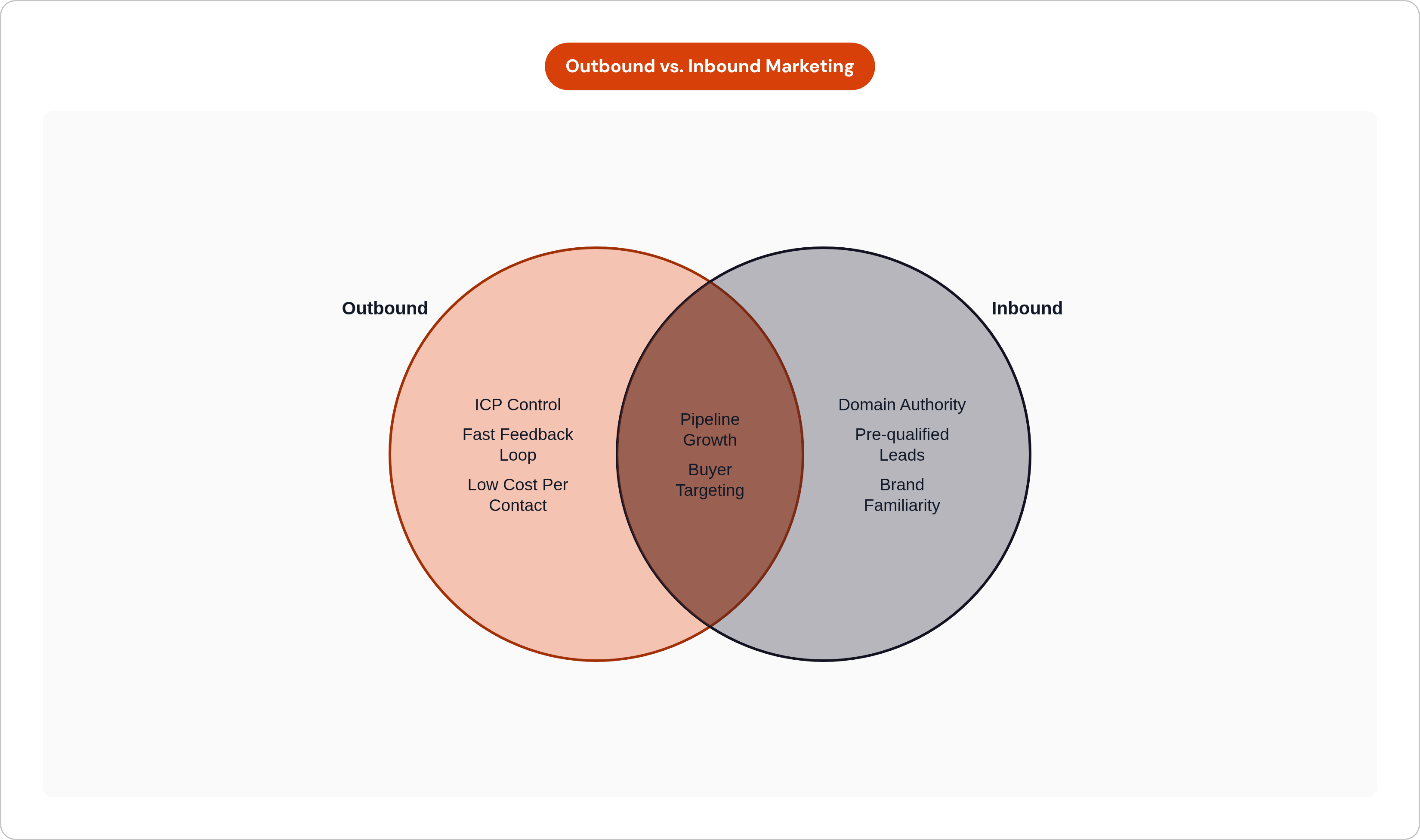
The shift is not a matter of preference or maturity signaling. It's a function of what you have accumulated: proven messaging, a documented ICP, enough closed deals to know what content your buyer actually finds credible, and enough revenue to absorb the lag time of a slow-compounding channel.
Around the high single-digit ARR range, a hybrid model stops being optional. Outbound fills the pipeline; inbound builds the brand familiarity that makes outbound progressively more efficient. These are complementary functions, not competing ones, but their sequencing matters. Research on growth-stage companies suggests the best results tend to emerge from an equal blend of outbound and inbound, with the critical qualifier being "growth stage," not seed, not early Series A.
Inbound's real value at this point is cost reduction over time. A buyer who already knows your brand converts faster and with less sales effort. Inbound builds that familiarity at scale in a way outbound cannot. But this is an argument for sequencing inbound correctly, not for starting with it. One might argue that a founder with early traction should split attention between SEO and outbound simultaneously — but the data from growth-stage research suggests that depth on outbound first, before layering content, tends to produce better outcomes.
The broader market shift toward buyer self-sufficiency reinforces this argument. Sixty-one percent of B2B buyers now prefer a rep-free buying experience, according to the 2025 Gartner Sales Survey. This is a structural change that inbound and self-serve motions are built for. But buyers who prefer independent research still need to encounter your brand during that research. Before you have inbound authority, outbound is how you enter their consideration set in the first place.
The transition trigger is validated repeatability. When outbound has proven the ICP, the pitch, and the conversion motion, inbound amplifies what's already working. Founders who split attention between SEO strategy and cold sequences at twenty customers tend to finish behind the ones who went deep on outbound first and layered content in once the motion was proven. Cardinal, an AI-powered outbound platform that deploys AI agents to handle prospecting, enrichment, and email sequencing for high-growth companies, is one tool built around that sequencing priority. This is considerably easier to see in retrospect than in the moment, which is perhaps the most candid thing I can offer about it.