G2 and Review Site Intent Data in Outbound Campaigns
Timing your outreach to specific G2 signals closes deals twice as fast as generic blasts.

G2 and other review sites hand B2B teams something outbound rarely gets on its own: a record of exactly which account is researching which product, at which stage, right now. Most teams treat that record like a list to blast rather than a trigger to time, and that habit is the single biggest reason the data underperforms. A signal only pays off when it drives a specific, timed response built for that exact signal, not a generic template fired at every account that lights up the G2 dashboard. Get this part wrong and none of the plays further down actually matter.
Start with a number that should reframe how any revenue team thinks about outbound. Per 6sense's 2024 Buyer Experience Report, which surveyed thousands of B2B buyers, the majority of the buying journey wraps up before a buyer ever picks up the phone or replies to a vendor's email. That's a statement about where the deal actually gets shaped, and it happens almost entirely out of view, in what researchers now call the dark funnel. G2 activity is one of the few windows into that invisible majority: it catches the moment a buyer is reading reviews, running a comparison, or checking pricing, well before the moment they decide to respond to a rep at all.
Review sites carry real weight in that research phase. G2's 2025 CMO Buyer Behavior Report, drawing on roughly 1,100 B2B decision-makers, ranks review sites as the second-largest shortlist-influencing source at 15.1%. A buyer reading G2 reviews isn't casually browsing the category; they're already building or narrowing a shortlist, a different mental state than someone who clicked a paid ad and bounced.
The dollar case backs this up, though a caveat is worth naming before getting too excited about it. Dreamdata's October 2024 benchmark study found deals carrying a G2 intent signal close at twice the size of the average deal, and 12% of closed-won revenue carries G2 influence somewhere in its history. Correlation doesn't prove causation here: bigger, more deliberate buyers do more structured research on their own regardless of channel, so the G2 activity might be a symptom of that deliberateness rather than a lever anyone can pull. Either way, the opportunity is real but the playbook still has to get built and run well; the data doesn't do the work by itself. Generic, untriggered outbound is still fighting over scraps of attention among the roughly 30% of buyers visible through traditional channels, while G2 intent data opens a route into the other 70% researching quietly, unseen by any SDR team.
How signal type maps to buyer urgency — and what that means for sequencing priority
G2 tracks nine distinct signal types tied to specific URLs inside its marketplace: Profile, Pricing, Alternatives, Category, Compare, Sponsored content, Licensed content, Reference page, and Competitive. Treating those nine as interchangeable, covered by one email template, is the single biggest mistake a team can make with this data, and most teams make it anyway, because building nine responses feels like more work than building one. It isn't, not once the urgency spread below is on the table.
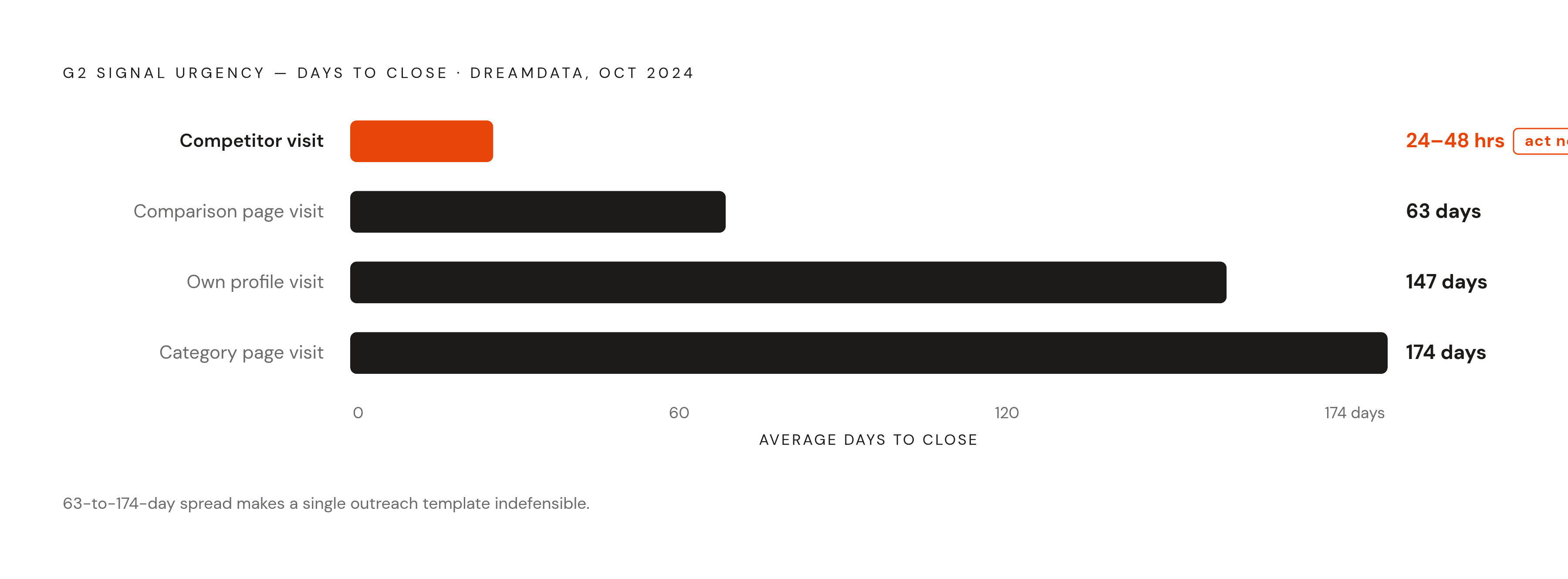
Dreamdata's October 2024 study ranks four primary moments by urgency and average time-to-close, and the spread between them makes the case for signal-specific handling on its own. A visit to a competitor's profile or pricing page is the most urgent: the buyer is actively sizing up a named alternative, and the useful window before that competitor's own sales team engages runs roughly 24 to 48 hours. A comparison page visit closes fastest of all, a 63-day average; the buyer has already picked a shortlist and is differentiating, so outreach should lead with proof, not introductions. A visit to a company's own profile runs a 147-day average close, warmer than cold outreach but with real runway left. Category page visits are the slowest at 174 days, early-awareness browsing better suited to retargeting than a sales call.
G2's scoring model, introduced in June 2022, adds a second axis on top of signal type: Buying Stage (Awareness, Consideration, Decision) crossed with Activity Level (Low, Medium, High). That replaced a single blended intent score, and the reasoning matters. "Decision stage, High activity" tells a rep something a flat number never could. This combination works as a triage layer sitting on top of signal type. An account in Decision stage with High activity jumps to the front of the queue no matter which of the nine signal types triggered it, and Activity Level, tracking recency and frequency of visits, lets reps stack-rank multiple triggered accounts instead of guessing which one to call first.
The fallout of ignoring all this runs in both directions at once, which is what makes it so costly. Teams that respond to every G2 signal with the same template are almost certainly under-responding to competitor visits, where 48 hours actually matters, while over-investing in category visitors who won't be ready to talk for months. The 63-day versus 174-day spread between comparison visits and category visits is the clearest evidence available that trigger-based sequencing beats one cadence for everyone, using the same rep hours but pointing them at radically different windows of opportunity.
The competitive displacement play: responding to competitor profile and pricing visits
The trigger is specific: an account visits a competitor's G2 profile or a competitor's pricing page. G2's Competitive Intent Signals feature, launched in August 2025, now surfaces this before the buyer has necessarily touched a company's own listing at all, a meaningfully earlier starting point than waiting for them to find you first.
Speed decides this play more than anything else does. The competitor almost certainly runs its own G2 integration, which means their sales team gets notified of that same profile activity, probably close to the same moment. Whoever reaches the buyer first gets to frame the comparison; whoever arrives second is stuck reacting to a narrative someone else already set. The practical window is 24 to 48 hours. Past that, the conversation happening in the buyer's head has likely already been shaped by whoever showed up first, and no amount of message polish recovers that lost position.
Messaging matters almost as much as speed. Opening with "saw you were looking at [Competitor]" reads as surveillance, and G2 doesn't confirm the buyer even knows their activity is visible, so that opener can backfire badly. Skip it. A better lead surfaces the comparison without stating it outright: something like "a lot of teams evaluating this category come to us after trying [Competitor], usually because of X." From there, anchor on one specific differentiator, not a feature checklist. A single customer result or a pulled quote from a G2 review reads like proof instead of marketing copy, and it lands harder than a side-by-side capabilities table. Keep the ask small: a 15-minute call framed as helping the buyer evaluate, not a pitch meeting.
A tight channel sequence keeps this inside the urgency window: email on day one, a LinkedIn connection with a short note on day two, a follow-up email carrying a proof point on day four. There's a persona problem baked into all of this, though. G2 tells a team which account is looking, not which person to contact, so this play needs a contact enrichment step wedged in before the sequence can even start. That gap is exactly where a connected system, one that handles list building and sequencing in the same place, saves a team the manual back-and-forth between separate tools. Platforms built around that consolidation, Cardinal being one, handle enrichment and sequencing without bouncing between separate logins.
The same signal, read differently, becomes a defensive tool. If an existing customer visits an Alternatives or Comparison page, that's a renewal flag rather than a new-logo opportunity, and it should route to customer success instead of sales under that same 24-to-48-hour logic.
The shortlist play: responding to comparison page visits
A comparison page visit tells a team something a profile visit doesn't: the buyer has already named their shortlist. They're not discovering the category anymore; they're differentiating between specific options, which makes this arguably the most commercially useful signal G2 offers. Of the four plays in this piece, it's also the easiest one to get wrong by underplaying it.
The 63-day average time-to-close, per Dreamdata's October 2024 study, sits shorter than a profile visit and longer than the raw urgency of a competitor visit. But the buyer's headspace here is about as close to decision-ready as G2 signals get, and that changes what the first message needs to do. There's no need to build category awareness, since the buyer already has it and found the vendor without any help from outbound.
Lead the message with the exact comparison the buyer is likely running: "most teams choosing between us and [Alternative] end up caring about X, Y, and Z, here's how that plays out." That validates the research already done instead of restarting the conversation from zero. Pull G2 review data directly into the email itself: a specific category where the reviews score higher, or a pattern that shows up repeatedly in what customers cite as the reason they switched. Offer something built for comparison, not a generic discovery call: a one-pager built around the differentiating features, or a demo structured around what the buyer is actually weighing.
Keep the sequence shorter than a cold outbound cadence, maybe three to four touches over ten days, then pull back. The buyer already has what's needed to decide, and dragging the sequence out past that point risks annoying someone close to a decision rather than moving them toward one. The most common way teams waste this signal is running the same "just wanted to reach out" template they'd send to anyone, cold or warm. Defaulting to a generic opener throws away the advantage the data just handed over: the signal already told the rep exactly what the buyer needs to hear, and ignoring that borders on malpractice.
The nurture play: responding to own profile and category visits
Own profile visits average a 147-day close, per Dreamdata's October 2024 numbers, which puts them in a very different category from the two plays above. The account has found the vendor, but the buyer is early, and treating this like a competitor-displacement moment mismatches urgency against what's actually happening on the ground. That mismatch, more than any messaging flaw, is what makes teams burn good accounts too soon.
The right motion here is a longer ABM sequence, with accounts showing High Activity Level bumped to the front of that queue. Messaging should lean educational rather than competitive: what outcomes similar customers achieve, how teams shaped like theirs actually use the product day to day. Buying Stage still matters even inside this slower category, though. A profile visit tagged Decision stage compresses that 147-day average considerably, and a rep should treat that account more like a comparison-stage lead than a nurture-stage one.
Category page visits sit at the far end, averaging 174 days to close per the same Dreamdata data, and that's genuinely early-awareness behavior. The buyer is problem-aware but hasn't necessarily connected that problem to a category of solution, let alone a specific vendor. Direct outbound at this stage carries real risk: a cold, aggressive sequence aimed at someone this early can burn the account before they're anywhere close to ready, generating an unsubscribe or worse. Retargeting ads, a LinkedIn audience sync, or a light nurture sequence of one or two touches spread over several weeks fits this stage far better than a rep-driven cadence. The smarter move is building an "early awareness" list from these signals and letting sales revisit it once Activity Level climbs or a stronger signal shows up on the same account.
That points to a broader principle worth naming directly: signal stacking. When an account moves through multiple signal types over days or weeks, say a category visit, then a profile visit, then a comparison visit, that progression tells a story on its own. The right response treats the most recent, highest-urgency signal as the trigger, not each event as its own isolated alert. Seventy-six percent of B2B marketers report increased ROI specifically from focusing effort on high-intent leads, and the flip side matters just as much: treating a low-intent signal, like a category visit, with a high-urgency play doesn't just fail to help. It actively burns the advantage the data was supposed to create.
What it takes to operationalize these plays without building a fragmented stack
None of the plays above work if the handoff between "signal fires" and "message sent" takes days, or needs five separate logins to execute. G2 identifies the account and the signal; it doesn't find the contact, personalize the message, trigger the sequence, or update the CRM. Each of those steps needs a system, and most teams end up stitching together four or five separate tools to cover the gap. That gap is exactly where the value of a fast, well-timed signal quietly leaks away.
Here's what usually happens instead, in practice: the G2 alert lands in a Slack channel or a shared inbox, someone has to notice it, someone else has to find the right contact at that account, and by the time a message actually goes out, a day or two has already burned off the 48-hour window that mattered most. That's not a tooling failure so much as a sequencing failure, and sequencing failures are fixable in a way tooling failures often aren't.
A connected revenue intelligence workflow looks different. The G2 signal fires and routes automatically, since G2 connects natively to platforms like HubSpot, Outreach, 6sense, and Demandbase, straight into whatever system runs go-to-market execution. The account gets enriched with contacts matching the target persona and ICP, the exact step G2 doesn't provide and where a separate enrichment layer usually has to sit. Signal type and buying stage then decide which pre-built play launches, automatically, not through a human deciding hours later after the urgency window has closed. The message gets personalized to the specific signal, competitor visit versus comparison versus profile, rather than defaulting to one generic template. The CRM updates on its own, so pipeline reporting actually reflects where the opportunity came from.
For founder-led and early-stage teams, the cost of running a five-piece stack (intent platform plus enrichment plus sequencing plus email infrastructure plus CRM) isn't just dollars. It's coordination time that small teams don't have much of, and the 2025 State of B2B GTM report, surveying 195 GTM leaders, found 45% plan to increase investment in intent-based outbound specifically. Yet early-stage teams are precisely the ones with the least bandwidth to manage a sprawling integration stack, a mismatch worth sitting with.
This is where AI agents change the equation, but only when the plays get defined first, and that qualifier is doing real work. Skip it and the agent has nothing to run except guesswork at scale. Signal type, buying stage, activity level, and target persona get specified once, as a rule set, and an AI revenue agent runs the timed outreach, the follow-ups, and the CRM sync without a human routing every account by hand. Human judgment goes into designing the play; the agent handles running it. That distinction matters, because the alternative, fully autonomous AI SDRs operating without defined plays, has a documented failure mode. Independent analysis found autonomous AI SDR vendor 11x.ai saw 70 to 80% trial-to-paid drop-off through 2025, and the pattern behind that number is instructive: agents running undefined motions at scale tend to fail loudly, not quietly. Well-scoped plays, with messaging checked by a human before wide deployment, beat turning an agent loose with no playbook, and that's not a close call.
How to measure whether your signal-to-play mapping is working
Measurement needs to happen per play, not as one blended number, since the four plays above run on completely different clocks and get judged by completely different success criteria. Blending them into a single conversion metric is the fastest way to draw the wrong conclusion about a play that's actually working fine.
The competitor visit play lives or dies on reply rate and meetings booked inside that 48-hour window. If those numbers are low, the problem is almost certainly the message framing rather than the timing, since the timing is already as tight as it can get. The comparison play should be judged on comparison-to-demo conversion; if buyers take the call but don't convert afterward, that's a sign the differentiators being pitched don't actually match what the buyer is weighing in their head. The profile visit play needs a longer lens, sequence-to-pipeline over a 90-day window, matching the slower 147-day close cycle it's built around. The category visit play gets measured differently altogether: account progression rate, meaning how many category-signal accounts go on to fire a higher-urgency signal within 60 to 90 days.
Signal stacking deserves its own tracking line, separate from single-signal accounts, and the sales velocity difference between stacked-signal and single-signal cohorts is usually the most persuasive number for getting rep buy-in. Accounts that move through category, then profile, then comparison signals within a short window are consistently the highest-converting group available, and lumping them into the same reporting bucket as one-off signals hides that pattern completely.
What does good iteration actually look like? Run each play against a small test cohort before rolling it out broadly, review reply patterns and message quality after the first 20 to 30 accounts, and adjust the signal-to-play mapping itself if a given signal type keeps underperforming what its urgency level would predict. Impact.com offers a concrete reference point here: activating campaigns directly off G2 Buyer Intent data cut cost-per-lead from $120 to $53, a drop of more than 50%, and that gain came from tighter targeting, not from spending more or blasting a wider list.
The compounding part is worth sitting with longest. Every run of a signal-specific play generates data about which signal types, which personas, and which messages actually convert in a given market, and that data sharpens the entire mapping between signal and response over time. The signal was never the hard part. What a team does with it, and how fast, is.