Does Cold Calling Still Work for B2B Outbound
Top performers hit 6.7% success rates while industry averages sit at 2.3%.

Cold calling isn't dying, but the industry-wide average makes it look that way, and that average is hiding the real story. Cognism's 2025 State of Cold Calling report, built from over 204,000 calls, puts the blended success rate at 2.3%, down from 4.82% the year before. Cognism's own sales team hit 6.7% in that same stretch, using the same phones, the same market, the same skeptical prospects. The number that should worry a sales leader is not 2.3%. It's the fact that a team three times better exists inside the same dataset, which means the gap is a strategy failure, not a channel failure.
The instinct to blame the phone is backwards. Most teams stuck at 2-3% are diagnosing a data problem, a timing problem, or a preparation problem, and mislabeling all three as "cold calling doesn't work anymore." This piece stays out of that debate. It's here to take apart exactly which levers separate a 2.3% team from a 6.7% one, because those levers are specific, measurable, and sitting inside every sales org's own control, whether they're using them or not.
What the aggregate numbers actually measure, and where they mislead
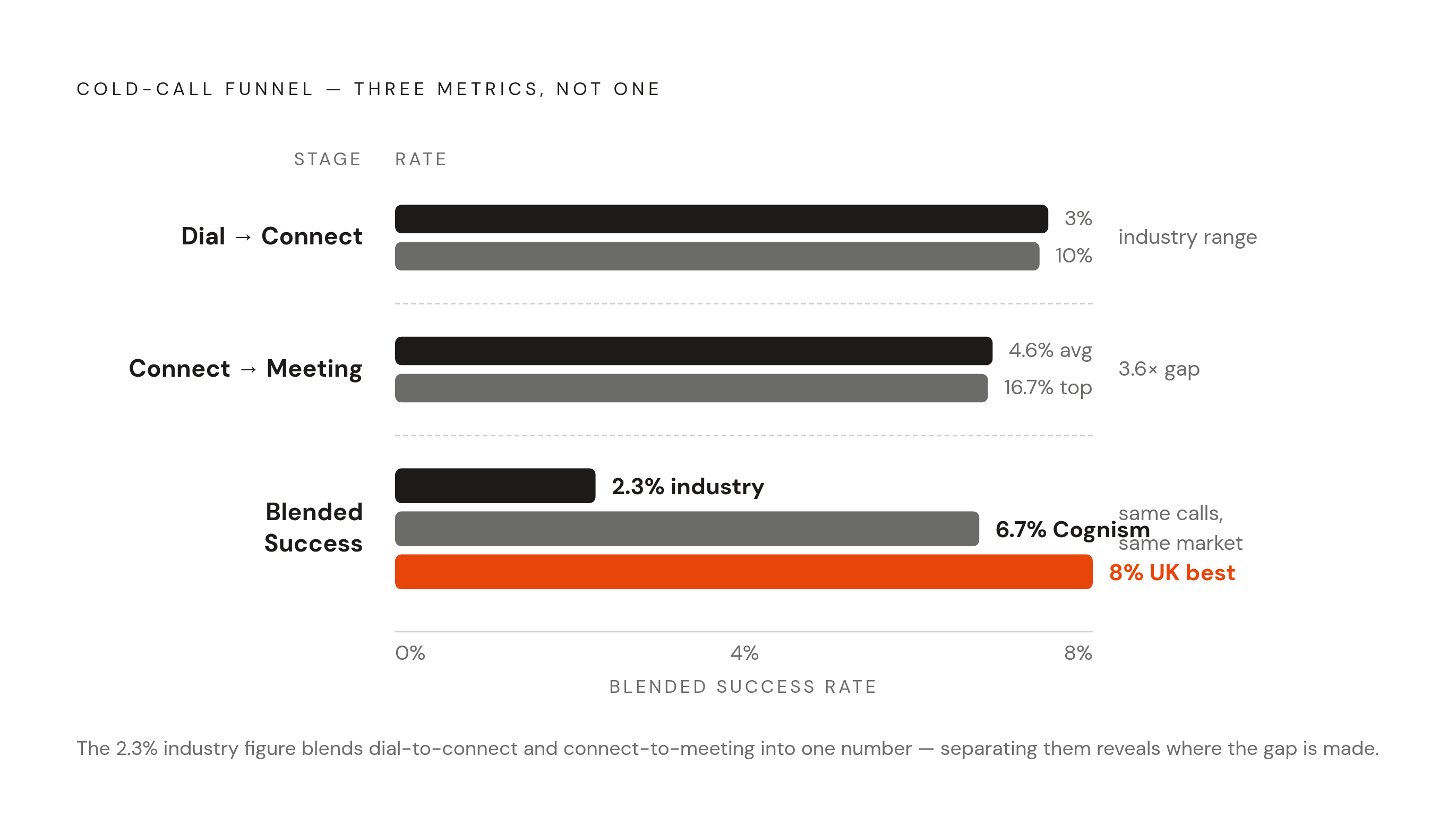
The 2.3% figure gets treated as gospel. It's actually a blend of at least three metrics that behave nothing alike. Dial-to-connect rate (the share of calls that reach a live human) runs somewhere between 3% and 10%, and climbs meaningfully with direct dials and verified data. Connect-to-meeting rate averages 4.6% but reaches 16.7% for top performers, according to SalesHive's B2B benchmarks. Then there's the blended 2.3%, the number that shows up in headlines because it's the scariest one available.
Collapsing these into one verdict hides where the losses actually happen, and most of them happen before anyone says hello. Consider voicemail: 81% of calls to unknown numbers go straight there. That sounds like a dead end, until you learn 67% of people actually check voicemails left by unknown numbers. That's not a failed touchpoint. That's a delayed one, and most reps write it off as wasted before it's had a chance to work.
Regional data makes the point sharper. Cognism's 2025 numbers show an 8% success rate in the UK, 6% in another region, 6% in the US. None of those resemble the blended 2.3%, because that average gets dragged down by teams dialing from bad lists and stale contact data, not by some ceiling built into the phone itself. Teams that read "cold calling doesn't work" off the aggregate number are usually looking at a data problem wearing a channel problem's clothes. Everything that follows depends on seeing that distinction clearly.
How data quality functions as the multiplier underneath every other variable
Bad data is a strategic issue that reaches far beyond some admin's job description. It's a strategic drain, and treating it as a footnote is probably the single biggest mistake outbound teams make. Poor data quality costs businesses an average of $12.9 million a year. Cold calling doesn't create that problem, it just inherits it, fully formed, the moment a rep pulls a list.
What does bad data actually do inside a calling operation? Wrong numbers inflate the dial count without producing a single conversation, so a rep logs 50 calls and has nothing to show beyond a sore dialing finger. Outdated contacts route reps to people who left the company eighteen months ago. Missing firmographic context means a rep dials without knowing company size or industry, forced into an opener generic enough to fit anyone, which is exactly the kind of opener that convinces no one. One study tracking over 55,000 dials found a 16.6% connection rate, a number that dwarfs the industry average dial-to-connect rate. If a team's connect rate is lagging, the data source is the first thing worth interrogating. Not the script.
Teams layering in intent signals to decide who gets called first, rather than working a static list top to bottom, consistently outperform the ones that don't. The gap comes down to who gets called, not how many times. Direct dials skip the gatekeeper. Verified numbers stop reps from burning calls on disconnected lines. Enriched records mean a rep knows the company's tech stack before picking up the phone, which matters more than it sounds, given that 82% of B2B buyers have accepted meetings from strategic cold calls. Preparation starts with the data a rep is handed. It doesn't start with how many times they rehearsed the opener in the mirror.
This is where AI-driven platforms actually earn their keep, and it's not by replacing judgment. A static list starts decaying the moment it's exported: people change roles, companies get acquired, numbers get reassigned to someone else entirely. Platforms that fold list building, contact verification, and intent signals into one workflow close that decay gap instead of leaving a rep to patch it together from three disconnected tools.
Timing and persistence, the execution variables most teams underinvest in
Two variables get treated as afterthoughts in most outbound playbooks, and both move the needle harder than almost anything else in this piece: when you call, and how many times you call. SalesHive's benchmarks found calling between 4 and 5 PM is 71% more effective than calling between 11 AM and noon. Change nothing else about a calling motion, just shift the window, and connect rates can lift 30% to 70%. That's a bigger swing than most script rewrites or training programs ever manage.
Day-of-week data points the same direction from two different angles. ZoomInfo's analysis of over 1.4 million calls points to mid-week as delivering the best pickup and booking rates, and other calling data consistently clusters the strongest booking days in that same window. Global teams calling across time zones lose this edge entirely if they don't adjust for it, since a perfect 4 PM slot in one office is the wrong hour somewhere else on the map.
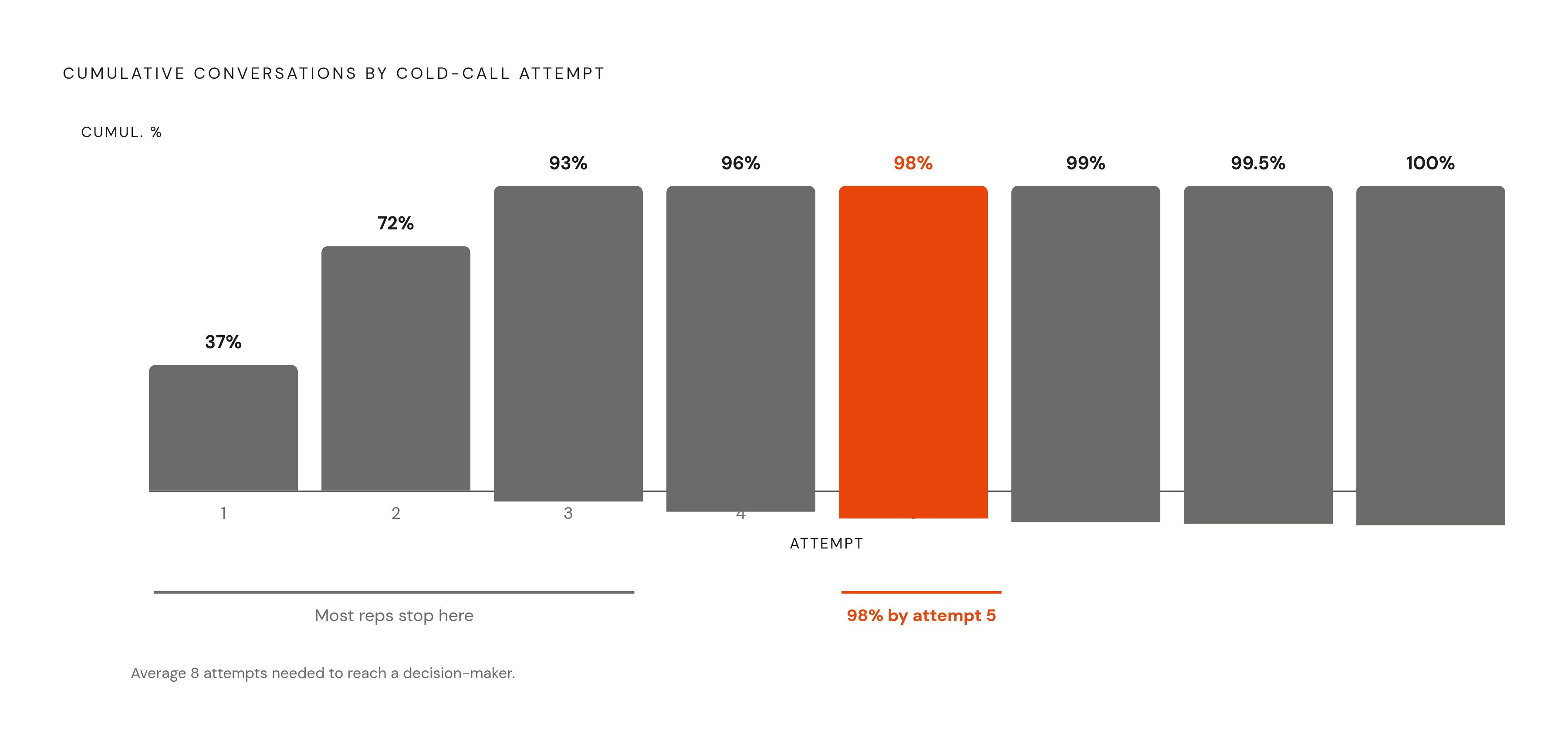
Persistence tells the starker story, though, and it's the one most reps get wrong on instinct. It takes an average of eight attempts to reach a decision-maker, and most reps quit after two or three. Cognism's data shows 93% of conversations happen by the third attempt, but that's conversations, not meetings, and reading it as license to stop dialing early is exactly backwards. Over 98% of conversations occur by the fifth call, which means the real opportunity sits in attempts three through eight, a range most reps abandon before they ever reach it. A typical outbound SDR runs 40 to 50 cold calls a day for 4 to 6 quality conversations, and that ratio only holds if the cadence is built to survive to attempt five instead of folding at attempt two.
Persistence is a systems problem. It's a systems problem, and it needs to be engineered with defined attempt counts and defined windows, rather than left to whatever a rep feels like doing after two rings go unanswered.
What happens during the call itself: why 93 seconds is the number that matters
Once a conversation starts, average length has crept from 83 seconds to 93 seconds, per Cognism's 2025 report. That's not decoration, it's a signal: the industry, at least among the teams doing this well, is drifting from rapid-fire dial volume toward fewer, more substantive conversations. Ninety-three seconds isn't long. But it's long enough to establish real relevance or blow the whole thing, and which one happens depends almost entirely on the first fifteen seconds of it.
The buyer on the other end isn't a blank slate. Most prospects arrive informed, so a generic pitch lands flat against someone who already knows the category basics and is listening for something they haven't already read. Millennials and Gen Z now represent a growing majority of B2B buyers, and that shift raises the bar further: these buyers take the call when the value is obvious and have close to no patience for an opener that could have been written for anyone in the market.
It's worth pausing on the assumption that senior buyers have gone dark on phone calls. They haven't. 57% of C-level and VP-level buyers say they prefer phone contact, which means the barrier was never the channel. It's relevance. Executives aren't screening out calls, they're screening out calls that don't sound like they were made specifically for them.
So what actually earns those 93 seconds? Referencing something real and recent, a funding round, a leadership change, a product launch. Knowing the prospect's role and the kind of pressure that role carries before dialing. Data cited in EBQ's 2025 roundup, drawn from Emblaze, found reps who lead with the buyer's problem rather than the product measurably outperform, and yet few reps actually do it. Calls also perform better outside of isolation. An email beforehand sets context, the call converts that context into conversation, and a LinkedIn touch afterward keeps the thread alive. The call that books the meeting is very often the one that opens with "following up on the note I sent Tuesday," rather than starting cold in the truest sense of the word.
How AI and intent signals are reshaping what "preparation" means before a dial
AI's footprint across sales orgs is wide but shallow right now, and that gap between adoption and depth matters more than the headline number. Gartner's 2025 Sales Technology Report puts AI usage at 89% of revenue organizations, up from 34% in 2023. Dig one layer down, though: of the 45% of B2B suppliers using AI in sales functions specifically, only 24% have deployed agentic AI, the kind that autonomously handles research and prioritization instead of just summarizing a call after the fact.
What does agentic AI actually change for a calling motion? It watches for intent signals in real time, a pricing page visit, a job change, a funding announcement, and surfaces the accounts most likely to convert before a rep ever dials. It enriches contact records automatically, so the rep opens the queue and finds context instead of a bare name and number. It coordinates the multi-touch sequence, email, call, LinkedIn, so the timing windows from the section above get hit systematically instead of depending on one rep remembering to check a clock. And it logs outcomes back into the CRM without someone typing notes at 6 PM, which keeps the pipeline feeding tomorrow's prioritization from going stale.
One documented comparison of AI agents against human reps found AI dramatically cheaper per touchpoint, yet human reps still generated meaningfully more revenue and higher meeting show rates. That's the honest read on where things actually stand: AI wins on coverage and prioritization, humans win on the conversation itself, and pretending otherwise in either direction is a mistake. McKinsey's October 2025 analysis of companies running AI-powered "next-best-experience" programs found revenue uplift in the 5% to 8% range. Not a revolution. A real, measurable edge, and worth taking seriously precisely because it isn't overhyped.
The architecture that seems to work splits the labor cleanly: AI handles list building, intent monitoring, sequence timing, and CRM sync, while the human rep owns the conversation on the phone. Neither piece replaces the other, and the platform question matters here too. A rep who has to log into three separate systems before dialing will, more often than not, skip the research step and dial cold in the least useful sense of the phrase. A rep looking at one prioritized, already-enriched queue doesn't have that excuse.
What separates the teams consistently hitting 6–10%+ from the ones stuck at 2–3%
The gap between a 4.6% average set rate and a 16.7% top-performer set rate is a process gap, a data gap, and a tooling gap stacked on top of each other. That framing matters because it means the gap is closeable by teams willing to change how they operate. It has nothing to do with hiring naturally gifted talkers.
Top-performing teams share a handful of habits, and none of them are exotic. They call from verified, enriched lists rather than static exports decaying since the day they were pulled. They build cadences around the 4-5 PM window and mid-week days instead of defaulting to whatever's open on a rep's calendar. They plan for the full average of eight attempts before writing an account off, instead of treating two unanswered rings as a closed door. They layer phone into multi-channel sequences: Research consistently shows hybrid cadences using phone, email, and LinkedIn together produce substantially higher reply rates than email running alone. They lead with the buyer's problem instead of a product pitch, even though, as noted above, only a small slice of reps manage this consistently. And they track connect rate and conversion rate as two separate numbers, so when performance dips, they know which half of the funnel actually broke.
Coaching matters more than it usually gets credit for. Cleverly's 2026 benchmarks found effective coaching lifts conversion rates by 38% and revenue per rep by 50%, which suggests the gap between average and elite teams is a feedback-loop problem just as much as a data or timing one. The best outbound teams treat every calling cycle as a data collection exercise, tracking what messaging landed, which objections kept recurring, which accounts actually connected, then adjusting before the next cycle starts rather than after the quarter ends.
For founder-led and early-stage teams, that fast feedback loop is arguably the single biggest edge cold calling has over content marketing or SEO. Thirty calls in an afternoon compress what would take weeks of A/B testing into real-time signal about whether a pitch actually resonates. That's not nothing for a team still figuring out who its ideal customer even is.
A practical starting framework for teams who want to move from average to top-performer range
Start with a data audit before touching anything else, because no amount of script polishing fixes a bad list. If connect rate sits below 10%, the list is the problem, full stop. Verify direct dials, enrich records with firmographic detail, and layer in intent signals so the question isn't just who to call, but who to call this week versus who can wait until next.
From there, rebuild the cadence. Sequences should plan for 5 to 8 attempts per account, spread across mid-week days with the 4-5 PM local slot treated as the priority touch, not an afterthought squeezed in when nothing else fits. Voicemail deserves a second look too. Since 67% of people check voicemails from unknown numbers, a short, specific message is a real touchpoint, not a wasted dial.
Before the phone rings, define what those 93 seconds need to accomplish. That means knowing the prospect's role, a recent trigger event worth referencing, and one specific problem the conversation should land on. The call doesn't need to close anything. It needs to earn a second one.
Metrics need to stay separated, too. Dial-to-connect rate tells you whether the data and timing are working. Connect-to-meeting rate tells you whether the conversation and targeting are working. Blending them back into one number, the exact mistake baked into the industry-wide 2.3% figure, just hides which half of the operation needs fixing.
Finally, look at the tooling stack itself. Fragmented systems, one tool for lists, another for dialing, another for sequencing, a fourth for the CRM, recreate the data decay problem from earlier and break the feedback loop that should sharpen each calling cycle. A unified system lets a five-person team run the same quality motion a fifty-person team runs, just at smaller scale. For founder-led teams especially, resist the urge to go wide with volume before that system exists. Twenty to thirty tightly targeted accounts a week, called with real precision, builds the ICP clarity and objection map that actually scales once headcount grows. Spraying wide before that clarity exists just produces more noise, not more meetings.
Sources
- 45+ Key B2B Cold Calling Statistics [2026]
- 83 Cold Calling Stats That Will Change How You Sell | EBQ
- 25+ Cold Calling Statistics 2026: Success Rates, Benchmarks & B2B Data
- Cold Calling Statistics: 2026 Benchmarks and Data for B2B Sales Teams
- Cold Calling Benchmarks for B2B Sales Teams (2026)
- Cold Calling Statistics 2025: What 10 Million Calls Taught Us