Emerging Outbound Channels Gaining Traction in 2026
Multichannel sequencing beats any single outbound channel today.

Cold email still works. It just doesn't work by itself anymore, and the data explains why. Response rates slid from notably higher levels in 2019 to a low single-digit percentage in the 2026 benchmark data, which isn't a bad quarter of copywriting catching up with someone. That's what a channel looks like once it floods past carrying capacity. Every channel in this piece exists because teams got pushed there by that flood, and the wrong move right now is treating any single one of them as the replacement. The right move, and the one this piece argues for, is combining them in sequence.
What "emerging channel" actually means in a 2026 outbound stack
Two things get blurred together constantly: channels that are new, and channels that just became effective at scale. LinkedIn direct messages aren't new. Reps have been sliding into inboxes there for over a decade. What changed is the ability to run AI-orchestrated LinkedIn sequences across hundreds of accounts at once, with agents watching for the right moment to send instead of a rep manually checking each profile between calls.
A channel earns the "emerging" label by clearing three bars, not one. The response or conversion numbers need to be climbing, not flattening out. Fast-growing GTM teams need to be documented actually using it, not just theorizing about it in a LinkedIn thought-leadership post. And the tooling needs to be mature enough to make it repeatable across a team, rather than dependent on the one rep who happens to have a knack for it.
This piece stays inside outbound: something a rep or an agent initiates. Inbound content flywheels and paid media sit outside that scope, whatever their other merits. Combining email, LinkedIn, and phone in a multichannel sequence lifts results by more than 287% compared to email alone, according to Martal research. That number settles the framing for everything that follows. The question was never which single channel wins. It's which combinations and sequences are earning attention right now, and in what order, and getting that order wrong is the single most common way teams waste a good channel.
AI-orchestrated LinkedIn outreach as a genuine channel, not a bolt-on
LinkedIn InMail pulls response rates between 18% and 25%, against cold email's low single-digit average. That's five to seven times the response rate, on a channel that still feels, for now, less spammed to the person receiving it. Buyers still experience LinkedIn as a place where a human is probably typing on the other end, at least relative to an inbox trained by a decade of mass blasts to feel like junk mail. That trust differential won't hold forever. It's real today, though, and it's measurable.
What AI orchestration adds isn't the message. It's the timing and sequencing logic underneath it. Agents watch for a prospect engaging with a post, trigger a connection request right after, and slot an InMail in alongside an email touch, personalized off a recent role change or a comment left three days earlier. No rep sits there tracking three hundred accounts by hand to catch that window, which is the kind of sequencing logic platforms like Cardinal, an AI agent platform for prospecting and outreach, are built to run automatically.
Two platforms show the range. 11x runs LinkedIn outreach as part of an autonomous motion alongside email, priced at a premium monthly rate, with phone handled as a separate capability. Amplemarket's Duo product takes a signals-based approach with a human still in the loop, spanning email, LinkedIn, and phone, priced between $600 and $5,000 a month depending on scope.
LinkedIn's own platform restrictions on automation tightened considerably in early 2026, and that isn't a footnote to skim past. A tool that works fine in December can get boxed in by January, and any team building this channel into a sequence needs to know exactly where the compliance line sits before betting a quarter's pipeline on it.
The mistake most teams make, and it's a common one, is running LinkedIn as the cold opener. That burns the exact trust differential that makes the channel work in the first place. LinkedIn belongs as the warm, middle touch in a sequence, never the first one. Sequencing carries as much weight here as the channel choice itself, maybe more.
Founder-led social selling as a distinct outbound motion, not personal branding
Founder-led outreach gets misread constantly as rep-led outreach with a nicer LinkedIn photo attached. That misses the mechanism entirely. Prospects extend more trust to a conversation that opens with a company's founder than one opening with an SDR they've never heard of, a dynamic driven by social proof and perceived authority, and that gap shows up in how people actually respond, not just in how they feel about it.
Sequence matters more than tactic here. A founder publishes point-of-view content on LinkedIn, builds authority over months rather than days, and that generates inbound interest on its own. Only then does the founder convert that warm interest into a direct outbound conversation, instead of cold-starting every exchange from zero the way a rep has to.
Research on LinkedIn lead generation finds that strategic, high-impact posting outperforms daily generic updates for qualified lead generation. The same report finds roughly a quarter of B2B marketers currently use some form of LinkedIn automation. Fewer, better posts beat volume, which is a different discipline entirely from firing off cold DMs all day. The outbound motion here gets triggered by a signal the content generated, never by raw send volume, and that distinction is the whole point of the channel.
Where this makes sense: early-stage founders without an inbound flywheel yet, niche ICPs where trust outweighs reach, cases where the founder's own expertise is genuinely the differentiator in the pitch. Where it doesn't work matters just as much. It doesn't replace direct outbound sequencing for accounts that haven't engaged with anything, and treating founder social as the pipeline itself, rather than the signal generator sitting upstream of pipeline, is the error worth naming directly.
Cost-wise, this is one of the more accessible channels going. LinkedIn's free tier or Sales Navigator runs around $100 a month, and a lean campaign built around it can run $250 to $600 a month total, per research from sales-echo.com. That's a real number for a founder deciding whether to build this channel before the first SDR hire.
Intent-triggered outreach as the mechanism that makes every channel work harder
Signal-based outbound stops asking "who should we reach out to this month" and starts asking "who just gave us a buying intent signal today." That's a different targeting logic altogether, and it changes what "personalized" even means once it takes hold.
Emails referencing a specific signal, a funding round, a leadership change, a hiring surge, land response rates between 15% and 25%, according to the 2026 Cold Email Benchmark Report as cited in Autobound's cold email guide. That's roughly five times the low single-digit baseline. Speed compounds it, and pipeline velocity depends on it: outreach sent within 48 hours of a funding event converts at a rate 400% higher, per DataNorth AI research. The signal matters, but how fast someone acts on it matters just as much, maybe more.
What signals are teams actually watching? Funding events suggest fresh budget and new initiatives, often reshaping ICP fit overnight as headcount and priorities shift. Executive changes tend to reset buying criteria overnight. Hiring surges point to a new function being built, or a pain point just now emerging. Technology stack shifts often mean an incumbent vendor is on its way out. Pricing page visits are first-party intent, arguably the strongest signal of the bunch, because the prospect is telling a company directly what's on its mind.
Tools like Apollo.io and Clay have shifted from static contact lists to live data streams, refreshing contact databases roughly every 30 days to keep bounce rates down. Clay handles enrichment through what it calls waterfall enrichment, layering multiple data sources together, with paid plans starting at $185 a month. Apollo.io covers intent signals and AI sequencing across email, LinkedIn, and phone, with a free tier and paid plans starting at a low monthly per-user price.
Smaller and sharper beats bigger and broader here, and the gap isn't small: campaigns sent to tightly targeted lists consistently outperform broad sends by a significant margin, a pattern well documented across outbound benchmarks. That gap is driven entirely by how tightly the list was built, and it's the actual lesson buried in intent data. It isn't a bigger addressable market. It's a smaller, better one, and teams that keep expanding their list instead of tightening it are optimizing the wrong variable.
AI voice agents as a maturing outbound channel for qualification and follow-up
Voice agents have gotten fast enough to feel almost normal on a phone call, with response latency now running roughly 600 to 800 milliseconds according to DataNorth AI. That's close enough to human latency that the pause doesn't register as robotic to most callers.
These agents now handle a meaningful share of initial inquiries without a human ever joining the call. In recorded tests, an agent acknowledges an objection, asks a clarifying question about whatever solution the prospect currently uses, and pivots into a pre-loaded differentiation angle built for exactly that scenario. Once a lead clears the qualification bar, the agent pushes structured data straight into the CRM and sets the deal stage itself. No rep has to run that handoff by hand.
Voice belongs in a sequence as a follow-up channel after email or LinkedIn has already put context in front of the prospect, or as an inbound qualification layer for high-intent visitors landing on a website. Treating it as a standalone cold-call replacement at scale is a stretch most teams aren't ready for, and probably shouldn't be chasing yet.
Worth being blunt about the boundary: these agents are good at securing a meeting. They are not good at closing a complex deal, and that's fine, because closing was never the job. Gartner predicts that by 2027, 70% of multiagent systems will run on narrowly specialized agents rather than generalist ones, which improves accuracy but adds coordination complexity on the back end. Voice agents slot into that architecture in the qualification role, not the closing role. Getting the channel running takes defined objection-handling scripts, a CRM integration that can actually receive the structured handoff, and a clear trigger point for when a human needs to step in.
AI-powered chat as an outbound-activated inbound channel
Chat earns its place in an outbound conversation only because of what triggers it. An outbound email or LinkedIn touch drives a prospect to a pricing page, and a chat agent engages that visitor right then, at the exact moment interest peaks, before the tab closes and the prospect forgets the company exists.
That's a different animal than the generic "how can I help you" widget sitting on most websites doing nothing. It runs off the same signal layer described in the intent section above, and works best when the agent already knows who the visitor is from a prior outbound touch, rather than opening cold every time.
Three named platforms show how this plays out depending on the stack underneath. Fin for Sales, built on Intercom's Fin AI platform, covers chat, email, WhatsApp, social, and SMS, handling qualification, product discovery, objection handling, and meeting booking. It runs on outcome-aligned pricing instead of per-seat, integrates natively with Salesforce, HubSpot, and Attio, and connects to tools like Marketo and Chili Piper through data connectors. It's inbound-only, with no outbound prospecting, and it requires the Intercom platform underneath it to function.
Qualified's Piper product is Salesforce-native, built for enterprise teams, engaging website visitors with Salesforce data and booking meetings on the spot. Pricing runs into the tens of thousands of dollars a year, firmly enterprise territory, best suited to Salesforce-centric teams with real traffic to work with. HubSpot Breeze sits inside HubSpot's existing plans, handling website chat and email for teams already living in that ecosystem, with deeper enrichment available through Breeze Intelligence as a separate, credit-based add-on rather than something bundled in.
None of the three convert particularly well on a cold visitor with zero context, and that's the tell. Outbound sequencing is what fills the top of this funnel with people worth engaging in the first place. The two motions depend on each other more than they compete.
Direct mail and dimensional outreach as a high-conversion channel for target accounts
Physical mail gets opened. Physical mail open rates are widely reported to exceed those of cold email, a gap that helps explain why the channel has persisted. That gap alone explains why direct mail never disappeared, even as every other channel got automated into noise.
Response rates compare favorably to typical digital ad performance, and that's before factoring in dimensional mail specifically: personalized gifts, handwritten notes, creative physical packages sent to a named account instead of a list. Dimensional mail is the highest-signal version of this channel precisely because it can't be sent to a thousand people at once. Someone has to build it for one account, by hand, on purpose.
This fits account-based marketing plays aimed at a defined, high-value list, often deployed as a pattern-interrupt after a prospect has gone quiet across several digital touches. The constraint is obvious, and worth stating without softening it: cost and labor make this a poor fit for volume. It's a precision tool built for a short list, not something that scales to thousands of sends a month, and forcing it there wastes the exact thing that makes it work.
It performs best triggered by something specific: a funding announcement, a conference the prospect just attended, a job change posted on LinkedIn that morning. Sent as a generic gift blasted to a broad list with no context behind it, it's just an expensive email. For early-stage or founder-led teams without enterprise budget, dimensional mail aimed at a tight list of 20 to 50 dream accounts is genuinely within reach. It doesn't take a large budget. It takes selectivity about who makes the list, and some creativity in what lands on their desk.
How multi-agent systems orchestrate these channels into a single connected motion
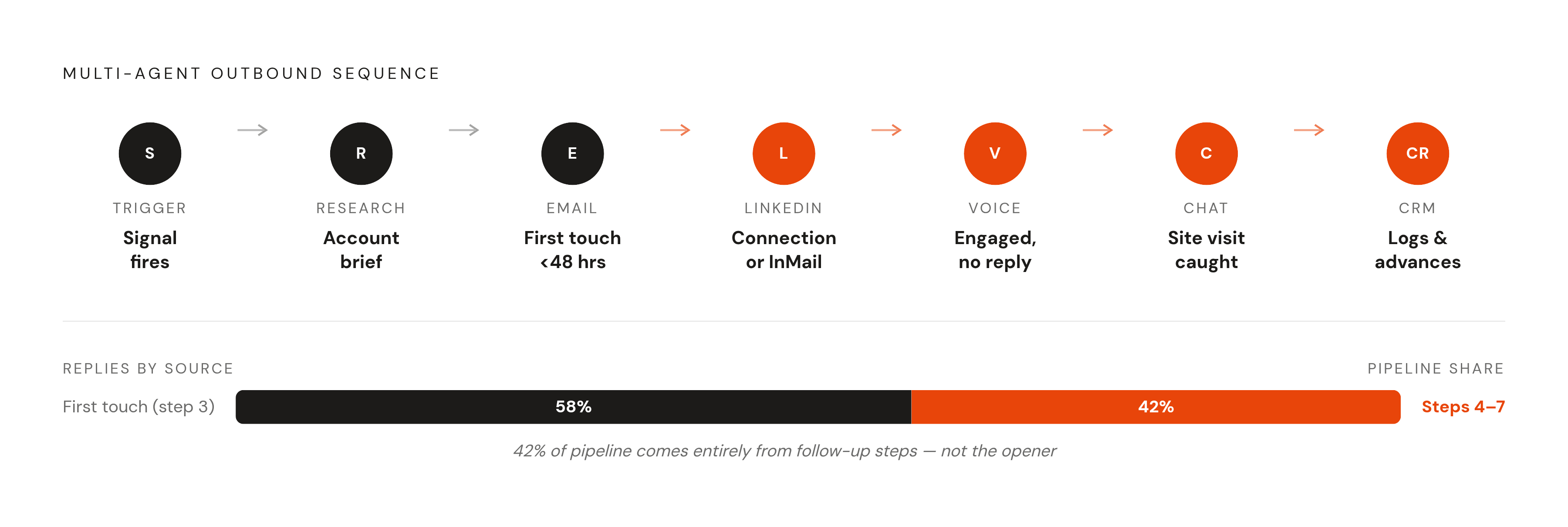
By 2026, running multiple channels at once isn't a differentiator. It's the floor everyone starts from. The real strategic question has moved past "which channel" into "how do these channels sequence against each other based on what a prospect just did an hour ago."
Multi-agent architecture is how that sequencing gets built in practice. One agent specializes in prospecting and watching for signal. Another drafts and sends the outreach itself. Another manages qualification, whether by voice or chat. Another handles CRM sync and moves the deal stage forward without waiting on a rep to remember. Each agent does one job well, rather than one system trying to be good at everything and ending up mediocre at most of it.
The sequencing logic that tends to produce results follows a fairly consistent shape. A signal fires: a funding event, a pricing page visit, a job change posted that week. A research agent builds an account brief within minutes. An email agent sends a signal-anchored first touch inside 48 hours. A LinkedIn agent follows with a connection request or InMail as the second touch. A voice agent calls accounts that engaged but never replied. A chat agent catches the prospect if it lands on the website afterward. A CRM agent logs all of it and advances the deal stage on its own.
Here's the number worth sitting with, and it's the one that should reorganize how teams spend their attention: the first email in a sequence captures 58% of all replies, according to Unify GTM data, which means the remaining 42% come entirely from the follow-ups after it. Nearly half of pipeline sits in the follow-up sequence, not the opener. That alone makes multi-touch orchestration a requirement, not a nice-to-have feature bolted on for show.
Top-decile campaigns, the ones built on tight signal discipline and careful sequencing, clear reply rates of 10.7% or higher according to the 2026 benchmark data. The distance between that number and the median campaign has less to do with which channel got picked and more to do with how disciplined the signal-and-sequencing work was underneath it. Teams that go shopping for a new channel when the real gap was in the sequencing the whole time are solving the wrong problem, and no amount of new tooling fixes that.
Two platforms show what this orchestration looks like inside existing CRM infrastructure. Salesforce's Agentforce embeds AI agents directly into Salesforce, generating quotes autonomously, triggering approval workflows, and updating deal stages without a rep touching each one, priced at $2 per conversation or through Flex Credits at $500 per 100,000 credits. Gong's Big Dipper scores very highly on autonomy for deal execution tasks, drafting follow-ups, updating CRMs, and flagging deals that need attention before they go cold.
None of this replaces judgment. It relocates judgment, from deciding whether to send email number four to deciding whether the entire signal-to-sequence architecture is watching the right accounts in the first place. Cold email didn't die. It got outcompeted by everything built around it, the moment volume alone stopped being enough to carry a quarter on its own.