What a Healthy Outbound Pipeline Looks Like at Each Funding Stage
How outbound sales strategy shifts across pre-seed through Series B.

A healthy outbound pipeline at pre-seed would look like negligence at Series B, and a healthy Series B motion would have been impossible to build at pre-seed. That is the governing idea behind everything that follows: "healthy" is a stage-relative judgment, defined by what outbound is actually supposed to accomplish at that point in the company's life, not a fixed benchmark measured in meetings booked or reply rates cleared. At pre-seed, outbound exists to invalidate assumptions. At seed, it exists to find a pattern. At Series A, it exists to become a system someone other than the founder can run. At Series B and beyond, it exists to scale that system without cutting the signal that made it work. Founders who misjudge which job outbound is doing at their current stage tend to fail in one of two predictable directions: they automate noise before they understand what they are automating, or they leave pipeline on the table by refusing to build the infrastructure their growth now requires.
Pre-seed: outbound as a founder's instrument for learning, not lead generation
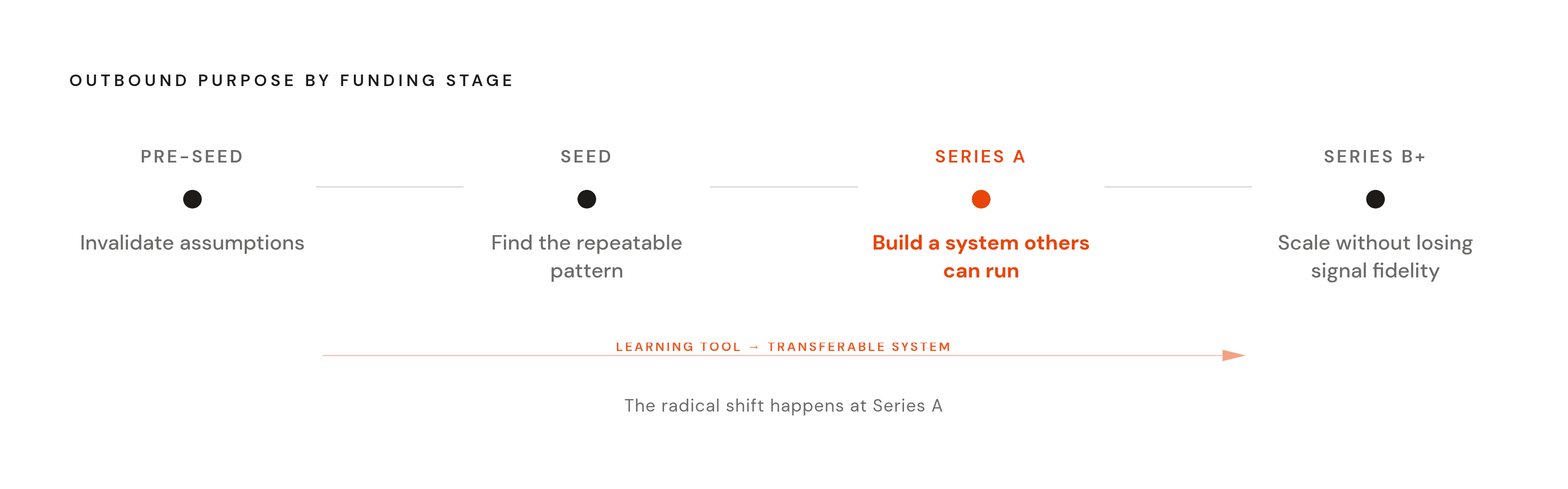
At pre-seed, a healthy outbound pipeline is measured in assumptions invalidated and ICP hypotheses tested, one conversation at a time, with the founder on every call and in every thread. The question outbound is answering here is narrower and more fundamental than "can we generate pipeline?": who has the problem, how acutely do they feel it, and will they actually pay to solve it? Every touch should be built to answer a piece of that question. Volume is not the point and should not be treated as one.
Superhuman Prospecting's early-stage playbook frames this cleanly: relevance beats volume, and ICP clarity has to exist before a founder buys a single sequencing tool. That ordering matters. A founder who defines the ICP first and reaches out by hand can correct course after five conversations. A founder who buys a sequencer first has already committed to a message and a list before learning whether either one is right. Unify's early-stage outbound guidance makes a similar case for keeping the motion founder-led until the targeting and messaging are teachable: the value of the founder doing this work personally is that mistakes are cheap and immediately visible, rather than scaled across a list before anyone notices they are mistakes.
The ICP itself should not come from a database filter at this stage. It comes from reverse-engineering the five best hypothetical buyers: who they are, what they do all day, what would make this problem urgent enough to act on. The filter, the firmographic criteria, the technographic targeting, comes later, once reality has had a chance to correct the theory. Tooling should stay deliberately minimal. What it requires is discipline: blocking calendar time for outreach, writing short and specific messages instead of templated ones, and logging every objection, every phrase a prospect uses, every signal of real interest or real indifference, immediately after each call.
A healthy pattern at this stage looks like a small number of highly specific conversations each week, each one feeding directly back into the next week's message. There is no pipeline coverage ratio to hit at pre-seed, no quota to defend in a board meeting. MERGE-SKIP
Seed: finding the repeatable pattern before hiring anyone to run it
The question changes at seed. It is no longer "will anyone buy this?" It becomes "which type of buyer converts, on what message, through what channel, and how fast?" A healthy seed-stage pipeline is legible: it produces enough consistent signal that the founder can see what is working and what to try next, even if the numbers aren't where they'll eventually need to be.
ICP definition tightens considerably at this stage. The early hypothesis, built from five imagined buyers, gets replaced by firmographic criteria (company size, industry, geography, funding stage) layered with behavioral triggers (hiring patterns, recent funding announcements, leadership changes). The Pipeline Lab's 2026 outbound strategy guide states the underlying logic: strong segmentation improves relevance, reply rates, and meeting quality, while weak segmentation produces random results no matter how well-crafted the message is.
Signal-based triggers earn their place in the process here. It is an argument for reaching the same qualified prospect through more than one door.
A/B testing starts to matter at seed in a way it didn't before, because there is finally enough volume to read the results. Email deliverability is one underrated piece of infrastructure that deserves attention here too. Secondary sending domains, proper authentication records, and a deliberate warm-up period before a campaign launches are not optional plumbing. They are why messages land in an inbox instead of a spam folder, and a seed-stage team that skips this step can sabotage a perfectly good message before a single prospect ever reads it.
Tooling expands modestly to match the expanded scope of what founders now need to learn. A signal detection layer, basic enrichment, and a sequencer get added to the stack, but the purpose of each is to make the founder's outreach more informed, not to replace the founder's judgment about who to contact and what to say. A healthy seed pipeline has enough volume to read conversion rates at each funnel stage, clear data on which ICP tier responds fastest, and a message framework that has already been revised at least three times based on real replies. An unhealthy one grows in volume without growing in legibility: more meetings booked, but no visible pattern in who actually converts, or a stack of tools quietly generating data that nobody is reading.
Series A: translating the founder's intuition into a motion others can run
At Series A, the outbound motion is only as healthy as its transferability. What worked at seed worked because the founder was in every conversation, noticing nuances no dashboard could capture. That same dependency becomes the company's growth ceiling the moment it tries to add a second person to the motion.
The job of outbound at Series A is not discovery. Discovery happened at seed. The job now is codification: turning what the founder learned into a system that a first sales hire, or a small team, can run consistently without the founder present for every call. This reframes the hiring question in a useful way. Who can operate the motion and instrument the feedback loops that keep it honest matters more than who can simply execute outreach, because a hire who executes without understanding the underlying signal logic will drift from the pattern the moment things get busy. Technical operators who can build repeatable sequences, read signal data, and maintain data quality earn more value at this stage than hires chosen purely for dialing volume.
Pipeline coverage ratios become meaningful for the first time here. Earlier stages didn't have enough consistent volume for a coverage math to mean much. At Series A, the company needs enough pipeline at each stage to cover its close rate, and that relationship between coverage and capacity has to be visible to the team, not something only the founder can sense. Process details that seemed unnecessary earlier start paying for themselves: auto-advance rules for early prospecting stages, alerts when a deal has sat too long at a given stage, follow-up sequences triggered automatically by stage movement. Each of these reduces the manual upkeep that, left undone, produces the inconsistent CRM records that quietly corrupt every pipeline metric built on top of them.
Personalization has to become a shared asset instead of a founder habit that lives only in one person's head. The Pipeline Lab describes a trigger-to-CTA architecture that captures this well: Trigger, Problem, Impact, Proof, CTA, a structure specific enough to teach and loose enough for a team to iterate on as they learn. AI tools at this stage work best as amplifiers for plays that are already defined, executing a known structure faster, rather than as autonomous systems expected to invent the right message on their own. The plays need to exist first. Automation earns trust by executing a proven play reliably, not by guessing at one.
A healthy Series A pipeline is one the founder can step back from without it collapsing. That means a first hire who understands both the ICP and the signal logic behind it beyond just the script, and a CRM that reflects what is actually happening in the pipeline rather than a hopeful version of it. Letting go of a motion that worked specifically because the founder was personally involved takes deliberate effort. It does not happen on its own, and treating it as a natural handoff rather than an engineered one is where many Series A outbound motions quietly stall.
Series B and beyond: scaling a proven motion without losing signal fidelity
The risk at Series B is not that outbound is too small, but that the speed demanded by scale dilutes the signal fidelity and personalization discipline that made the motion work. The pattern is known by now. Holding onto what made that pattern precise while expanding it across new segments, new geographies, and a larger team executing it is the challenge.
Market expansion becomes the primary GTM focus, and that means the ICP cannot simply be assumed to transfer intact into a new vertical or a new region. The scorecard changes too: net revenue retention, expansion revenue, and segment-level unit economics sit alongside new pipeline as what the company actually tracks. Outbound now has to coordinate with expansion motions rather than operate purely as a net-new acquisition engine. Full-funnel diversification becomes deliberate at this stage rather than opportunistic: outbound into a new vertical runs as a bounded experiment, parallel to the core motion, with its own acceptance criteria for whether it earns more investment or gets shut down.
Signal prioritization gets more structured as the company scales, because not every trigger carries the same weight in every segment. Tiering those signals is what keeps the team's attention on the ones that actually predict a meeting.
Agentic AI becomes genuinely viable as a scaling layer here, but only for motions that are already defined and proven. Agents deployed before that motion is defined just produce autonomous noise at a faster clip than a human ever could. The value of AI at Series B is execution speed on a known play, not invention of a new one.
Governance infrastructure stops being optional at this scale. Orchestration rules that prevent overlap, cap touch frequency, and route each contact to the correct sequence keep a motion scaling cleanly instead of scaling its own reputational damage. A healthy Series B pipeline runs the core motion at consistent efficiency in its established segment, tests parallel experiments in new segments with clear stop-or-scale criteria for each, and surfaces, through its data infrastructure, which signals and messages are actually producing meetings rather than just which campaigns are sending volume. What the team cannot see in that data, it cannot improve.
The two failure modes that cut across every stage: over-automating early and under-investing late
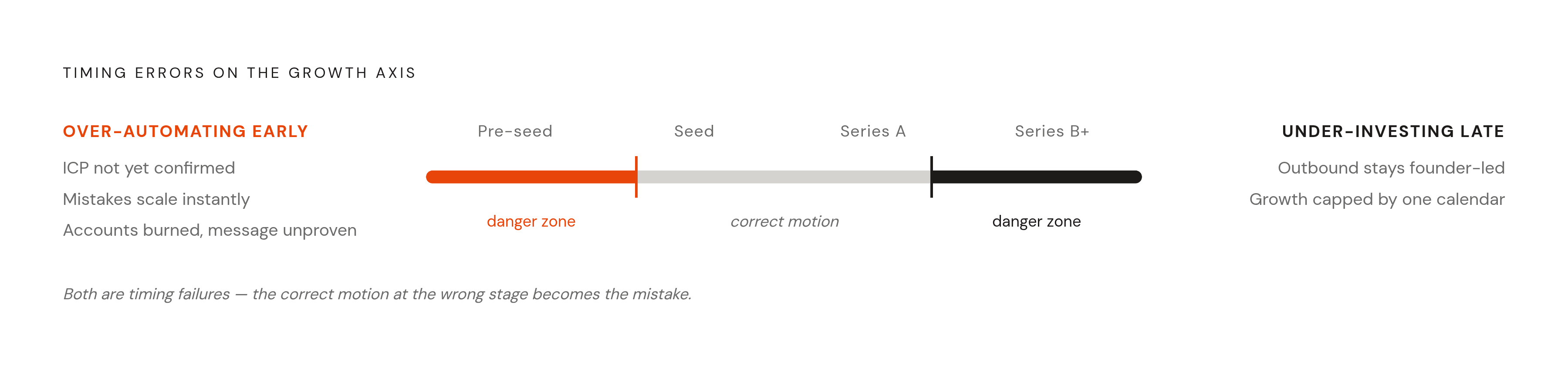
Nearly every outbound pipeline failure traces back to one of two timing errors: automating before the pattern is understood, or refusing to systematize after it has already been proven. Recognizing which one applies is the first real step toward fixing it, and the two errors sit at opposite ends of the company's growth, which is part of what makes them easy to miss from the inside.
Over-automating early means deploying sequencing tools, AI agents, or high-volume campaigns before the ICP is tight and the message has been tested against real replies. Worse, it burns through accounts that might have converted later, once the targeting and message were actually right, and those accounts don't always give a company a second chance. The Pipeline Lab names the mechanism directly: automation without QA scales mistakes instantly, and bad personalization tokens or irrelevant triggers damage credibility at precisely the moment when credibility is the only real asset a pre-seed or seed company has to spend.
Under-investing late is the mirror error. A company that keeps running outbound as a founder-touch, judgment-dependent motion well past Series A caps its own growth at the size of one person's calendar. The instincts and relationships that produced the company's earliest wins become, paradoxically, the ceiling that prevents its next phase of growth, because nothing about that approach can be taught, measured, or handed to a second person without losing most of what made it work.
Diagnosing which failure mode applies starts with a short set of questions tied to where the company actually sits. At pre-seed, the question is whether outreach is teaching the founder something specific about the buyer with every batch of conversations, or whether it has quietly turned into a numbers game measured by opens and sends. At seed, the question is whether the data coming back is legible enough to show which ICP tier and which message are actually converting, or whether volume has grown without any accompanying clarity. At Series A, the question is whether the motion could survive the founder stepping away from it for a month. At Series B, the question is whether the systems in place can tell the team which signals and segments are earning their investment, or whether scale has outrun the infrastructure needed to measure it. The stage tells a founder which question to ask. The honest answer tells them which of the two failure modes they are actually living inside.