How Many Outbound Touches It Takes to Book a Meeting Today
Top performers book meetings in five touches, not eight, by choosing the right channels.

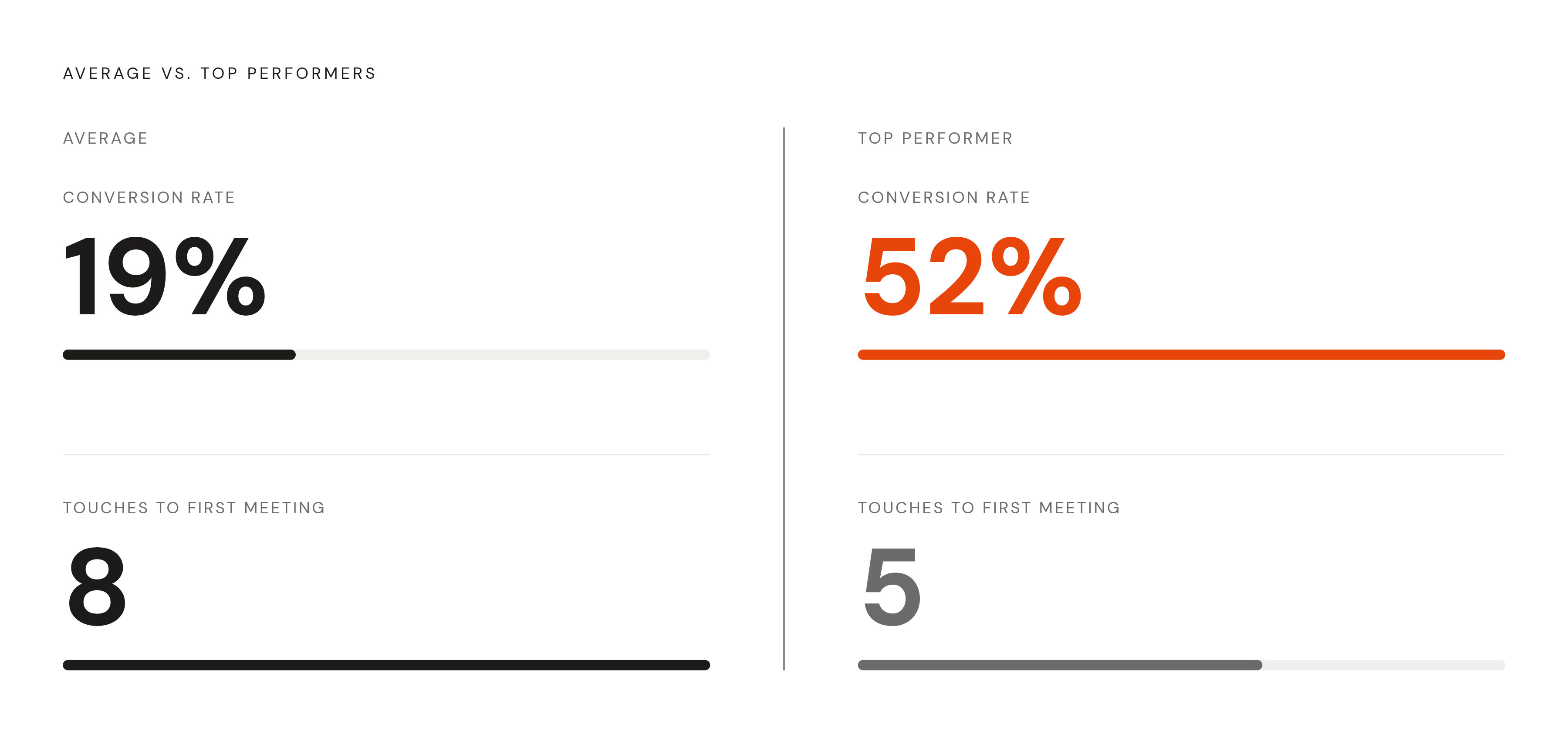
RAIN Group finds that booking a first outbound meeting takes 8 touches on average. Top performers do it in 5, and they convert at 52% compared to 19% for everyone else. That gap, three touches and a 33-point swing in conversion, is the real story here: it's not about grinding out more attempts, it's about a set of decisions around channel, timing, and message design that compress the number without cutting corners on quality.
Why the 8-touch average is the right starting point, and what it measures
Start with what "8 touches" actually counts, because this number gets misquoted constantly. RAIN Group's figure refers to active, sales-initiated outreach: cold emails, cold calls, LinkedIn messages, voicemails. Things a rep or an SDR does on purpose, in sequence, to get one person to say yes to a meeting.
That's a different animal from the 222-to-266 total-touchpoint figures HockeyStack found in broader buyer-journey research. Those numbers count everything: ad impressions, content downloads, retargeting hits, a prospect skimming a case study at 11pm on a Tuesday. One measures how hard a rep has to work to get a meeting, while the other measures how long and winding the road to purchase actually is, most of which sales never sees or controls directly. One measures how hard a rep has to work to get a meeting. The other measures how long and winding the road to purchase actually is, most of which sales never sees or controls directly.
So when a sales leader says "our average is 11 touches, we're above benchmark," the first question to ask is: 11 touches of what, exactly? If that number includes marketing touches, it's not comparable to RAIN Group's 8. Mixing the two is one of the most common measurement errors in outbound planning, and it quietly wrecks a lot of pipeline forecasting.
What's making the average creep up in 2026
Cold email used to work harder per touch than it does now. Reply rates have fallen steadily: 8.5% in 2019, down to 5% by 2025, and 3.43% industry-wide heading into 2026. Each drop in reply rate means the same outcome now needs more attempts to reach it. That's simple arithmetic, but it's easy to miss when a team is used to thinking about touch count as a fixed, stable number rather than something that moves with the deliverability environment.
Part of that decline traces back to inbox infrastructure getting stricter, not friendlier. Google enforces SMTP rejection codes (permanent 5xx errors, temporary 4xx errors) more aggressively than it used to, and Microsoft now requires authentication for bulk senders. Crossing the platform's bounce rate and spam complaint thresholds causes a domain's deliverability to take a real hit. These aren't soft guidelines anymore. They're hard infrastructure limits that determine whether a message lands in an inbox at all, regardless of how good the copy is.
Open rates, meanwhile, have become close to useless as a diagnostic. The average is around 27.7%, but Apple Mail accounts for roughly 49.29% of all opens, and it preloads tracking pixels automatically whether or not a human ever looks at the message. A team optimizing subject lines against open rate data is optimizing against a number that's nearly half noise. Reply rate and meeting rate remain the honest signals; open rate, at this point, is mostly a ghost.
Then there's the buyer side of the equation. A typical B2B purchase now pulls in something like 13 internal stakeholders and 9 external influencers. Reaching one person was never really the job, but it's gotten harder to pretend otherwise. More people in the room means more touches required just to get the account, not the individual, moving.
Deal size, buying committee complexity, and the target number
The 8-touch average isn't one-size-fits-all, and treating it as a universal target ignores what actually happens at different deal sizes. SMB and transactional deals tend to close in fewer direct touches and shorter cycles: fewer stakeholders, less to lose. Mid-market deals require more touches than SMB on the sales side, and the full buyer journey, including marketing and self-serve research, averages around 76 touchpoints. Enterprise deals with a $100K-plus annual contract value require significantly more direct touches, with the full journey stretching to somewhere between 266 and 417 touchpoints.
Here's where it gets interesting. A mid-market deal that "takes 8 touches" means 8 touches distributed across a champion, an economic buyer, a technical evaluator, and someone in procurement, not 8 touches to one person. It means 8 touches distributed across a champion, an economic buyer, a technical evaluator, and someone in procurement. Multi-threading isn't a nice-to-have tactic layered on top of the sequence; it's baked into what that touch count actually represents. A deal where multiple contacts are engaged is less dependent on a single champion carrying the message internally, and in practice, they often don't.
So if an 8-touch sequence isn't producing meetings, the instinct is to blame the copy or the channel mix. Is every one of those touches landing on the same person? A perfectly written sequence aimed at the wrong (or only) contact will stall no matter how many times it's sent.
Why channel mix matters more than touch count alone
Touch count is only half the equation. Channel matters just as much, maybe more, and the data backs that up clearly. SyncGTM finds that multichannel cadences, combining email, LinkedIn, and phone, outperform single-channel sequences by 2 to 3x in reply rate. Teams running email alone are seeing reply rates well below the already-thin industry averages, with cost-per-meeting figures that run well above what multichannel teams pay for the same outcome. That gap reflects something structural rather than who writes better emails. It's structural: a prospect who ignores an email might still answer a phone call, or notice a LinkedIn connection request, simply because it interrupts a different part of their attention.
A well-built sequence spreads touches, evidence points to 6 to 12 as the effective range, across multiple channels over roughly 14 to 21 days, and each touch does something different rather than repeating the same ask in a slightly different font. One version of that sequencing logic looks like this: day 1, an email with a pattern-break opener; day 2, a LinkedIn profile view and connection request; day 4, a second email with a specific piece of value and a soft call to action; day 6, a LinkedIn message if the connection went through; day 8, a cold call paired with a voicemail; day 11, a third email carrying a case study or proof point; day 15, a break-up email; day 21, a LinkedIn like or comment to stay visible without asking for anything.
Notice what's happening across that sequence: no single channel carries the whole weight, and no touch just repeats the last one. Switching channels resets the prospect's attention each time, and that reset, not some magic property of LinkedIn or the phone individually, is the mechanism behind the 2-to-3x lift.
What the cold calling numbers look like in 2026
Cold calling still works, but the benchmark for how many dials it takes has shifted. The average is 25 to 35 dials to book a meeting; top performers compress that down to 12 to 18. What explains the difference? Three compounding ratios: connect rate, conversation rate, and meeting conversion rate, multiplied together. The single biggest lever inside that chain is data quality, meaning accurate phone numbers and correct contact information, not raw call volume or a sharper script.
Segment shifts the numbers further. SMB calling tends to need fewer dials because decision-makers are more reachable directly. Mid-market is in that 25-to-35 range, partly because VP and Director-level calendars are saturated with meetings and hard to break into. Enterprise and account-based motions run meaningfully higher, a function of longer sales cycles and the multi-threading requirement discussed above; reaching one person by phone rarely moves an enterprise deal on its own.
Outbound-focused SDRs typically dial 50 to 80 times a day, while reps working inbound leads make 30 to 50. But raise the volume without fixing the underlying ratios, and the numbers barely move. Dialing more doesn't fix a bad list or a weak opener; it just produces more failed attempts, faster.
The single biggest lever: outreach triggered by buying signals
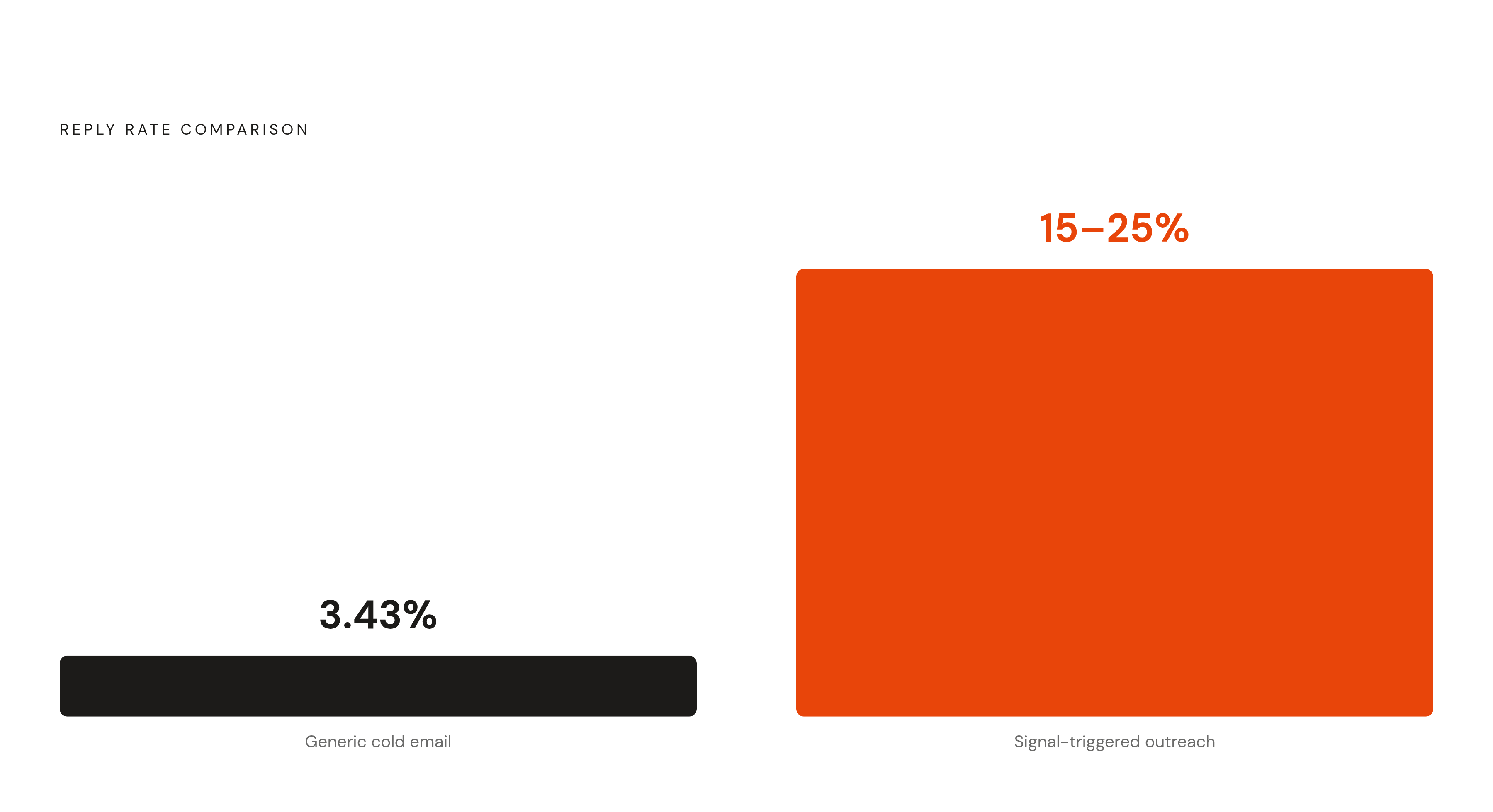
Everything above assumes outreach is happening in a vacuum, one contact, one sequence, timed on a calendar rather than triggered by anything happening in the account. Signal-triggered outreach breaks that assumption, and the results show why it matters so much. Messages sent in response to a real buying signal see reply rates of 15 to 25%, compared to the 3.43% industry average for generic cold email. That's a difference in kind, not a marginal improvement. It's a difference in kind.
What counts as a signal? A funding round, a new executive hire, a spike in research activity around a category, a past customer who just landed at a new company, a visit to a pricing page, anything observable that suggests an account is moving closer to a purchase decision rather than sitting still. Five signal types tend to matter most: first-party web activity, intent data from review sites, third-party topic surges, event-based signals (conference attendance, webinar sign-ups), and champion moves, a known buyer changing jobs.
Timing is where most teams leave value on the table. A signal loses most of its power if outreach doesn't follow within 24 to 48 hours. Wait a week, and the moment that made the message relevant has usually passed, the prospect has moved on to the next thing, and the outreach lands as just another cold touch with none of the advantage a timely signal would have given it.
Message design: why every follow-up must carry a new idea
Most sequences fail because every touch says roughly the same thing in a slightly different wrapper. They fail because every touch says roughly the same thing in a slightly different wrapper. A follow-up that reads "just wanted to bump this to the top of your inbox" isn't a touch, it's a placeholder, and prospects can tell the difference immediately. People reply because a message gave them something worth responding to, not because a rep persisted long enough to wear them down.
Assign each touchpoint exactly one job, and don't let it do double duty. Touch 1 opens with something that breaks the pattern and includes one specific insight relevant to the account. Touch 2 is a voicemail that references the first email, adding a voice and a second channel without repeating the pitch. Touch 3 delivers a real piece of value: a benchmark, a case study, a data point that stands on its own even if the prospect never buys anything. Touch 4 is soft, a comment on something the prospect posted, not a pitch disguised as engagement. Touch 5 brings in customer proof or ROI numbers, doing the work of social validation. Touch 6 makes a direct ask with a specific agenda attached, not a vague "worth a quick chat?" Touch 7 gets ahead of the most common objection for that buyer profile before it's even raised. Touch 8 is the clean break-up message, giving the prospect (and the rep) permission to close the loop without lingering.
On LinkedIn specifically, a couple of tactics interrupt the pattern in ways plain text doesn't. A voice note under 30 seconds stands out mostly because almost nobody sends them, so it registers as different by default. A short video does something similar: when a string of text messages has gone unanswered, a different format gives the prospect a new reason to engage that doesn't feel like the same ask recycled again.
AI revenue agents and the touch equation for high-growth teams
By the end of 2026, the expectation across much of the industry is that most of the initial outreach, the first email, the first LinkedIn message, will be AI-generated and triggered directly off buying signals, with a human rep stepping in only once a prospect responds. That's a meaningful shift from sequences built entirely by hand and sent on a fixed schedule regardless of what's actually happening at the account.
AI outbound agents are increasingly built to run the full top-of-funnel motion: building the prospect list, researching each account, drafting a personalized first message, and managing follow-up autonomously, all without a human touching it until a meeting lands on the calendar. For founder-led teams and early-stage go-to-market operations, that matters because the 8-touch, multichannel cadence described throughout this piece, coordinated across email, LinkedIn, phone, and tight timing windows, is genuinely hard to sustain by hand at any real scale without a sizable SDR team behind it.
These agents tend to perform best when given a narrow, well-defined job rather than being asked to run the entire outbound motion at once. A sequence triggered by a funding-round signal is a different job from a sequence built around a champion who just changed companies, and treating them as the same play tends to blur the personalization that made signal-triggered outreach work.
Diagnosing touch count versus touch quality problems
If an 8-touch sequence isn't converting, the instinct is usually to add more touches. Before doing that, it's worth breaking the funnel into its individual layers and measuring each one separately, because the fix for a broken connect rate looks nothing like the fix for a weak pitch.
Start with connect rate. Anything under 8% on cold calls usually points to a data quality problem, bad numbers, wrong timing, before it points to anything about the pitch itself. Next, conversation rate: how often does a connected call turn into a real conversation lasting more than 30 seconds with the actual right person? A low number here usually means the opener is losing people in the first few seconds. Then meeting conversion rate: if genuine conversations aren't turning into booked meetings, the issue sits with the pitch or the qualification criteria, not the volume of dials that got there.
A lower show rate traces back to weak qualification at the point of booking rather than anything that happened afterward. Well-qualified appointments typically show up 75 to 85% of the time; a lower number usually traces back to weak qualification at the point of booking rather than anything that happened afterward. Finally, meeting-to-opportunity rate: meetings that turn into real pipeline. A low number here suggests the sequence is booking meetings with the wrong people, quantity without qualification.
For calibration, outbound SDRs typically book a meaningful number of qualified meetings per month, with top performers pulling well ahead of average. If 8-touch sequences keep failing, has multi-threading actually been attempted, or has every touch gone to the same champion while the economic buyer and technical evaluator never heard from anyone? Champion-only outreach stalls regardless of how sharp the copy is.
Last diagnostic, and maybe the most revealing one: what share of current sequences are triggered by an actual buying signal, versus built purely on a title match, VP of Sales, Director of Marketing, with no signal behind it? The distance between 3.43% (generic cold email) and 15 to 25% (signal-triggered) is almost entirely explained by that one variable. Everything else covered here, channel mix, message design, multi-threading, matters. But signal timing is the lever that moves the number the most, and it's often the easiest one to check first.