How B2B SaaS Outbound Performance Has Shifted Over the Past Two Years
Signal-led targeting has replaced volume as the only outbound playbook that still works.

Outbound in B2B SaaS hasn't gotten weaker over the past two years. It's split in two: the volume playbooks that dominated 2022 and 2023 have collapsed, while teams that rebuilt targeting around specific, observable buying signals have pulled so far ahead that the two groups barely look like they're playing the same game.
Why the volume-based outbound playbook broke when it did
Three things happened at roughly the same time, and none of them reverse. Email providers started enforcing SPF, DKIM, and DMARC authentication seriously, and spam filters got good at spotting the template pattern every sales enablement blog taught reps to write for a decade: five sentences, one call to action, repeat. Buyers built up tolerance too. Someone getting more than 120 sales emails a month, which is closer to the norm than the exception for a director-level buyer at a mid-market company, stops registering them as individual messages. They become noise, filtered by the brain before the inbox provider even gets a chance.
Then there's the issue nobody wants to say out loud: volume stopped differentiating sellers the moment every seller in a category started doing it at the same scale, with the same tools, off the same purchased intent lists. Volume only works as an edge when the competition isn't also doing it. Once outbound became table stakes, the channel didn't get worse so much as it got crowded, and crowded looks identical to worse from where a rep sits.
The decline wasn't gradual. The playbooks that reliably booked meetings in 2022 and 2023 hit diminishing returns sharply and quickly. LinkedIn made it worse, not better. PhantomBuster's LinkedIn Prospecting Report describes a "Volume Tax," where high-volume senders see connection acceptance rates drop for the specific reason that they're high-volume senders. The platform's dynamics now work against the exact behavior the old playbook was built on.
Behind all of it is a buyer who changed how they buy, not just how they filter email; this shift in buying behavior is the real cause of what follows. B2B buyers now spend only 17% of their time actually meeting with potential suppliers. The rest goes to independent research, peer reviews, vendor comparison content, and forums, anywhere but a call with a rep. Outbound now arrives into accounts that already formed an opinion, often without a single sales conversation happening first. That changes what a cold message is even for.
How wide the performance gap has become
Start with the number, because it carries the whole argument: in 2024, top-performing B2B SaaS companies generated several times more pipeline than their peers, and by 2026 that gap had widened further. "The best teams are somewhat ahead" turned into "the best teams are operating in a different bracket," using the same channel, chasing the same buyers, producing results that no longer belong on the same chart.
What does 5.7x mean on an ordinary Tuesday? Two companies sell comparable products to comparable buyers at comparable price points, and one ends the quarter with a full pipeline because it figured out who to contact and when, while the other is still buying lists and hoping volume makes up for precision.
Missed quota rates reveal that gap, and the picture is ugly. A large share of sellers missed quota in recent periods, and it's a targeting story: reps working stale, static ICP lists burned activity against accounts with zero readiness to buy, while teams working signal-qualified accounts continued converting at stronger rates.
Revenue growth and individual attainment have quietly split from each other as well. Most sales organizations grew revenue over this period, but the growth concentrated hard, in top performers rather than the broader rep population. Benchmark data puts a number on it: just 14% of sellers drive 80% of revenue. Read that twice. Aggregate numbers reported to a board can look perfectly healthy while the actual distribution stays lopsided, propped up by a small group of people who adapted while everyone else treads water.
What signal-led outbound means and what triggers it
Signal-led outbound gets mistaken for a messaging style, hyper-personalized copy, a clever subject line. That's a misread: it's a targeting discipline, full stop. It's a targeting discipline, full stop. A prospect gets contacted because they exhibited a specific, observable behavior indicating they're closer to ready.
The signals teams actually work with fall into a handful of categories. Intent signals cover a company actively researching a problem the product solves, visible through job postings tied to that problem, content consumption patterns, or third-party intent data tracking topic surges. Event-based triggers include a job change, a funding announcement, a competitor's customer complaining publicly, and a company announcement implying new budget or new priorities. Behavioral signals sit closer to the product itself: pricing page visits, usage spikes in product-led growth motions, trial activity suggesting an account is evaluating seriously rather than browsing. Technographic signals track stack changes, a company adding or dropping a tool that competes with or sits adjacent to what's being sold.
Cognism's State of Outbound 2026 frames the shift in a way that's hard to argue with: top-performing teams stopped organizing outbound around headcount ratios and the old "one SDR per X AEs" model, and started organizing around signals instead. The question shifted from how many reps a team needs to where intent signals and conversion rates actually justify spending a human's time. That's a different resource allocation model entirely, and it explains a good chunk of the performance gap by itself.
It also explains why generic outreach now does active damage rather than just underperforming. Data from formanorden.com shows 73% of B2B buyers avoid suppliers that send irrelevant outreach. The signal layer isn't a nice-to-have that makes a message feel more personal. It decides whether a message registers as relevant or gets filed as generic, and generic now carries a reputational cost, not just a low reply rate.
The experiment that made the performance difference undeniable
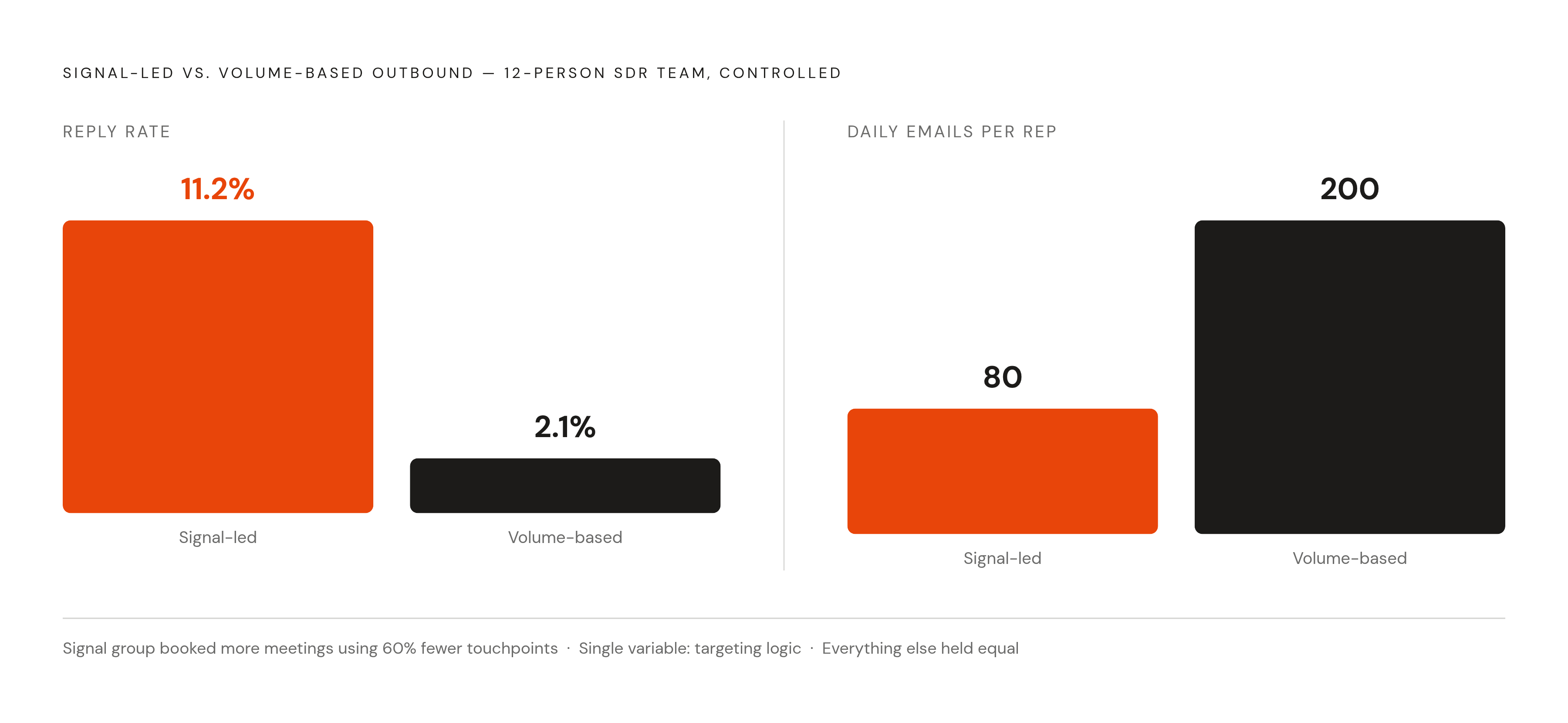
One test, run inside a 12-person SDR team at a mid-market SaaS company, makes the case in a way that's hard to wave off as a data quirk. The team split into two groups running in parallel: same product, same ICP definition, same headcount, so the only real variable left standing was targeting logic.
The volume group ran the old playbook: roughly 200 cold emails a day, LinkedIn connection requests to anyone matching the ICP regardless of any behavioral signal, spread across a 14-touch sequence over six weeks. The signal group did close to the opposite. Daily volume dropped 60%, targeting narrowed to prospects showing active buying signals only, and the sequence shrank to five touches over two weeks.
The results aren't subtle. The signal group booked more meetings using 60% fewer touchpoints to do it. Reply rate tells the same story from a different angle: 11.2% for the signal group against 2.1% for the volume group, more than a 5x difference in the one metric that tells a team a sequence is worth continuing.
What makes the test worth taking seriously is what it holds still. Same product, same ICP, same team. The only thing that moved was how prospects got picked and how urgently the message needed to land. And the finding isn't just an internal curiosity: platform-scale data shows the same pattern. Outreach personalized around a specific signal, a job change, a competitor interaction, a company announcement, hits an 18% reply rate against a platform-wide average of 3.43% for generic sends. Roughly a 5x gap again, this time measured across billions of emails rather than one six-week test, which suggests the internal experiment was a preview rather than an outlier.
How high-performing teams restructured their outbound workflow around signals
Once targeting shifts to signals, the workflow around it has to shift too, and where top teams actually spend their time turns out to be genuinely counterintuitive. Analysis of high-performing SDR teams from 2025 shows they prioritize phone outreach above all other channels, with LinkedIn second and email third, and keep admin work to a minimum. Phone-first, not email-first. That inverts the assumption most outbound playbooks have run on for a decade, where email carried the bulk of volume and the phone showed up only as a follow-up.
Why does phone work now in a way it might not have a few years back? Cognism's numbers show it directly: SDRs using verified phone numbers hit cold-call answer rates of 13.3%, nearly level with the 14.4% answer rate AEs get calling warm leads. Close that gap and the whole idea of "cold" calling starts to look misnamed. The channel was never the problem; the problem was calling numbers that were wrong, outdated, or attached to the wrong person. Fix the data, and a cold call starts behaving like a warm one.
Channel orchestration matters as much as channel choice. Sequences that combine email, phone, and LinkedIn through AI orchestration convert at more than double the rate of single-channel outreach, and the signal itself shapes how the sequence is structured, so the nature of the trigger informs which channel leads and how urgent the first touch needs to be.
The sequence mechanics that hold up under this model cut against a lot of old sales training. Shorter sequences outperform the bloated multi-touch cadences that used to be standard, with evidence pointing to meaningful drop-off well before the fourteenth touch. Subject lines stay short, email bodies stay concise, and each message carries a single clear call to action rather than multiple options buried in a paragraph. Send timing targets mid-day and mid-week windows when prospects are most reachable. Sequences get shorter, not longer, for a specific reason: a real trigger hands the rep a credible reason to reach out in the first message, so there's less need to manufacture justification across touch six, seven, and eight. The signal does the work volume used to try to do.
Where AI fits into signal-led outbound
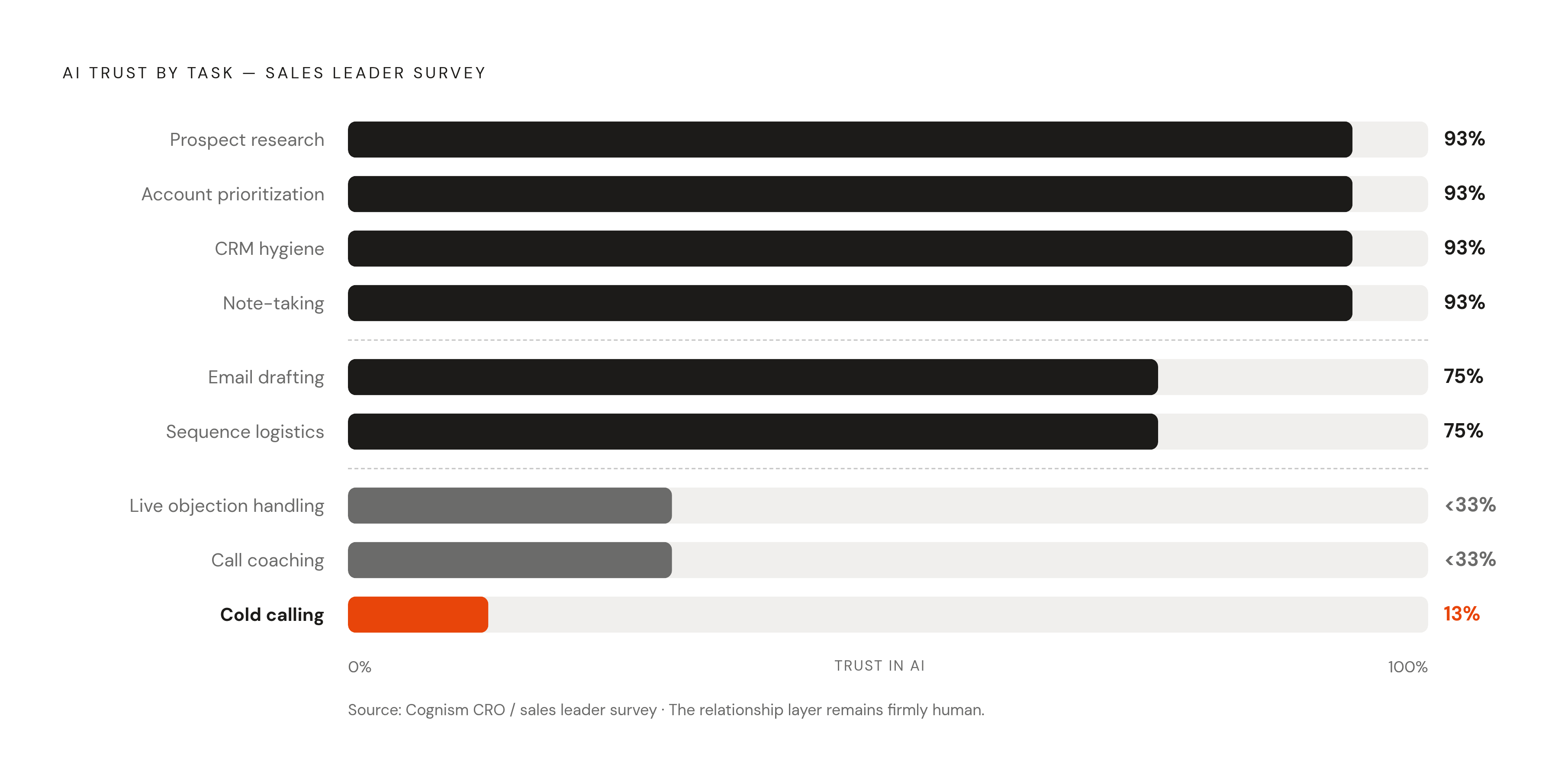
Sales leaders hold a fairly clear, and fairly split, view of what AI deserves trust with. Cognism's survey of CROs and sales leaders across SaaS and IT services found 93% expect AI to match or exceed human performance on prospect research and account prioritization within 24 months, and that same 93% expect it to handle CRM hygiene and note-taking. Around 75% expect AI to draft email copy and manage sequence logistics. That's real confidence, but it's aimed squarely at prep work and admin overhead, not at the parts of the job involving a live human on the other end of a conversation.
Only 13% of leaders in that same survey think AI will handle outbound cold calling at a human level. Fewer than a third picked live objection handling or call coaching as things they'd trust to AI. The pattern holds steady: research and logistics are getting automated fast, while the relationship layer, the actual back-and-forth where a buyer pushes back and a rep responds in real time, hasn't been cracked yet by anything on the market.
The performance data backs that skepticism up directly. A 2026 analysis of 100,000 paired outbound emails found AI-written messages produced a 4.1% reply rate against 5.2% for human-written ones. Meeting-booked rates split the same way: 0.7% for AI versus 1.1% for human. AI-written emails also got flagged as spam at roughly 8%, more than double the 3% rate for human-written messages, which loops right back to the deliverability pressure already reshaping the channel.
The gap doesn't close once a meeting gets booked, either, and this might be the most important number in the whole set. AI-sourced meetings convert to opportunities at 15%, against 25% for human-sourced meetings. That's a 40% relative quality gap, and it compounds at every stage further down the funnel: a meeting sourced by AI that doesn't convert costs a team not just the meeting but everything downstream that meeting was supposed to produce.
Fragmented tooling is the operational enemy of signal-led outbound
Signal-led outbound only works if a signal can move fast once it fires. A trigger gets detected in one tool, the sequence launches from a second tool, the CRM needs to reflect the change in a third, and every handoff between those systems adds latency. In a model built entirely around timing, latency is what turns a signal from useful into stale before a rep ever lays eyes on it.
Data quality is the real blocker, and the numbers say so directly. IBM's State of Salesforce report, surveying more than 1,200 customers, found 53% cite poor data quality as the top barrier to adopting agentic AI. Without clean, connected data across systems, a signal has nowhere reliable to route to, and the entire premise of signal-led outbound rests on that routing happening correctly and fast.
The market has started responding at the category level. Gartner formally introduced the Revenue Action Orchestration category in October 2025 and published its first Magic Quadrant for it in December 2025, a fairly strong signal that the industry now sees coordination between tools, not another point solution bolted onto an already crowded stack, as the gap left to close. The M&A activity backs that reading up directly: Salesloft completed its merger with Clari in December 2025, combining sales engagement and revenue intelligence under one roof at a reported combined ARR. The logic behind that deal matches the logic driving the category shift: one connected system that moves a signal into an action and into the CRM without a human re-keying it three times along the way.
What this means for founder-led and early-stage GTM teams
Early-stage teams sit in a better position for a signal-led world than most large sales organizations do, even if that's rarely how it gets framed. A founder talking directly to customers can read a buying signal in a single conversation and act on it the same day, without routing it through a CRM, a sequence tool, and a manager's approval first. That directness, usually treated as a scrappy limitation of not having a real sales team yet, is closer to a structural advantage in a model built around speed between signal and action.
Where a team should even start still depends heavily on price point. Analysis from rashiumapathi.substack.com finds that products priced above roughly $20,000 in annual contract value almost always need a founder-led or human-led sales motion, full stop. Below roughly $5,000 ACV, self-serve or product-led growth is the more sensible starting motion. Which signals matter differs between the two: a $20K deal cares about funding events and org changes, while a sub-$5K product cares almost entirely about in-product usage behavior.
By 2026, the dominant motion for a lot of companies sits between those two poles. Users discover a product through PLG channels, self-serve trials, and freemium tiers, and a sales team steps in only once usage data shows an account is worth pursuing at higher value, a pattern innovativegroup.io documents clearly. The signal driving that motion is product behavior itself, not third-party intent data purchased from a vendor, which makes it a cheaper and more accurate signal than almost anything available to a company without a live product generating usage data.
AI compounds the advantage for small teams specifically. Research from ceo-worldwide.com found a two-person team using AI tools can replicate the output of a considerably larger GTM organization, faster, cheaper, and often more consistently. Signal-led outbound is what makes that claim operational rather than aspirational. It's what lets two people spend their limited hours entirely on accounts already showing readiness, instead of spreading that same time across a list built on static filters that say nothing about timing.
The repeatable habits that separate teams sustaining signal-led performance from those that plateau
Signal-led outbound isn't a campaign a team runs once and files away as a case study. The 5.7x pipeline gap, the meeting lift from the internal experiment, and the 5x reply-rate gap in the platform-wide benchmark all describe teams that treated signal detection as an ongoing operating discipline.
The teams sustaining performance past the first few quarters share a handful of habits. They keep refining which signals actually predict conversion for their specific product, instead of assuming intent data or job-change triggers behave identically across every category, because they don't. They keep tooling connected tightly enough that a signal reaches a rep in hours, not days, since a stale signal behaves almost exactly like no signal. They keep AI scoped to research, prioritization, and CRM hygiene, the areas the data actually supports, while keeping live conversations and objection handling in human hands, where the quality gap still runs wide. And they keep sequences short and specific, trusting a well-timed trigger to do the work a fourteen-touch cadence used to try to force by sheer repetition.
None of that is complicated in principle. It's just hard to sustain, because it means treating outbound as a live, adjusting system rather than a settled playbook built once and repeated until it stops working. The teams still running 2023's approach in 2026 are failing because the ground moved, and volume, however well-executed, was never going to be the thing that mattered on the other side of that shift. They're failing because the ground moved, and volume, however well-executed, was never going to be the thing that mattered on the other side of that shift.