What Average Deal Cycle Length Looks Like for Outbound-Sourced Pipeline
Outbound deals close far slower than inbound at identical deal size and complexity.

Outbound teams that plan around the median B2B sales cycle figure are planning around a number that describes none of their deals. A founder building a forecast model off that number is building on the wrong input, and the gap between that input and reality surfaces in board or investor meetings, right when they ask why pipeline isn't converting on schedule.
The shape of the distribution gives away the problem. The median sales cycle is 84 days, but the mean runs considerably higher, and that gap only opens up when a long tail of large, slow deals drags the average upward, the exact kind of deal outbound teams chase disproportionately. A median tells readers where the midpoint sits. It says nothing about the shape of everything pulling away from that midpoint, and for outbound specifically, the pull is almost entirely in one direction: longer.
Where did the 84-day figure even come from? It's a real dataset, not a guess, but also one company's customer base rather than an independently replicated industry standard, and treating it as a universal constant asks more of the number than its source supports.
The starting line matters just as much as the dataset behind it. Zeliq's 2026 guide draws a clear boundary: the cycle begins at first qualified contact, an accepted discovery meeting or a documented intent threshold, not at the first cold touch a rep sends into the void. Teams that measure from first touch instead of first qualified contact are quietly shortening their own numbers, which makes outbound look faster than it actually runs and sets up a forecasting miss nobody can trace back to its cause.
Blending by lead source compounds all of it. A referral deal and a cold outbound deal at the identical ACV run on entirely different clocks, shaped by entirely different trust dynamics, and no benchmark table should ever put them in the same row. The rest of this piece exists to pull those rows apart: first by deal size, company size, and industry, then by lead source itself, then by the buying committee growth that's made the outbound gap worse since 2019, then by the velocity math that shows what the gap actually costs, and finally by the one context, founder-led outbound, where the whole structural disadvantage temporarily doesn't apply.
Deal size, company size, and industry's effect on outbound cycle time
Before lead source enters the picture at all, three variables already explain most of what makes one cycle short and another long. Deal size is the single strongest predictor of cycle length, and the relationship is close to linear: each substantial step up in annual contract value roughly doubles the time it takes to close, because each jump in ACV adds a new class of stakeholder and a new approval step that didn't exist at the smaller size. Focus Digital's 2026 industry benchmark study lays out a benchmark table by ACV band on average sales cycle length. The jump between tiers isn't gradual; it's a series of step changes, each one marking the point where a new layer of organizational process gets triggered.
Deal size is not the whole story, though, and the research is specific about how much of the story it actually explains. The rest comes down to process discipline, how qualified the buyer's intent actually is, and the quality of the data teams are using to track the deal in the first place. That means a team blaming its long cycles entirely on the size of the deals in its pipeline is misdiagnosing the problem, because three-quarters of what's driving cycle length has nothing to do with ACV at all.
Company size layers on top of deal size rather than simply tracking it. Focus Digital's 2026 data points to the 201 to 500 employee range as the clearest inflection point in the entire dataset, the place where procurement suddenly turns formal and a deal that would have closed in weeks at a smaller company starts accumulating sign-off requirements, and organizations at the largest end of the scale close deals many times slower than micro-businesses do. A mid-market deal at a higher ACV ends up inheriting enterprise-length timelines without the operational infrastructure that, at true enterprise scale, at least keeps the process moving. The mid-market looks like a faster, lighter-weight version of enterprise selling, but in practice it's often the slowest tier relative to the resources on the buyer's side.
Industry adds a third layer, though its effect appears less in which vertical a team sells into and more in where time gets spent once a deal is underway. Within industries, the Proposal stage consumes the largest share of total cycle time across all industries studied, making it the single longest phase, more than negotiation, more than final closing paperwork. The real time sink tends to sit earlier, in the stage where a team is building and refining the proposal itself, which suggests the fix belongs upstream of where most sales teams go looking for one.
Outbound pipeline's longer cycle time at equal deal size
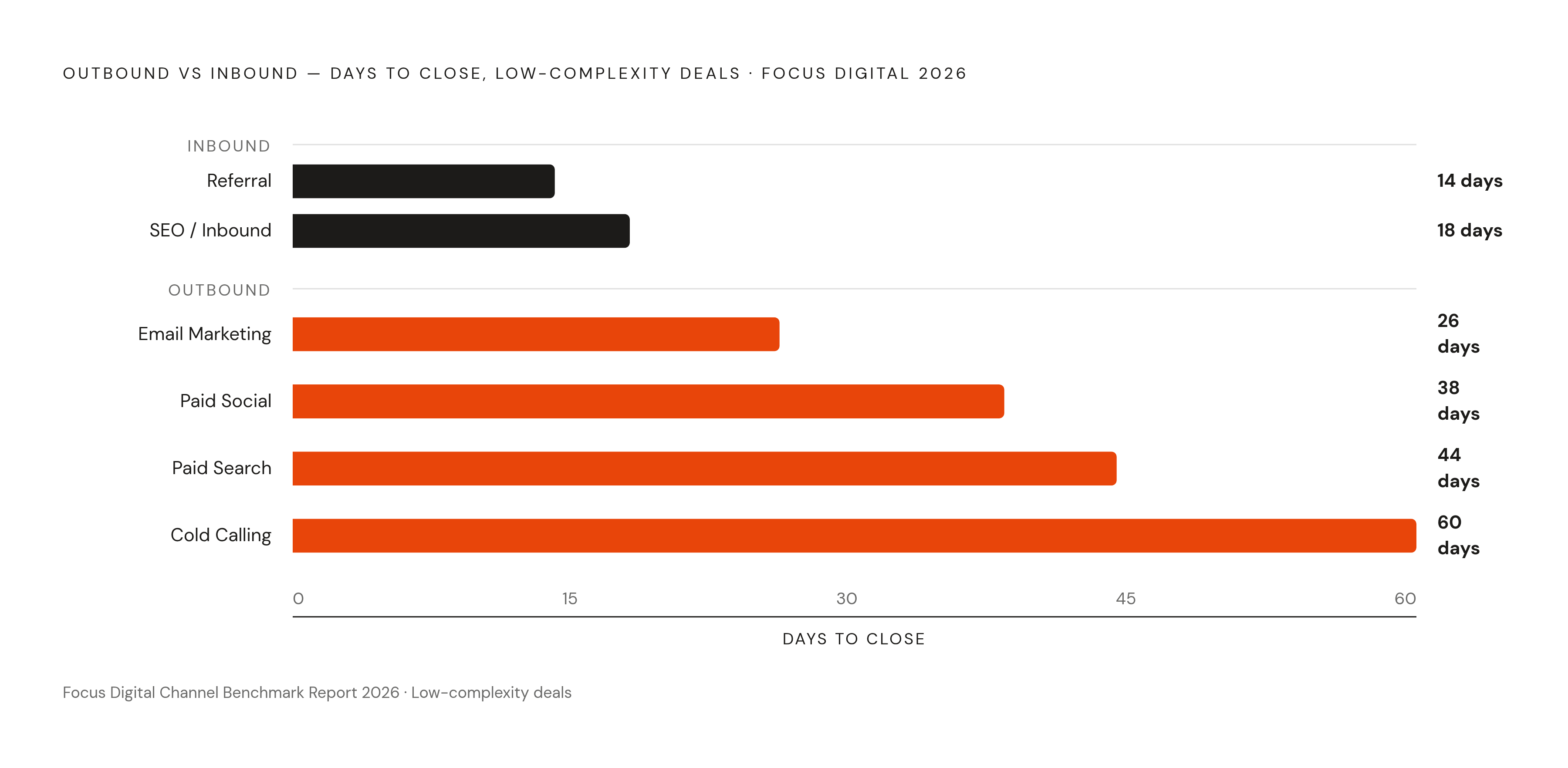
Hold deal size constant, hold company size constant, hold industry constant, and outbound-sourced pipeline still runs longer than every other lead source. And that deficit doesn't shrink as the deal gets bigger. It compounds, because every stakeholder a larger deal pulls in is one more cold relationship the outbound seller has to build from the same zero starting point.
Focus Digital's 2026 channel benchmark table makes the gap concrete. Cold calling, direct mail, and social media outreach all come in meaningfully longer than inbound channels such as SEO and referrals, with cold calling at 60 days for low-complexity deals, and even Email Marketing, the shortest outbound channel, still comes in above where inbound channels benchmark. The pattern holds across every channel classified as outbound: none of them, not even the fastest one, reaches inbound speed.
The mechanism behind that gap is that outbound deals carry none of the pre-built intent inbound or referral deals start with. A cold prospect has to be convinced the problem is worth solving at all, then convinced this particular vendor is the right one to solve it with, and both of those steps happen inside the cycle rather than before it.
The outbound penalty doesn't live only at the top of the funnel. Every stage of an outbound-sourced deal is doing double duty, moving the deal forward and building the baseline trust that an inbound or referral deal already walked in with.
Buying committee growth and the outbound cycle problem since 2019
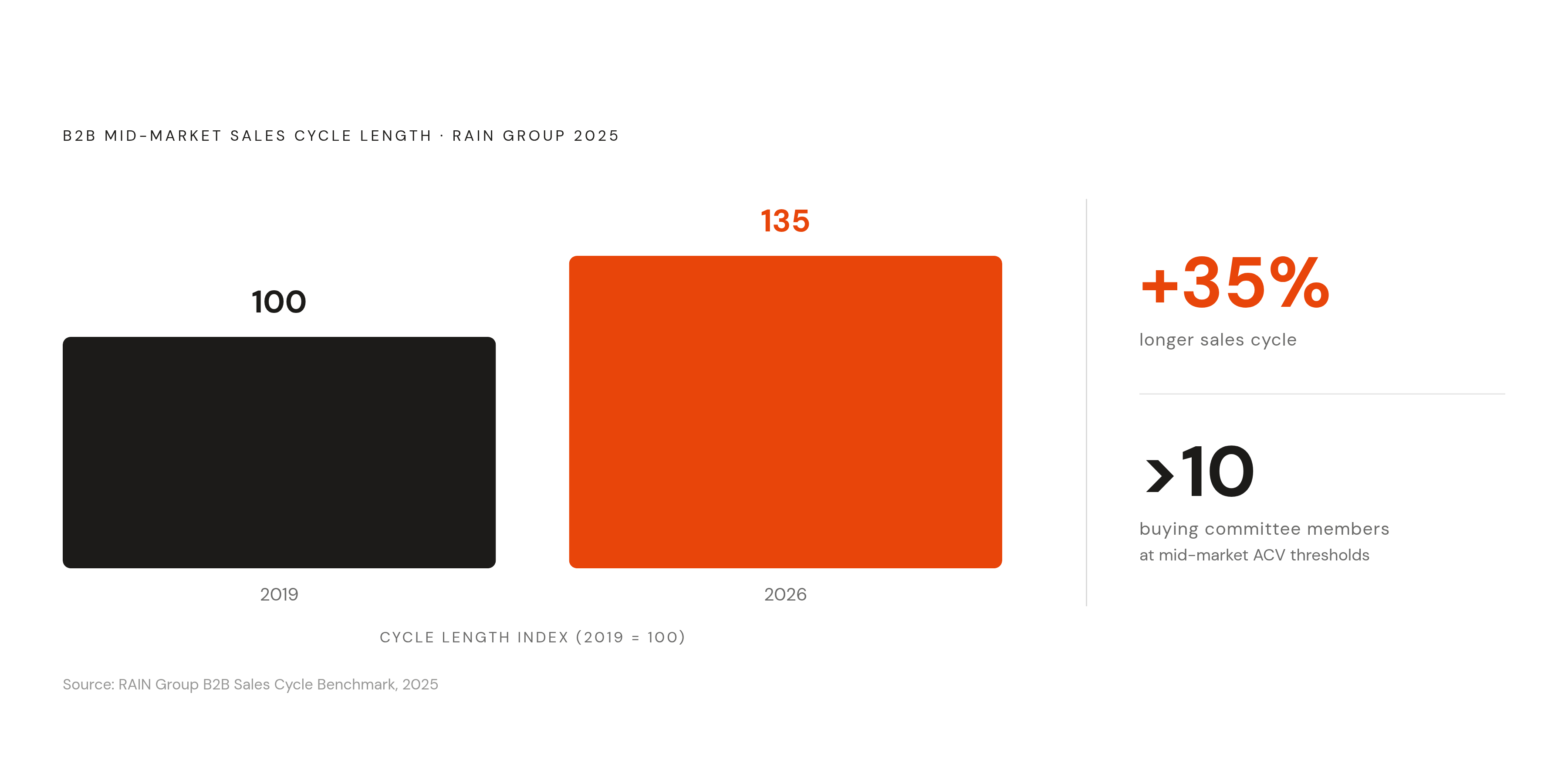
Everything described so far is a snapshot. The more troubling finding is that the snapshot has been getting worse every year since 2019, and the mechanism driving that decline hits outbound-sourced pipeline harder than any other channel. Buying committees have grown across B2B selling broadly, and every additional stakeholder a seller has to bring along represents one more cold relationship to warm from nothing, a cost that referral and inbound deals mostly avoid because their initial champion often does that internal selling on the seller's behalf.
The scale of that growth is visible in RAIN Group's 2025 B2B Sales Cycle Benchmark, which puts the median mid-market cycle in 2026 a full 35% higher than it stood in 2019, just six years earlier, and names buying committee growth as the primary force behind that increase. The median buying committee on larger deals has expanded considerably since 2020, with some benchmarks placing it above ten people once a deal crosses a mid-market ACV threshold, and Focus Digital's 2026 analysis finds that each additional decision maker added to a deal adds meaningful days to the overall cycle. Ten people is closer to an internal electorate than a committee in the conventional sense, and a seller running cold outbound has to earn a yes from each constituency inside it separately.
Procurement has reinforced that growth rather than offsetting it. Zeliq's 2026 guide finds that a large majority of companies above a mid-market employee threshold now route higher-ACV deals through IT procurement, a share far larger than what it stood at in 2019. That's a second stakeholder class stacking on top of the first, not a replacement for it, so the committee a seller has to win over keeps growing on two axes simultaneously: more business-side decision makers, and more formal procurement gatekeeping layered underneath them.
The consequence of all that growth is visible in connected-CRM data from Ebsta and Pavilion, which finds cycles running substantially longer against a 2021 baseline, while win rates have fallen at the same time, against both the prior year and against 2021. Call it a pipeline paradox. More activity is producing worse results, and that paradox hits hardest exactly where trust has to be rebuilt from scratch with every new name added to the committee: cold outbound.
A team that tags the number of distinct stakeholders engaged on each deal has a leading indicator for cycle length sitting in its own system, measurable deal by deal, long before the deal itself resolves one way or the other.
What pipeline velocity math reveals beyond cycle length
Cycle length tells a team how long a deal takes. It says nothing on its own about how much revenue is actually moving through the pipeline per unit of time, and that second question decides whether outbound's longer cycle is a tolerable cost or a quiet drain on the business. Pipeline velocity answers it directly: qualified opportunities multiplied by win rate multiplied by average deal value, divided by sales cycle length. Cycle length is the denominator, so a longer cycle shrinks velocity even when every other input in the formula looks healthy, including a large average deal size in the numerator.
That formula is why outbound's bigger average deal size doesn't rescue it the way intuition might suggest it should. A bigger numerator and a lower win rate, combined with a longer cycle in the denominator, nets out to half the throughput. That's a gap cycle length by itself never reveals, because cycle length alone says nothing about win rate or deal count, only about time.
Where in the cycle does that lower win rate actually take hold? Zeliq's stage conversion benchmarks point to the Discovery-to-Demo transition as the single weakest point of conversion across the entire funnel, and while those figures aren't segmented specifically by lead source, the logic connects cleanly to everything established in the earlier sections: a demo that isn't personalized well kills a cold relationship more reliably than a failure at any other stage. A cold prospect doesn't extend that same benefit of the doubt, and a demo that doesn't speak directly to their specific situation reads as proof the seller never understood the problem.
For a venture-backed startup, cycle length functions as a read on go-to-market quality in the eyes of an investor: a short cycle at a given ACV reads as a clean, well-run motion, while a cycle running several times longer at that same ACV invites the kind of direct question a Series A partner is going to ask in the room.
Velocity improves, concretely, when outbound gets run with real signal discipline rather than volume alone. Peridio is one named example of what that improvement looks like in practice, a case where tighter targeting and sharper qualification moved the velocity needle without simply adding more reps or more sends. The specific tactics behind that kind of compression deserve their own treatment elsewhere. The proof here is that velocity is a lever teams can actually pull, not a number fixed in place by deal size or lead source alone.
Founder-led outbound and early-stage cycle compression
Everything in the preceding sections describes the structural drag outbound carries once a sales motion is running at scale, with hired reps working a fixed process against a buying committee that doesn't know them. Founder-led outbound operates under different physics, because a sales organization replacing the founder on the call won't retain the same early cycle times. A founder selling directly carries a cycle compression advantage no hired seller can replicate: the ability to adjust ICP, offer, and pricing inside a single live conversation, which accelerates the exact trust-building work that otherwise bloats a cold outbound cycle.
Part of that advantage comes simply from who is on the call. The founder already is that decision.
The hardest part of this stage is knowing when it ends, and the signal is a data pattern, not a calendar date or a headcount milestone: once the same ICP and the same message have worked across two consecutive cycles, the motion has become documentable and testable enough to hand off to someone else. Founder-led outbound is the brief window before all of that pull fully applies, and the only reliable way to know it's ending is the evidence sitting in the CRM itself.