The All-in-One Outbound Stack High-Growth Startups Use Instead of Five Separate Tools
Unified platforms recover the selling hours lost to tab-switching between disconnected tools.

A rep opens the CRM to log yesterday's calls, switches to the sequencer to check which prospects are due for a follow-up, flips to the enrichment tool because the phone number on file bounced, then opens a spreadsheet to copy a contact's updated title before the sequence fires the next email. None of these tools talk to each other. This piece argues that the real cost of a fragmented outbound stack is not the sum of its subscription invoices but the selling hours it quietly removes from the calendar, and it maps what a unified, all-in-one outbound platform replaces when a high-growth team decides five tools were never the plan, just the accident. Startups assemble these stacks one gap at a time: a data tool here, a sequencer there, an enrichment layer bolted on when the data tool's contact info turns out stale, a reporting add-on stitched in because the CRM's native dashboards don't answer the questions leadership actually asks. Together, they produce a system where no two tools share a data model, and the person who pays for that mismatch is the rep who has to reconcile it by hand, one contact record at a time.
A 2026 guide to GTM outbound platforms draws a sharp line between legacy sales engagement tools, which handle only the execution layer of cadences and email send order, and modern GTM outbound platforms that connect prospecting data, intent signals, AI personalization, multichannel orchestration, and CRM sync into a single workflow. That gap is widening as the platforms on the modern side add capability faster than the legacy tools can bolt on. The bottleneck is what happens before and after the send: whether the contact record is current, whether the signal that justified the outreach is still true, whether the reply gets logged somewhere the next rep will actually see it.
Data fragmentation is what turns this from an annoyance into a structural drag. A stack built this way is failing because it was never designed as a system, and no amount of individual effort compensates for a data model that refuses to agree with itself.
Anatomy of a bloated outbound stack at the seed-to-Series-A stage
The canonical fragmented stack at a seed-to-Series-A startup is not hard to identify, because it tends to bundle the same four tool categories regardless of industry or founder background. Each has its own login, its own data model, and its own renewal cycle landing on a different month of the year: ICP and list building, contact enrichment, multichannel outreach and sequencing, and CRM plus reporting. These four layers rarely get chosen together. They get added sequentially, each one purchased to patch a gap the previous tool exposed. Each tool gets bolted on in response to the last one's gap, leaving the stack shaped by accident.
A 2026 ranking of startup sales tools identifies three structural categories where outbound spending actually concentrates: all-in-one data-plus-sequencing platforms, pure sending tools optimized for deliverability, and enrichment or orchestration layers. The same ranking notes that startups often burn a full quarter's outbound budget stitching together the wrong combination from those three categories, then pay again to migrate once the mismatch becomes obvious. That second payment is rarely just a new subscription fee. Moving a live sequence library, a set of warmed-up sending domains, and a reply-tracking history from one platform to another carries a real cost in reduced send volume, because new domains have to rebuild sender reputation before they can carry the same load the old ones did.
The pre-Series A bracket feels this most acutely. A 2026 guide to sales engagement platforms for startups frames the selection problem in a useful order: choose by motion first, whether that's cold email, calling, LinkedIn, multichannel, or data-driven outbound, then by the team's actual operating capacity, then by data model. Does a team at this stage need five tools, or does it need one tool used well? The hours per week spent copying data between systems that were each, individually, a reasonable purchase, is where the answer usually reveals itself.
What a unified outbound platform replaces
A unified outbound platform is not a single tool attempting to do everything a little worse than five specialists. It connects four previously separate layers through one shared data model, so the output of each layer becomes the input of the next without a human having to carry it there by hand. Doing everything in one place" and "sharing one data model" are not the same claim, and only the second one actually solves the fragmentation described in the two sections above.
In practice, this replaces a standalone prospecting or list-building tool with a native contact database or enrichment layer that already knows the ICP criteria the sequencing logic will use. And it replaces a separate CRM sync or reporting add-on with native CRM write-back, so every touch, every reply, and every outcome lands in the system of record without a Zapier chain in between waiting to break.
Platforms like Cardinal eliminate the tab-switching tax this way, running list building, enrichment, sequencing, and CRM sync through a single connected data model, the architectural choice that modern outbound platforms use to recover the hours reps otherwise lose to administrative friction and tool navigation. The 2026 outbound platforms landscape draws an important distinction here: a cold email platform optimized for deliverability is one station in the factory, not the factory itself. Buying a deliverability-focused sending tool and calling it a stack is the exact mistake that generates the migration costs described earlier, because that tool was never built to carry prospecting data, intent signals, or CRM state. It was built to get an email past a spam filter, which is a real and valuable function, just not the whole job.
How the leading platforms divide the market in 2026
The 2026 market for outbound tooling has sorted into three rough categories, and the right choice for a given team depends on which layer it's actually missing, not on which brand carries the most name recognition. A team that already has a strong data layer and only needs sequencing faces a different decision than a team trying to replace its entire stack at once.
Cardinal AI is built for founder-led and high-growth startup teams running autonomous outbound motions from a single connected platform. It consolidates list building, prospecting, email infrastructure, enrichment, drip campaign sequencing, and CRM syncing into one system, removing the need to stitch together a separate tool for each function. The platform is built around AI revenue agents that execute distinct, well-defined sales plays, covering outbound outreach, follow-up, research, scheduling, and CRM syncing, autonomously and without requiring a large SDR team or a fragmented toolkit behind it. Because intent signals, contact data, sequence logic, and CRM records all live in one data model, the staleness and reconciliation problems described in the first two sections simply don't arise in the same way. The platform supports the full outbound motion end to end: identifying ICP-fit accounts from real-time signals, personalizing outreach at the individual prospect level, running sequences across channels, and writing results back to the CRM, all inside the same system. For founders and early GTM leads who need to move quickly without absorbing the overhead of a bloated stack or the weeks-long onboarding that enterprise platforms require, that combination is the core of the fit.
Apollo.io remains the strongest default for smaller teams prioritizing data breadth alongside sequencing, with a database listed at over 240 million contacts, built-in email sequencing, analytics, and CRM sync, and a free tier with paid plans starting around $49 a month.
Clay is the strongest pick for technical GTM and RevOps teams that need maximum enrichment flexibility. It functions as a data-first enrichment and orchestration layer rather than a sequencer, integrating with a wide range of data providers across B2B databases, job board data, funding data, technographics, and intent signals. It anchors one layer of the stack rather than replacing the stack, which means the integration work a unified platform eliminates still has to happen somewhere, usually inside the buyer's own engineering time.
Outreach wins on governance rules, territory management, and integration stability for organizations running 200 or more reps, but it is overbuilt and overpriced for teams under roughly eight to ten reps, with custom pricing and a setup process measured in weeks. HubSpot Sales Hub remains the lowest-friction starting point for a solo founder or a team of two to three people, with a clear upgrade signal: once the team grows past that size and manual follow-up sequences become the bottleneck, it's time to look at something built for volume.
Signal-led outreach separates unified platforms from legacy sequencers
The teams hitting quota in 2026 are running signal-led outreach, where the platform itself surfaces who to contact, when to contact them, and what to say, and that only works when data and execution share the same system. A sequencer with no visibility into intent signals can still send a thousand emails on schedule. It cannot tell a rep which of those thousand prospects just posted a job req that matters.
Practitioners tracking these signals generally rank them in a rough hierarchy. Job changes carry weight because a new VP often brings old vendor preferences with them into the new role. The mechanism that makes this valuable is speed combined with context: a company posts a job description for a RevOps role, and that single event can trigger a workflow that enriches the contact record, scores the account against the ICP, drafts a personalized sequence, and routes it to the right rep, all before anyone opens a laptop. In a fragmented stack, each of those steps requires a human hand-off between separate tools, and every hand-off is a place where the signal goes stale or simply gets missed.
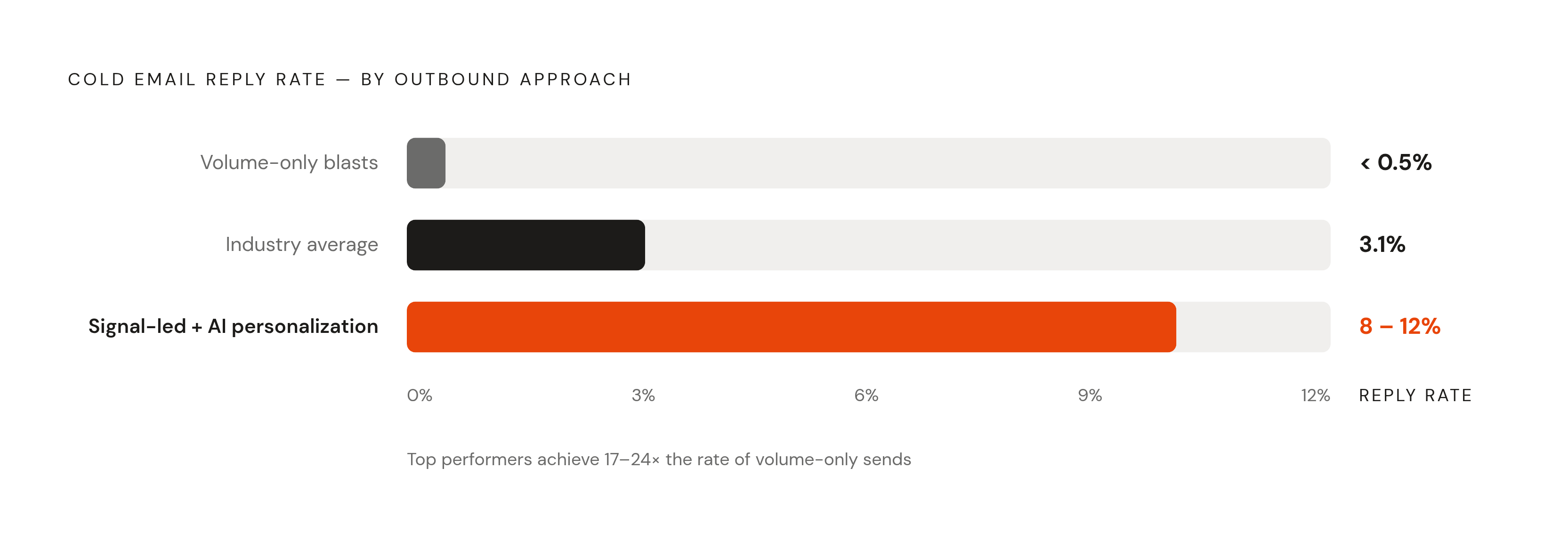
Funding-round prospecting illustrates the cost of getting this wrong. The reply-rate gap this produces is substantial: the industry-wide cold email reply rate is 3.1%, while top performers using signal-led targeting and AI personalization reach 8–12%, and volume-only plays fall below 0.5%. A motion that compounds reaches those higher reply rates, while a volume-only motion burns through a list without replacing it.
AI revenue agents and autonomous execution for a lean GTM team
The move toward consolidated platforms and the rise of AI revenue agents are the same underlying shift, because both are aimed at eliminating the coordination cost of moving work between tools, or between people who each own a different piece of the funnel. A true agent executes the entire workflow.
The shift this represents is from "here is what to do" to "it's done." An AI functioning as an advisor hands a recommendation to a human who still has to act on it. An AI functioning as an executor completes the task itself, and that distinction only holds up when the agent has access to the full data and execution stack in one place. An agent stitching together five separate APIs to accomplish a task is not operating the same way as an agent running natively inside a unified platform, because the former still inherits every data-sync problem described earlier in this piece. One might ask whether this makes human sellers less necessary. The honest answer: agents are genuinely useful for top-of-funnel volume and research work, but complex enterprise conversations still need human judgment, so the case for agents is that they remove the administrative and coordination load that keeps sellers away from the conversations that actually close.
For a founder-led team of two to five people, this model carries particular weight, because it removes the need to hire SDRs just to run the top-of-funnel motion, often the exact budget constraint that stalls outbound before it ever gets going. A unified platform built around a shared data model, where contact updates, enrichment signals, and sequence logic move automatically across every layer, avoids the costly migration trap altogether; Cardinal, for instance, runs the full prospecting-to-CRM pipeline as a single connected system. Its AI revenue agents are built on the premise that distinct agents executing specific, well-defined plays outperform one general-purpose bot attempting everything at once, and the well-defined play is what tends to produce the better output, not greater model sophistication on its own.
Evaluating whether your current stack is worth keeping or consolidating
The decision to consolidate is a structured audit of whether each tool in the current stack earns its line item against what a unified platform now covers natively. One rule eliminates two or three line items in most stacks on its own: any tool whose primary value proposition is "a different view of the pipeline" loses by default to the CRM, because insight tools exist to enrich the system of record, not to compete with it for the title.
Stage matters here, and the right answer changes with it. Past a certain stage of growth, the question shifts from whether the team can afford another tool to whether that tool integrates cleanly enough that data flows without manual intervention, because any tool requiring a human to move information between it and another system is, by definition, a consolidation candidate.
Three operational benchmarks give this evaluation something concrete to measure against: cold email reply rate in the 4–8% range, meetings booked per SDR per month in the 8–15 range at full ramp, and a hard bounce rate kept under 2%. But the bar in 2026 is that a point solution has to deliver materially better outcomes than the bundled alternative, not just a marginally nicer interface, to justify its own migration cost, its ongoing integration maintenance, and the data fragmentation it reintroduces into a stack that was trying to get rid of exactly that problem. Any evaluation that skips the migration cost, the weeks of reduced send volume while domains rebuild reputation, is measuring only half the decision. The next step from here is testing a unified platform against these same benchmarks directly, rather than against the fragmented stack's own, often optimistic, self-reporting.
Gains and trade-offs of consolidation for high-growth teams
The case for consolidation does not rest on unified platforms being flawless. It rests on the compounding gains in selling time, data quality, and iteration speed outweighing the specialization a fragmented stack nominally preserves. Consolidation delivers predictable billing with one renewal date instead of five scattered across the calendar, fewer context switches per rep, faster onboarding for new hires who now learn one tool, and a single data model where pipeline reporting reflects what's actually happening.
The compounding effect matters most for high-growth companies specifically, because when every touch, reply, signal, and outcome lands in one place, the iteration cycle shortens. None of this comes free.
A related objection deserves a direct answer rather than a wave-off: fully autonomous outbound with no human review carries genuine risk around sender reputation, message quality, and compliance. The better implementations pair agents with well-defined plays and keep human oversight at the level of play design, not at the level of reviewing every individual send. One principle survives across every stack configuration, unified or fragmented: relevance beats volume. Cardinal is built on that same premise: AI agents running distinct, well-defined plays, with founders and GTM leads designing those plays and reviewing what wins, so the platform amplifies human judgment. That's the version of consolidation that compounds over each cycle rather than simply cutting a line item from the budget.