Outbound Connect Rates by Channel Across B2B Segments
Connect rates are segment-specific metrics, not universal benchmarks for planning.

Connect rates across cold email, phone, and LinkedIn are not one number. They vary sharply by B2B segment, by persona, and by how disciplined the sequencing is behind them, which means the "average connect rate" that gets quoted in most sales enablement decks is closer to a rough guess than a planning tool. This piece works through what each channel actually delivers, why the gaps between average and top-decile performance have widened rather than narrowed, and what that means for how GTM leaders allocate effort across a sequence.
Why connect rates are a poor headline number without segment and channel context
Ask a room full of sales leaders what the average B2B connect rate is, and the answers will vary by a factor of five or more, and most of them will be technically correct. That is the problem. A blended average that mixes SMB cold calls with enterprise email campaigns and LinkedIn warm touches produces a number that describes nothing in particular. It is an average of averages, smoothed across contexts that behave nothing alike.
Segment, persona, channel, and data quality each move the outcome independently, and they do not move together. A phone campaign into SMB managers behaves nothing like a phone campaign into enterprise VPs, and a cold email into a warm, signal-triggered account behaves nothing like a cold email into a static, purchased list.
Definitions do not match across vendors, a quieter problem underlying the segment issue. "Connect rate" for phone usually means live conversation divided by total dials. For email, it usually means a human reply, though some vendors bury automated bounces or out-of-office replies inside that number without saying so. For LinkedIn, it means acceptance of a connection request, which is a different kind of event entirely from a reply or a live conversation. Vendor benchmarks can vary by several percentage points depending purely on what gets counted in the numerator and denominator The State of B2B Outbound 2026: Benchmarks, Trends, and What Changed. None of that changes the substance of the numbers that follow, but it does mean a reader should hold every benchmark loosely until the counting method behind it is clear.
Cold calling benchmarks by segment and persona
The overall picture for cold calling is roughly 2 to 3% dial-to-meeting conversion, which works out to about one meeting for every 40 dials SalesHive The State of B2B Outbound 2026: Benchmarks, Trends, and What Changed ORRJO. Top-performing teams reach 5 to 8% or higher on the same channel, sometimes on the same dial volume, and the separation is driven by data quality and coaching rather than raw talent SalesHive The State of B2B Outbound 2026: Benchmarks, Trends, and What Changed ORRJO. The gap is not a talent gap. It is a process gap, and process gaps are fixable in a way that talent gaps are not.
Segment breaks this open considerably. SMB contacts, meaning managers and individual contributors, connect at higher rates because there is less screening and fewer calendar conflicts standing between the dial and the person. Gatekeeper friction starts to appear in the moderate range for mid-market, meaning directors and VPs. Enterprise, meaning C-suite and senior VPs, is at the bottom structurally because gatekeeper density, calendar saturation, and assistant screening stack on top of each other. That is a math problem, not a rep problem, and treating it as a coaching issue when it is actually a structural ceiling wastes a lot of management energy.
Inbound follow-up, where speed-to-lead sits under five minutes, connects at dramatically higher rates than that cold baseline. It is a different animal from cold outbound entirely, and the comparison mostly exists to show how far cold calling's ceiling sits below a warm lead's floor.
The single biggest lever inside cold calling is data quality. Moving from a generic, purchased list to verified mobile direct-dial data roughly doubles connect rate on its own, with no other change to the cadence or the script. That is over a third of a shift spent dialing numbers that were never going to connect.
Persistence is the second lever, and it is measurable in a way that should change how cadences get built. Research on cold calling patterns finds that by the third attempt, roughly 93% of the conversations a rep will ever have with that prospect have already happened The State of B2B Outbound 2026: Benchmarks, Trends, and What Changed. That is a narrow window, but it is a real one The State of B2B Outbound 2026: Benchmarks, Trends, and What Changed.
Timing matters too, though it is a smaller lever than data quality or persistence. None of this suggests cold calling as a channel is in decline. The 5 to 8% top-decile range is achievable on the same dial volume most teams are already working, with better data and tighter cadence discipline layered on top SalesHive ORRJO. Connect rate range for generic cold outbound in the U.S. runs 3–10%, meaning 18+ dials are needed to reach one live prospect, according to SalesHive GTME McKinsey.
Cold email benchmarks in 2026: deliverability headwinds, AI saturation, and current standards for "good"
Cold email has deteriorated, and the deterioration is visible across multiple independent datasets. That is a real, measured decline, not an anecdotal one.
Two forces are driving it. The first is deliverability infrastructure tightening at the inbox level. Google's bulk sender requirements now enforce strict DKIM, SPF, and DMARC alignment, with a spam complaint target of 0.1% and a hard enforcement ceiling at 0.3% GTME. Microsoft's filters have gotten more aggressive on top of that, and Apple Mail Privacy Protection has made open rates essentially useless as an engagement proxy, since it inflates the number regardless of whether anyone actually opened the email GTME. Anyone still reporting open rate as a primary email metric in 2026 is measuring something close to noise SalesHive The State of B2B Outbound 2026: Benchmarks, Trends, and What Changed ORRJO.
The second force is more interesting and more uncomfortable: AI saturation crossed a trust threshold. Roughly 62% of outbound replies are now AI-generated without human review, buyers can tell, and reply rates dropped 33% year-over-year attributable to that effect alone KnowledgeNet.ai. That is a striking number. It suggests the market corrected for AI-generated outbound faster than most teams adjusted their own sending practices, because it means the channel did not get harder in the abstract KnowledgeNet.ai. It got harder specifically for senders who let AI write and send without a human checking the output first.
Segment breakdown sharpens the picture further. Enterprise, 1,000-plus employees, sees 0.8% reply and 0.11% meeting rate, and getting even that requires multi-threaded account-based outreach with genuinely hand-crafted top-of-sequence messaging. The pattern across all three segments is consistent: the bigger the account, the smaller the margin for generic messaging.
Signal-based outreach is the clearest lever available inside email specifically. Outreach triggered by job changes, funding events, or tech stack shifts produces reply rates of 15 to 25%, against 1 to 3% for generic templated email. For every 100 cold emails sent, the typical yield is 1–2 booked meetings, according to leadriver.io in 2026.
Email is not dying so much as splitting in two The State of B2B Outbound 2026: Benchmarks, Trends, and What Changed. Generic blast volume is becoming close to worthless, while tightly targeted, signal-triggered campaigns running on clean infrastructure still produce elite numbers. Email success in 2026 is a pre-send infrastructure and targeting problem as much as it is a copywriting problem SalesHive The State of B2B Outbound 2026: Benchmarks, Trends, and What Changed ORRJO. Average B2B cold email reply rate stands at 1–5% depending on data source, with Instantly's 2026 Cold Email Benchmark Report (drawn from millions of campaigns across thousands of B2B sending domains) putting 5–10% as "good" and above 10% as elite territory The State of B2B Outbound 2026: Benchmarks, Trends, and What Changed GTME McKinsey. Among mid-market companies with 100–999 employees, the reply rate is 1.4% and the meeting rate is 0.21%, with warm-path intros and intent triggers moving the needle.
LinkedIn benchmarks and the channel's function as sequence infrastructure
LinkedIn has become the leading channel for warming a first touch. Connection request acceptance rates for well-targeted, personalized outreach run 25 to 45% across most B2B segments in 2026. That is a strong number on its own, but the more revealing story is what happens after the connection gets accepted.
LinkedIn is not immune to the saturation pressure hitting email; the platform simply lags it by a cycle or two The State of B2B Outbound 2026: Benchmarks, Trends, and What Changed. But how does this affect LinkedIn's standing as a channel? The answer is that its standalone reply rate softening barely matters, because the number that actually predicts outcomes is a different one entirely: sequences that include a LinkedIn touch outperform email-only sequences by 3.4x on reply KnowledgeNet.ai. That is the number that makes LinkedIn indispensable even as its solo performance drifts downward.
LinkedIn's platform risk deserves direct attention. LinkedIn's automation detection has gotten materially better, and acceptance rates below 20% now trigger account restrictions, while weekly connection request limits have been tightened and flagged profiles face suspensions ranging from days to weeks Built For B2B. That draws a clear line for anyone building a sequence: LinkedIn used as a manual, personalized warm-touch step inside a coordinated sequence is high-ROI, while LinkedIn used as an automated blast channel is high-risk.
One more figure sets a ceiling regardless of channel: a warm introduction produces a 27% reply rate, versus 1.4% for cold email, a lift of roughly 19x. That gap makes the case for finding warm paths into an account at scale, not just for the handful of named strategic accounts that get manual attention.
LinkedIn's value is multiplicative rather than additive. It does not simply add a third lane of outreach alongside email and phone; it raises the floor of every other channel it touches inside a sequence. The more useful mental model is LinkedIn as connective tissue holding a sequence together, not LinkedIn as a third outreach lane running in parallel. LinkedIn message reply rates have declined from 10–20% in 2024 to 8–15% in 2026, roughly a 15% drop, according to GTME in 2026 Built For B2B.
How channel combination and sequencing logic determine meeting book rates more than any single channel's baseline
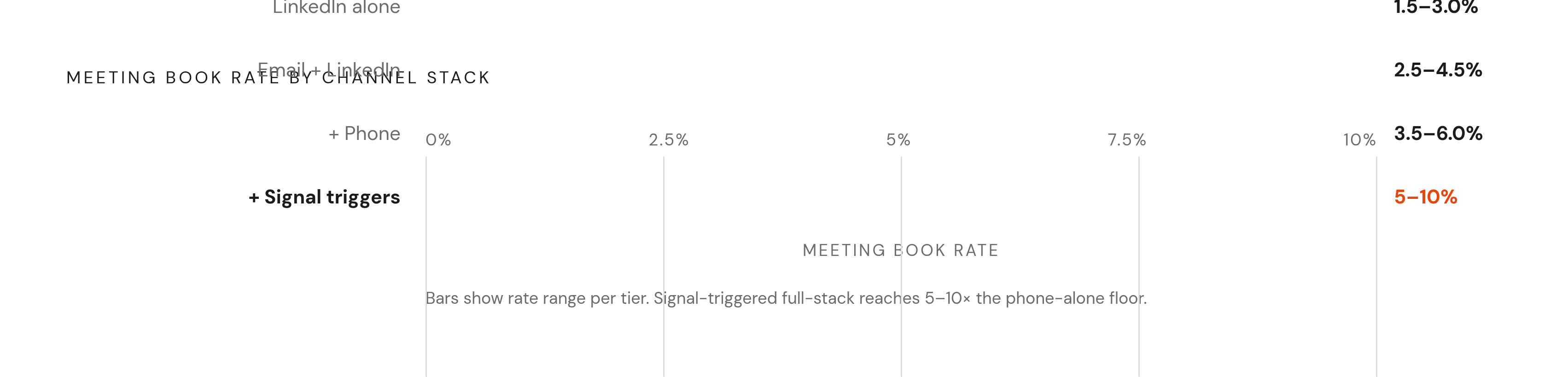
A comparison across more than 200 campaigns lays out meeting book rates by channel mix, and the pattern is difficult to miss. Email alone books meetings at 1.0 to 2.0%. LinkedIn alone runs 1.5 to 3.0%. Phone alone is 0.5 to 1.5%. Combine email and LinkedIn, and the number jumps to 2.5 to 4.5%. Add phone to that combination, and it climbs to 3.5 to 6.0%. Layer signal-triggering on top of the full multi-channel stack, and the range reaches 5.0 to 10.0%.
That is not additive math. Each channel added compounds the others rather than simply stacking on top of them, and signal-triggering roughly doubles the floor of the full multi-channel approach. A broader industry summary puts multi-channel outperformance at 40 to 60% over single-channel on qualified meetings booked overall, a useful directional number to sit alongside the more granular table above.
The 2.1-million-touch dataset referenced earlier breaks the same pattern down at finer resolution. Cold email alone produces 1.4% reply and 0.18% meeting rate. Add a LinkedIn connection, and reply climbs to 3.2% with a 0.41% meeting rate. Add a LinkedIn message and a voice note on top of that, and reply reaches 4.8% with a 0.62% meeting rate KnowledgeNet.ai. Each added touch, sequenced correctly, is pulling meaningfully more weight than the one before it.
Sequence length matters just as much as channel inclusion. The median sequence now runs 11 steps, up from 8 in 2024, but past 14 steps, returns turn negative. Longer is not automatically better, and there is a real, measurable point past which adding more touches actively hurts the outcome rather than helping it. That measurement should change how GTM leaders think about channel allocation. The practical implication is that channels should be treated as sequencing architecture rather than parallel campaigns run independently of one another; each touch exists to warm the one that follows it, and the order the touches arrive in matters nearly as much as whether each channel is present at all.
What the top-decile programs do differently
The distance between average and excellent outbound programs is wider now than the raw channel numbers alone would suggest. Programs run with tight ICP discipline, demand-warmed audiences, and senior strategic input hold 5 to 8% reply rates with 90%-plus meeting attendance, while the same channels and the same tools, run poorly, deliver less than a third of those results ORRJO. That gap is structural, and three recurring separators produce it consistently.
Data quality and ICP discipline come first ORRJO. Verified mobile direct-dial data against generic lists roughly doubles connect rate on phone, and the same separation shows up in email, where clean, segmented lists against scraped ones drive comparable gaps in deliverability and reply. Signal-triggering against static lists comes second: outreach triggered by job changes, funding events, pricing page visits, or hiring patterns consistently outperforms static list-based outbound by 2 to 4x on positive reply rate. Intent functions as a timing layer, turning a decent sequence into a genuinely strong one.
AI saturation deserves a second look here as a quality differentiator rather than just a deliverability problem. With 62% of outbound replies now AI-generated without human review, and that effect measurably driving a 33% year-over-year reply rate drop, top-decile teams have drawn a clear line: use AI for research, enrichment, and drafting, but keep a human reviewing before anything sends. That single habit, more than any tool choice, is preserving reply rates that undifferentiated AI output cannot reach on its own.
Coaching turns out to be the biggest single multiplier inside all of this. Daily coaching and role-play can push cold call conversion from an average of roughly 2.3% toward a top-decile range near 9%. That number alone should settle the talent-versus-process question: the gap between average and excellent is overwhelmingly a process and coaching gap, not a talent gap. One might argue that is the more encouraging finding in this entire body of research, since a coaching gap is something a manager can actually close, given enough discipline and repetition, in a way that a talent gap simply is not. The persistence gap is real and measurable: 8 attempts are needed on average to reach a prospect, most reps stop at 2–3, and top teams build 8–12 touch cadences over 2–3 weeks without compressing or abandoning them prematurely, according to SalesHive in 2026. Benchmarks are only useful if they function as a diagnostic, and the reader should come away with a clear framework for identifying which of the three separators (data quality, signal-triggering, or cadence discipline) is their primary constraint.
How AI agents change the outbound execution calculus without replacing the fundamentals that drive the benchmarks
AI adoption inside revenue organizations has gone from a competitive edge to default infrastructure in a short window: adoption is 89% as of the 2025 Sales Technology Report, up from 34% in 2023, and 92% of sales teams plan to increase AI investment further in 2026. That adoption curve is real, but adoption and capability are not the same claim.
Of the 45% of B2B suppliers who say they use AI in sales, only 24% have implemented agentic AI, the autonomous, workflow-driving kind rather than a simple drafting assistant McKinsey. Fewer than 10% of organizations have scaled AI meaningfully in any given function McKinsey. So the honest picture is one of broad but shallow adoption: most teams have touched AI somewhere in the workflow, and a much smaller fraction have built anything that actually operates without a human steering it.
What does the performance data say once AI is actually running outbound end to end? Further downstream, AI SDRs convert booked meetings into opportunities at a materially lower rate than human SDRs do, a quality gap that compounds downstream. That is not a small detail. It means the quality gap does not stay contained at the top of the funnel; it follows the lead all the way through to pipeline.
The teams pulling ahead with AI are not the ones replacing SDRs with it. They are running AI against accounts that would otherwise sit untouched entirely, while keeping human reps on named accounts and the highest-priority motions. That is a prioritization architecture, not a wholesale replacement, and it matches everything the earlier sections established about data quality and signal-triggering: agentic AI's genuine advantage is in list building, enrichment, and signal identification at a scale no human team can match on its own. It gives the fundamentals more surface area to work with. It does not substitute for them. Mutiny's 2026 analysis of paired outbound emails examined what the performance data actually shows on AI vs. human outbound. AI reply rates were lower than human reply rates, AI meeting-booked rates were lower than human meeting-booked rates, and AI emails carried a higher spam-flag rate.
Sources
- Cold Calling Benchmarks for B2B Sales Teams (2026) | SalesHive
- 2026 B2B Outbound Email Benchmarks: Reply Rates, Channels, AI
- B2B Outbound Benchmarks 2026: Reply Rates, Open Rates, and Conversion Data - GTME Blog | GTME
- State of B2B Outbound 2026 | Independent Benchmarks | ORRJO
- The State of B2B Outbound 2026: Benchmarks, Trends, and What Changed
- The B2B Outbound Sales Playbook for 2026 | Built For B2B
- How are B2B sales teams using AI in 2026? - MutinyHQ