Automating Outbound Sequences From Intent Signal Firing to Personalized Send
Build the five layers in order or watch your outbound program burn domain reputation.

Automating outbound sequences from intent signal to personalized send works only when five layers get built in a specific order: signal detection, enrichment, personalization, sequencing, and measurement, each feeding the next. Most teams build this backwards. They buy a sequencing tool first, load it with a static list pulled from a database, and call it personalization when they swap in a first name and a company name on the subject line. The tool works exactly as designed and still produces nothing, because a sequencer has no idea which of the thousand accounts on that list are actually in a buying window right now. Fix the order, and the same tools start producing pipeline. Get the order wrong, and every dollar spent on the pieces downstream of signal detection accelerates a slow kind of damage to sending infrastructure that takes months to undo.
The failure compounds at every handoff. A strong signal layer feeding a broken enrichment layer produces a sharply targeted email sent to an address that bounces, which tells the receiving mail server something is off with the sending domain. A capable sequencer running ahead of real personalization sends generic copy faster and burns domain reputation faster, which is the opposite of what a founder wants when outbound is still the main growth lever. None of the five layers is optional, and none of them works in isolation: enrichment without a signal layer in front of it enriches the wrong accounts, and measurement without the other four layers in place has nothing useful to measure.
Treat the five layers as a pipeline. Signal detection, enrichment, personalization, sequencing, and measurement form a dependency chain: each layer's output becomes the next layer's raw material, and the order in which a team assembles them decides whether the system produces meetings or just produces email. The sections that follow walk through that build order one layer at a time, starting with signal detection, which has to come first regardless of how tempting it is to start with the sending tool.
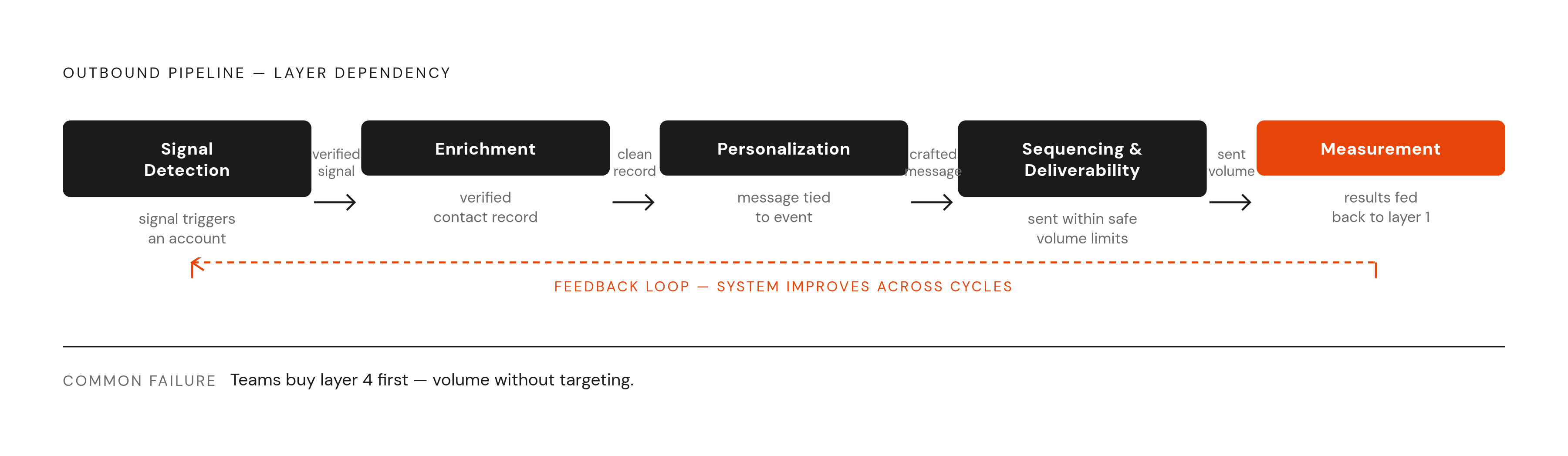
Layer 1, Signal detection: reaching buyers inside the window when intent exists
A signal is evidence that something changed inside an account recently enough that the change still matters. A new VP starts a role, a company closes a funding round, an engineering team swaps one piece of its stack for another, or a visitor returns to a pricing page for the third time in a week. Each of these events opens a window during which that account is genuinely more receptive to outreach than it was a month earlier, and that window tends to close within days. Static lists built from firmographic filters alone, the kind most CRMs are already full of, say nothing about which accounts are in that window today. Signal detection replaces the static list with a live feed of accounts in motion.
Signals vary in strength, and the strongest ones predict a near-term purchase while the weakest only flag organizational change. First-party intent, a visit to a pricing page, a whitepaper download, or attendance at a webinar, carries the most weight because the account already knows the brand and took an action directly tied to it. Third-party intent sits a step below that: topic research tracked on G2, or an intent spike picked up by a platform like Bombora (data that 6sense also ingests as a third-party source), shows an account researching a category of solution without yet knowing who the sender is. Zero-party and social signals, such as a job change, a funding announcement, a hiring post, or engagement on LinkedIn, sit a further step below: they point to a window of organizational change without confirming that anyone at the account is actively searching for a fix yet.
Apollo's 2026 outbound playbook lays out a practical version of this layering: a large taxonomy of buying-intent topics stacked on top of standard ICP filters, combined with website visits, hiring activity, and technology adoption signals, used to rank accounts by how ready they are to be contacted today. These tools carry real annual costs, and they only pay for themselves once outbound volume is high enough to make the marginal signal worth the price.
Almost every GTM team raises the same objection: an ICP list already exists, so why add a signal layer on top of it? Firmographics answer the question of who can buy. Signals answer the separate question of who is ready to buy right now, and without that second answer, the ICP list is a snapshot of the market as it looked when the list was built, rather than a feed of what is happening inside those accounts this week.
Layer 2, Enrichment: turning a signal into a reachable, complete contact record
A signal says an account is in motion. It does not say who at that account to contact, what their current title is, or whether the email address on file still works. Enrichment takes a triggered account and turns it into a specific, verified person with a working email, a current job title, and the firmographic and technographic details the personalization layer will need a few steps later. Skipping this step or doing it poorly throws away the targeting precision built up in the signal layer at the moment of send.
The most common failure at this layer is relying on a single data provider. Waterfall enrichment solves this by checking more than one provider in sequence, stopping as soon as one of them returns a verified match rather than always burning a credit on every provider regardless of outcome. Clay's current public pricing, after its 2026 restructure, runs on a Launch plan and a higher-cost Growth plan, with credits pooled across the team.
Enrichment has a clear boundary, and confusing it with the layer that comes after is one of the most common reasons outbound stacks end up bloated with overlapping tools. Enrichment fills in the contact record. It does not send messages, manage sender reputation, warm up a domain, or handle replies, all of which belong to the sequencing layer covered further down. Once enrichment data is verified and attached to a contact record, it has to land in the sequence and the CRM without manual re-entry or a second export step. A platform built to carry signal detection, enrichment, personalization, and sequencing in one connected system, which is the architecture Cardinal is built around, keeps that handoff clean and avoids the duplicate work and data loss that occur at the seam between two separate tools.
Layer 3, Personalization: using enrichment data to write messages that reflect the signal, not a template
Enrichment produces the raw material: a verified name, a title, a set of background facts about the account and the person. Personalization turns those facts into a message that reads like it was written because of a specific event, not adapted from a template with a merge field dropped in. A message that references the actual signal, a new VP's first month in the role, a funding round closed two weeks earlier, a third visit to the pricing page, converts at a different rate than a message with a name swapped into an otherwise generic opener, because it lands at the moment that event is most relevant and shows the account that someone understood why the outreach happened at all.
Tools built for this kind of research have gotten specific. Claygent, for instance, can read a prospect's LinkedIn profile, scan recent posts on a company blog, and pull from a recent podcast appearance, then draft a two-line opener that references something current and specific to that person. Doing the same thing manually, or by stitching together several separate APIs without a layer that orchestrates them, takes meaningfully longer per contact and doesn't scale past a handful of accounts a day.
But how much of this should run without a person checking it? That question sits underneath the whole personalization layer, and it doesn't have a clean answer. The practical middle ground most teams land on is to automate the research and the first draft, then keep a person in the loop for a final review before anything sends, particularly while a sequence or a persona is still new. Apollo's own guidance follows the same shape: start with a manual review step on every message, and only remove that step once reviews consistently come back with no changes needed. If reps keep editing drafts at a steady rate, that's a reason to revisit the guidelines the AI is working from, not a reason to pull the human reviewer out of the process.
Founder-led outbound adds a wrinkle: the entire value of a message that appears to come from a founder is that it sounds like that founder actually wrote it. Signal-based sequences can be assembled by automation end to end, but the message itself has to read as the founder's own voice, tied to the specific signal that triggered the outreach, or the premise collapses the moment a recipient notices the mismatch.
Personalization compounds across channels. A sequence built around one trigger event, a personalized email on day one, a LinkedIn connection request on day three that references the same event, and a follow-up email on day five that acknowledges the earlier touch, tends to outperform a sequence that repeats the same channel three times. Spellbook's experience after replacing its prior email stack illustrates the combined effect: open rates rose sharply, and the new approach generated $2.59M in pipeline, a result that traces to both the timing (sending on signal rather than on schedule) and the relevance of the message itself, not to simply sending more volume.
Layer 4, Sequencing and deliverability: sending at the right time without burning the infrastructure that makes sending possible
A well-targeted, signal-triggered, carefully written message that lands in a spam folder produces exactly the same result as no message at all. That's the failure mode this layer exists to prevent, and it's the one most founders scaling outbound run into without warning, usually right around the point where reply rates that used to look healthy start dropping for no obvious reason. Deliverability isn't a background setting to configure once, and most teams don't look at it closely until the damage is already done.
Domain and mailbox management sits at the center of this problem. Cold outbound has to stay within safe daily send limits per domain; push volume meaningfully past that threshold on a single domain, and sender reputation starts to degrade in ways that can take months to repair, not days. For teams sending at real volume, spreading sends across several mailboxes per user, rather than funneling everything through one account, is the structural fix for staying within safe limits while still reaching enough accounts.
The split between tools tends to create the most friction at this layer. Cardinal consolidates list building and prospecting, email infrastructure, and drip campaign sequencing into one connected platform, removing that particular split and the overhead that comes with keeping two systems synced. The argument for consolidation here is that deliverability and sequencing depend on the same underlying data, sender history and signal timing among them, and keeping them in separate tools makes that dependency harder to manage.
Layer 5, Measurement: closing the loop so the next cycle is better than the last
Measurement in a signal-to-send system does more than produce a report at the end of the month. It tells the team which trigger types actually produced meetings, which message variants converted and which didn't, and which sequences are worth keeping, and that information flows back into the top of the pipeline. A system with signal detection, enrichment, personalization, and sequencing all working, but no measurement layer feeding results back, runs the same guesses every cycle.
Each layer needs its own specific measurement, not one blended set of numbers. At the signal layer, the question is which trigger types, a job change, a pricing-page visit, a funding event, actually produced meetings, not just which ones produced opens. At the enrichment layer, match rate and bounce rate are the relevant figures, and a high bounce rate points to an enrichment problem, not a messaging problem, so it needs to be diagnosed as one. At the personalization layer, reply rate broken out by message variant and by signal type is the data that decides which AI-generated guidelines need tightening and which are already working. At the sequencing layer, inbox placement rate, unsubscribe rate, and domain health scores reveal an infrastructure problem before it compounds into a reputation problem that takes months to undo.
Apollo's AI-prioritized task surface is a concrete example of measurement operating in something closer to real time than a weekly review. It scores a rep's possible actions against intent data and account activity, so the highest-value conversation available is already at the top of the list when that rep logs in. The underlying principle holds regardless of which tools a team runs: keep what wins, cut what doesn't, and let every cycle start from a sharper baseline than the one before it. A sequence that consistently needs rep edits before it goes out is itself a measurement signal, one that points back to the personalization guidelines that need revisiting, not a reason to remove the human review step that catches the problem in the first place.