Deploying Stage-Specific AI Sales Agents Across Prospecting Qualification and Closing
Specialized AI agents outperform generalists across each sales stage.

AI revenue agents for distinct sales motions work best when prospecting, qualification, and closing support have separate reasoning, inputs, and success criteria. Deploying stage-specific AI sales agents means using live signals to find accounts, adaptive conversations to qualify buyers, and administrative support to help humans close. The advantage comes from connecting those specialists into one revenue motion, rather than asking a generalist agent to own the funnel.
Why one AI agent trying to own the whole funnel consistently underperforms
The calendar fills, but the opportunities do not improve. A system that can find contacts and send outreach may book meetings without finding out why those buyers should move ahead. The AE then inherits the discovery work that automation was supposed to remove. What looks like a prospecting gain becomes a closing bottleneck because the system measures activity at one stage while pushing its cost into another.
That failure begins with different reasoning demands. Prospecting requires interpreting live account signals, including hiring trends, funding rounds, and leadership changes. Qualification calls for real-time conversational reasoning to handle objections and assess, in a structured way, how ready the buyer is. Closing calls for judgment about buying committees, relationships, and commercial terms. Competence at detecting an account change does not establish competence at understanding an objection or negotiating a concession.
The distinction between an agent and an assistant matters here, but only briefly. An assistant suggests work for a rep to carry out, while an agent can plan, act, observe, and adapt within its assigned task. A fixed-sequence workflow does not acquire that reasoning simply because its vendor calls it an agent. If it cannot change course when things change for the buyer, using it more widely spreads the same limits to more work.
Cardinal’s stance is that AI agents work best when they execute distinct, well-defined sales plays. That is an architectural claim. Each stage needs its own way to judge success, and each agent needs to pass on what it learned to the next. Without those boundaries, “end to end” describes coverage alone.
What a prospecting agent actually does differently from a static list or a sequencer
A prospecting agent earns its place by changing which accounts deserve attention as new evidence arrives. It monitors executive changes, funding rounds, technology stack shifts, hiring spikes, and strategic announcements as a continuous feed. It then scores how strong each signal is to tell a possible buying window from background noise. A sequencer executes against a list someone else built, whereas a prospecting agent builds and rebuilds that list.
The same context can make outreach more specific. Advanced prospecting agents use retrieval-augmented generation to draw on public filings, LinkedIn activity, and company news when composing opening lines. One founder put this into practice by scraping daily building permit records above a dollar threshold, using an LLM to research each prospect’s LinkedIn and building portfolio, and putting personalized emails in Gmail drafts. The useful unit was a relevant message grounded in a reason to contact that person.
6sense emphasizes predictive intent, using first- and third-party signals, identity resolution, and web deanonymization to identify accounts researching a category. Clay emphasizes specific, verifiable triggers that a rep can reference directly, such as a newly hired VP of Sales. Common Room uses data on how people use a product and take part in a community for product-led or community-led motions.
The trade-off is how much assembly the team can support. Some enterprise teams use predictive intent with contact-level enrichment and sequencing, which costs them a lot each year. For teams seeking consolidation, Cardinal connects list building, signal monitoring, and outreach sequencing, removing the handoff between signal detection and execution. Yet even connected prospecting produces only a warm signal. Can the next layer receive that context and turn it into discovery?
How qualification agents work and why speed and conversational depth both matter
Qualification begins where account-level evidence stops. A funding round may explain why an account is worth contacting, but it does not establish the buyer’s use case, budget, or timeline. An inbound demo request presents a similar gap between expressed interest and an actionable opportunity. The qualification agent’s job is to close that gap through conversation.
Speed matters because interest and availability do not wait for a rep’s schedule. An around-the-clock qualification agent removes the delay caused by waiting for a person to respond. Yet a quick response helps only if it leads to a better understanding of the buyer. A fast form with a conversational interface still leaves the buyer doing most of the work.
The deeper change is to treat the conversation itself as the qualification artifact. Asking “what's pushing you to evaluate this now” can reveal a trigger that title and company size cannot capture. Each answer gives the agent context for its next question, so discovery feels like progress. By the time of the AE call, the buyer has also already put the problem into words.
That requires multi-turn reasoning and a structured destination. A purpose-built agent can adapt when the buyer changes direction, assess buyer readiness conversationally, and acknowledge an objection before probing the current solution. Once the lead qualifies, it can schedule the AE meeting, push structured qualification data into the CRM, and set the deal stage.
This distinction also clarifies inbound versus outbound deployment. AI can replace SDR activity in the first three to five inbound touches without replacing outbound prospecting, strategic account development, or multi-stakeholder orchestration. The work consequently separates into inbound conversation design and outbound revenue research.
What closing agents can and cannot do, and why humans still own the final stage
A qualified buyer does not make a deal self-closing. Buying committees can have competing priorities, and commercial negotiation depends on trust, reciprocity, and judgment about concessions. Executive sponsors want a person who can be held accountable. Complex product demonstrations may also need live technical validation. These demands set a boundary for automation that leaves a human in charge of the final stage.
Within that boundary, AI can do substantial work. Salesforce Agentforce generates quotes using deal data, pricing rules, and product catalogs, while flagging necessary approvals. Its operation under the employee’s permissions matters because quote preparation is not unrestricted authority to make commercial commitments. Spellbook supports contract review within MS Word by flagging risky clauses or deviations for human review.
The same division applies to pipeline management. Agents can update CRM records, move deal stages based on recent communications, and surface deals at risk. They can also draw on similar deals to identify useful follow-up timing and framing. This removes administrative friction that otherwise competes with the AE’s attention to the buyer.
Delegating closing work requires keeping the relationship and the commercial decision in human hands. When qualification and preparation arrive complete, the AE can spend more time on those human responsibilities. The value of a closing agent is that it clears the path for the person who owns the deal.
Why full autonomy across all three stages produces volume but destroys pipeline quality
Why not give one autonomous agent the full funnel and let it optimize everything? The difficulty is that an easily counted outcome can displace the outcome that matters. A system optimized for meetings can book anyone willing to accept an invitation. Without qualification that reasons about fit, those meetings take time away from closing and fail to add deals the team can win to the pipeline. More activity then produces lower conversion and a higher cost per closed deal.
Autonomy becomes a problem when it is attached to a narrow objective and extended beyond the task that objective can govern. The number of meetings says little about how well buyers were qualified, just as the number of conversations says little about their intent to buy. A fixed-sequence workflow is especially limited because it cannot adapt when the quality of its output deteriorates. Even recovered time has little value if the team does not redirect it toward high-value selling.
Gartner predicts that more teams will use multi-agent systems in which each agent does a different job. Each agent can be optimized for its task’s success criteria instead of treating every interaction as another step toward a calendar booking. Its output also becomes something the next stage can evaluate.
The prospect of agentic AI project cancellations should therefore sharpen deployment discipline. Giving each agent one job lets the team check how well it does that job. Defining what it hands over, what the next agent receives, and what a human reviews makes the boundary inspectable.
How do you sequence agent deployment for a founder-led team still finding its motion?
Most founders move too quickly from an unproven motion to an agent. When the team has yet to understand the buyer, trigger, and objection pattern, automation spreads that uncertainty to more work. Start instead with a focused list of named accounts and deep manual research. Use the first several conversations to identify a repeated buyer profile, pain, trigger, and objection pattern. The motion becomes teachable when those elements stop changing with every conversation.
The transition gate is concrete. If the same ICP and message work across two consecutive outbound cycles, document the motion and test an agent handoff. If a human has not made it work twice in a row, an agent will not repair the underlying message. Contact discovery, enrichment, signal monitoring, research collection, and follow-up reminders can be automated earlier because they assemble information. Target selection, positioning, qualification framing, and the relationship stay with the founder until the pattern is teachable.
Unify’s Peridio customer story illustrates that sequence. Peridio, an 11-to-50-person company, already knew its niche ICP but tracked founder-led outbound in spreadsheets and lacked a scalable way to prioritize accounts. It turned its ICP and founder-led messaging into signal-based plays, added web and social signals, and used task-based sequences to keep the founder’s voice as people in more roles took on the work. This motion brought in influenced and direct pipeline and closed one Fortune 100 customer without a large sales team. Automation carried an understood motion rather than discovering the market on the founder’s behalf.
That sequence also changes the first GTM hire. The role calls for a hybrid technical operator who can run outbound, qualify leads, own demos, and turn learning into playbooks. A connected platform such as Cardinal can support separate prospecting and follow-up agents without requiring a separately integrated stack. Its role at this point is to amplify documented founder judgment.
How to connect prospecting, qualification, and closing agents into one compounding revenue motion
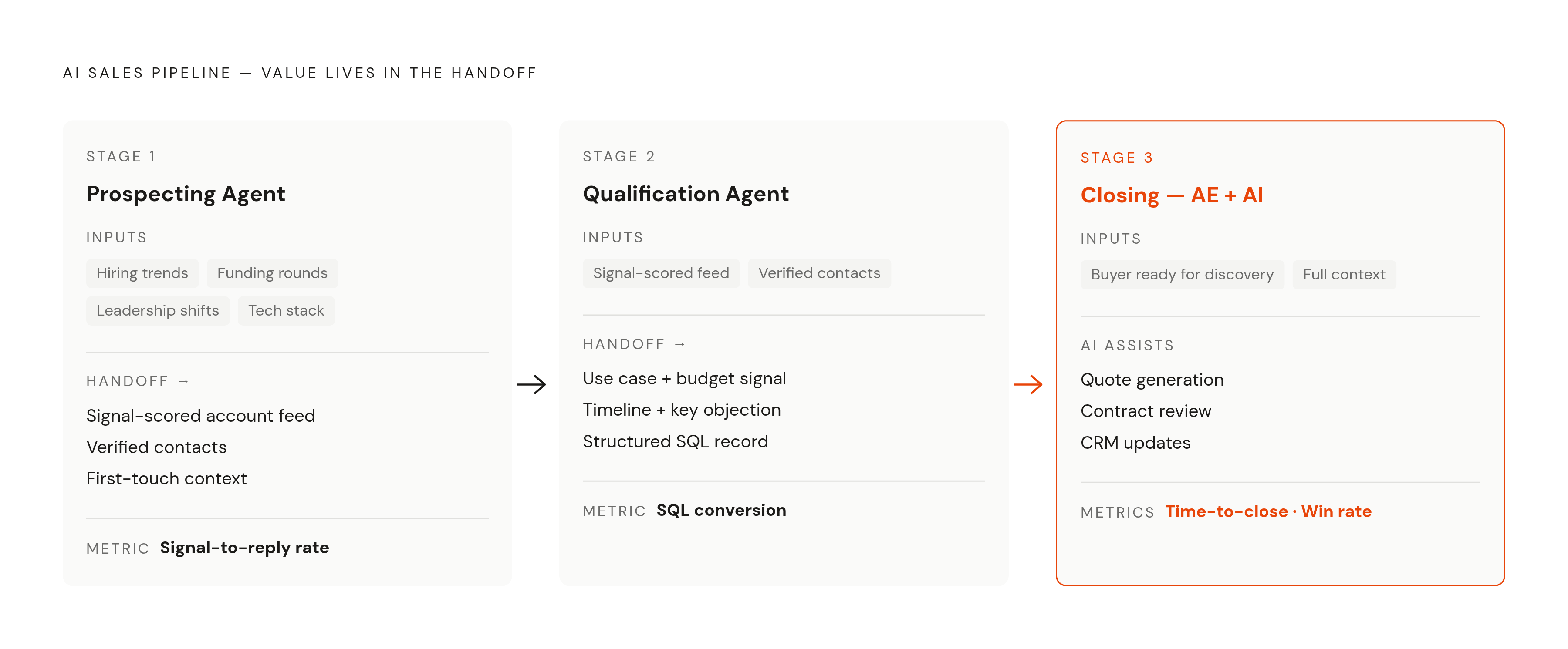
The prospecting agent should hand over a live, signal-scored account feed with verified contacts and personalized first-touch context. The qualification agent should receive that trigger so its opening conversation does not start cold. Its output should be a structured record containing the use case, budget signal, timeline, and key objection. The closing layer then gets a buyer who is ready for discovery to continue and the context to pick up where it left off.
Define those handoffs explicitly, including the format of the output and what a human reviews before it advances. A fragmented stack introduces opportunities for data loss and delay between list building, enrichment, sequencing, qualification, and CRM sync. A connected system keeps the trigger for outreach, the qualification conversation, and the AE record together in one motion.
The measurements must follow the same boundaries. Measure prospecting on signal-to-reply rate, and qualification on SQL conversion. Measure closing support on AE time-to-close and win rate. Continue to iterate on the message before increasing volume.
The compounding effect comes from what the completed cycle teaches the next one. Closed deals show which qualification patterns mattered, while qualified conversations show which prospecting signals were worth following up on. Those outcomes feed back into account scoring, conversation design, and follow-up choices. Every cycle sharpens the next.